
Moon Phase Today Luxembourg
On Saturday, October 10, 2026, the moon in Luxembourg City is a New Moon with 0% illumination. Moon age: 28.9 days.
☽ Best Places to View the Moon in Luxembourg City
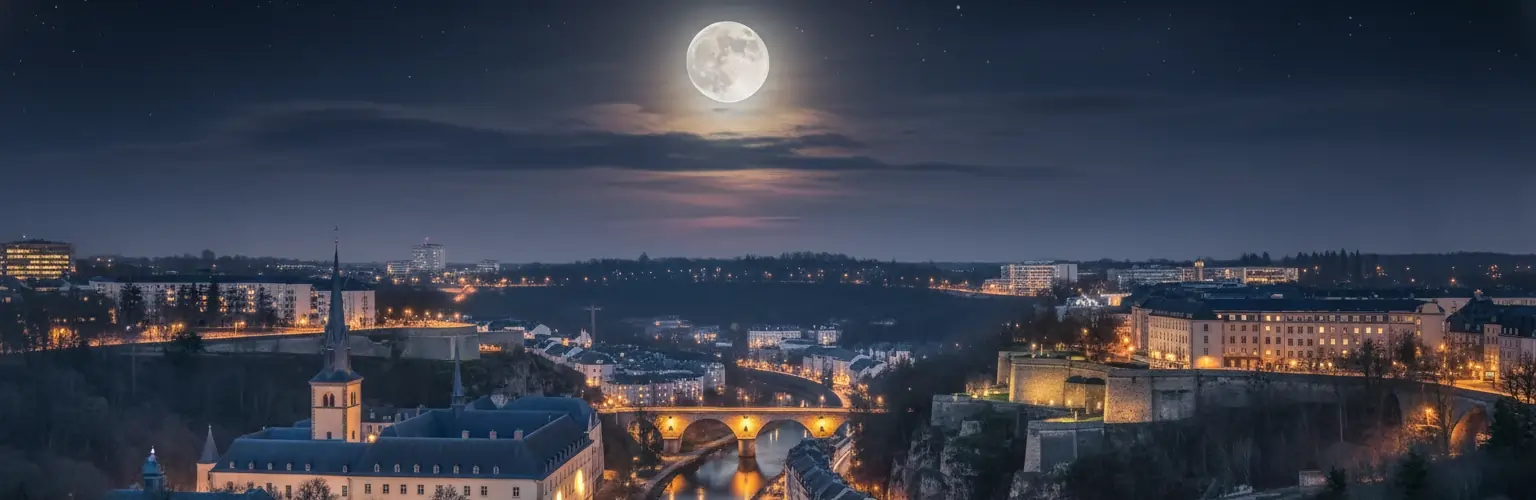
Luxembourg City is a masterpiece of vertical geography, where a fortified Upper City sits perched atop sheer sandstone cliffs, looking down into the deep, winding gorges of the Alzette and Pétrusse rivers. At 49.6° North latitude, the moon tracks across a sky that frames both UNESCO-listed medieval fortifications and the futuristic glass skyline of the Kirchberg plateau. Known for the Chemin de la Corniche—frequently called "Europe’s most beautiful balcony"—the city offers multiple levels of perspective. The moon rises over the ancient sandstone walls, silhouetting historic spires and stone arches in a landscape that feels like a living fairytale.
Chemin de la Corniche
The absolute #1 viewpoint. This elevated promenade runs along the 17th-century ramparts, offering a panoramic view over the Grund quarter and the Alzette valley. On many dates, the moon rises directly across the valley, framing the St. John’s Church spire and the massive sandstone fortifications. Free and open 24/7; the most iconic "post-card" composition in the Grand Duchy.
Pfaffenthal Panoramic Elevator
Connecting the Upper City to the Alzette valley floor, this glass elevator features a cantilevered upper platform. From this high-tech glass perch, the moon rises behind the historic Neumünster Abbey and the distant Kirchberg financial district. The Alzette River below catches the lunar reflection, creating a stunning mix of medieval architecture and modern glass. Free to ride, open daily until late.
Place de la Constitution
Central square home to the Gëlle Fra (Golden Lady) memorial. From the edge of the square, you have a wide-open view over the Pétrusse Valley and the Adolphe Bridge—an early 20th-century stone arch bridge that acts as a perfect architectural foreground. The moon rises over the valley, silhouetting the bridge's parallel central arches and the spires of the Notre-Dame Cathedral. Highly accessible and well-lit at night.
Bock Casemates – Upper Viewpoints
The Bock promontory is the cradle of the city. While the subterranean tunnels have closing hours, the upper public entrances and rocky outcrops are accessible 24/7. The moon rises over the Lower Town (Grund) and the Alzette. The cannon ports and defensive sandstone ruins provide natural frames for creative photography of the lunar disc clearing the valley ridges.
Montée de Clausen
A quieter eastern overlook that bridges the gap between the modern Kirchberg and the historic Grund. The moon rises behind the city’s ancient "Wenceslas Wall," casting long shadows across the sandstone cliffs. It offers a more intimate perspective with significantly fewer crowds than the Corniche, making it a favorite for long-exposure photography that requires complete tripod stability.
Kirchberg – Mudam/Dräi Eechelen
For a mix of modern and ancient, the park surrounding the Mudam sits on the high Kirchberg plateau. From the ruins of Fort Thüngen, you look back across the valley toward the Old Town. The moon rises behind the historic spires while the glass-and-steel architecture of the museum provides a contemporary foreground. Noticeably darker skies than the city center.
◉ Best Times for Moon Photography
📷 Quick Photography Tips
Luxembourg operates on CET (UTC+1) in winter and CEST (UTC+2) during summer. Transport Note: All public transport (trains, trams, and buses) in Luxembourg is free for both residents and visitors, excluding 1st class rail travel. You can easily move from the Upper City to Kirchberg or the Valley floor without a ticket—essential for catching the moon from multiple angles.
The moon phase today in Luxembourg City is shown in detail above. For the moon phase today in any other city worldwide, visit our Dynamic Moon Phase Calculator on the home page.
◐ What the Experience Actually Feels Like
Standing on the Chemin de la Corniche as the moon rises is like stepping into a medieval oil painting. The experience is defined by depth. Below you, the Grund quarter is a quiet maze of slate-roofed houses and the dark, narrow Alzette river. The moon clears the eastern plateau, and suddenly, the vast sandstone walls of the fortress begin to glow with a pale, silver light. Because the city is built in a gorge, the moon doesn't just appear; it illuminates the city in layers, starting with the high-rises of Kirchberg before descending into the valley floor.
In winter, the air in the gorge is often still and cold. The Alzette valley can fill with a low, thick mist that pools around the base of the fortifications. From the Upper City, the moon shines down on this sea of white, silhouetting the Bock promontory like a ship in a ghostly sea. It is incredibly quiet; the sound of the river and the distant chime of the Cathedral bells are often the only sounds to break the lunar stillness.
The mix of eras is the city's signature. From the Place de la Constitution, you can see the moon suspended above the early 20th-century stone arches of the Adolphe Bridge while the glass towers of Kirchberg glow in the background. It is a reminder that while the city has evolved from a formidable military stronghold into a global financial hub, the celestial geometry of the valley remains unchanged. The moon has watched over these sandstone cliffs for a thousand years.
"The moon clears the eastern plateau and the sandstone walls begin to glow with a silver light. The city is illuminated in layers, from the high Kirchberg down into the valley floor."
✓ Your Luxembourg Moon Chase Checklist
Before You Go
- Check the moonrise time on this page — the deep valley means the moon will appear "later" if you are standing in the Grund
- Check the fog forecast; low mist in the Alzette valley is the "holy grail" for atmospheric fortress shots
- Download the Mobiliteit.lu app — though transport is free, it’s the best way to track the funicular and trams
- Use PhotoPills or Stellarium to track the exact arc relative to the Adolphe Bridge in the Pétrusse valley
- Verify if any construction is happening on the Adolphe Bridge or Corniche that might block your intended angle
What to Bring
- A telephoto lens (200mm+) to "compress" the moon against the historic spires of the Old Town from Kirchberg
- A wide-angle lens for the Corniche, allowing you to capture the full sweep of the Alzette valley and fortifications
- Serious windproof layers — the valleys act as wind tunnels and the rampart promenades can be exceptionally cold after dark
- A remote shutter release or use a timer to prevent tripod shake in the high-elevation winds
- Spare camera batteries — long winter nights on the ramparts will drain lithium power quickly
- Comfortable walking shoes — Luxembourg involves a lot of vertical travel via steep stairs and slopes
On the Night
- Arrive at the Corniche 45 minutes early; the "Blue Hour" when the fortress floodlights first turn on is spectacular
- Focus manually on the moon’s edge; the high-contrast lights of the valley floor can confuse autofocus systems
- Bracket your exposures — take one for the bright lunar disc and one for the darker shadows of the sandstone walls
- Utilize the free Pfaffenthal Elevator to quickly change levels and get two different perspectives of the same moonrise
- Stay for 20 minutes after moonrise; the composition evolves as the moon clears the atmospheric valley haze
? Luxembourg Moon Phase — Frequently Asked Questions
Q. What is the moon phase today in Luxembourg?
The moon phase today in Luxembourg is a New Moon with 0% illumination. The next full moon is in 17 days, on Oct 26. Moonrise is at 7:43 AM and moonset at 6:34 PM.
Q. Where is the best place to view the moon in Luxembourg?
The Chemin de la Corniche is the absolute #1 viewpoint — often called "Europe's most beautiful balcony" — with the moon frequently rising directly across the Alzette valley behind St. John's Church spire. The Pfaffenthal Panoramic Elevator's cantilevered upper platform frames the moon behind Neumünster Abbey and Kirchberg, Place de la Constitution looks over the Adolphe Bridge and Pétrusse Valley, and the Bock Casemates, Montée de Clausen, or Kirchberg's Mudam/Fort Thüngen add further historic or darker-sky alternatives.
Q. Is public transport useful for moving between viewpoints?
Yes — all public transport in Luxembourg (trains, trams, and buses) is free for both residents and visitors, excluding first-class rail travel, making it easy to move between the Upper City, Kirchberg, and the valley floor to catch the moon from multiple angles without a ticket. The free Pfaffenthal Panoramic Elevator is especially useful for quickly changing levels during the same moonrise.
Q. Does Luxembourg observe daylight saving time?
Yes. Luxembourg operates on CET (UTC+1) in winter and switches to CEST (UTC+2) during summer, in line with the rest of the European Union. The times shown on this page are already adjusted for whichever period applies today.
Q. What's the best time of year for moon photography in Luxembourg?
November through February brings the sharpest air, snow on the ramparts, and a more southerly moon path for tighter alignments with the fortress walls. Autumn offers a different reward — valley fog pooling in the Alzette gorge creates ethereal, misty shots that silhouette the church spires poking through the cloud.
Q. Does this page work for cities besides Luxembourg?
This page is set up specifically for Luxembourg City, Luxembourg. For the moon phase in any other city or location worldwide, use the Dynamic Moon Phase Calculator on the moonphase.today home page.
✦ Explore Further
Moon Phase Today: Brussels
Check tonight's moon phase in Brussels, about 135 miles north-west.
📷Moon Photography Guide
Camera settings, lenses, and techniques for shooting sharp, well-exposed moon shots.
📐Looney 11 Exposure Calculator
Dial in the exact f-stop, ISO, and shutter speed for a full moon — the same rule used in our Corniche tips.
🌆Blue Hour Calculator
Find tonight's exact blue hour window to time your Chemin de la Corniche moonrise shots.
NASA Moon Phase & Libration Gallery
NASA's Scientific Visualization Studio's daily renders of the moon's exact phase, libration, and orientation, straight from official mission data.