
Moon Phase Today Cancún
On Sunday, October 4, 2026, the moon in Cancun is a Waning Crescent with 34% illumination. Moon age: 23.7 days.
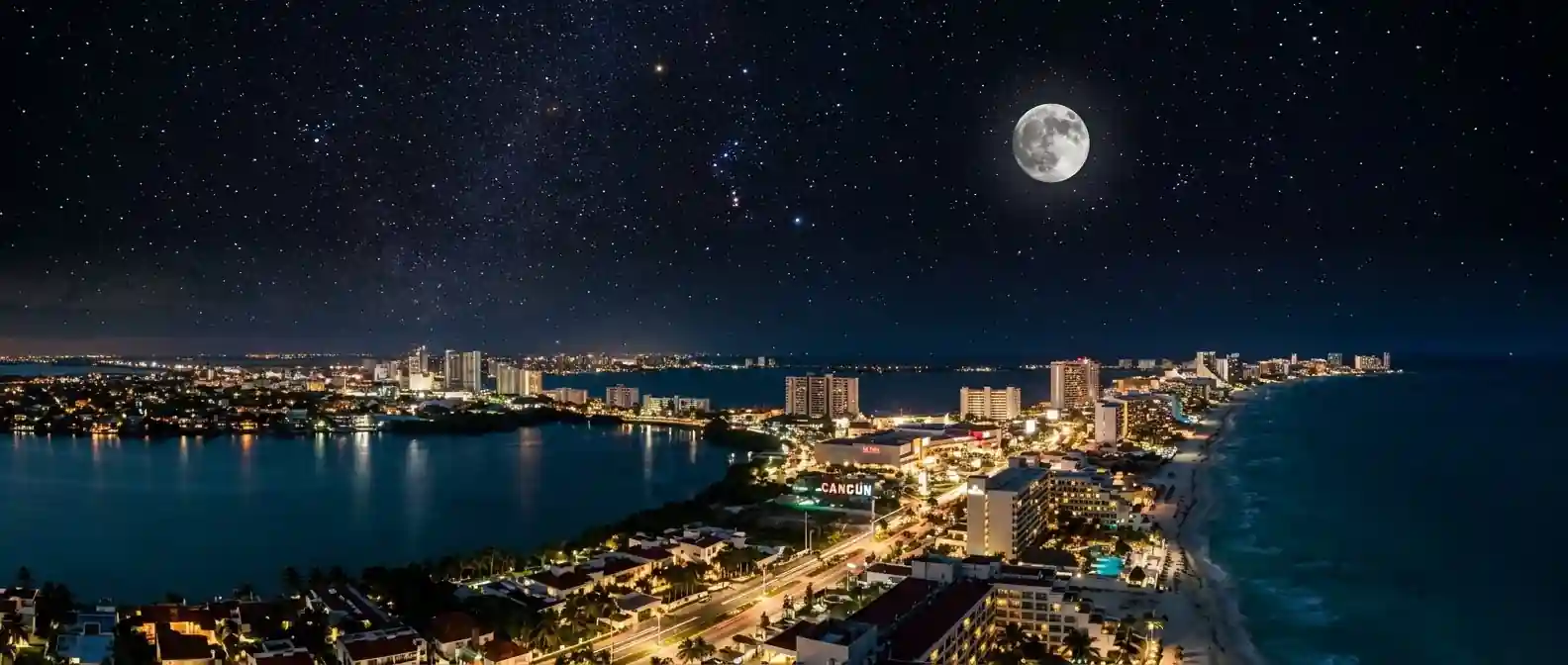
☽ Best Places to View the Moon in Cancun, Mexico
Cancun lies within a broad coastal plain and lagoon system, with Nichupté Lagoon between the mainland urban area and the Hotel Zone coastal strip. The Caribbean lies on the eastern side of the Hotel Zone, while the lagoon provides western water views. Wide beaches and lagoon corridors provide open horizons within a strongly light-polluted resort city.
Playa Delfines – Mirador & Public Beach
Popular public beach in Hotel Zone known for wide sand, ocean views and the colorful Cancun sign. Located near the southern part of the Hotel Zone with long beach and scenic overlook. Public beach with family facilities and playground, offering eastern horizons over the Caribbean suitable for Moon-over-sea compositions in an urban, light-polluted setting.
Malecón Tajamar – Waterfront Urban Recreation Corridor
Waterfront urban recreation area beside Nichupté Lagoon near the entrance to the Hotel Zone. Current municipal material refers to the streets and interior circuit and a nighttime program using the area in 2026. Offers views of the lagoon and Hotel Zone buildings across the water, with palm-lined areas for walking, cycling and exercise.
Laguna Nichupté – Nichupté-Facing Public Areas
Lagoon lies between the mainland urban area and the Hotel Zone coastal strip. Nichupté-facing public areas around Malecón Tajamar and hotel-zone bridges provide western water horizons. Useful for Moon-over-lagoon compositions in an urban, light-polluted location rather than dark-sky observing.
Playa Tortugas & Playa Caracol – Northern Hotel Zone
Reasonable beach examples in northern Hotel Zone with public access and ferry terminals toward Isla Mujeres. Beaches can provide eastern horizons over the Caribbean, although structures, beach facilities and local shoreline geometry can affect the actual photographic horizon. Best treated as urban, light-polluted observing locations for cityscape Moon compositions.
Accessible Central Hotel Zone Beaches – Public Accesses
Public accesses such as Playa Marlin and Playa Ballenas provide open beach areas within central Hotel Zone. Broad sandy areas with views over Caribbean, surrounded by hotels and artificial lighting, making them suitable for Moon-over-sea and Moon-over-city compositions in a light-polluted environment.
Punta Nizuc Area & Accessible Southern Beaches
Around Punta Nizuc and accessible southern beaches near the southern tip of the Hotel Zone. Area provides southeastern and southern horizons over Caribbean and reef areas. Use accessible public areas and observe posted access rules, as not every shoreline section has unrestricted public access.
◉ Best Times for Moon Photography in Cancun
📷 Quick Tips for Cancun
🕐 Timezone
Eastern Standard Time (EST) — UTC−5 year-round; no daylight-saving clock changes.
📍 Geography Note
Horizons: Cancun lies within broad coastal plain and lagoon system with Hotel Zone coastal strip. Nichupté Lagoon lies between mainland urban area and Hotel Zone, Caribbean on eastern side of Hotel Zone. Malecón Tajamar is waterfront urban recreation area beside Nichupté Lagoon near entrance to Hotel Zone where Hotel Zone buildings are visible across water.
Elevation: Low, generally flat coastal terrain reaching about 10 m in central urban area per urban-planning document. Municipality of Benito Juárez is 930.7 km² according to INEGI 2020 census profile. Hotel Zone narrow peninsula / island-like coastal strip between Caribbean and Nichupté Lagoon.
Access: Playa Delfines popular public beach in Hotel Zone with ocean views and Cancun sign, Playa Tortugas and Playa Caracol reasonable beach examples with structures and shoreline geometry affecting horizon, Punta Nizuc around southern tip with accessible southern beaches observing posted access, Malecón Tajamar urban recreation corridor with streets and interior circuit and nighttime program in 2026, El Rey Archaeological Zone open 08:00–17:00 last entry 16:30 per INAH and therefore unsuitable for ordinary night photography and removed from nighttime cards.
The moon phase today in Cancun is shown above. For moon phase today anywhere else, visit the calculator on our home page.
◐ What It Feels Like
At Playa Delfines, wide white sand and the colorful Cancun sign provide an eastern view over the Caribbean, within a strongly lit resort city.
At Malecón Tajamar beside Nichupté Lagoon, a waterfront urban recreation corridor offers palm-lined areas with views across lagoon toward Hotel Zone buildings.
Along Hotel Zone beaches from Playa Tortugas and Playa Caracol to around Punta Nizuc, accessible public areas provide sandy foregrounds where structures and shoreline geometry can affect the actual photographic horizon.
"Beach overlook with ocean sign, lagoon corridor beside the city, and hotel-zone beaches facing the Caribbean."
✓ Checklist for Lunar Observers
Before You Go
- Check moonrise / moonset azimuth — whether alignment is over Caribbean or lagoon depends on date and position
- Check SMN — haze and cloud over Caribbean and lagoon, conditions do not necessarily differ predictably
- Confirm access — Playa Delfines public beach, Malecón Tajamar waterfront corridor with interior circuit and 2026 nighttime program, Punta Nizuc around southern tip accessible beaches, El Rey 08:00–17:00 last entry 16:30 INAH unsuitable for night
What to Bring
- Telephoto and wide for beach and lagoon foregrounds
- Tripod for landscape and bracketing — useful for multi-exposure, close Moon can be handheld
- Lens cloth for dust, dew, condensation and sea spray
- Water and light layer — sea breeze after sunset at low elevation
On the Night
- Manual focus on lunar limb — focus on Moon itself preferable when possible
- Bracket for disc vs. foreground — difficult to retain both in single exposure
- Stay on designated paths and observe posted access rules
- Urban beaches and lagoon walkways provide open sightlines as light-polluted locations, useful for Moon-over-city and Moon-over-water rather than dark-sky observing
? Cancun Moon Phase — Frequently Asked Questions
Q. What is the moon phase today in Cancun?
The moon phase today in Cancun is a Waning Crescent with 34% illumination. The next full moon is in 22 days, on Oct 25. Moonrise is at 12:41 AM and moonset at 2:37 PM.
Q. Where is the best place to view the moon in Cancun?
Playa Delfines, a public beach in the southern Hotel Zone with wide sand and the colourful Cancun sign, gives eastern horizons over the Caribbean for moonrise over the sea. Accessible central Hotel Zone beaches such as Playa Marlin and Playa Ballenas offer similar sea views, while Playa Tortugas and Playa Caracol serve the northern Hotel Zone. On the lagoon side, Malecón Tajamar and other Nichupté-facing public areas give water views across to the Hotel Zone buildings, and the Punta Nizuc area covers the southern horizons. All are urban, light-polluted locations rather than dark-sky sites.
Q. Where does the moon rise and set in Cancun, and how high does it climb?
At about 21°N, Cancun's moon rises and sets within roughly 30° of due east and due west, so moonrise over the Caribbean from the eastern-facing Hotel Zone beaches is the norm rather than the exception. When the moon's declination is north of Cancun's latitude, as it can be around a winter-solstice full moon, it passes almost overhead or slightly north of the zenith, while a summer full moon culminates much lower, roughly 40–45° up in the south. Whether a given moonrise lines up over the Caribbean or across the lagoon depends on the date and your exact position, and beach structures and shoreline geometry can change the visible horizon.
Q. Why does the crescent moon look different from Cancun than from Europe?
At tropical latitudes the sun sets on a steep path, so an evening crescent often sits almost directly above the setting sun, which tilts it toward a bowl or "smile" shape rather than the upright crescent typical of higher latitudes. The steep path also means the moon sets quickly after twilight, so a thin crescent has a short observing window. Low-elevation coastal terrain of about 10 m gives an open western sightline over the mainland, though city lighting will dominate any faint earthshine.
Q. What camera settings and phases work best for moon photography in Cancun?
For a full moon, start with Looney 11 (f/11, ISO 100, 1/100 s) and refine using your histogram, since humidity, haze and changing twilight levels affect the scene. The moon is much brighter than a dark foreground, so shoot RAW and bracket or blend exposures to keep both crater detail and the beach, lagoon and hotel lights. A waxing gibbous is useful at blue hour at Playa Delfines and Malecón Tajamar while the foreground is still lit, and a full moon rises around sunset. A 200–400 mm lens compresses the moon against Hotel Zone buildings or the Cancun sign, and a tripod and manual focus on the moon with magnified live view keep it sharp.
Q. How do humidity, haze and light pollution affect moon viewing in Cancun?
Cancun is a strongly light-polluted resort city, which rarely limits the lunar disc itself but washes out earthshine and faint sky detail, and a new moon is better for stars only outside the brightest resort areas. Caribbean humidity, haze, wind and cloud can soften contrast, and conditions can change quickly. Check the Servicio Meteorológico Nacional for haze, wind and cloud before heading out, and carry a lens cloth for dew and sea spray.
Q. Can I photograph the moon at Cancun's beaches and lagoon after dark?
Access varies by site. Playa Delfines is a popular public beach, and public accesses such as Playa Marlin and Playa Ballenas open central Hotel Zone beaches, but not every shoreline section has unrestricted public access, so follow posted rules. Malecón Tajamar is an urban recreation corridor whose municipal material mentions a nighttime program in 2026, so check current notices. The El Rey Archaeological Zone is open only 08:00–17:00, with last entry at 16:30, so it is not suitable for night photography.
Q. Does this page work for cities besides Cancun?
This page is set up specifically for Cancun, Mexico. For the moon phase in any other city or location worldwide, use the Dynamic Moon Phase Calculator on the moonphase.today home page.
✦ Explore Further
Moon Phase Today: Mérida
Check tonight's moon phase in Mérida, the Yucatán capital west of Cancun.
🌴Moon Phase Today: Havana
See the moon over Havana, across the Yucatán Channel from Cancun.
🇲🇽Moon Phase in Mexico
Browse moon phase pages for cities across Mexico, from Tijuana to Cancun.
🌍World Moon Phase Directory
Find the moon phase, rise and set times for cities in every region of the world.
NASA Moon Phase & Libration Gallery
NASA's Scientific Visualization Studio's daily renders of the moon's exact phase, libration, and orientation, straight from official mission data.