
Moon Phase Today Amman
On Saturday, October 10, 2026, the moon in Amman is a New Moon with 0% illumination. Moon age: 28.9 days.
☽ Best Places to View the Moon in Amman
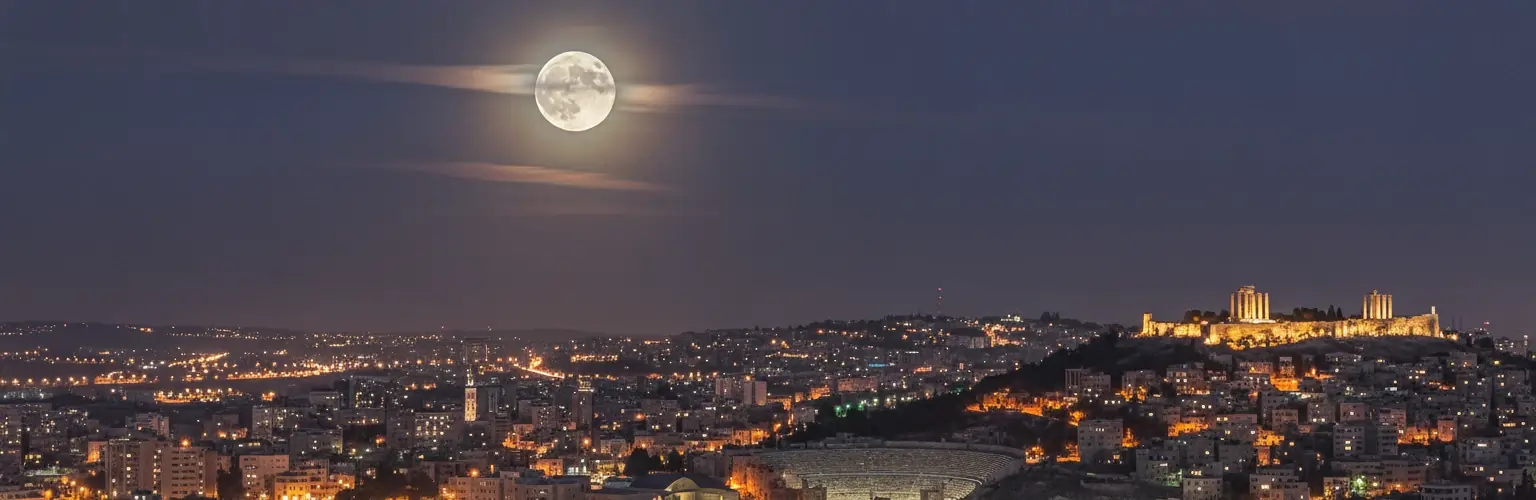
Amman is a city defined by its honey-limestone topography, built across seven original hills that rise up to 1,000m above sea level. At 31.9° North latitude, moon photography here is an exercise in capturing the "White City" as its stone facades reflect a cool silver light. The moon rises over the eastern Jabals, silhouetting Bronze Age ruins and modern glass towers, while the deep valleys trap a warm urban amber. Amman rewards the observer who utilizes its elevated terraces to frame the lunar disc against a skyline of minarets and ancient Roman masonry.
Amman Citadel (Jabal Al-Qal'a)
The premier viewpoint at 850m elevation. The moon rises over the eastern city bowl, silhouetting the columns of the Temple of Hercules. Logistics: The grounds close at 4:00 PM in winter and 7:00 PM in summer; for late-night shots, use the public hilltop road surrounding the site which offers identical panoramic views.
Roman Theatre – Jabal Al-Jofeh
A 2,000-year-old theater carved into the foot of Jabal Al-Jofeh. The theater itself faces North, but the upper tiers provide a massive panorama of the city center. The moon clears the Citadel hill to the west, flooding the stone seating in silver light. While the theater closes at dusk, the surrounding Hashemite Plaza remains open 24/7 for low-angle compositions.
Rainbow Street (Jabal Amman)
Amman's most celebrated social ridge. From rooftop perches like Cantaloupe, the moon rises directly over the Citadel hill and the Roman Theatre. The vibrant night market smoke and warm streetlights provide a lively urban foreground. It is the best spot to capture the "Vertical Amman" effect where lights stack up the steep hillsides of the historic core.
Jabal Al-Weibdeh Terraces
The city's bohemian arts quarter. Paris Square and the surrounding villa terraces offer elevated views east toward the Citadel. Weibdeh provides an intimate, old-world framing with narrow lanes and early 20th-century Arabic architecture. It is a quieter alternative to Jabal Amman, perfect for photographers seeking a residential "village" feel.
Abdali Boulevard – Skywalks
For a modern architectural contrast, the new Abdali financial district provides a high-tech foreground. The moon rises behind the glass-and-steel towers, creating a sharp juxtaposition with the illuminated limestone hills of the older city. The elevated pedestrian promenade is safe, well-lit, and eye-level with the city's modern skyscrapers.
Wadi Rum – Desert Excursion
Located 4 hours south, Wadi Rum is an International Dark Sky Reserve. The moon rises over massive sandstone monoliths, casting long crimson shadows across the dunes. With zero light pollution and high air transparency, it is the premier location for professional astrophotography in Jordan. Note: The drive from Amman is approximately 320 kilometers.
◉ Best Times for Moon Photography
📷 Quick Photography Tips
Amman operates on AST (Arabia Standard Time, UTC+3) year-round. Jordan abolished daylight saving time in late 2022. Because Amman is surrounded by steep hills and the plateau to the East, the "actual" moonrise sighting will be delayed by 5–10 minutes compared to flat-horizon calculations.
The moon phase today in Amman is shown in detail below — complete with exact illumination percentage, moonrise/set times, and the best local spots to see it. For the moon phase today in any other city worldwide, visit our Dynamic Moon Phase Calculator on the home page.
◐ What the Experience Actually Feels Like
There is a specific, sensory weight to a moonrise in Amman. Standing on the Citadel hill as the sun dips behind the western Jabals, the experience begins with the Adhan (Call to Prayer). As the moon clears the eastern horizon, the sound of a hundred mosques begins to echo through the valleys, the chants overlapping in a haunting, melodic wave. The air often carries the scent of cardamom coffee and woodsmoke from the downtown grills.
In winter, the experience is sharp and crystalline. The high-altitude air is so dry that the moon appears to have a physical texture, its craters silhouetting the Temple of Hercules with surgical precision. The "White City" lives up to its name; the limestone facades reflect the lunar light so effectively that the hills seem to glow from within. It is a moment of profound stillness above the city's ancient pulse.
On the terraces of Rainbow Street, the mood is more social. You share the moonrise with locals enjoying conversation, the moon providing a silver backdrop to the city's modern rhythm. But out in the desert of Wadi Rum, the world vanishes. The silence is absolute, and the moon rise over the red massifs is a prehistoric event—the stone turns from crimson to gold, then to cold silver, revealing a landscape that feels more like the moon's surface than our own.
"The honey-limestone facades reflect the lunar light so effectively that the hills seem to glow from within. It is a moment of profound stillness above the city's ancient pulse."
✓ Your Amman Moon Chase Checklist
Before You Go
- Check the moonrise time on this page — remember that the hills will delay the visual rise for those in the downtown valleys
- Verify Site Access: The Citadel closes at 4:00 PM (winter) and 7:00 PM (summer); plan to use the public hilltop roads for late viewing
- Download PhotoPills or Stellarium to track the exact arc relative to the Temple of Hercules columns
- Check the haze/dust forecast; high desert dust can make the moon appear massive and orange at the horizon
- Ensure your camera battery is at 100%; high-altitude night shooting in the winter cold drains power quickly
What to Bring
- A telephoto lens (200mm-400mm) to "compress" the moon behind the Citadel columns or the Abdali towers
- A Beanbag: Helpful for stabilizing your camera on the ancient, uneven stone walls of the theaters and ruins
- Serious layers — Amman's altitude means nights are chilly, and winter temperatures can drop to 5°C (41°F)
- A remote shutter release or use a 2-second timer to prevent tripod shake in the hilltop evening winds
- A high-quality lens cleaning cloth; the fine desert dust of Jordan will settle on your gear within minutes
- Sturdy walking shoes for the steep staircases and uneven masonry of the historic hilltop districts
On the Night
- Arrive at your spot 45 minutes early; the "Blue Hour" transition is when the limestone looks most ethereal
- Focus manually on the moon’s craters; the flickering city lights below can often confuse autofocus systems
- Bracket your exposures — take one for the bright lunar disc and one for the textured shadows of the limestone hills
- At the Citadel ridge, move away from the main road lights to minimize lens flare in your lunar compositions
- Stay for 20 minutes after moonrise; the composition sharpens as the moon clears the lower horizon haze
? Amman Moon Phase — Frequently Asked Questions
Q. What is the moon phase today in Amman?
The moon phase today in Amman is a New Moon with 0% illumination. The next full moon is in 17 days, on Oct 26. Moonrise is at 6:19 AM and moonset at 5:58 PM.
Q. Where is the best place to view the moon in Amman?
Amman Citadel on Jabal Al-Qal'a, at 850m, is the premier viewpoint, with the moon rising over the eastern city bowl and silhouetting the Temple of Hercules columns. The Roman Theatre's upper tiers and surrounding Hashemite Plaza offer a massive panorama of the city center, Rainbow Street's rooftops look toward the Citadel with a lively night-market foreground, and Jabal Al-Weibdeh's Paris Square, the Abdali Boulevard skywalks, or Wadi Rum's desert reserve add further intimate, modern, or truly dark-sky alternatives.
Q. How far is Wadi Rum from Amman?
Wadi Rum, an International Dark Sky Reserve, is located roughly 320 kilometres south of Amman, about a 4-hour drive, and offers zero light pollution with the premier astrophotography conditions in Jordan.
Q. Does Amman observe daylight saving time?
No. Amman operates on AST (Arabia Standard Time, UTC+3) year-round — Jordan abolished daylight saving time in late 2022. The times shown on this page never need a seasonal adjustment.
Q. What's the best time of year for moon photography in Amman?
November through March brings the sharpest air transparency and crisp winter sky clarity, while October and March offer ideal temperatures for long hilltop sessions. Whatever the season, Amman sits above 800m, so temperatures drop rapidly at sunset, and a jacket is worth bringing even after a hot day.
Q. Does this page work for cities besides Amman?
This page is set up specifically for Amman, Jordan. For the moon phase in any other city or location worldwide, use the Dynamic Moon Phase Calculator on the moonphase.today home page.
✦ Explore Further
Moon Phase Today: Beirut
Check tonight's moon phase in Beirut, about 200 miles north-west.
📷Moon Photography Guide
Camera settings, lenses, and techniques for shooting sharp, well-exposed moon shots.
📐Looney 11 Exposure Calculator
Dial in the exact f-stop, ISO, and shutter speed for a full moon — the same rule used in our Citadel tips.
🌆Blue Hour Calculator
Find tonight's exact blue hour window to time your Citadel moonrise shots.
NASA Moon Phase & Libration Gallery
NASA's Scientific Visualization Studio's daily renders of the moon's exact phase, libration, and orientation, straight from official mission data.