
Moon Phase Shizuoka
On Sunday, October 11, 2026, the moon in Shizuoka is a New Moon with 0% illumination. Moon age: 0.4 days.
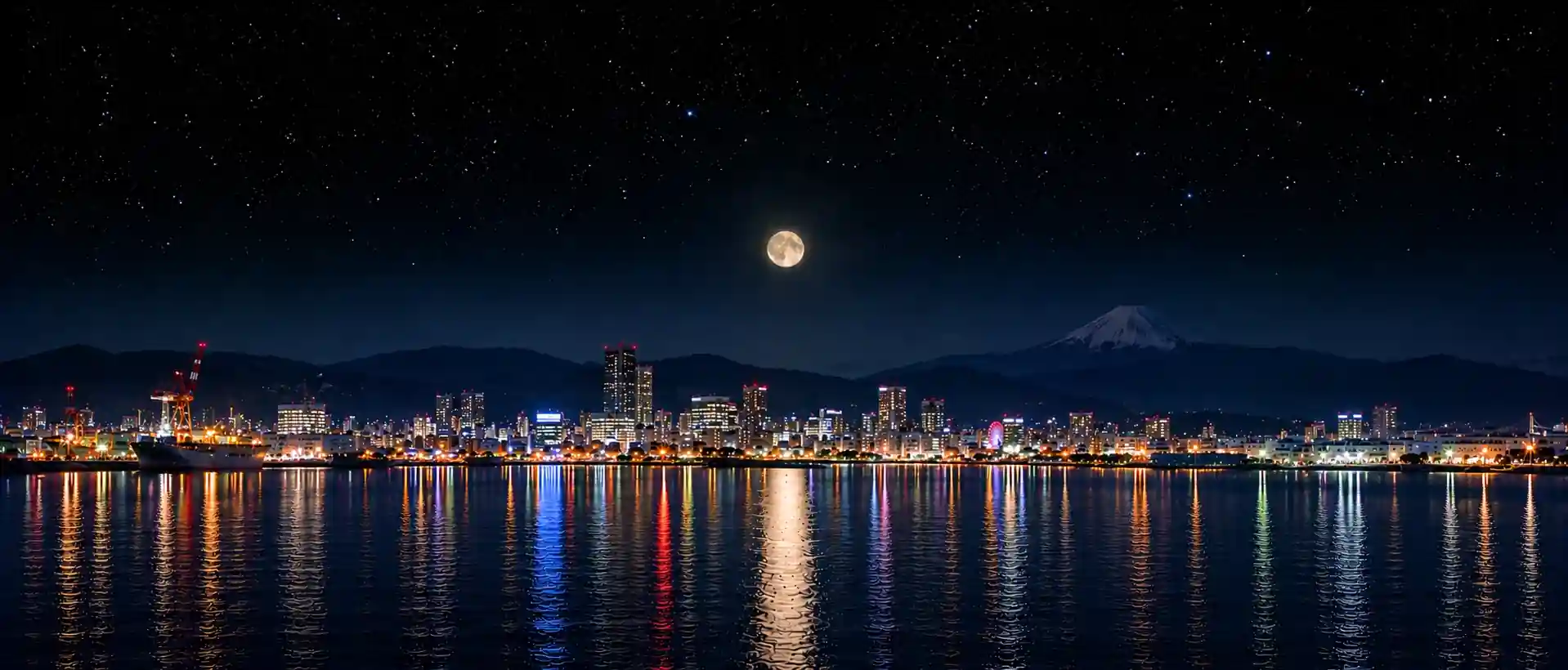
☽ Best Places to View the Moon in Shizuoka, Japan
Shizuoka sits at roughly 34.98°N on the Pacific coast of central Honshu, the capital of Shizuoka Prefecture with around 664,000 residents. The city is inseparable from two things: Mount Fuji, visible across Suruga Bay on clear days, and Tokugawa Ieyasu, founder of the Tokugawa shogunate, who spent his retirement here and was first laid to rest on a hilltop above the city. Between a scenic hilltop with a genuinely round-the-clock viewing deck, a shogun's castle park, and a pine-lined shore facing Fuji itself, Shizuoka gives an unusually scenic set of places to watch the moon.
Nihondaira Yume Terrace & Kunōzan Tōshō-gū Shrine
A scenic hilltop counted among Japan's "100 Scenic Places," with sweeping views across Suruga Bay to Mount Fuji from the Yume Terrace observation facility. Its indoor floors keep set hours, but the outdoor rooftop observation corridor is accessible at any time, day or night, and is registered as a Japan Nightscape Heritage site. A ropeway nearby descends to Kunōzan Tōshō-gū, a National Treasure shrine and Ieyasu's original burial site before his remains were later transferred to Nikkō; in autumn 2026 the shrine is hosting a special-ticket nighttime illumination event, "Kōsai-IRODORI," on selected dates — check current booking requirements.
Sunpu Castle Park
The site of Tokugawa Ieyasu's retirement castle, with reconstructed elements including the Tatsumi Yagura turret and Higashi Gomon gate standing among the remaining moats and stone walls. The park's Momijiyama Garden, a strolling-style feudal lord's garden built around scenes representing Suruga's famous sights, closes and isn't illuminated at night, so it's best treated as a daytime visit.
Shizuoka Sengen Shrine
A large shrine complex historically serving as the Suruga region's chief shrine, with 26 buildings designated Important Cultural Properties, set among old trees a short walk from the city centre. Its wooded outdoor grounds give a calmer setting than the busier station district nearby, though individual shrine buildings keep their own hours.
Miho no Matsubara
A pine-lined stretch of shoreline on Suruga Bay, part of the wider Mount Fuji UNESCO World Heritage listing and famous for its view of the mountain across the water. It's one of the most photographed spots in the region, and the open coastline gives broad sightlines over the bay, though the exact direction of moonrise will vary through the year.
Toro Archaeological Site
The excavated remains of a late Yayoi-period settlement roughly 1,900 to 2,000 years old, with reconstructed houses, warehouses, and rice paddies on the original site. It's a quiet, low-key stop for anyone curious about the deeper history beneath the modern city.
Suruga Bay Waterfront, Shimizu
The port district facing Suruga Bay, easily reached from central Shizuoka. It's the simplest option for an ordinary evening, with fresh seafood restaurants nearby and an open view out toward the water.
◉ Best Times for Moon Photography
📷 Quick Photography Tips
Shizuoka runs on Japan Standard Time (UTC+9) year-round — Japan does not observe daylight saving time, so the offset from UTC stays the same in every season.
For the moon phase in any other city worldwide, visit our Dynamic Moon Phase Calculator for instant lunar data tailored to wherever you are.
The moon phase today in Shizuoka, Japan is shown in detail above — complete with exact illumination percentage, moonrise/set times, and the best viewpoints to see it. For the moon phase today in any other city or location worldwide, visit our Dynamic Moon Phase Calculator on the home page.
◐ While Actually There
Shizuoka's whole geography seems arranged around a single view. Nihondaira is a scenic hilltop that happens to face Mount Fuji across Suruga Bay, and Miho no Matsubara's pine-lined shore does the same job at sea level. What makes Nihondaira particularly useful after dark is a design detail: the Yume Terrace building keeps normal hours, but its outdoor observation corridor stays open at any time, day or night, specifically because it's recognized as one of Japan's official nightscape heritage sites.
Ieyasu's own presence lingers everywhere once you notice it. He retired to Sunpu Castle, ruled from there in his final years, and was first buried at Kunōzan Tōshō-gū on the hill above the city before his remains were moved to the more famous mausoleum at Nikkō. The National Treasure shrine that remains here is arguably the more intimate of the two — reachable by ropeway from the same hilltop the Yume Terrace sits on, tying the city's two great subjects, mountain and man, together in a single afternoon.
Sunpu Castle Park's grounds, Sengen Shrine's outdoor precinct, and the Suruga Bay waterfront are all straightforward for an ordinary evening, while the Yume Terrace's outdoor corridor and any special events at Kunōzan Tōshō-gū are worth checking for current schedules.
"Shizuoka's whole landscape seems arranged around one view of Mount Fuji — and a hilltop terrace built for exactly that view happens to stay open all night."
✓ Your Shizuoka Moon Chase Checklist
Before You Go
- Check the moonrise time and phase on this page for each night of your stay
- Check current Nihondaira ropeway hours if you want to combine the summit with Kunōzan Tōshō-gū
- Check current dates and booking requirements for any special evening events at Kunōzan Tōshō-gū
- Check current opening hours for Sunpu Castle Park's reconstructed buildings if you want to go inside, not just view the grounds
- Check the forecast for typhoon activity if visiting in late summer or early autumn
What to Bring
- A light jacket for winter evenings — generally mild rather than severely cold, though a warm layer is still worth having
- A tripod, useful at open spots like Miho no Matsubara and the Suruga Bay waterfront, and at Nihondaira's outdoor corridor
- Comfortable shoes for walking Nihondaira's paths and Sunpu Castle Park's grounds
- A light rain layer, especially during the June rainy season
- Spare camera batteries and a lens cloth for humid summer evenings
On the Night
- Arrive 20–30 minutes before moonrise at open spots like Miho no Matsubara or the Suruga Bay waterfront
- Nihondaira Yume Terrace's outdoor observation corridor stays open regardless of the building's hours — a reliable fallback if other spots have closed
- Shoot RAW and bracket exposures, especially where city lights below Nihondaira mix with moonlight
- Mind wind at exposed coastal spots, particularly along Miho no Matsubara
- Watch for typhoon-related weather changes if visiting between summer and early autumn
? Shizuoka Moon Phase — Frequently Asked Questions
Q. What is the moon phase today in Shizuoka?
The moon phase today in Shizuoka is a New Moon with 0% illumination. The next full moon is in 16 days, on Oct 26. Moonrise is at 6:17 AM and moonset at 5:23 PM.
Q. Where is the best place to view the moon in Shizuoka?
Nihondaira Yume Terrace is the most reliable nighttime viewpoint: its indoor floors keep set hours, but the outdoor rooftop observation corridor is accessible at any time and is registered as a Japan Nightscape Heritage site. Miho no Matsubara and the Shimizu waterfront on Suruga Bay give open sightlines over water. Sunpu Castle Park's grounds are not lit at night, so plan any castle-and-moon composition for the approach to sunset. Special evening events at Kunōzan Tōshō-gū run on selected dates with tickets, so check current schedules.
Q. Where does the moon rise and set in Shizuoka, and how high does it climb?
At about 35°N, the Moon's rising point swings between roughly east-northeast (azimuth near 54°) and east-southeast (near 126°) over a month at the widest point of its 18.6-year declination cycle, with the setting point mirrored in the west. That cycle peaked with the major lunar standstill of 2024–2025, so the monthly swing is still near its widest. At this latitude the Moon always culminates in the south, ranging from about 26° above the southern horizon at its southern extreme to about 84° at its northern extreme. A December full moon typically culminates near 78°, while a June full moon peaks near 32°.
Q. Can the moon rise or set behind Mount Fuji from Shizuoka?
No. Fuji lies north-northeast of Shizuoka, about 45 km from Miho no Matsubara, at a bearing near 25° to 35° depending on your viewpoint and roughly 4° to 5° above a flat horizon. At this latitude the Moon rises no further north than about azimuth 54° and sets no further north than about 306°, so it never lines up with the summit. At the most northerly moonrises, the Moon and Fuji sit roughly 20° to 30° apart, close enough to share a 28–35 mm full-frame image. Fuji is usually clearest between December and March.
Q. Is light pollution a problem for moon observing in Shizuoka?
The Moon is bright enough to observe and photograph from almost anywhere in the city, so light pollution rarely limits the lunar disc itself. With around 664,000 residents and a lit port district, Shizuoka does wash out earthshine on a thin crescent and faint stars or planets near the Moon. Elevated positions such as Nihondaira look down on the city lights, while coastal spots like Miho no Matsubara keep buildings out of your foreground. Shizuoka remains a light-polluted urban location rather than a dark-sky site.
Q. How do the seasons affect moon viewing in Shizuoka?
Winters are cool and relatively dry, which often favors clear skies and Fuji visibility, though freezing temperatures are possible on colder nights. Summers are warm and humid, with a rainy season in June and typhoon risk from summer into early autumn, so cloud is the main obstacle to lunar observing then. Humidity also fogs cold lenses: let your gear acclimate after leaving an air-conditioned space and carry a cloth. Check the cloud and typhoon forecasts before heading out.
Q. What camera settings work best for moon photography in Shizuoka?
For a full moon, start with Looney 11 (f/11, ISO 100, 1/100 s) and refine using your histogram, since it is a baseline rather than a guarantee. Shoot RAW and bracket exposures where city lights below Nihondaira share the frame with the Moon, then blend them. A wide-angle lens can include both the Moon and Fuji, while a 200–400 mm lens frames the Moon large against the bay. Use a tripod and mind wind at exposed coastal spots such as Miho no Matsubara.
Q. Does this page work for cities besides Shizuoka?
This page is set up specifically for Shizuoka, Japan. For the moon phase in any other city or location worldwide, use the Dynamic Moon Phase Calculator on the moonphase.today home page.
✦ Explore Further
Moon Phase Today: Hamamatsu
Check tonight's moon phase in Hamamatsu, roughly 65 km west-southwest of Shizuoka along the coast.
🏙️Moon Phase Today: Yokohama
See the moon over Yokohama, roughly 125 km east-northeast of Shizuoka.
🇯🇵Moon Phase in Japan
Browse moon phase pages for cities across Japan, from Sapporo to Kagoshima.
🌍World Moon Phase Directory
Find the moon phase, rise and set times for cities in every region of the world.
Moon Photography Guide
Tips for photographing the Moon, from exposure to framing.