
Moon Phase Sakai
On Saturday, October 10, 2026, the moon in Sakai is a New Moon with 0% illumination. Moon age: 29.0 days.
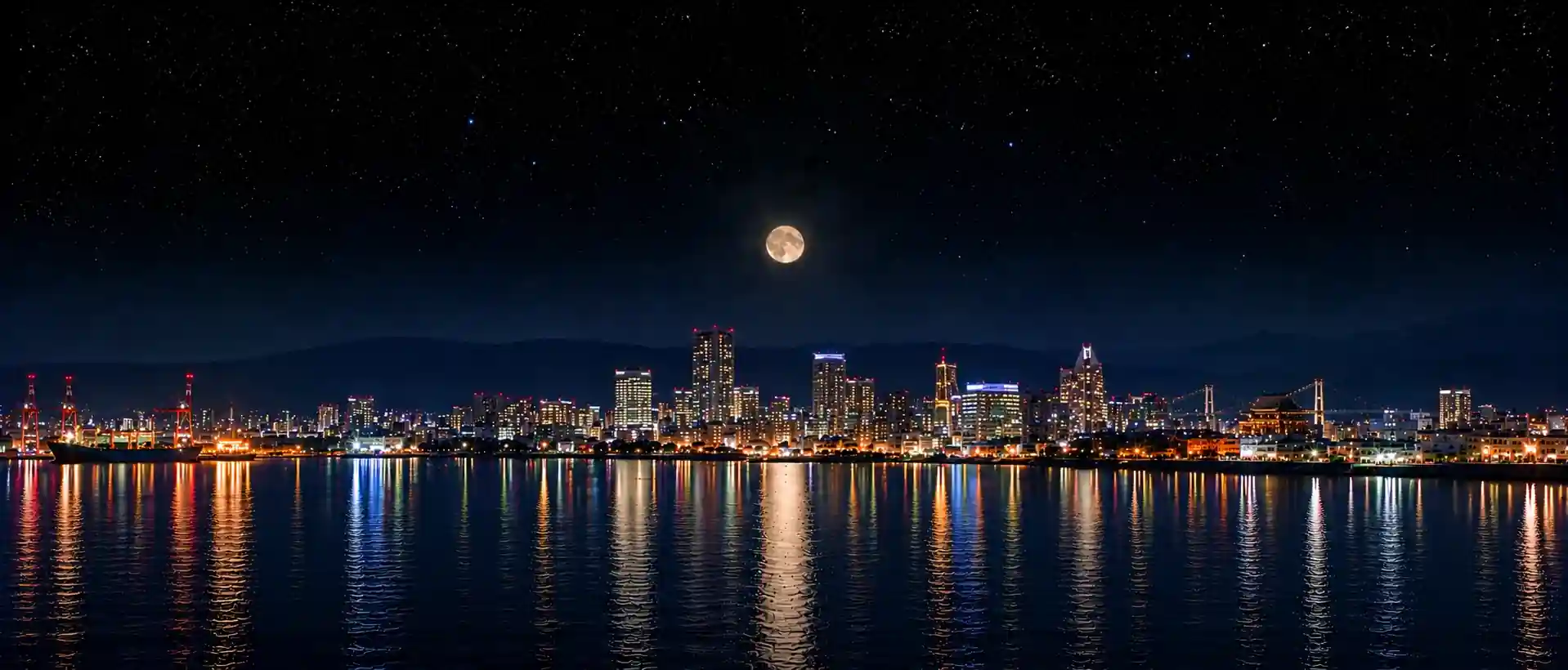
☽ Best Places to View the Moon in Sakai, Japan
Sakai sits at roughly 34.57°N on Osaka Bay, directly south of Osaka city, with around 800,000 residents. One of Japan's most important medieval seaports, Sakai carries an extraordinary depth of history beneath its modern streets — the keyhole-shaped burial mounds of the Mozu-Furuichi Kofun Group, a UNESCO World Heritage Site since 2019, sit right in the middle of the city. Between an ancient tomb larger than almost anything else built by human hands, a centuries-old metalworking tradition, and the bay itself, Sakai gives a genuinely layered set of places to watch the moon.
Daisen Kofun & Daisen Park
A keyhole-shaped burial mound traditionally identified as the mausoleum of Emperor Nintoku, measuring about 486 metres long and surrounded by triple moats. It's Japan's largest keyhole-shaped kofun and one of the world's largest ancient burial mounds, part of the UNESCO-listed Mozu-Furuichi Kofun Group. The surrounding Daisen Park sits between the Nintoku and Richu tombs, with museums, teahouses, and a Japanese garden — check current hours for any indoor facilities you want to visit.
Sakai City Traditional Crafts Museum
A museum dedicated to Sakai's cutlery tradition, tracing a metalworking craft with roots reaching back to the Kofun period through to today's high-quality kitchen knives. It's a daytime destination worth combining with a visit to the nearby kofun.
Ōtori Taisha Shrine
The most important shrine of the ancient Izumi region, with wooded grounds exceeding 50,000 square metres. Grounds are open 5:30 to 18:00, with reception hours ending at 16:30, so it's best treated as a daytime or early-evening stop rather than a late-night one.
Old Sakai Lighthouse
A wooden lighthouse built in 1877, standing 11.3 metres and operational until 1968, now a National Historic Site on the old harbour seawall. It gives an open waterfront setting rather than an unobstructed bay view, given the surrounding reclaimed and industrial land.
Sen no Rikyū's Birthplace
A site marking the birthplace of Sen no Rikyū, born in Sakai in 1522 and a major figure in the development of wabi-cha, the tea ceremony aesthetic. It's a small, quiet stop tying the city's mercantile history to a much broader cultural legacy.
Sakai Waterfront, Osaka Bay
Selected areas of the harbour facing Osaka Bay, easily reached from central Sakai. It's one of the city's simpler options for an ordinary evening, with a view out toward the water.
◉ Best Times for Moon Photography
📷 Quick Photography Tips
Sakai runs on Japan Standard Time (UTC+9) year-round — Japan does not observe daylight saving time, so the offset from UTC stays the same in every season.
For the moon phase in any other city worldwide, visit our Dynamic Moon Phase Calculator for instant lunar data tailored to wherever you are.
The moon phase today in Sakai, Japan is shown in detail above — complete with exact illumination percentage, moonrise/set times, and the best viewpoints to see it. For the moon phase today in any other city or location worldwide, visit our Dynamic Moon Phase Calculator on the home page.
◐ While Actually There
Sakai's most extraordinary feature isn't obvious from street level. Daisen Kofun is so large — a forested, moated mound nearly 500 metres long — that its keyhole shape only really reveals itself from the air, which means most visitors experience it as a quiet green hill rather than the enormous tomb it actually is. Walking Daisen Park's public paths at dusk, with the mound rising on one side and cherry trees or tea houses on the other, is a strange kind of quiet for a city this size.
The knife-making tradition tells a related story from a different angle. Sakai's metalworking has roots reaching back to the Kofun period, when the city's own history notes forging technology laid foundations in the production of tools for tumulus construction. Whether smiths were specifically summoned to build Nintoku's tomb is more origin legend than settled history, but the underlying continuity — ironwork here going back well over a thousand years — is real, right through to the cutlery Sakai produces today.
Daisen Park's public grounds and the waterfront are straightforward for an ordinary evening, while the Traditional Crafts Museum and Ōtori Taisha's buildings are best planned as daytime stops given their published hours.
"Sakai's biggest landmark is so large you can barely tell it's there — a tomb about 1,500 years old that looks, from the ground, like nothing more than a quiet forested hill."
✓ Your Sakai Moon Chase Checklist
Before You Go
- Check the moonrise time and phase on this page for each night of your stay
- Check current opening hours for the Sakai City Traditional Crafts Museum if you want to combine it with your visit
- Check current access at Daisen Park's museums and teahouses if you want to go inside rather than just walk the grounds
- Check Ōtori Taisha's current hours (grounds 5:30–18:00, reception until 16:30) if you plan to visit the shrine buildings themselves
- Check the forecast for typhoon activity if visiting in late summer or early autumn
What to Bring
- A light jacket for winter evenings — generally mild rather than severely cold, though a warm layer is still worth having
- A tripod, useful at open spots like the Sakai waterfront
- Comfortable shoes for walking the paths around Daisen Park
- A light rain layer, especially during the June rainy season
- Spare camera batteries and a lens cloth for humid summer evenings
On the Night
- Arrive 20–30 minutes before moonrise at open spots like the Sakai waterfront or Daisen Park
- Shoot RAW and bracket exposures, especially where the moat and tree cover around the kofun mix with moonlight
- Keep to marked paths around the protected kofun sites
- Confirm your return transport if visiting the waterfront in the evening
- Watch for typhoon-related weather changes if visiting between summer and early autumn
? Sakai Moon Phase — Frequently Asked Questions
Q. What is the moon phase today in Sakai?
The moon phase today in Sakai is a New Moon with 0% illumination. The next full moon is in 17 days, on Oct 26. Moonrise is at 5:26 AM and moonset at 5:08 PM.
Q. Where is the best place to view the moon in Sakai?
The Sakai waterfront on Osaka Bay and the area around the Old Sakai Lighthouse, a wooden lighthouse on the old harbour seawall, give the most open sightline in the city, though the surrounding reclaimed and industrial land means it is an open waterfront rather than an unobstructed bay view. Daisen Park, between the Nintoku and Richu tombs, has moats, tree cover and a Japanese garden that suit a still, reflective evening walk around Daisen Kofun. Ōtori Taisha Shrine's wooded grounds are a daytime or early-evening stop, and the Sakai City Traditional Crafts Museum and Sen no Rikyū's birthplace are daytime destinations.
Q. Where does the moon rise and set in Sakai, and how high does it climb?
At about 34.6°N, Sakai's moonrise and moonset points swing across the horizon each month, from roughly east-northeast to east-southeast for rising and west-northwest to west-southwest for setting. A winter full moon culminates high in the south, at roughly 79° above the horizon, while a summer full moon stays lower, peaking near 32°. Sakai sits on the eastern shore of Osaka Bay, so the bay lies to the west, the direction of moonset: from the waterfront a setting moon can drop over the water, while a rising moon comes up behind the city. At ground level the forested Daisen Kofun and the surrounding city block a low horizon, so check the azimuth for your date and exact spot.
Q. Is light pollution a problem for moon observing in Sakai?
The moon is bright enough to observe and photograph from almost anywhere in Sakai, so light pollution rarely limits the lunar disc itself. It does wash out earthshine on a thin crescent and any faint sky detail. Sakai is part of the Osaka Bay metropolitan area, and the harbour, industrial waterfront and city streets all carry substantial artificial lighting, so it is a light-polluted site rather than a dark-sky one. Daisen Park's tree cover can screen some direct lights, but the overall glow still washes out faint detail.
Q. What camera settings and phases work best for moon photography in Sakai?
For a full moon, start with Looney 11 (f/11, ISO 100, 1/100 s) and refine using your histogram, since it is a baseline rather than a guarantee. The moon is much brighter than the lit waterfront and city, so shoot RAW and bracket or blend exposures to keep both crater detail and the foreground. A waxing gibbous is useful for blue hour while the foreground is still lit, and a waxing moon sets over Osaka Bay in the evening. A 200–400 mm lens helps isolate the moon against the lighthouse or the treeline, with a tripod for bracketing and manual focus on the moon using magnified live view. Moats can give a reflection when the water is calm and lies between you and the moon.
Q. How do the rainy season, typhoons and bay wind affect moon viewing in Sakai?
Sakai has warm, humid summers with a rainy season in June and typhoon risk from summer into early autumn, so clear lunar windows can be short and weather can change quickly. Humidity can leave condensation on lenses, especially if your gear comes from an air-conditioned space. The waterfront is more exposed to wind off the bay than the streets around the kofun, which can shake a tripod. Winters in the Kansai region are cool, with occasional cold spells, little persistent snow, and freezing temperatures possible on colder nights. Check local forecasts for cloud, wind, rain and typhoon activity before heading out.
Q. What time zone are Sakai's moonrise and moonset times shown in?
Sakai runs on Japan Standard Time, UTC+9, year-round. Japan does not observe daylight saving time, so moonrise and moonset times stay on the same local clock in every season and the offset from UTC never changes.
Q. Can I shoot the moon at Sakai's viewpoints after dark?
Access varies by site. Ōtori Taisha's grounds are open from 5:30 to 18:00, with reception ending at 16:30, so it suits a daytime or early-evening stop. The Sakai City Traditional Crafts Museum keeps daytime hours, and Daisen Park's museums and teahouses have their own hours if you want to go inside rather than walk the grounds. Keep to marked paths around the protected kofun sites. The Old Sakai Lighthouse and the waterfront are open urban spaces, so confirm your return transport for an evening visit.
Q. Does this page work for cities besides Sakai?
This page is set up specifically for Sakai, Japan. For the moon phase in any other city or location worldwide, use the Dynamic Moon Phase Calculator on the moonphase.today home page.
✦ Explore Further
Moon Phase Today: Osaka
Check tonight's moon phase in Osaka, directly north of Sakai on Osaka Bay.
⚓Moon Phase Today: Kobe
See the moon over Kobe, west of Sakai along the northern shore of Osaka Bay.
🇯🇵Moon Phase in Japan
Browse moon phase pages for cities across Japan, from Sapporo to Kagoshima.
🌍World Moon Phase Directory
Find the moon phase, rise and set times for cities in every region of the world.
Blue Hour Calculator
Work out when blue hour falls, ideal for waxing gibbous shots around Daisen Park's moats.