
Moon Phase Montpellier
On Saturday, October 10, 2026, the moon in Montpellier is a New Moon with 0% illumination. Moon age: 29.0 days.
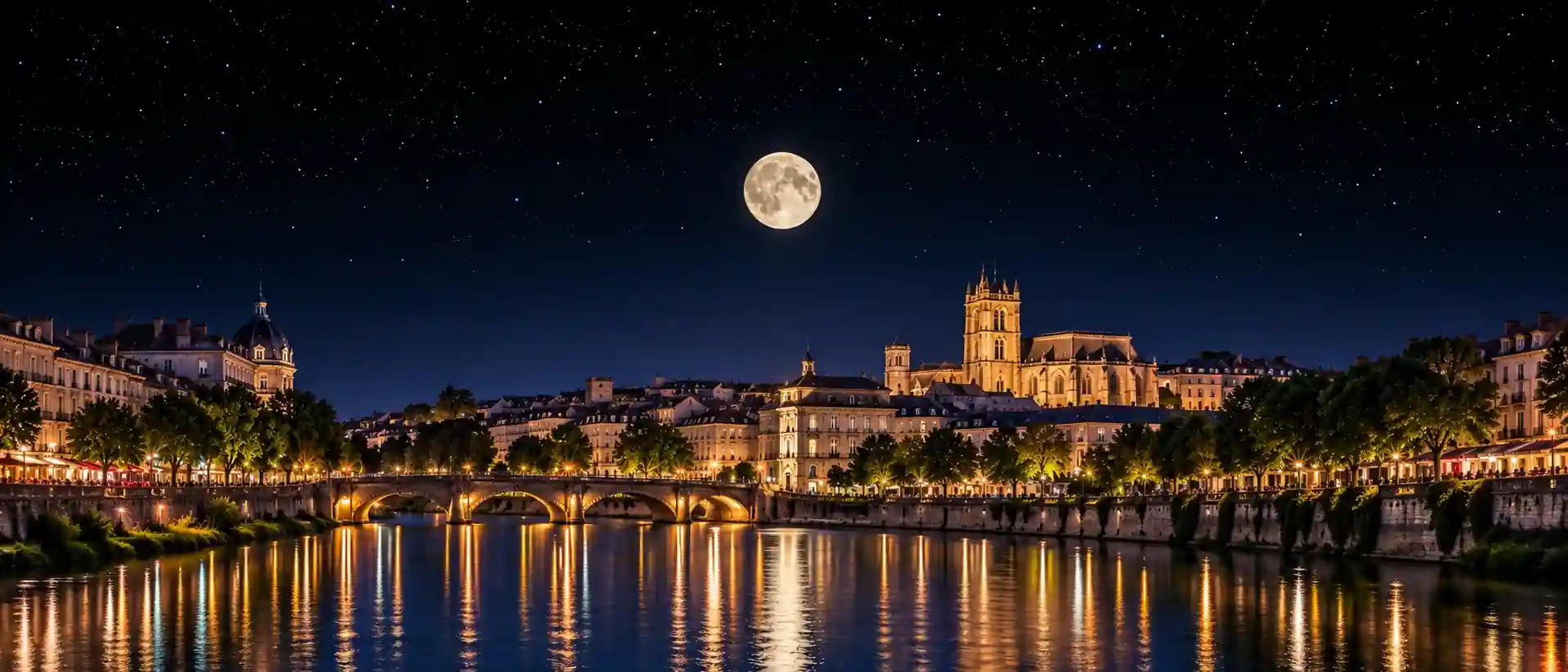
☽ Best Places to View the Moon in Montpellier, France
Montpellier sits at roughly 43.61°N near the Mediterranean coast in southern France, the seventh-largest city in France with around 310,000 residents. Home to medical teaching dating to 1180 and a university officially founded in 1289, Montpellier's school of medicine is considered the oldest continuously operating in the Western world, and the city has continued to grow rapidly for decades, all while keeping an 18th-century water tower and Roman-style aqueduct at its highest point. Between that elevated promenade, a formal square built around a Baroque fountain, and a modern district modeled on ancient Greece, Montpellier gives a genuinely varied set of places to watch the moon.
Promenade du Peyrou & Arc de Triomphe
A formal esplanade laid out at the end of the 17th century on one of the highest points in the city, entered through an Arc de Triomphe built in 1691-92 to honour Louis XIV, whose top can be reached by climbing 90 steps for a panoramic view. The promenade runs past an equestrian statue of the king to a hexagonal water tower completed in 1768, with sweeping views over the city and, on a clear day, toward the Mediterranean and the Cévennes.
Aqueduc Saint-Clément
An 18th-century aqueduct built between 1753 and 1765 in a Roman style, its famous double-arcade section at Les Arceaux stretching about 800 metres, once carrying water some 14 kilometres from the Saint-Clément spring to the Peyrou's water tower. Its arcades give a distinctive, historic backdrop for an evening walk in the Arceaux district.
Place de la Comédie
The heart of the city, centred on the Three Graces fountain, completed in 1776 and installed on the square in 1797, and framed by the 19th-century opera house. Wide boulevards radiate out from here toward the old town, making it Montpellier's easiest option for an ordinary evening.
Antigone District
A striking neoclassical neighbourhood designed by Catalan architect Ricardo Bofill starting in 1977, its monumental façades and public squares drawing openly on ancient Greek architecture, running from Place de la Comédie down to the Lez River. It's a good option for an evening walk with an unusually theatrical sense of scale.
Jardin des Plantes
France's oldest botanical garden, established in 1593 and created as a teaching garden where medical students could study medicinal plants, with sections still devoted to therapeutic and Mediterranean species today. Its quieter, tree-shaded paths give a calmer option than the busier historic centre, within its posted hours.
Cathédrale Saint-Pierre & the Old Medical Faculty
A fortress-like Gothic cathedral adjoining the University of Montpellier's medical faculty, whose medical tradition dates to the 12th century and whose teaching was formally authorized in 1180, making it one of the oldest continuously operating medical schools in the Western world. The surrounding streets of the old town give a historic, easy-to-walk setting for an evening near the cathedral's towers.
◉ Best Times for Moon Photography
📷 Quick Photography Tips
Montpellier runs on Central European Time (UTC+1), shifting to Central European Summer Time (UTC+2) for daylight saving time, from the last Sunday in March to the last Sunday in October.
For the moon phase in any other city worldwide, visit our Dynamic Moon Phase Calculator for instant lunar data tailored to wherever you are.
The moon phase today in Montpellier, France is shown in detail above — complete with exact illumination percentage, moonrise/set times, and the best viewpoints to see it. For the moon phase today in any other city or location worldwide, visit our Dynamic Moon Phase Calculator on the home page.
◐ While Actually There
Montpellier's high ground has always been more practical than ornamental. The Peyrou was built as a genuine piece of civic infrastructure — a water tower fed by an aqueduct running some 14 kilometres from a spring, dressed up with a triumphal arch and royal statue because 17th-century engineering apparently demanded a bit of theatre. It's the same principle Antigone follows three centuries later: monumental architecture built to do an ordinary job, in this case housing people rather than distributing water.
The city's medical history runs even deeper than its Baroque water infrastructure. Medical teaching in Montpellier was formally authorized as early as 1180, and the university itself was officially founded in 1289, making its medical faculty one of the oldest continuously operating in the Western world. The Jardin des Plantes next to it was never meant as a pleasure garden — it was created as a teaching garden where medical students could study medicinal plants.
None of it requires much beyond checking the Peyrou's posted hours, since it isn't open around the clock. Place de la Comédie, Antigone, and the old town streets around the cathedral are all straightforward for an ordinary evening without much advance planning.
"Montpellier dressed up a water tower with a triumphal arch and a royal statue — practical infrastructure doing double duty as the best view in the city."
✓ Your Montpellier Moon Chase Checklist
Before You Go
- Check the moonrise time and phase on this page for each night of your stay
- Check current opening and closing times for the Promenade du Peyrou before planning an evening visit
- Check current opening hours for the Jardin des Plantes if you want to combine it with your visit
- Check current opening hours for the Cathédrale Saint-Pierre if you want to go inside, not just view the exterior
- Check the forecast for summer heat or occasional strong winds depending on your travel dates
What to Bring
- A light layer for winter evenings — generally mild by French standards, though a warm layer is still worth having
- A tripod, useful at open spots like the Promenade du Peyrou
- Comfortable shoes for walking between the Peyrou, Antigone, and the old town
- A light layer for summer evenings, which stay warm well after sunset
- A cloth to wipe down camera gear on dusty or humid evenings
On the Night
- Arrive 20–30 minutes before moonrise at open spots like the Promenade du Peyrou
- Shoot RAW and bracket exposures, especially where the illuminated Arc de Triomphe or water tower mix with moonlight
- Confirm the Peyrou's current closing time before planning a late visit
- Mind wind at exposed elevated spots, particularly on the esplanade
- Keep an eye on the forecast for summer thunderstorms or other rapidly changing conditions
? Montpellier Moon Phase — Frequently Asked Questions
Q. What is the moon phase today in Montpellier?
The moon phase today in Montpellier is a New Moon with 0% illumination. The next full moon is in 17 days, on Oct 26. Moonrise is at 7:44 AM and moonset at 6:54 PM.
Q. Where is the best place to view the moon in Montpellier?
The Promenade du Peyrou, an esplanade on one of the highest points in the city, is the best-known elevated spot, with the Arc de Triomphe, the equestrian statue and the hexagonal water tower, and sweeping views over the city and, on a clear day, toward the Mediterranean and the Cévennes. The arcades of the Aqueduc Saint-Clément at Les Arceaux give a historic backdrop nearby, while Place de la Comédie is the easiest central option. The Antigone district's neoclassical squares run from Place de la Comédie down to the Lez River, and the Jardin des Plantes offers quieter tree-shaded paths within its posted hours.
Q. Where does the moon rise and set in Montpellier, and how high does it climb?
At about 43.6°N, Montpellier's moonrise and moonset points swing across the horizon each month, from roughly northeast to southeast for rising and northwest to southwest for setting. A winter full moon culminates high in the south, at roughly 70° above the horizon, while a summer full moon stays low, peaking near 23°. The Mediterranean lies to the south and the Cévennes to the north, so from the elevated Peyrou a low summer full moon crosses the sky in the direction of the coast, while a winter moon setting in the northwest sets over the direction of the Cévennes. Check the azimuth for your date and exact spot, since alignments with the arch or water tower depend on where you stand.
Q. Is light pollution a problem for moon observing in Montpellier?
The moon is bright enough to observe and photograph from almost anywhere in Montpellier, so light pollution rarely limits the lunar disc itself. It does wash out earthshine on a thin crescent and any faint sky detail. The illuminated Arc de Triomphe and water tower, Place de la Comédie and the Antigone district all carry substantial artificial lighting, so Montpellier is a light-polluted site rather than a dark-sky one, best suited to moon-over-city compositions.
Q. What camera settings and phases work best for moon photography in Montpellier?
For a full moon, start with Looney 11 (f/11, ISO 100, 1/100 s) and refine using your histogram, since it is a baseline rather than a guarantee. The moon is much brighter than the lit monuments, so shoot RAW and bracket or blend exposures to keep both crater detail and the Arc de Triomphe or water tower in the foreground. A waxing gibbous is useful for blue hour at the Peyrou while the foreground is still lit, and a full moon rises around sunset. A 200–400 mm lens helps isolate the moon against distant monuments, with a tripod for bracketing and manual focus on the moon using magnified live view.
Q. How do summer heat, wind and storms affect moon viewing in Montpellier?
Montpellier has a Mediterranean climate with warm, generally dry summers. Dust and heat can affect gear over a long evening, and warm air rising from hot pavement can cause shimmer near the horizon when the moon is low, softening fine detail. The Peyrou esplanade is exposed to wind, which can shake a tripod or long lens, and summer thunderstorms can change conditions quickly. Check local forecasts for cloud, wind and storms before heading out, and carry a lens cloth to wipe down equipment.
Q. Can I shoot the moon at Montpellier's viewpoints after dark?
Access varies by site. The Promenade du Peyrou keeps posted opening and closing hours rather than staying open around the clock, so confirm the current closing time before planning a late visit. The Jardin des Plantes also operates within posted hours, and Cathédrale Saint-Pierre keeps its own hours if you want to go inside rather than photograph the exterior. Place de la Comédie, the Antigone district and the old-town streets are open urban spaces with artificial lighting.
Q. Does this page work for cities besides Montpellier?
This page is set up specifically for Montpellier, France. For the moon phase in any other city or location worldwide, use the Dynamic Moon Phase Calculator on the moonphase.today home page.
✦ Explore Further
Moon Phase Today: Marseille
Check tonight's moon phase in Marseille, east of Montpellier along the Mediterranean coast.
🌇Moon Phase Today: Toulouse
See the moon over Toulouse, west of Montpellier toward the Garonne.
🇫🇷Moon Phase in France
Browse moon phase pages for cities across France, from Paris to Strasbourg.
🌍World Moon Phase Directory
Find the moon phase, rise and set times for cities in every region of the world.
Moonrise Tonight
Check tonight's moonrise time so you can be in position on the Peyrou esplanade before the moon clears the horizon.