
Moon Phase Kumamoto
On Saturday, October 10, 2026, the moon in Kumamoto is a New Moon with 0% illumination. Moon age: 29.0 days.
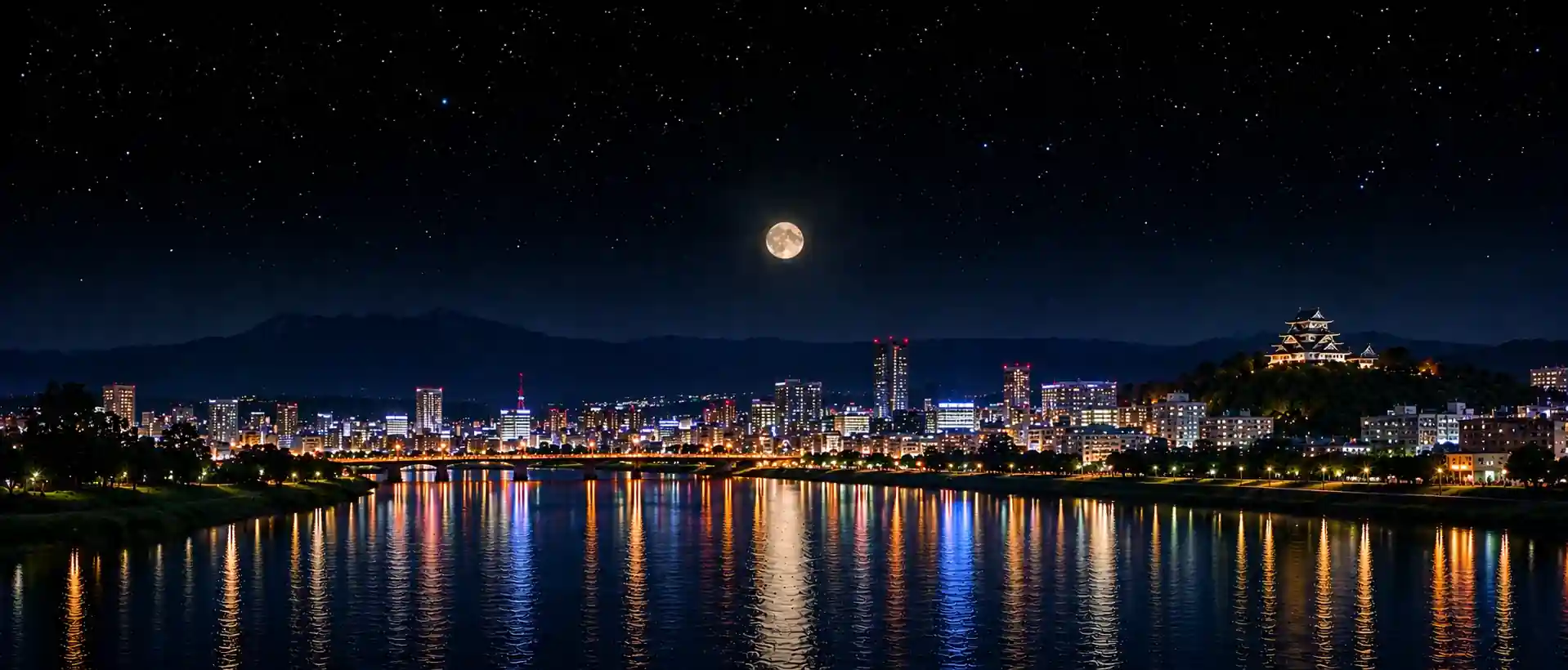
☽ Best Places to View the Moon in Kumamoto, Japan
Kumamoto sits at roughly 32.81°N on Kyushu, between the Ariake Sea and the Aso volcanic massif, the capital of Kumamoto Prefecture with around 730,000 residents. Its entire drinking water supply comes from groundwater recharged by rainfall around Aso's western foothills and the Shirakawa river basin, earning it the nickname the "City of Water," and its castle — one of Japan's three premier castles — remains partway through a long restoration after the 2016 earthquake. Between the castle, a spring-fed garden built for its tea water, and a lake fed by the same groundwater system, Kumamoto ties the moon to water at almost every turn.
Kumamoto Castle
Built between 1599 and 1607 by Kato Kiyomasa, one of Japan's three premier castles, known for its curved musha-gaeshi stone walls designed to repel attackers. Badly damaged in the 2016 earthquakes, its main keep reopened to the public in 2021, though restoration of the wider complex continues, with regular evening illumination lighting the walls after dark — check current access before planning your visit.
Kumamoto City Hall Observation Floor
A free observation floor on the 14th floor of City Hall, open until 22:00 (from 8:30 on weekdays, 9:00 on weekends and holidays), directly facing the castle. It's specifically recommended for its view of the illuminated castle at night, making it one of the city's most reliable evening moon-viewing spots.
Lake Ezu
A spring-fed urban lake supplied by the same Suizenji–Lake Ezu groundwater system that feeds the city's famous garden, ringed by walking and cycling paths through a grassy park. It's a quiet, birdlife-rich spot for an evening walk away from the castle district.
Sakura-no-baba Josaien
A reconstructed 17th-century castle-town commercial district at the entrance to Kumamoto Castle, with shops and food stalls built in a historic style. It's a natural stop before or after viewing the castle itself.
Kamitori & Shimotori Shopping Arcades
Kumamoto's main covered shopping streets, in the heart of the city centre — Shimotori is the prefecture's largest arcade, with Kamitori running about 360 metres nearby. It's the easiest option for an ordinary evening, with the moon somewhere overhead as you walk between shops and restaurants.
Suizenji Jojuen Garden
A landscape garden developed in the 1630s around a spring chosen for the quality of its water for brewing tea, with a large spring-fed pond and a miniature landscape evoking the Tokaido road, including a manicured Mount Fuji. Within the garden's Izumi Shrine, a fountain is said to offer the "Water of Longevity" — but the garden keeps daytime hours only (8:30–17:00, last entry 16:30), making it a daytime rather than moonlit visit.
◉ Best Times for Moon Photography
📷 Quick Photography Tips
Kumamoto runs on Japan Standard Time (UTC+9) year-round — Japan does not observe daylight saving time, so the offset from UTC stays the same in every season.
For the moon phase in any other city worldwide, visit our Dynamic Moon Phase Calculator for instant lunar data tailored to wherever you are.
The moon phase today in Kumamoto, Japan is shown in detail above — complete with exact illumination percentage, moonrise/set times, and the best viewpoints to see it. For the moon phase today in any other city or location worldwide, visit our Dynamic Moon Phase Calculator on the home page.
◐ While Actually There
Kumamoto's relationship with water runs all the way down to the ground it's built on. Rainfall around Aso's western foothills and the Shirakawa river basin filters through volcanic deposits before resurfacing as springs across the city, supplying its entire drinking water supply as groundwater — a genuinely unusual arrangement for a city this size. Suizenji Jojuen was built specifically around one of those springs, its garden literally designed to showcase the water's quality, and Lake Ezu, a short distance away, draws on the same underground system.
The castle tells a more visibly ongoing story. Its main keep only reopened in 2021 after the 2016 earthquake, and much of the wider complex is still being carefully restored, stone by stone. Watching that recovery unfold from the free City Hall observation floor, across the moat from the castle itself and open until 22:00, is a quietly moving way to spend an evening in the city — and it's specifically recommended for its view of the illuminated keep after dark.
Suizenji is worth building a daytime visit around rather than an evening one, since it closes at 17:00. Sakura-no-baba, the shopping arcades, and Lake Ezu's promenade are all straightforward for an ordinary evening without much advance planning.
"Kumamoto's water comes from the same volcanic ground that shapes its whole landscape — the garden, the lake, and the tap all trace back to the same underground source."
✓ Your Kumamoto Moon Chase Checklist
Before You Go
- Check the moonrise time and phase on this page for each night of your stay
- Check Kumamoto Castle's current access status before your visit, since parts of the complex remain under restoration
- Plan any Suizenji Jojuen Garden visit for before 16:30 (last entry) — it doesn't stay open into the evening
- City Hall's 14th-floor observation deck is open until 22:00 (8:30 weekdays, 9:00 weekends/holidays) — no reservation needed
- Check the forecast for typhoon activity if visiting in late summer or early autumn
What to Bring
- A light jacket for winter evenings — generally mild rather than severely cold, though a warm layer is still worth having
- A tripod, useful at open spots like Lake Ezu's promenade
- Comfortable shoes for walking the castle grounds and the paths around Lake Ezu
- A light rain layer, especially during the June rainy season
- Spare camera batteries and a lens cloth for humid summer evenings
On the Night
- Arrive 20–30 minutes before moonrise at open spots like Lake Ezu or the City Hall observation floor
- Shoot RAW and bracket exposures, especially where illuminated castle stonework mixes with moonlight
- Keep to marked paths around any part of the castle grounds still under restoration
- Confirm your return transport if visiting Lake Ezu in the evening, since it sits a little further from the centre
- Watch for typhoon-related weather changes if visiting between summer and early autumn
? Kumamoto Moon Phase — Frequently Asked Questions
Q. What is the moon phase today in Kumamoto?
The moon phase today in Kumamoto is a New Moon with 0% illumination. The next full moon is in 17 days, on Oct 26. Moonrise is at 5:45 AM and moonset at 5:29 PM.
Q. Where is the best place to view the moon in Kumamoto?
The free observation floor on the 14th floor of Kumamoto City Hall, open until 22:00 (from 8:30 on weekdays and 9:00 on weekends and holidays), faces the castle directly and is one of the most reliable evening vantage points, with a view of the illuminated walls after dark. Kumamoto Castle itself is still under restoration after the 2016 earthquakes, so check current access before planning around specific areas. Lake Ezu, a spring-fed lake with walking paths, offers an open sightline over water away from the castle district. Suizenji Jojuen Garden closes at 17:00, so treat it as a daytime visit.
Q. Where does the moon rise and set in Kumamoto, and how high does it climb?
At about 32.8°N, the Moon's rising point swings between roughly east-northeast (azimuth near 55°) and east-southeast (near 125°) over a month at the widest point of its 18.6-year declination cycle, with the setting point mirrored in the west. That cycle peaked with the major lunar standstill of 2024–2025, so the monthly swing is still near its widest. At this latitude the Moon always culminates in the south, ranging from about 29° above the southern horizon at its southern extreme to about 86° at its northern extreme. A December full moon typically culminates near 81°, while a June full moon peaks near 34°.
Q. Can the moon rise behind Mount Aso as seen from Kumamoto?
Yes, within limits. Mount Aso's central cones, led by Takadake at 1,592 m, lie about 38 km east-northeast of Kumamoto Castle at a bearing near 77°, raising that part of the horizon roughly 2° above a flat one. The Moon rises near that bearing when its declination is about +11° to +12°, which happens twice a month. Clearing a 2° ridge takes about 10 minutes, so the visible moonrise comes later than a flat-horizon time. Views of the mountains need clear air, and the bearing and distance are measured from the castle rather than from every point in the city.
Q. Is light pollution a problem for moon observing in Kumamoto?
The Moon is bright enough to observe and photograph from almost anywhere in the city, so light pollution rarely limits the lunar disc itself. With around 730,000 residents and a nightly illuminated castle, Kumamoto does wash out earthshine on a thin crescent and faint stars or planets near the Moon. Elevated positions such as the City Hall observation floor and open areas such as Lake Ezu help keep nearby buildings out of the foreground. Kumamoto remains a light-polluted urban location rather than a dark-sky site.
Q. How do humidity, the rainy season and typhoons affect moon viewing in Kumamoto?
Summers are warm and humid, with a rainy season in June and typhoon risk from summer into early autumn, so cloud is the main obstacle to lunar observing in those months. Humidity also fogs cold lenses: let your gear acclimate after leaving an air-conditioned space and carry a cloth. Winters are generally mild, with freezing temperatures possible on colder nights. Check the cloud and typhoon forecasts before heading out, particularly between June and October.
Q. What camera settings work best for moon photography in Kumamoto, and how do I capture water reflections?
For a full moon, start with Looney 11 (f/11, ISO 100, 1/100 s) and refine using your histogram, since it is a baseline rather than a guarantee. Shoot RAW and bracket exposures where the illuminated castle shares the frame with the Moon, and blend them afterward. For a reflection on calm water, the mirror image sits at the same angle below the horizon as the Moon is above it, so the reflection point lies about your eye height divided by the tangent of the Moon's altitude from you: roughly 9 m away for a Moon at 10° with an eye height of 1.6 m, and closer for a higher Moon. A low Moon and a tripod-mounted camera therefore work best at Lake Ezu.
Q. Does this page work for cities besides Kumamoto?
This page is set up specifically for Kumamoto, Japan. For the moon phase in any other city or location worldwide, use the Dynamic Moon Phase Calculator on the moonphase.today home page.
✦ Explore Further
Moon Phase Today: Kagoshima
Check tonight's moon phase in Kagoshima, roughly 135 km south of Kumamoto.
🏙️Moon Phase Today: Kitakyushu
See the moon over Kitakyushu, about 120 km north of Kumamoto on the northern tip of Kyushu.
🇯🇵Moon Phase in Japan
Browse moon phase pages for cities across Japan, from Sapporo to Kagoshima.
🌍World Moon Phase Directory
Find the moon phase, rise and set times for cities in every region of the world.
Moonrise Tonight
Check tonight's moonrise time so you can be in position before the Moon clears the horizon.