
Moon Phase Kawasaki
On Saturday, October 10, 2026, the moon in Kawasaki is a New Moon with 0% illumination. Moon age: 29.0 days.
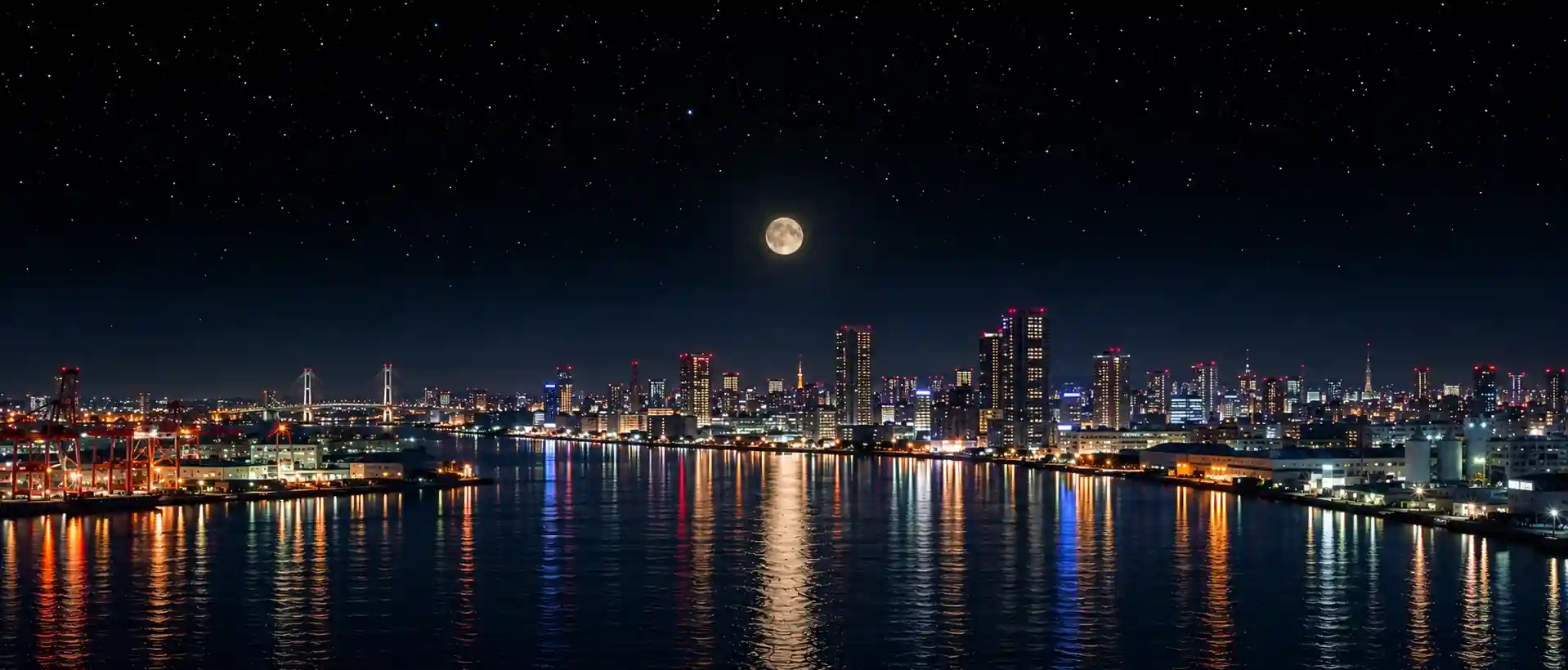
☽ Best Places to View the Moon in Kawasaki, Japan
Kawasaki sits at roughly 35.52°N between Tokyo and Yokohama on Tokyo Bay, with around 1.57 million residents. Its waterfront is dominated by one of Japan's largest industrial areas, and the city became one of the country's best-known centres of "factory night view" tourism (kōjō yakei), with organized tours developing from experimental sightseeing programs in the late 2000s. Between that, a historic temple, and a hillside park with its own planetarium, Kawasaki gives an unusually varied set of things to look at once the sun goes down.
Kawasaki Marien & the Keihin Industrial Night View
A waterfront community facility at the centre of Kawasaki's port area, with a 10th-floor observation room 51 metres above ground and a 360-degree panorama over Kawasaki Port and Tokyo Bay. Its night view has been recognized as a Japan Night View Heritage, while organized cruises offer a much closer look at the illuminated industrial waterfront. Admission is free, with the observation room open daily except for New Year and occasional closures.
Ikuta Ryokuchi Park
Kawasaki's largest general park, in the hilly Tama-ku ward, with an observation platform atop Mount Masugata, a rose garden, a firefly-inhabited wetland, and the Kawasaki Municipal Science Museum, which includes a planetarium. It's one of the city's better options for combining a real outdoor viewpoint with a planetarium visit.
Kawasaki Daishi (Heiken-ji Temple) & Taishi Park
Founded in 1128, one of Kawasaki's oldest surviving religious landmarks and among Japan's most-visited temples, especially around New Year. Its adjoining park includes the Chinese-style Shin-yu-en garden. Some temple and garden facilities have their own operating hours rather than staying open all night.
Todoroki Ryokuchi Park
A large sports-focused park in Nakahara Ward, home to Todoroki Athletics Stadium and the Kawasaki City Museum. It's a general urban green space rather than a dedicated viewpoint, useful for an ordinary evening without travelling out to the hills.
Tama River Waterfront
The river forming Kawasaki's northern boundary with Tokyo, with paths along both banks. Nearby Kawasaki-juku was one of the post stations on the historic Tōkaidō route linking Edo and Kyoto; today the river itself gives an open, low-horizon view over the water in the middle of a heavily built-up stretch of the Kantō plain.
Lazona Kawasaki Plaza & Kawasaki Station
The shopping and entertainment complex directly connected to Kawasaki Station, easily the most convenient spot on this list. It won't give you a dark sky, but it's the simplest option for an ordinary night out with the moon somewhere overhead.
◉ Best Times for Moon Photography
📷 Quick Photography Tips
Kawasaki runs on Japan Standard Time (UTC+9) year-round — Japan does not observe daylight saving time, so the offset from UTC stays the same in every season.
For the moon phase in any other city worldwide, visit our Dynamic Moon Phase Calculator for instant lunar data tailored to wherever you are.
The moon phase today in Kawasaki, Japan is shown in detail above — complete with exact illumination percentage, moonrise/set times, and the best viewpoints to see it. For the moon phase today in any other city or location worldwide, visit our Dynamic Moon Phase Calculator on the home page.
◐ While Actually There
Kawasaki doesn't try to hide what it is. Rather than dress up its industrial waterfront or push it out of sight, the city leaned into it — organized factory-night-view tours grew here out of experimental sightseeing programs in the late 2000s, and there are now regular cruises and bus tours built entirely around looking at oil refineries and power plants lit up after dark. Watching the moon rise over that landscape from Kawasaki Marien's observation room is a specifically Kawasaki experience, closer to an industrial skyline than anything natural.
Move inland and the city changes register almost completely. Ikuta Ryokuchi Park, in the hills to the west, has its own planetarium alongside a real observation point and a firefly-inhabited wetland — a rare combination of looking at a projected sky and the actual one within the same afternoon. Kawasaki Daishi, meanwhile, gives the city one of its oldest surviving religious landmarks, sitting quietly a short walk from the Tama River.
None of it asks much of you beyond checking a few schedules — the temple grounds, the planetarium, and any Marien cruise all keep their own hours, while the river, the station area, and Todoroki Ryokuchi Park stay accessible for an ordinary evening without much planning.
"Kawasaki didn't hide its factories — it built a whole way of watching them after dark, and the moon just happens to rise over the same skyline."
✓ Your Kawasaki Moon Chase Checklist
Before You Go
- Check the moonrise time and phase on this page for each night of your stay
- Check current schedules for Kawasaki Marien's observation room and any factory night view cruise if you want to combine one with your visit
- Check Ikuta Ryokuchi's planetarium showtimes if you want to see a show before heading out to the observation point
- Check Kawasaki Daishi and Taishi Park's current opening hours, since some facilities don't stay open all night
- Check the forecast for typhoon activity if visiting in late summer or early autumn
What to Bring
- A light jacket for winter evenings — generally mild rather than severely cold, though a warm layer is still worth having
- A tripod, useful at open spots like the Tama River
- Comfortable shoes for the paths and climb to Ikuta Ryokuchi's Mount Masugata observation platform
- A light rain layer, especially during the June rainy season
- Spare camera batteries and a lens cloth for humid summer evenings
On the Night
- Arrive 20–30 minutes before moonrise at open spots such as the Tama River; for Kawasaki Marien, allow enough time to arrive before its admission cutoff
- Confirm cruise departure times in advance if you want to see the factory night view from the water rather than the observation room
- Shoot RAW and bracket exposures, especially where industrial lighting or the temple mix with moonlight
- Mind wind at exposed waterfront spots, particularly around the Tama River
- Watch for typhoon-related weather changes if visiting between summer and early autumn
? Kawasaki Moon Phase — Frequently Asked Questions
Q. What is the moon phase today in Kawasaki?
The moon phase today in Kawasaki is a New Moon with 0% illumination. The next full moon is in 17 days, on Oct 26. Moonrise is at 5:08 AM and moonset at 4:51 PM.
Q. Where is the best place to view the moon in Kawasaki?
Kawasaki Marien, a waterfront facility at the centre of the port area, has a 10th-floor observation room 51 metres above ground with a 360-degree panorama over Kawasaki Port and Tokyo Bay, and admission is free. Ikuta Ryokuchi Park in the hilly Tama-ku ward has an observation platform atop Mount Masugata, a rose garden and the Kawasaki Municipal Science Museum with its planetarium. The Tama River waterfront gives an open, low-horizon view over the water, Kawasaki Daishi and Taishi Park offer a historic temple setting, and Todoroki Ryokuchi Park and Lazona Kawasaki Plaza at the station are easy options for an ordinary evening.
Q. Where does the moon rise and set in Kawasaki, and how high does it climb?
At about 35°N, Kawasaki's moon rises between roughly northeast and southeast and sets between roughly northwest and southwest over each month, depending on its declination. A winter full moon culminates high, at roughly 80° above the southern horizon, while a summer full moon stays low, peaking at about 25–30°. The port waterfront looks out over Tokyo Bay, so the moon can rise over the illuminated industrial skyline as seen from Kawasaki Marien, and where it lines up with chimneys, tanks or the river depends on the date and your viewpoint.
Q. Can I photograph the moon over Kawasaki's factory night view?
Yes, Kawasaki became one of Japan's best-known centres of factory night view tourism, and Kawasaki Marien's night view has been recognised as a Japan Night View Heritage. The moon over the illuminated Keihin Industrial Area's chimneys and tanks makes a distinctly Kawasaki composition, and organised cruises offer a closer look at the waterfront from the water. Industrial lighting mixes with moonlight, so shoot RAW and bracket exposures, and allow enough time to arrive before Kawasaki Marien's admission cutoff.
Q. Can I see a planetarium show in Kawasaki?
Yes. The Kawasaki Municipal Science Museum in Ikuta Ryokuchi Park includes a planetarium, and the park also has a real observation platform atop Mount Masugata, so you can see a projected sky and the actual one in the same visit. The planetarium runs on its own showtime schedule rather than staying open late, so check current times before planning an evening around it.
Q. What camera settings work best for moon photography in Kawasaki, and how do humid summers and typhoons affect it?
For a bright full moon, start with the Looney 11 rule (f/11, ISO 100, 1/100 s) and adjust from your histogram. A tripod helps at open, exposed spots such as the Tama River, which catches more wind off the water than the streets around the station. Summer evenings are warm and humid, with a rainy season in June and typhoon risk from summer into early autumn, so carry a lens cloth and let gear acclimate before shooting if you have come from an air-conditioned space. Winters are generally mild, with freezing uncommon but possible on cold nights.
Q. Can I photograph the moon in Kawasaki after dark?
Access varies by site. Kawasaki Marien's observation room is open daily except for New Year and occasional closures, with an admission cutoff. Factory night view cruises and the Ikuta Ryokuchi planetarium run on their own operating schedules, which can change seasonally, and Kawasaki Daishi and Taishi Park have facilities with their own hours rather than staying open all night. The Tama River waterfront, the station area and Todoroki Ryokuchi Park are more straightforward for an ordinary evening.
✦ Explore Further
Moon Phase Today: Tokyo
Check tonight's moon phase in Tokyo, just north of Kawasaki across the Tama River.
⚓Moon Phase Today: Yokohama
See the moon over Yokohama, just south of Kawasaki on Tokyo Bay.
🇯🇵Moon Phase in Japan
Browse moon phase pages for cities across Japan, from Sapporo to Kagoshima.
🌍World Moon Phase Directory
Find the moon phase, rise and set times for cities in every region of the world.
NASA Moon Phase & Libration Gallery
NASA's Scientific Visualization Studio's daily renders of the moon's exact phase, libration, and orientation, straight from official mission data.