
Moon Phase Florence
On Saturday, October 10, 2026, the moon in Florence is a New Moon with 0% illumination. Moon age: 29.0 days.
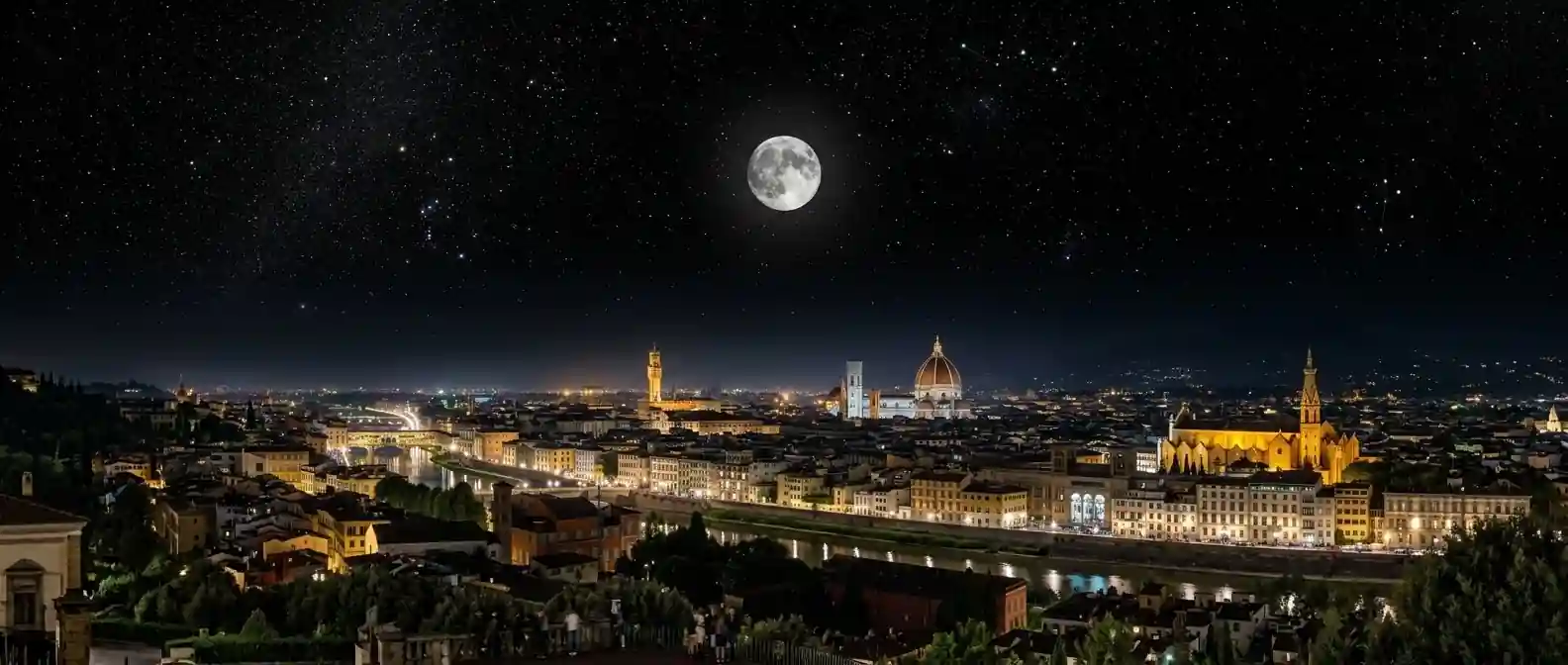
☽ Best Places to View the Moon in Florence, Italy
Florence lies in Tuscany along the Arno River, with the historic centre on the plain and hills rising to the south and north toward Fiesole.
Piazzale Michelangelo – Famous Panoramic Terrace
The city's famous panoramic terrace on a hill south of the Arno with broad views over Duomo and Ponte Vecchio. Designed as part of 19th-century urban renewal. Public square with no regular opening hours currently listed — check current notices.
San Miniato al Monte – Highest Panoramic Basilica
Described as one of the highest and most panoramic places in Florence, above Piazzale Michelangelo. Hilltop basilica with panorama over Duomo, Arno and Fiesole hills. Church interior Mon–Sat 09:30–13:00 and 15:00–18:00, Sun 15:00–17:30 — exterior terrace separate from interior hours.
Forte di Belvedere – Fortress Viewpoint
Fortress offering spectacular views south of the centre. Seasonal ticketed access, currently Tue–Sun 10:00–20:00 closed Monday during June–October opening period. Not normally a late-night viewpoint — check current schedule.
Fiesole – Hill Town Overlooking Florence
Separate municipality north of Florence directly overlooking the city and Arno valley. Viewpoints include Villa Medici a Fiesole and Badia Fiesolana among the 18 official panoramic viewpoints. Provides higher elevation views toward the city — identify as outside municipal boundary.
Parco delle Cascine – Large Park West Along Arno
Large park west of the historic centre along the Arno River with open parkland and river corridor horizons. Urban park with substantial artificial lighting. Check current park notices for any restrictions.
Giardino delle Rose & Bardini – Terraced Gardens
Terraced gardens near Piazzale Michelangelo with elevated foregrounds over Duomo and historic centre. Rose Garden open year-round with seasonal daily hours, typically 09:00–17:00 winter to 09:00–20:00 May–September. Bardini has seasonal hours and ticketing — check current hours before visiting.
◉ Best Times for Moon Photography in Florence
📷 Quick Tips for Florence
🕐 Timezone
Central European Time — CET UTC+1, CEST UTC+2 during daylight-saving. Europe/Rome.
📍 Geography Note
Florence lies along the Arno River with hills to the south and north. The historic centre sits on the plain, with higher terrain toward Piazzale Michelangelo, San Miniato and Fiesole.
The city's official list of 18 panoramic viewpoints includes Piazzale Michelangelo and San Miniato al Monte, plus Villa Medici a Fiesole and Badia Fiesolana in Fiesole. Forte di Belvedere is described as offering spectacular views but is not on that specific 18-viewpoint list.
All locations are urban and light-polluted, useful for Moon-over-city rather than dark-sky observing. For moonrise direction, check azimuth for your particular date.
◐ What It Feels Like
At Piazzale Michelangelo, the famous terrace south of the Arno provides broad views with Duomo and Ponte Vecchio at your feet.
At San Miniato al Monte, one of the highest places in the city offers a panorama over Duomo, Arno and the Fiesole hills beyond.
At Forte di Belvedere and Fiesole, a fortress viewpoint and a separate hill town provide elevated perspectives south and north of the historic centre.
"Famous panoramic terrace south of the Arno, one of the highest places above it, and a fortress and hill town for additional elevated perspectives."
✓ Checklist for Lunar Observers
Before You Go
- Check moonrise and moonset azimuth — use exact location to determine alignment with Duomo or hill foregrounds
- Check forecasts for cloud, haze and humidity over the Arno valley
- Confirm access — Piazzale is a public square with no regular hours listed, San Miniato interior has limited hours with exterior separate, Belvedere seasonal Tue–Sun, Rose and Bardini have seasonal daily hours
What to Bring
- Telephoto and wide lenses for hill and Duomo foregrounds
- Tripod for landscape and bracketing — close Moon can be handheld, tripod useful for blue-hour compositions
- Lens cloth for dust, dew or condensation
- Light jacket for changing evening temperatures
On the Night
- Focus on Moon with magnified live view for lunar detail, adjust focus distance for composed landscapes
- Bracket for disc versus foreground — difficult to retain both in single exposure
- Stay on designated paths and observe posted access rules, especially for churches and fortress with ticketing
? Florence Moon Phase — Frequently Asked Questions
Q. What is the moon phase today in Florence?
The moon phase today in Florence is a New Moon with 0% illumination. The next full moon is in 17 days, on Oct 26. Moonrise is at 7:13 AM and moonset at 6:23 PM.
Q. Where is the best place to view the moon in Florence?
Piazzale Michelangelo, the famous panoramic terrace on the hill south of the Arno, gives broad views over the Duomo and Ponte Vecchio, and San Miniato al Monte sits above it as one of the highest and most panoramic places in the city. Forte di Belvedere offers fortress views south of the centre, while Fiesole, a separate municipality north of Florence, overlooks the city and the Arno valley from higher ground, with Villa Medici a Fiesole and Badia Fiesolana among the city's official panoramic viewpoints. Giardino delle Rose and the Bardini gardens add terraced foregrounds near Piazzale Michelangelo, and Parco delle Cascine gives open parkland and river-corridor horizons to the west.
Q. Where does the moon rise and set in Florence, and how high does it climb?
At about 43.8°N, Florence's moonrise and moonset points swing across the horizon each month, from roughly northeast to southeast for rising and northwest to southwest for setting. A winter full moon culminates high in the south, at roughly 70° above the horizon, while a summer full moon stays low, peaking near 23°. The southern terraces at Piazzale Michelangelo and San Miniato face north over the city, so the moon appears over the Duomo side only when it is low in the northeast or northwest, mostly around a winter full moon, and at other times it is behind you. Viewpoints on the northern hills, including Fiesole, look south across the city and the Arno valley, which is where the moon's high southern path lies.
Q. Is light pollution a problem for moon observing in Florence?
The moon is bright enough to observe and photograph from almost anywhere in Florence, so light pollution rarely limits the lunar disc itself. It does wash out earthshine on a thin crescent and any faint sky detail. The historic centre, the hill terraces and Parco delle Cascine are all urban locations with substantial artificial lighting, so Florence is a light-polluted site rather than a dark-sky one, best suited to moon-over-city compositions.
Q. What camera settings and phases work best for moon photography in Florence?
For a full moon, start with Looney 11 (f/11, ISO 100, 1/100 s) and refine using your histogram, since it is a baseline rather than a guarantee. The moon is much brighter than the lit city, so shoot RAW and bracket or blend exposures to keep both crater detail and the Duomo and Arno foreground. A waxing gibbous is useful for blue hour at Piazzale Michelangelo and San Miniato while the foreground is still lit, and a full moon rises around sunset. A 200–400 mm lens helps isolate the moon against the Duomo and surrounding hills, with a tripod for bracketing and manual focus on the moon using magnified live view.
Q. How do haze and fog in the Arno valley affect moon viewing in Florence?
Florence lies along the Arno with hills to the north and south, and humidity, haze or low cloud in the valley can reduce sky transparency and soften lunar contrast, with conditions changing quickly. The hill terraces at Piazzale Michelangelo, San Miniato and Fiesole sit above the valley floor, so they can be a better choice when haze pools low, though not always. Check local forecasts for cloud, haze and visibility before heading out, and carry a lens cloth for dust, dew or condensation.
Q. Can I shoot the moon at Florence's viewpoints after dark?
Access varies by site. Piazzale Michelangelo is a public square with no regular opening hours currently listed, so check current notices. San Miniato al Monte's interior is open Monday to Saturday 09:30–13:00 and 15:00–18:00 and Sunday 15:00–17:30, and its exterior terrace is separate from the interior hours. Forte di Belvedere has seasonal ticketed access, currently Tuesday to Sunday 10:00–20:00 and closed Monday during the June to October opening period, so it is not normally a late-night viewpoint. Giardino delle Rose runs on seasonal daily hours, typically 09:00–17:00 in winter to 09:00–20:00 from May to September, and Bardini has seasonal hours and ticketing, so confirm current hours before visiting.
Q. Does this page work for cities besides Florence?
This page is set up specifically for Florence, Italy. For the moon phase in any other city or location worldwide, use the Dynamic Moon Phase Calculator on the moonphase.today home page.
✦ Explore Further
Moon Phase Today: Bologna
Check tonight's moon phase in Bologna, north of Florence across the Apennines.
🗼Moon Phase Today: Pisa
See the moon over Pisa, west of Florence along the Arno toward the Tuscan coast.
🇮🇹Moon Phase in Italy
Browse moon phase pages for cities across Italy, from Turin to Palermo.
🌍World Moon Phase Directory
Find the moon phase, rise and set times for cities in every region of the world.
Lunar Looney 11 Calculator
Turn the Looney 11 rule into exposure settings for full moon shots over the Duomo and the Arno valley.