
Moon Phase Chiba
On Saturday, October 10, 2026, the moon in Chiba is a New Moon with 0% illumination. Moon age: 29.0 days.
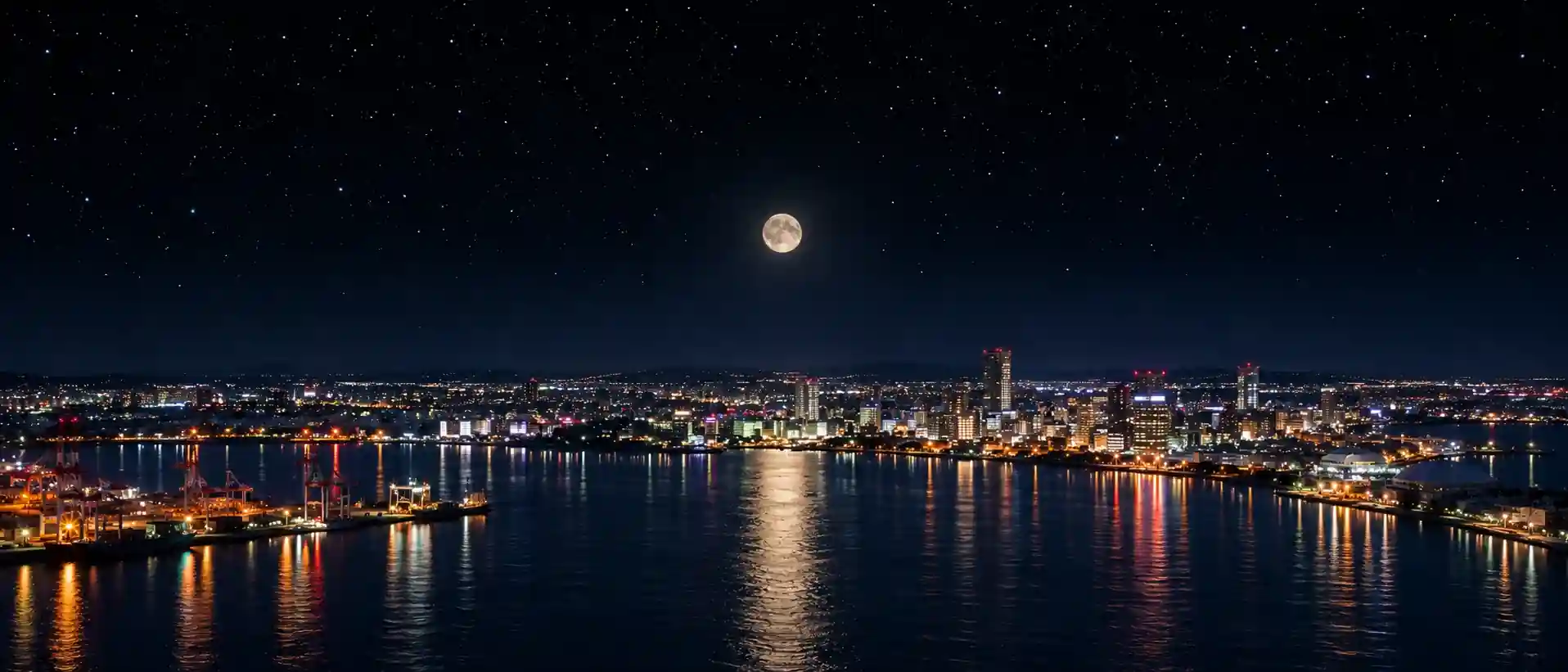
☽ Best Places to View the Moon in Chiba, Japan
Chiba sits at roughly 35.61°N on Tokyo Bay, about 40 kilometres east of central Tokyo, and is the capital of Chiba Prefecture with a population of around 1 million. One of the Kantō region's major port cities, it carries an unusually long human history for a modern commuter city — the Kasori Shell Mounds nearby are one of the world's largest shell-mound sites, left behind by a Jōmon-period community thousands of years ago. Between a lozenge-shaped port tower, a castle-style museum on a historic site, and Japan's first artificial beach, Chiba gives a mix of old and new settings for watching the moon over the bay.
Chiba Port Tower & Chiba Port Park
A slim, lozenge-shaped tower rising about 125 metres in Chiba Port Park, opened in June 1986 to commemorate Chiba Prefecture's population passing five million. Its observation floor gives panoramic views over Tokyo Bay, with Tokyo Skytree, the Tokyo Bay Aqua-Line, and Mount Fuji visible on clear days. Current summer hours run until 9pm, shortening in the colder months.
Chiba Castle (Inohana Castle Site)
A 1967 castle-style museum building standing on the historic Inohana site, traditionally associated with the Chiba clan. Chiba Tsuneshige is said to have moved his base to Chiba in 1126, but archaeological investigations haven't found a Kamakura-period castle or residence here; the strongest current theory places an actual castle on the site much later, in the late Muromachi period. The museum itself keeps daytime hours, closing at 17:00.
Kasori Shell Mounds
An archaeological site from the Jōmon period, one of the world's largest shell-mound sites, with a free museum on site. It's a striking reminder of just how long people have lived around this stretch of Tokyo Bay, though it's a daytime destination — the museum closes at 17:00.
Inage Beach & Seaside Park
Japan's first artificial beach, opened in 1976 as part of the redevelopment of Chiba's reclaimed coastline. Its open shoreline provides broad views across Tokyo Bay and a natural setting for watching the moon over the water.
Sengen Shrine & Pine Forest, Inage
A shrine set among the historic Inage Pine Forest, a Chiba City-designated scenic site. The public surroundings provide a quieter, more sheltered alternative to the open beach nearby, with the pines giving a distinctive silhouette against the sky.
Makuhari Messe & Waterfront
A major convention centre that opened its first facilities in October 1989, anchoring the modern Makuhari waterfront district of offices, hotels, and residential towers. It's a convenient urban option for an ordinary evening, with the moon rising somewhere over the district's newer skyline.
◉ Best Times for Moon Photography
📷 Quick Photography Tips
Chiba runs on Japan Standard Time (UTC+9) year-round — Japan does not observe daylight saving time, so the offset from UTC stays the same in every season.
For the moon phase in any other city worldwide, visit our Dynamic Moon Phase Calculator for instant lunar data tailored to wherever you are.
The moon phase today in Chiba, Japan is shown in detail above — complete with exact illumination percentage, moonrise/set times, and the best viewpoints to see it. For the moon phase today in any other city or location worldwide, visit our Dynamic Moon Phase Calculator on the home page.
◐ While Actually There
Chiba's history on this stretch of Tokyo Bay goes back much further than its modern commuter-city reputation suggests. The Kasori Shell Mounds were left by a Jōmon-period community that lived here thousands of years ago, gradually building up one of the world's largest shell-mound sites — a site created unintentionally through generations of everyday life, rather than any deliberate design.
Everything else in the city feels comparatively recent by contrast. The castle-style museum building at Inohana dates only to 1967, the Port Tower to 1986, and Makuhari Messe to 1989 — three very different eras of the same waterfront city, each adding its own layer. Inage Beach, meanwhile, gives you the simplest option of all: an artificial shoreline, Japan's first of its kind, doing the oldest job there is, putting you next to open water with a clear view of the sky.
None of it asks much of you beyond checking the Port Tower's seasonal hours. Inohana Park, Inage Beach, and the public surroundings of Sengen Shrine can work as straightforward evening stops, while Kasori's museum is a daytime visit.
"Chiba's oldest monument wasn't built on purpose — it's a shell mound left behind by thousands of years of ordinary meals, sitting quietly beside a modern port tower doing the same job today."
✓ Your Chiba Moon Chase Checklist
Before You Go
- Check the moonrise time and phase on this page for each night of your stay
- Check current seasonal opening hours for Chiba Port Tower before planning a visit around moonrise
- Check current opening hours for the Kasori Shell Mounds museum if you want to go inside rather than just view the site
- Check current opening hours for the Chiba Castle museum if you want to see inside, not just the park grounds
- Check the forecast for typhoon activity if visiting in late summer or early autumn
What to Bring
- A warm layer for winter evenings — generally mild rather than severely cold, but still worth planning for
- A tripod, useful at open spots like Inage Beach and Chiba Port Park
- Comfortable shoes for the walk through Kasori's site and Sengen Shrine's pine forest
- A light rain layer, especially during the June rainy season
- Spare camera batteries and a lens cloth for humid summer evenings
On the Night
- Arrive 20–30 minutes before moonrise at open spots like Inage Beach or Chiba Port Park
- Shoot RAW and bracket exposures, especially where the Port Tower or Makuhari's lit skyline mix with moonlight
- Mind wind at exposed coastal spots, particularly along Inage Beach
- Keep to marked paths around Kasori's protected archaeological site
- Watch for typhoon-related weather changes if visiting between summer and early autumn
? Chiba Moon Phase — Frequently Asked Questions
Q. What is the moon phase today in Chiba?
The moon phase today in Chiba is a New Moon with 0% illumination. The next full moon is in 17 days, on Oct 26. Moonrise is at 5:07 AM and moonset at 4:49 PM.
Q. Where is the best place to view the moon in Chiba?
Chiba Port Tower, about 125 metres tall in Chiba Port Park, gives the highest panorama over Tokyo Bay, with Tokyo Skytree, the Tokyo Bay Aqua-Line and Mount Fuji visible on clear days, but only during its observation hours. Inage Beach and Seaside Park, Japan's first artificial beach, give an open shoreline and broad views across the bay for watching the moon over the water. The pine forest around Sengen Shrine in Inage offers a sheltered alternative with pine silhouettes against the sky, and Makuhari Messe and the waterfront give a modern urban option. The Chiba Castle museum and the Kasori Shell Mounds keep daytime hours.
Q. Where does the moon rise and set in Chiba, and how high does it climb?
At about 35.6°N, Chiba's moonrise and moonset points swing across the horizon each month, from roughly east-northeast to east-southeast for rising and west-northwest to west-southwest for setting. A winter full moon culminates high in the south, at roughly 78° above the horizon, while a summer full moon stays lower, peaking near 31°. Chiba sits on the eastern shore of Tokyo Bay, so the bay lies in the direction of moonset: from Inage Beach or the Port Tower a setting moon can drop over the water, while a rising moon comes up over the city and the land to the east. Mount Fuji lies west-southwest across the bay, roughly where a full moon sets in spring and late summer, so on some evenings a setting moon can pass near it when visibility allows. Check the azimuth for your date and exact spot.
Q. Is light pollution a problem for moon observing in Chiba?
The moon is bright enough to observe and photograph from almost anywhere in Chiba, so light pollution rarely limits the lunar disc itself. It does wash out earthshine on a thin crescent and any faint sky detail. Chiba is part of the Tokyo metropolitan area, and the lit Port Tower, the Makuhari waterfront skyline and the reclaimed coastline all carry substantial artificial lighting, so it is a light-polluted site rather than a dark-sky one. An open beach gives a clean low horizon, but the bay-wide glow still washes out faint detail.
Q. What camera settings and phases work best for moon photography in Chiba?
For a full moon, start with Looney 11 (f/11, ISO 100, 1/100 s) and refine using your histogram, since it is a baseline rather than a guarantee. The moon is much brighter than the lit Port Tower and waterfront, so shoot RAW and bracket or blend exposures to keep both crater detail and the foreground. A waxing crescent or gibbous moon suits an evening moonset over Tokyo Bay from Inage Beach, and a full moon rises around sunset over the city. A 200–400 mm lens helps isolate the moon against the Port Tower or the pines, with a tripod for bracketing and manual focus on the moon using magnified live view.
Q. How do the rainy season, typhoons and bay wind affect moon viewing in Chiba?
Chiba has warm, humid summers with a rainy season in June and typhoon risk from summer into early autumn, so clear lunar windows can be short and weather can change quickly. Humidity can leave condensation on lenses, especially if your gear comes from an air-conditioned space. Open spots like Inage Beach and Chiba Port Park are more exposed to wind off the bay than the streets of the centre, which can shake a tripod and put sea air on your gear. Winters are generally cool and drier, with freezing temperatures possible on colder nights. Check local forecasts for cloud, wind, rain and typhoon activity before heading out.
Q. What time zone are Chiba's moonrise and moonset times shown in?
Chiba runs on Japan Standard Time, UTC+9, year-round. Japan does not observe daylight saving time, so moonrise and moonset times stay on the same local clock in every season and the offset from UTC never changes.
Q. Can I shoot the moon at Chiba's viewpoints after dark?
Access varies by site. Chiba Port Tower keeps seasonal hours, with summer hours running until 9pm and shorter hours in the colder months, so check current times before planning a visit around moonrise. The Chiba Castle museum and the Kasori Shell Mounds museum both close at 17:00, so they are daytime stops, and you should keep to marked paths around Kasori's protected archaeological site. Inage Beach, the public surroundings of Sengen Shrine and the Makuhari waterfront are open urban spaces, though wind can be strong on the beach.
Q. Does this page work for cities besides Chiba?
This page is set up specifically for Chiba, Japan. For the moon phase in any other city or location worldwide, use the Dynamic Moon Phase Calculator on the moonphase.today home page.
✦ Explore Further
Moon Phase Today: Tokyo
Check tonight's moon phase in Tokyo, about 40 kilometres west of Chiba.
⚓Moon Phase Today: Yokohama
See the moon over Yokohama, across Tokyo Bay from Chiba.
🇯🇵Moon Phase in Japan
Browse moon phase pages for cities across Japan, from Sapporo to Kagoshima.
🌍World Moon Phase Directory
Find the moon phase, rise and set times for cities in every region of the world.
ISS Tracker
Track the International Space Station for bright evening passes over Tokyo Bay.