

James Webb Space Telescope: The Complete Guide
Everything worth knowing about NASA’s largest and most powerful space observatory — how it works, what it has found, and how it compares to the telescope it succeeded.
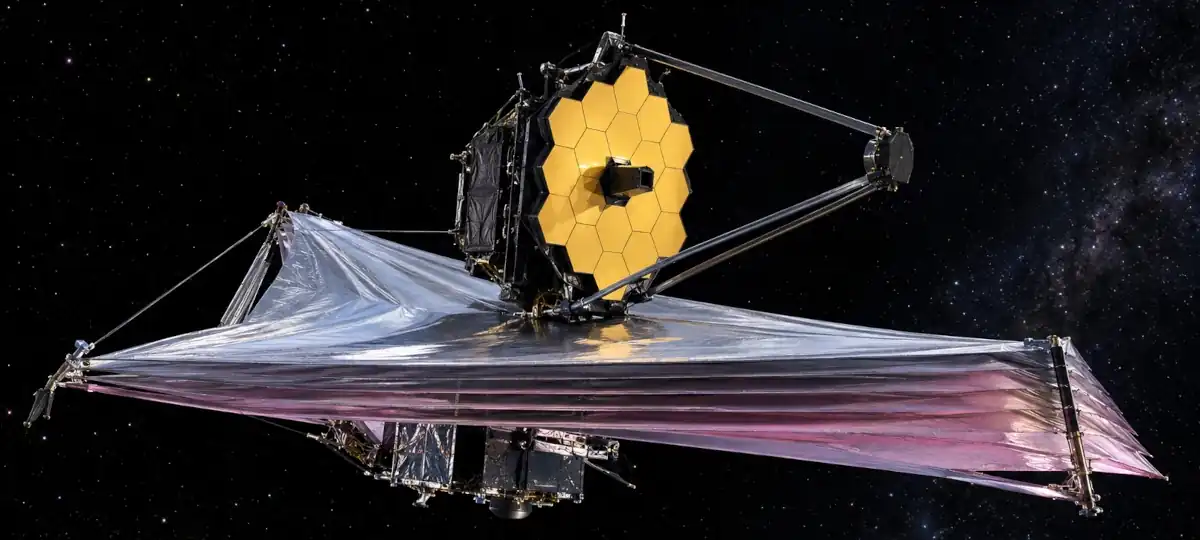
The James Webb Space Telescope (JWST) is the largest and most powerful space telescope ever deployed. NASA launched it on December 25, 2021, and it now operates roughly 1.5 million kilometers from Earth. JWST observes the universe mainly in infrared light, which lets astronomers see galaxies as they existed less than 300 million years after the Big Bang. It also lets them measure the chemical makeup of distant exoplanet atmospheres, and capture infrared views of Solar System bodies that are hard or impossible to see at visible wavelengths. This guide covers the telescope’s specifications, engineering, instruments, funding history, timeline, biggest discoveries, and how it stacks up against the Hubble Space Telescope.
Vital Statistics
Program History and Cost
JWST’s path to launch was one of the longest and most expensive in the history of space science. The mission began in 1996 under the name “Next Generation Space Telescope.” Planners set an initial cost estimate of roughly $500 million and a target launch year of 2007. Neither held.
From Concept to Contractor (1996–2002)
By 2002, NASA had renamed the project after former administrator James E. Webb. It had also grown to an estimated $1–3.5 billion once Northrop Grumman won the prime contractor role.
Rising Costs and Repeated Delays (2010–2018)
A 2010 independent review found the program’s budgeting flawed from the outset. As a result, the estimate rose to $6.5 billion, with a new 2015 launch target. Then, technical setbacks with sunshield testing and mechanical issues pushed the number higher still. In 2018, Congress stepped in and imposed a hard development cost cap of $8 billion, requiring formal reauthorization.
The Final Price Tag
NASA’s 2018 revised estimate set Webb’s development cost at $8.8 billion. Including launch and the first five years of science operations, the total lifecycle cost came to $9.66 billion — about nineteen times the original 1996 estimate and fourteen years later than first projected. At its peak, JWST consumed about a third of NASA’s entire astrophysics budget. Even so, it never topped roughly 3% of the agency’s total annual budget in any single year.
Why Infrared — and Why L2
Unlike Hubble, which observes mostly in visible and ultraviolet light, JWST is built for infrared astronomy. It covers wavelengths from visible red light at about 0.6 microns through the mid-infrared at about 28.5 microns. That choice solves two problems. First, the most distant galaxies are so redshifted by cosmic expansion that their light — originally visible or even ultraviolet — stretches into infrared by the time it reaches us. A telescope that can’t see infrared simply can’t see the earliest galaxies at all. Second, infrared light passes through clouds of dust and gas that block visible light. This lets JWST peer into stellar nurseries and dusty galactic cores that stay hidden from Hubble.
Infrared observation creates a new problem, though: heat. Any warm object, including the telescope itself, glows in infrared and would drown out the faint signals JWST is hunting for. That’s why JWST doesn’t orbit Earth the way Hubble does. Instead, it sits at the second Sun–Earth Lagrange point (L2), a gravitationally stable spot about 1.5 million kilometers from Earth on the side facing away from the Sun. From there, a tennis-court-sized, five-layer sunshield passively cools the telescope. The coldest instrument, MIRI, runs at about 7 Kelvin (-266°C/-447°F), while the other three instruments sit around 40 Kelvin (-233°C/-387°F). Meanwhile, the sun-facing side of the spacecraft can reach over 85°C (185°F) — a difference of roughly 300°C across five extremely thin membrane layers.
Instruments
JWST carries four scientific instruments, each built through international partnerships involving NASA, ESA, and CSA, and each specialized for a different part of the infrared spectrum.
NIRCam (Near-Infrared Camera)
NIRCam is JWST’s primary imager. It captured most of the telescope’s iconic deep-field and nebula images, and it also handles wavefront sensing — the process that helped align the telescope’s 18 mirror segments after launch. NIRCam observes across 0.6–5 microns using Teledyne HgCdTe (mercury-cadmium-telluride) detector arrays. It also includes coronagraphs, which block a star’s light so astronomers can directly image faint companions and nearby circumstellar material, including some exoplanet systems.
NIRSpec (Near-Infrared Spectrograph)
NIRSpec splits incoming light into spectra to identify chemical composition. It covers 0.6–5.3 microns at three resolving powers (R=100, 1000, and 2700). Its signature feature is the microshutter array: a grid of 248,000 individually controllable microshutters, and the first programmable multi-object slit mask ever flown in space. This array captures spectra from over 100 objects at once, which is a major reason JWST can survey large samples of distant galaxies efficiently rather than one at a time. NIRSpec also offers a smaller integral field unit for spatially resolved spectroscopy of single objects, plus five fixed slits as a single-object fallback mode.
MIRI (Mid-Infrared Instrument)
MIRI observes the longest wavelengths JWST can detect, roughly 5–28 microns, and it’s the coldest instrument aboard. Its detectors need to run colder than the sunshield alone can manage, so a dedicated mechanical cryocooler chills them to about 7 Kelvin. MIRI uses arsenic-doped silicon detectors, unlike the mercury-cadmium-telluride arrays elsewhere on the telescope. Astronomers also use its coronagraph mode for direct imaging of exoplanets, plus detailed structure in dust disks and distant galaxies too cool to show up well in near-infrared light.
FGS/NIRISS (Fine Guidance Sensor / Near-Infrared Imager and Slitless Spectrograph)
The Fine Guidance Sensor keeps the telescope locked onto its target with the precision needed for multi-hour exposures. NIRISS, built by the Canadian Space Agency, adds slitless spectroscopy and aperture-masking interferometry, and is frequently used for transiting exoplanet observations and for detecting faint companions close to bright stars.
Mirror and Sunshield Engineering
The Primary Mirror
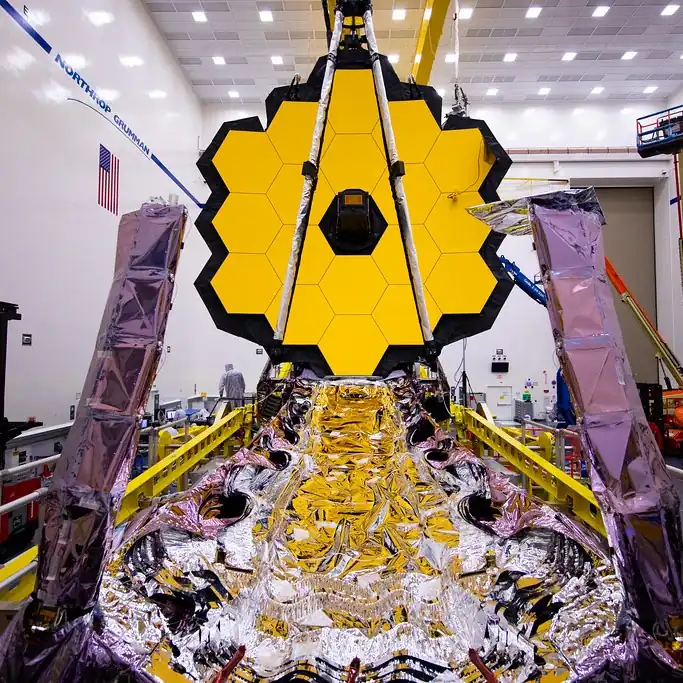
JWST’s primary mirror consists of 18 hexagonal beryllium segments. Engineers picked beryllium for its light weight and dimensional stability at extreme cold. Each segment carries a microscopically thin layer of gold to maximize infrared reflectivity. The segments folded up to fit inside the Ariane 5 rocket fairing, then unfolded in space. After that, tiny motorized actuators behind each segment aligned them to a precision of nanometers — a process that took several months after launch.
The Sunshield
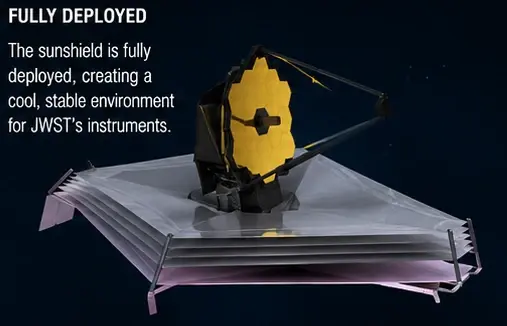
The sunshield uses five layers of a specialized polymer film, each thinner than a human hair. Vacuum gaps separate the layers, letting heat radiate away instead of conducting through. Fully deployed, it spans roughly the size of a tennis court. Ninety cables totaling about 400 meters hold it taut, along with 70 hinge assemblies, 8 motors, and around 400 pulleys.
Built With No Room for Error
What made the deployment genuinely nerve-wracking for the mission team was the sheer number of things that had to work correctly with zero chance of a repair. At launch, JWST carried 344 identified single-point failures — individual components or steps where one malfunction could have ended the mission outright. Roughly 80% of them were tied to the two-week deployment sequence. Unlike Hubble, which orbits close enough to Earth that Space Shuttle astronauts serviced it five times, JWST sits far beyond the reach of any current crewed spacecraft. In other words, there was no way to send anyone to fix a stuck latch or a torn shield. The riskiest single milestone was sunshield tensioning, which alone involved 139 of Webb’s 178 total release mechanisms; it completed successfully on January 4, 2022, ten days after launch. By the end of commissioning, engineers had retired nearly all of the original 344 single-point failures. A 2022 in-flight performance review found only 49 remained, most of them ordinary single-string components common to any mission, such as a single high-gain antenna.
“Cosmic Dawn: The Untold Story of the James Webb Space Telescope” — NASA’s full-length documentary on Webb’s development, testing, and launch
Timeline
| Date | Milestone |
|---|---|
| 1996 | Mission concept originates as the “Next Generation Space Telescope,” estimated at $500 million |
| 2002 | Renamed the James Webb Space Telescope; Northrop Grumman selected as prime contractor |
| 2010 | Independent review finds budgeting fundamentally flawed; cost estimate rises to $6.5 billion |
| 2018 | Congress imposes an $8 billion development cost cap; final cost later set at $9.66 billion |
| Dec 25, 2021 | Launch from Kourou, French Guiana aboard an Ariane 5 rocket |
| Jan 4, 2022 | Sunshield fully deployed and tensioned |
| Jan 24, 2022 | Arrives at L2 and enters its halo orbit |
| Jul 12, 2022 | First full-color science images released; enters science operations |
| 2023–present | Ongoing science operations, including repeated record-breaking galaxy detections and exoplanet atmosphere studies |
Landmark Discoveries
The most distant confirmed galaxies
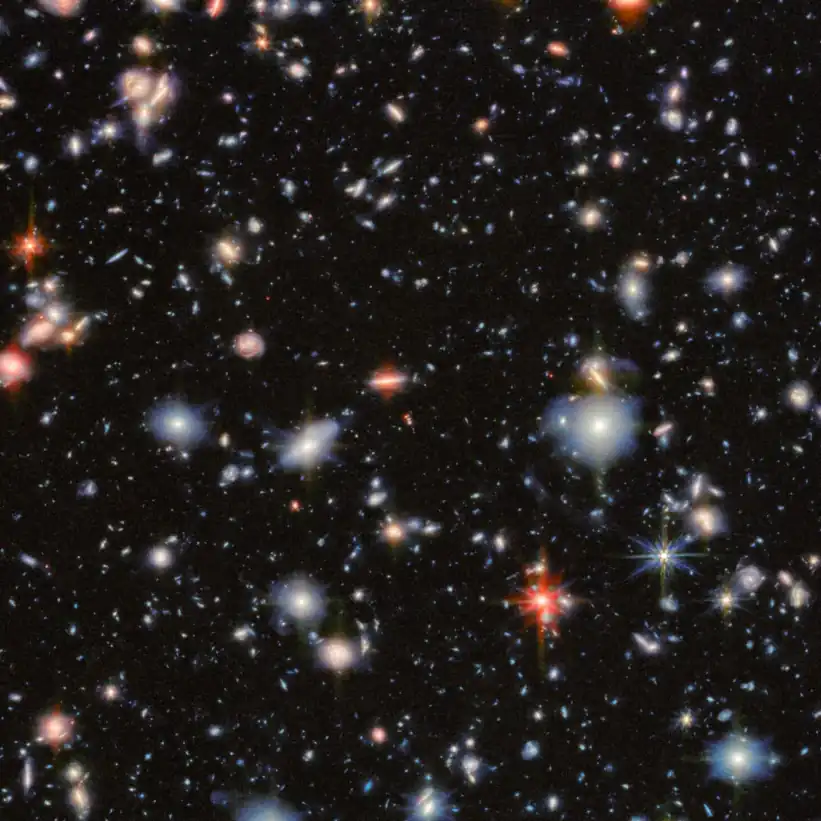
JWST has repeatedly broken the record for the most distant confirmed galaxy. The current record holder, MoM-z14, has a spectroscopically confirmed redshift of 14.44, corresponding to a galaxy seen as it existed roughly 280 million years after the Big Bang — about 2% of the universe’s present age. It was first imaged with NIRCam in May 2025 as part of the “Mirage or Miracle” survey in the COSMOS Legacy Field and confirmed via NIRSpec spectroscopy, and it surpassed the previous record holder, JADES-GS-z14-0 (redshift 14.32), which itself had come from the JWST Advanced Deep Extragalactic Survey (JADES) and displaced Hubble’s former record-holder, GN-z11.
Carbon dioxide in an exoplanet atmosphere
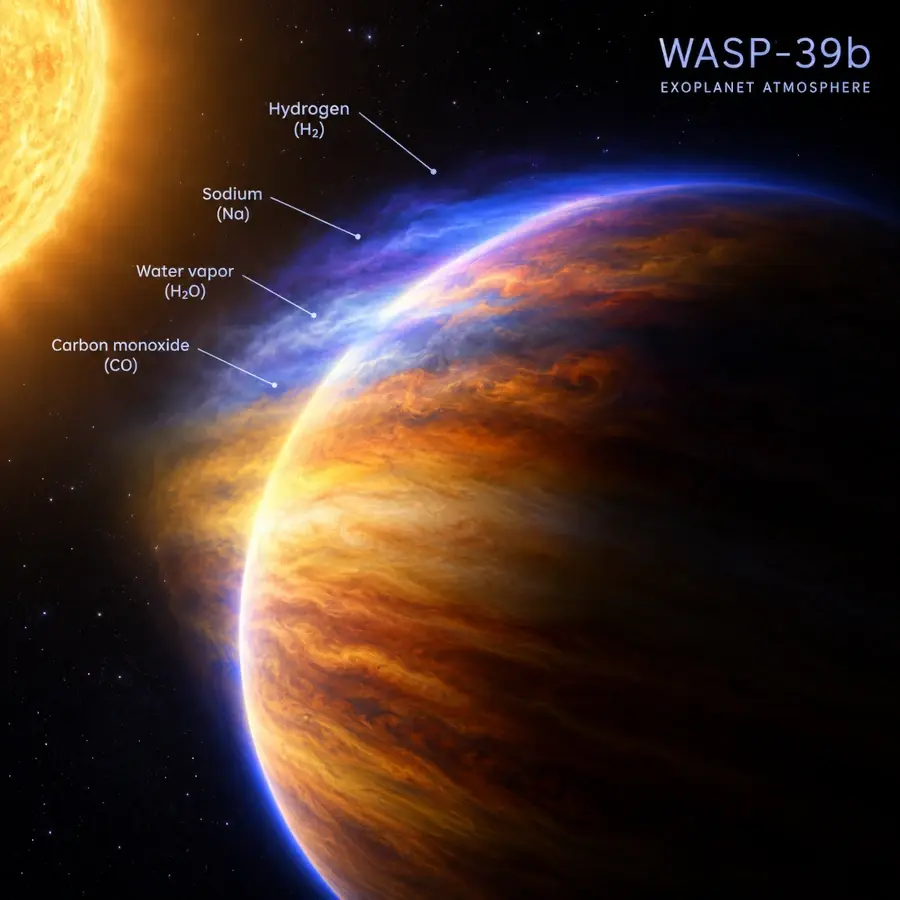
In August 2022, JWST’s NIRSpec instrument delivered the first unequivocal detection of carbon dioxide in the atmosphere of a planet outside our Solar System: WASP-39b, a hot, puffy “hot Jupiter” orbiting a Sun-like star about 700 light-years away. Follow-up observations across multiple JWST instruments later identified water, sodium, potassium, carbon monoxide, and sulfur dioxide in the same atmosphere — the sulfur dioxide detection was itself notable as the first confirmed photochemical byproduct (a molecule created by starlight-driven chemical reactions) ever found on an exoplanet. Beyond WASP-39b, JWST has continued characterizing atmospheres on other worlds, including K2-18b, one of the more debated potentially habitable-zone exoplanet targets.
An early, rapidly feeding black hole
In 2024, astronomers using JWST’s NIRSpec instrument identified a supermassive black hole at the center of the galaxy GN-z11, dating to roughly 400 million years after the Big Bang — at the time, the earliest black hole yet confirmed. At an estimated 6 million solar masses, it appeared to be feeding on surrounding gas at roughly five times the theoretical Eddington limit, a rate that challenges standard models of how such massive black holes could form so early. Since then, JWST surveys have turned up other early, actively accreting candidates — including one linked to the galaxy GHZ2, dated to around 350 million years after the Big Bang — though as of this writing those candidates remain preliminary and not yet as firmly confirmed as the GN-z11 result, so which object holds the actual “earliest” title is still an open question. For background on how astronomers classify and measure objects like this, see our guides on black hole size and what a quasar actually is.
Interstellar object observations
JWST has also turned its instruments on rare interstellar visitors passing through our Solar System. In August 2025, its NIRSpec instrument made the first spatially resolved detection of gas and ice around interstellar comet 3I/ATLAS, finding a coma dominated by carbon dioxide relative to water — a mixing ratio well outside the range seen in Solar System comets — alongside carbon monoxide, water ice, and other volatiles. A follow-up observation in December 2025, after the comet’s closest pass by the Sun, gave astronomers their first mid-infrared chemical fingerprint of any interstellar object, reinforcing that 3I/ATLAS likely formed under very different conditions than the comets native to our own Solar System. See our 3I/ATLAS viewing guide for more on the object’s path and viewing windows.
Solar System imaging
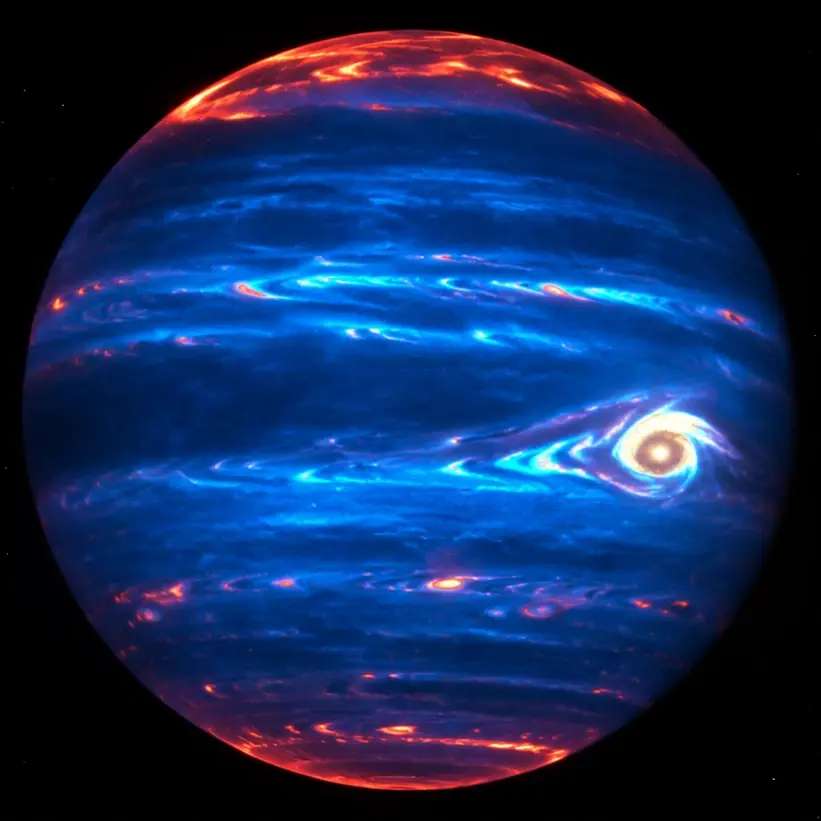
Beyond deep-space targets, JWST has captured detailed infrared images of Saturn’s rings, faint dust bands around the planet not previously visible, and Neptune’s ring system — work that complements, rather than replaces, dedicated planetary probes.
James Webb Space Telescope vs Hubble
JWST is often described as Hubble’s successor, but the two telescopes are designed to complement rather than replace each other — Hubble remains active and continues to make observations in wavelengths JWST doesn’t cover.
| Feature | James Webb Space Telescope | Hubble Space Telescope |
|---|---|---|
| Launch year | 2021 | 1990 |
| Mirror diameter | 6.5 m | 2.4 m |
| Primary wavelengths | Infrared | Visible, ultraviolet, some near-infrared |
| Orbit | Sun–Earth L2 (~1.5 million km away) | Low Earth orbit (~540 km altitude) |
| Serviceable by astronauts | No | Yes (5 servicing missions, last in 2009) |
| Light-collecting area | ~25 m² | ~4.5 m² |
| Total mission cost | ~$10 billion (development + launch + first 5 years of operations) | ~$16 billion in 2021 dollars since 1977 — NASA notes this excludes Space Shuttle deployment/servicing costs |
| Best suited for | Earliest galaxies, dust-obscured regions, exoplanet atmospheres | Visible-light imaging, ultraviolet studies, well-established long-term monitoring |
| Expected lifespan | 20+ years (fuel-limited) | 30+ years and counting |
Common Misconceptions
“JWST replaces Hubble”
Both telescopes are currently operating. They observe different wavelengths and are used for different, often complementary, purposes — many major discoveries combine data from both.
“JWST orbits Earth like Hubble does”
JWST orbits the Sun, not Earth, at the L2 Lagrange point roughly four times farther away than the Moon. Hubble orbits Earth directly at low altitude.
“JWST can see the Big Bang itself”
JWST sees some of the earliest galaxies to have formed, several hundred million years after the Big Bang — an extraordinary feat, but not a direct observation of the Big Bang itself, which no telescope can image.
Data Access and International Partnership
JWST is a joint mission between NASA, the European Space Agency (ESA), and the Canadian Space Agency (CSA), operated day-to-day by the Space Telescope Science Institute (STScI) in Baltimore. Observing time is awarded competitively through annual proposal cycles. Most General Observer proposals carry a baseline exclusive access period of up to 12 months, giving the proposing team time to analyze their data before it becomes public — but the exact length depends on the program type: some categories, including many Guaranteed Time Observer and Treasury programs, are assigned a shorter or zero-length exclusive access period by default, and principal investigators can also voluntarily waive their proprietary rights. After that period (where one applies), all data — including the underlying raw exposures — is released into the Mikulski Archive for Space Telescopes (MAST), a free, permanent, publicly searchable archive mirrored at partner archives in Europe and Canada.
Frequently Asked Questions
How much did the James Webb Space Telescope cost?
JWST’s total lifecycle cost, including development, launch, and its first five years of science operations, is approximately $10 billion — up from an original 1996 estimate of about $500 million, making it one of the most expensive science missions ever undertaken.
Where is the James Webb Space Telescope located?
JWST orbits the Sun near the second Sun–Earth Lagrange point (L2), about 1.5 million kilometers from Earth on the side facing away from the Sun.
When did the James Webb Space Telescope launch?
JWST launched on December 25, 2021, aboard an Ariane 5 rocket from Kourou, French Guiana, and began science operations in July 2022.
How long will the James Webb Space Telescope last?
JWST’s primary mission was designed to last 5.5 years, but its fuel-efficient launch and orbit insertion mean it’s expected to remain operational for 20 years or more.
Why does the James Webb Space Telescope observe in infrared instead of visible light?
Infrared lets JWST see the most distant galaxies, whose light has been redshifted into infrared wavelengths, and see through dust clouds that block visible light.
Can the public access James Webb Space Telescope data?
Yes. Nearly all JWST data eventually becomes freely available through the public Mikulski Archive for Space Telescopes (MAST). Most General Observer data is released within about 12 months of being collected, though some program types have a shorter or no exclusive access period at all.