

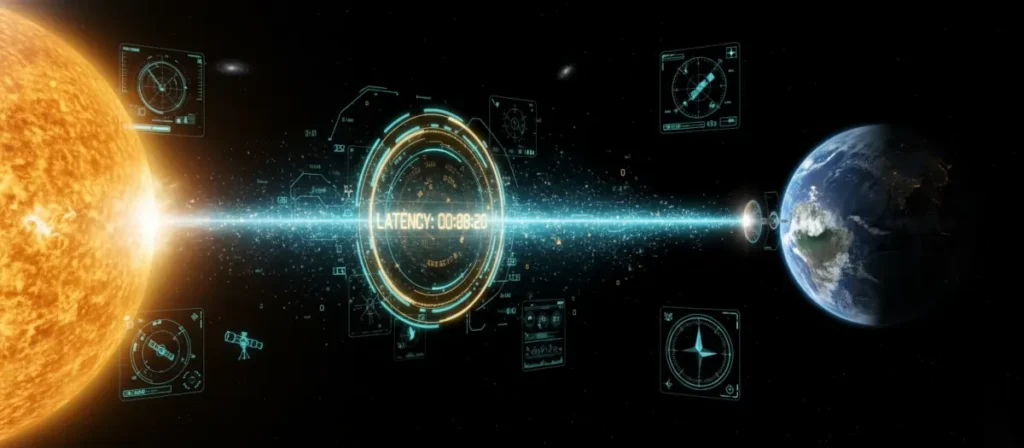
Sunlight Latency Clock
Temporal Telemetry Active
The Sun
08:20
MINUTES AGOC-Velocity299,792 km/s
Avg Distance—
Total Lag—
Temporal Data Archive
Analyzing the speed of light across the cosmic scale.
📁 SECTOR: THE_SUN
The 8-Minute Lag
Because the Sun is 93 million miles away, its photons must navigate a massive void before reaching our atmosphere.
- The Vanishing Act: If the Sun suddenly stopped glowing, we would continue to see it in our sky, full and bright, for 8 minutes and 20 seconds.
- Gravity Lag: Gravity also travels at the speed of light. Earth would continue its orbital path around a “ghost” sun for that same 8-minute window.
- Elliptical Variance: Because Earth’s orbit isn’t a perfect circle, the delay fluctuates between 490 and 507 seconds throughout the year.
📁 SECTOR: INNER_PLANETS
Radio Latency & Mars
Communicating with robots on other worlds is a test of extreme patience. The finite speed of light prevents real-time control.
- No Joysticks: NASA engineers cannot “drive” Mars rovers. By the time a command to “Stop” reaches Mars, the rover may have already driven off a cliff 10 minutes prior.
- Autonomy: This latency is why Martian rovers require advanced AI to navigate obstacles on their own.
- Jupiter Sync: At its furthest point, light from Jupiter takes 52 minutes to reach us. A question asked to a probe there takes nearly 2 hours to get a response.
📁 SECTOR: DEEP_PROBES
Voyager 1: The Human Limit
Voyager 1 is the most distant human-made object in existence, having crossed into the interstellar medium.
- 22-Hour Signals: As of 2026, it takes light nearly a full day (22.5 hours) to travel one way between Earth and the probe.
- Signal Strength: By the time Voyager’s signal reaches Earth, it is a billion times weaker than the battery in a digital watch, requiring massive 70-meter antennas to hear.
- Expanding Void: Because Voyager is moving away at 38,000 mph, the latency increases by about 30 milliseconds every single day.
📁 SECTOR: EXTRAGALACTIC
The Andromeda Paradox
The Andromeda Galaxy is our nearest neighbor, yet it represents a terrifying jump into the deep past.
- Prehistoric Light: The photons hitting your retina from Andromeda tonight left that galaxy 2.5 million years ago.
- The Mirror: If an alien in Andromeda looked at Earth today, they would see our ancestors (the first humans) just beginning to use stone tools.
- The Scale of c: Light travels 6 trillion miles in a year. Andromeda is so far that the number of miles (15 quintillion) is essentially meaningless to the human brain.
OBSERVER PRO-TIP: When you use the Universal Latency Clock, notice the “Light Departed At” timestamp. This is the specific moment in history you are observing when you look at that object through a telescope.
Temporal Physics FAQ
CODE: SUN_LAG ⚡ How long does it take for sunlight to reach Earth?
It takes an average of 8 minutes and 20 seconds for light to travel from the Sun to Earth. Because Earth’s orbit is elliptical, this distance varies slightly, meaning the “latency” of the Sun ranges from 8 minutes and 10 seconds to 8 minutes and 27 seconds depending on the time of year.
CODE: LUNAR_SYNC 🌑 Can we see the Moon in real-time?
No celestial object is seen in real-time. Light from the Moon takes approximately 1.28 seconds to reach Earth. When you look at the Moon, you are seeing it as it existed just over a second ago. This is the shortest “lookback time” in human observation.
CODE: MARS_COMMS 🔴 Why is there a communication delay with Mars rovers?
The delay is caused by the finite speed of light. Radio signals travel at 299,792 km/s. Depending on where Earth and Mars are in their orbits, it takes between 3 minutes and 22 minutes for a command to reach a rover. This prevents “joystick” driving and requires rovers to have autonomous AI.
CODE: INTERSTELLAR_LINK 🛰️ How long is the signal delay for Voyager 1?
As of 2026, the signal delay for Voyager 1 is approximately 22.5 hours one-way. Because the probe has left our solar system and is traveling further into interstellar space, this latency increases by about 30 milliseconds every single day.
CODE: GALACTIC_HUB 🌀 Why is looking at Andromeda like looking back 2.5 million years?
The Andromeda Galaxy is 2.5 million light-years away. Since a light-year is the distance light travels in a year, the photons hitting your eyes tonight actually left Andromeda 2.5 million years ago—long before modern humans (Homo sapiens) walked the Earth.
CODE: C_CONSTANT ⚖️ Does light ever travel faster or slower in space?
In the vacuum of space, light always travels at the universal speed limit (c), which is 299,792,458 meters per second. This is a constant of physics. While light can be “bent” by gravity (gravitational lensing), its speed remains unchanged across the vacuum.
CODE: LOOKBACK_PHYSICS 📜 What is the “Lookback Time” concept?
Lookback Time is the duration between when a photon was emitted and when it is detected by an observer. Because of lookback time, a telescope is functionally a time machine. The further away a star is, the deeper into the past we are looking.
CODE: NEPTUNE_TELEMETRY 🔵 How long does it take light to reach the furthest planet?
Light from Neptune takes an average of 4 hours and 10 minutes to reach Earth. Even at its closest approach, the “lag” of Neptune is never less than 4 hours, making it impossible to see the planet as it exists in the current moment.