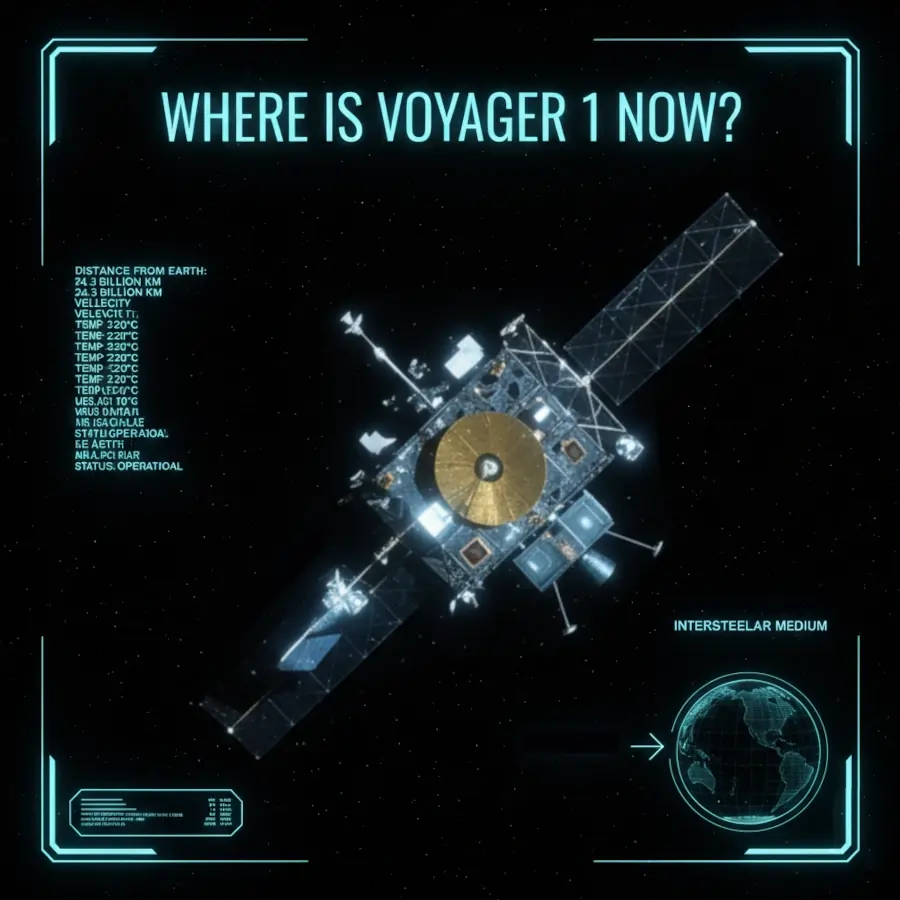
Voyager 2 live distance and status tracker
Where is Voyager 2
Now
A five-year mission that became a 47-year journey
The only spacecraft to visit all four outer planets — Jupiter, Saturn, Uranus, Neptune — and then keep going into the space between the stars. This is what it is doing out there, why it matters, and how much time it has left.
Where does the Sun end
and the galaxy begin?
The question sounds philosophical. It isn't. For most of the twentieth century it was genuinely unanswered — a boundary predicted by theory, inferred from models, but never directly touched. Scientists knew that the Sun exhales a continuous stream of charged particles called the solar wind, and that this wind must eventually be stopped by the pressure of the interstellar medium pressing back from the other direction. They called the outer edge of that standoff the heliopause. They just had no idea exactly where it was, what it looked like up close, or what the physics of the crossing would feel like in real data.
Voyager 2 answered all of it. On November 5, 2018, after 41 years of flight, it crossed the heliopause at a distance of 119.7 astronomical units from the Sun — about 17.9 billion kilometres. The crossing was unmistakable. The solar wind, which had been the background hum of every plasma reading since launch, dropped to near zero almost instantly. The density of the surrounding plasma jumped sharply. The magnetic field orientation shifted. The temperature of the local medium plummeted. In the span of a few days of telemetry, Voyager 2 went from being a spacecraft inside our solar system to being the first operational scientific instrument in interstellar space.
What the data revealed was both confirmation and surprise. The transition was sharper than many models had predicted — more like crossing a membrane than wading through a gradient. Outside the heliopause, the plasma was denser and cooler than expected, and the magnetic field was stronger. These were the fingerprints of the local interstellar medium: material shaped over billions of years by the deaths of other stars, supernova shockwaves that rolled through the galaxy long before our solar system formed.
Voyager 1 had crossed the heliopause six years earlier, in August 2012, heading north through the constellation Ophiuchus. But its plasma science instrument had failed in 1980, leaving a critical gap in what it could measure at the boundary. Voyager 2, heading south through the constellation Pavo, made the crossing with its full plasma instrument suite intact. This meant that for the first time in history, scientists had a direct, instrument-verified measurement of what lies beyond the Sun's influence — not modelled, not inferred, not proxied through indirect observation. Measured. In situ. With hardware that humans built and launched in 1977.
The two probes exit through different regions of the heliopause, separated by an angle of roughly 180 degrees. This geographic spread means they sample fundamentally different parts of the boundary — and comparison between their readings is already producing insights about the structure and asymmetry of the heliosphere that neither probe could generate alone. The heliosphere, it turns out, is not a perfect sphere. It is compressed on the side facing the direction of the Sun's movement through the galaxy, and extended — drawn out into a long tail — on the opposite side. Understanding that shape is crucial for understanding how well our solar system is shielded from galactic cosmic rays, and therefore relevant to the long-term conditions that made life possible on Earth.
Voyager 2 is currently the only functioning weather station in interstellar space. The data it returns cannot be obtained any other way — no telescope, no model, no proxy can replicate it.
That last point matters more than it might seem. Galactic cosmic rays — high-energy particles accelerated by distant supernovae and other violent events across the Milky Way — are partially blocked by the heliosphere before they reach Earth. The degree of that shielding varies with solar activity, with the structure of the heliosphere, and with our position in the galaxy. By measuring the cosmic ray flux inside and outside the heliopause simultaneously — Voyager 2 outside, other spacecraft inside — scientists can begin to characterise how effective that shield actually is. It is not a purely academic question. Cosmic radiation affects DNA. It played a role in the mutation rates that drove evolution. It will matter enormously to any future crewed missions beyond the protection of Earth's magnetosphere.
Currently, at approximately 142 astronomical units and receding at 15.4 kilometres per second, Voyager 2 is the most distant operational scientific instrument humanity has ever deployed. It is moving through a region of space that no probe will visit again for decades — possibly longer. Every reading it returns is, in the strictest sense, irreplaceable.
Talking to a whisper
across 20 billion kilometres
The engineering challenge of communicating with Voyager 2 is so extreme that it requires a new vocabulary to describe properly. The probe transmits at 23 watts — roughly the power of a dim refrigerator bulb. By the time that signal reaches Earth, having spread out across a sphere 20 billion kilometres in radius, the power arriving at the receiving antenna is approximately 10⁻¹⁶ watts. That is one ten-thousand-trillionth of a watt. A single photon of visible light carries more energy. The signal is not faint in the way that a distant radio station is faint. It is faint in a way that strains the English language.
Detecting it requires the largest steerable dish antennas ever built. NASA's Deep Space Network operates a global array of these dishes, but Voyager 2's southerly trajectory creates a constraint with no workaround: only one station on Earth is positioned to see it. Deep Space Station 43 in Tidbinbilla, outside Canberra, Australia, is a 70-metre dish — one of the largest in the world — and the only transmitter on the planet with both the size and the geographic position to reach Voyager 2. When DSS-43 went offline for upgrades in March 2020, NASA was unable to send commands to Voyager 2 for eleven months. The probe continued flying, its onboard sequence executing pre-loaded instructions, while engineers on Earth could only watch and wait.
The data rate makes the signal challenge even more vivid. Voyager 2 currently transmits at 160 bits per second. To put that in context: a single uncompressed photograph taken on a modern smartphone contains roughly 25 megabytes of data — about 200 million bits. At 160 bits per second, transmitting that one photo from Voyager 2 to Earth would take approximately fourteen and a half days. The entire scientific output of a day's worth of Voyager 2 observations fits in a data packet that would take seconds to download over any modern internet connection.
And yet those 160 bits per second are not wasted. Every bit is chosen carefully. The onboard computers — running on roughly 8 kilobytes of memory, less than a single plain-text email — compress, prioritise, and schedule the data stream. The magnetometer readings, the plasma wave data, the cosmic ray counts: all of it flows back across 20 billion kilometres and arrives at Canberra as a whisper that the dish must strain to hear above the thermal noise of its own electronics.
The round-trip light-time currently stands at approximately 39 hours. This is not a communications delay in any ordinary sense. It means that when engineers at the Jet Propulsion Laboratory in Pasadena decide to send a command — to adjust an instrument setting, to fire a thruster, to alter a data compression scheme — they will not know whether that command was received and executed correctly for a day and a half. And if something goes wrong, the response to their correction will take another 19.5 hours. It is mission control as geological patience.
This constraint shaped one of the most dramatic moments in the extended mission. In 2023, a software error caused Voyager 1 to begin transmitting garbled data — the probe's flight data system was sending information through the wrong computer chip, generating a stream of nonsense. Engineers at JPL spent five months diagnosing the problem across a 23-hour round-trip signal delay, crafting commands to a computer architecture that no longer has a living expert who wrote its original code, working from printouts and documentation that is older than most of the team members. They fixed it. The same team is responsible for Voyager 2, and the same constraints apply.
Because it travels so far south, only one antenna on Earth can reach Voyager 2: Deep Space Station 43 in Canberra, Australia — a 70-metre dish and the only transmitter powerful enough to send commands into the southern interstellar void.
The signal also travels through space that is not empty. Between Earth and Voyager 2 lies the entire interplanetary medium — a diffuse soup of solar wind particles and magnetic field lines — and then the heliosheath, and then interstellar space itself. The signal passes through regions of varying plasma density that can bend, disperse, and attenuate it. The Deep Space Network must correct for all of this, using sophisticated error-correction protocols baked into the transmission format. Even with those corrections, the received signal at DSS-43 is right at the edge of what the electronics can distinguish from background noise. Every engineering decision made about that antenna's sensitivity and calibration has a direct effect on whether the science keeps flowing.
Four watts a year —
the slow arithmetic of dying
When Voyager 2 launched in August 1977, its three Radioisotope Thermoelectric Generators produced approximately 470 watts of heat from the decay of Plutonium-238, converting that into roughly 470 watts of electrical power through an array of thermocouple junctions. That was enough to run all twelve science instruments simultaneously, power the onboard computers, operate the attitude control thrusters, heat the electronics bay, and still have margin to spare.
Plutonium-238 has a half-life of 87.7 years. Every year, a fraction of the remaining fuel decays into less radioactive daughter products, releasing slightly less heat. Simultaneously, the thermocouple junctions themselves degrade — the semiconductor material that converts heat differentials into electrical current slowly deteriorates under constant radiation exposure and thermal cycling. The combined effect is a loss of approximately 4 watts of electrical power per year. Four watts sounds trivial. Applied over 47 years, it has reduced the available power to roughly 50 watts — a third of what the probe launched with, and a fraction of what a standard household incandescent bulb consumes.
Every instrument on Voyager 2 uses power. Every heater keeping a component above the temperature at which lubricants freeze and electronics fail uses power. Every bit of data processing, every thruster pulse to maintain attitude, every byte transmitted across 20 billion kilometres uses power. For decades, engineers at JPL have been managing this budget with the precision of wartime rationing — deciding which instruments are worth their wattage, which heaters can be switched off and which systems can survive the cold, which capabilities can be sacrificed to keep the mission's scientific heartbeat going a few more years.
The decisions are irreversible. Once a heater is switched off and a component cools below its design minimum, the damage is permanent. Once an instrument is powered down, the expertise to recommission it may no longer exist — the engineers who designed it have largely retired or died. Each choice is made knowing it cannot be undone, and must therefore be made correctly the first time, across a signal delay that makes real-time troubleshooting impossible.
The history of these decisions reads like a slow-motion triage. The imaging science system — the cameras that returned humanity's first close-up portraits of Jupiter's moons, Saturn's rings, the tilted world of Uranus, and the electric-blue crescent of Neptune — was powered down in the 1990s. Its last photograph had already been taken; keeping it running would have been sentimental rather than scientific. Through the 2020s, heaters were switched off one by one as engineers determined which components could tolerate the exposure to near-absolute-zero conditions. Some systems are now operating far outside their original design specifications, in temperatures that the engineers who built them never expected them to survive.
In October 2024, the Plasma Science instrument was deactivated. Its geometric orientation relative to the interstellar plasma flow made its measurements increasingly ambiguous as the probe moved deeper into interstellar space — the instrument was designed for a heliospheric environment, and its value in the new environment did not justify the power cost. Five months later, in March 2025, the Low-Energy Charged Particle instrument was switched off. Its stepping motor — a mechanism that rotated the detector to sweep across different directions — consumed 15.7 watts per pulse actuation. At a total power budget of around 50 watts, that single motor was claiming nearly a third of everything available whenever it fired. The decision was straightforward in logic and difficult in every other sense.
Engineers at JPL have kept a spacecraft launched before the first Apple computer — running on 8 kilobytes of memory — operational across 47 years, 22 billion kilometres, and a power budget that shrinks by 4 watts every single year.
There is something worth sitting with in the engineering achievement here, separate from the science. The team currently operating Voyager 2 is working with hardware designed in the late 1960s and early 1970s, built using manufacturing techniques and components that no longer exist, documented in paper manuals rather than digital files, and controlled through programming languages that modern universities no longer teach. The original engineers are mostly gone. Their institutional knowledge lives partly in those faded manuals and partly in the accumulated memories of a dwindling group of people who learned the system from people who have since died. Every year the mission continues, the team keeping it alive is working harder, with fewer resources, against a tighter power budget and a deeper well of entropy — and every year they succeed.
A billion-year
message in a bottle
Bolted to the outside of Voyager 2's body is a 12-inch gold-plated copper disc, sealed in an aluminium jacket with a cartridge and needle, instructions for playback etched into the cover in the universal language of pulsar timing and hydrogen spin-flip transitions. It contains 115 analogue-encoded images, greetings spoken in 55 languages, 90 minutes of music, and a range of natural sounds — surf, wind, thunder, birdsong, a mother's first words to her newborn child.
Carl Sagan's committee chose the music with the conviction that it should represent the full range of human expression: Bach's Brandenburg Concerto No. 2 in F major, Chuck Berry's "Johnny B. Goode," a Navajo night chant, Georgian polyphony, Azerbaijani folk music, the Indian raga "Jaat Kahan Ho," Beethoven's Cavatina. The committee debated, argued, and revised. Sagan lobbied for Beatles songs; the rights couldn't be cleared. What made the final cut was not a consensus of the world's favourite music, but something more interesting — a genuine attempt at honest representation of human variety.
The disc was designed to last. Gold-plated copper does not corrode in the vacuum of space. In the absence of atmosphere, ultraviolet radiation, or liquid water, the material degrades at a rate so slow it defies intuitive comprehension. The estimated lifespan of the Golden Record is one billion years — roughly the time that separated the first multicellular life on Earth from the Cambrian explosion. In that time, the Sun will have exhausted its hydrogen fuel and expanded into a red giant, incinerating Mercury, Venus, and almost certainly Earth. The oceans will have boiled away a billion years before that. The continents will have rearranged themselves into configurations that no current map would recognise. And the Golden Record will still be out there, dark and cold and intact, carrying the sound of a mother talking to her child in a language that no one alive will be able to speak.
The images encoded on the disc include mathematical and physical constants, diagrams of the solar system and human DNA, photographs of humans eating, drinking, and working, pictures of landscapes and cities, and a calibration image for the decoding equipment. They were chosen by a subcommittee that included astronomer Frank Drake, artist Jon Lomberg, and writer Ann Druyan — who later married Sagan and has described the process of selecting the record's contents as one of the most profound experiences of her life. The record also contains her brainwave readings, recorded during an hour in which she meditated on the entire scope of human history and tried to think loving thoughts about humanity. Whether that is science, art, or something else entirely is a question the record leaves open.
The instructions for playback are encoded on the cover using diagrams that assume only a knowledge of hydrogen physics — the spin-flip transition frequency of a hydrogen atom, which defines a unit of time and a unit of length that any technologically capable civilisation would independently discover. The binary numbers give the playback speed. The diagram shows the stylus in the first groove. The pulsar map — the same one used on the Pioneer plaques launched earlier in the 1970s — gives the location of the Sun relative to fourteen pulsars, whose known spin-down rates allow any finder to calculate the approximate date of launch. The record is not just a message. It is a self-contained decoding manual for a message sent to an unknown audience in an unknown time.
"This is who we were. This was our music. We were here." — The implicit message of every second of audio on the Golden Record.
No one seriously expects it to be found. The galaxy contains roughly 300 billion stars. Voyager 2 is heading in no particular direction relative to any of them. The probability of another intelligent species encountering a specific one-metre disc drifting through the vastness of interstellar space, in the absence of any directed trajectory toward a populated system, in a timescale of billions of years, is so small that it approaches meaninglessness as a probability estimate. Sagan knew this. Everyone on the committee knew it. They made the record anyway, and the reason they gave — the reason that holds up — is that the act of making it mattered regardless of whether it is ever received. A civilisation that could look at itself honestly enough to choose what to put on that disc, and care enough to do it well, was demonstrating something about itself that had nothing to do with the recipient.
The Golden Record is the most durable object humanity has ever produced. It will outlast every building, every monument, every physical artifact of every culture that has ever existed on Earth. When the last glacier melts and the last mountain erodes flat and the last bacterium on Earth finally loses its battle with the expanding Sun, the Golden Record will still exist, unchanged, somewhere in the darkness between stars. That is not a small thing to have made.
A permanent citizen
of the Milky Way
Around 2030 — the exact year depends on which heater gets switched off next and how gracefully the remaining thermocouples degrade — Voyager 2 will fall silent. The power will drop below the threshold needed to simultaneously run an instrument and maintain a radio link to Earth. The 70-metre dish at Canberra will listen for a signal that no longer comes. And then Voyager 2 will continue doing exactly what it has done since August 20, 1977: moving outward, at 15.4 kilometres per second, in the direction of the constellation Pavo.
At that speed, it will take approximately 9,700 years just to travel one light-year. The nearest star system, Alpha Centauri, is 4.37 light-years away, but Voyager 2 is not heading toward it. It is heading south through the galaxy, toward a region where there are no particularly close stars. Its nearest stellar encounter — a pass within 1.7 light-years of the red dwarf Ross 248 — will not occur for approximately 42,000 years. By then, the pyramids at Giza will be as old to that future moment as our earliest cave paintings are to us now.
In approximately 296,000 years, Voyager 2 will pass within about 4.3 light-years of Sirius, the brightest star in the Earth's night sky — the star that the ancient Egyptians used to predict the Nile flood, that navigators used for millennia to find south, that has appeared in the mythologies of cultures on every inhabited continent. Voyager 2 will pass it in the dark, unseen, silent, long after the concept of Egypt has dissolved into history and then into legend and then into nothing anyone remembers.
In approximately 225 million years, Voyager 2 will have completed one full orbit of the Milky Way galaxy — the same duration that separated the Triassic period, when the first dinosaurs walked on Earth, from today. During that time, the stars around it will have shuffled, supernovae will have come and gone, new solar systems will have formed and perhaps life will have evolved in some of them. Voyager 2 will still be travelling. It will have crossed the galaxy not as a directed mission but as a piece of flotsam — a human-made object moving through the Milky Way on the same gravitational currents that carry every other piece of matter in this spiral arm.
It will circle the galaxy alongside billions of other stars — a silent, dark object carrying the sounds of a 1970s Earth into a future so remote it defeats language.
There is a particular kind of melancholy in watching the end of this mission approach in real time. We are, right now, in the final years of the era in which Voyager 2 can talk to us. The numbers on the live counter at the top of this page — the AU ticking upward, the signal lag creeping toward twenty hours — are among the last of a stream that began when Jimmy Carter was president, the Bee Gees were at the top of the charts, and no one alive had ever seen a computer on a desk. Everything Voyager 2 has done since then — the Jupiter flyby in 1979 revealing volcanic eruptions on Io; Saturn in 1981; Uranus in 1986, discovered to be spinning on its side with a magnetic field offset from its rotational axis in ways still not fully understood; Neptune in 1989, the farthest planet anyone had ever visited, with winds faster than anywhere else in the solar system and a moon called Triton that orbits backward and may be a captured Kuiper Belt object — all of it came from hardware that will go silent within the decade.
What Voyager 2 will leave behind, when the signal stops, is not just a collection of scientific data. It is proof that a species, in a brief window of technological capability, chose to look outward rather than only inward. It is proof that we built something that worked for five decades. It is proof that the boundary between our solar system and the rest of the galaxy is a real physical place that can be measured, that the interstellar medium is not a theoretical construct but a specific environment with specific properties, that the heliosphere that shelters all life on Earth has a shape and a structure and edges that instruments can touch.
And it is proof that a copper disc with a needle and a set of instructions, sealed in gold and launched into the dark, is the longest-lasting thing we know how to make. Long after the last human city has been reclaimed by forest or ocean or desert, long after the last trace of any human language has eroded from the last stone we ever carved, Voyager 2 will still be out there, carrying the sound of a thunderstorm recorded on Earth, the melody of a Bach partita, a mother saying goodnight to her child in fifty-five languages.
It simply will not be able to tell us where it is anymore.