

How the moon affects coral spawning — and triggers a blizzard beneath the waves
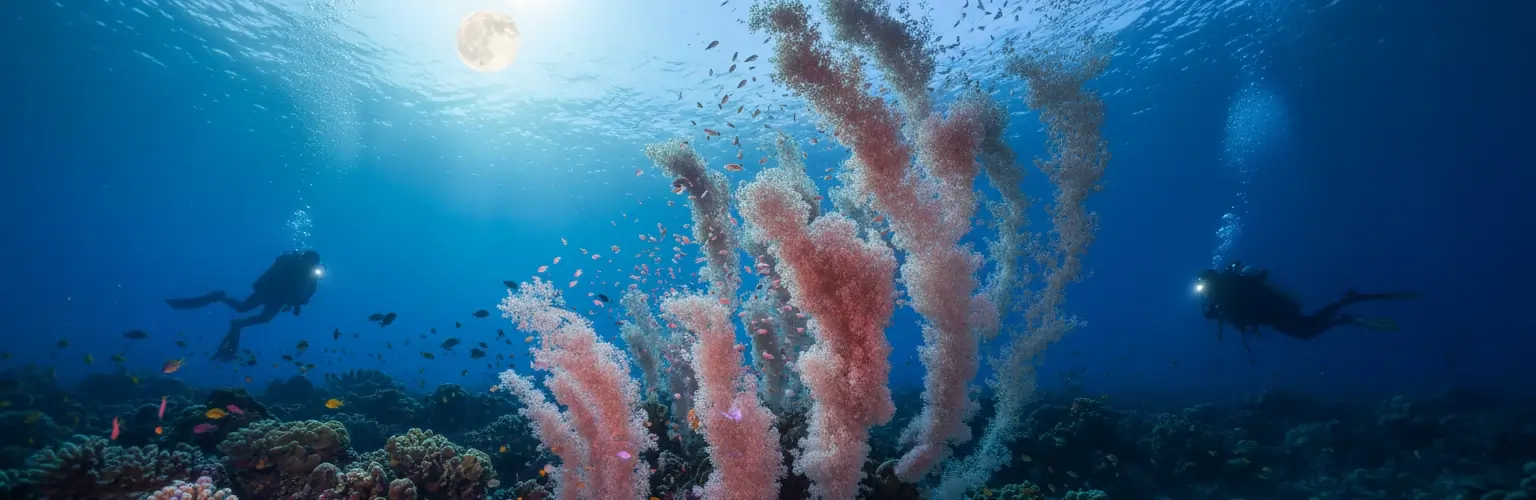
On a handful of nights each year — always in the days after a full moon, always in darkness — coral reefs across the planet do something extraordinary. Millions of individual animals, each no bigger than a pencil tip, release their eggs and sperm simultaneously into the water column. The result looks like a blizzard in reverse: billions of tiny pink and white bundles rising slowly toward the surface in a column of warm, still ocean.
The moon's influence on coral spawning is not incidental — it is the primary timer in a three-part biological clock that co-ordinates the largest synchronised reproductive event on Earth. Corals use ancient light-sensing proteins to detect the intensity of moonlight, then wait precisely 4 to 10 nights after the full moon for the window of true darkness that opens as the moon rises later each night. That darkness is their signal to spawn.
Below you'll find a live lunar tracker showing the current spawning likelihood for any reef in the world, followed by a full guide to the science — the triggers, the reef calendars, the threats, and how to observe and document a spawning event yourself.
Coral Spawning Sync warm season
Loading…
The master clock governing the world's most precise biological event
Every year, across thousands of kilometres of reef, millions of coral colonies release their gametes in perfect unison — timed to a clock set by the sun, the moon, and the darkness between them. Here's how it works, and why it matters.
What's actually happening beneath the surface
For a diver witnessing it for the first time, coral spawning looks like a reverse snowstorm — billions of tiny pink, orange, and white spheres rising slowly toward the surface in a column of still, warm water. What you're watching is the result of months of biological preparation, compressed into a single extraordinary night.
Most reef-building corals (order Scleractinia) are broadcast spawners. Unlike brooders — which fertilise eggs internally and release fully-formed larvae — broadcast spawners release their gametes directly into the water column, trusting ocean currents and sheer numerical density to bring sperm and egg together. In hermaphroditic species — the majority of reef-builders — the polyp packs both into a single buoyant gamete bundle. The lipid-rich eggs act as a float, carrying the sperm upward to the surface where fertilisation occurs.
The "setting" phase — your countdown signal
Around 30–60 minutes before release, gamete bundles migrate into the polyp's mouth, visibly bulging the oral disc outward. This is the moment to position your macro lens. The bundle emerging halfway from the mouth is what reef photographers call the shot.
The three triggers that synchronise a reef
Spawning is not controlled by a single cue. It operates as a three-level hierarchy — each layer narrowing the timing from the right month, to the right night, to the right hour. A failure at any level can cost the reef an entire year of recruitment.
Annual cue
Solar irradiance
The sun determines the month. Corals monitor sea surface temperature, waiting for it to reach its annual peak. Low-wind seasonal doldrums keep gamete concentrations high enough for fertilisation to succeed.
Monthly cue
The lunar cycle
The moon determines the night. Corals use light-sensing proteins called cryptochromes to detect moonlight. Spawning 4–10 nights after the full moon creates a window of total darkness that shields rising gametes from visual predators.
Circadian cue
Sunset timing
The sunset determines the hour. The rapid drop in light at dusk fires the final "go" signal. Each species has its own offset — Acropora millepora spawns around 130 minutes after sunset, Acropora hyacinthus waits until 190 minutes — preventing cross-species fertilisation entirely.
Why the darkness window matters
On the full moon itself, moonlight floods the reef from sunset to sunrise — perfect hunting conditions for planktivorous fish. Corals track this using cryptochromes, ancient proteins specifically sensitive to the blue-light frequency of moonlight. By waiting 4–10 days for the moon to rise progressively later each night, they carve out a 2-to-3 hour window of true darkness. That window is when the spawning happens.
The three triggers operate as a strict hierarchy — miss any one of them and the reef loses an entire year of recruitment. There is no second chance within the same season.
The thermal window that triggers gamete maturation rotates around the globe over the calendar year, meaning every major reef system has its own spawning signature — and its own quirks.
| Reef system | Primary window | Notes |
|---|---|---|
| Great Barrier Reef | Oct–Dec peak Nov | World's largest event. Shallow inner reefs warm faster and spawn weeks ahead of outer reefs. |
| Western Caribbean | Aug–Sep peak Aug | Famous for split spawns. Star corals (Orbicella spp.) often release within 15 minutes of predicted time. |
| Red Sea | Apr–May | Timed to the period of most rapid temperature increase, not peak heat — a different biological logic to most reef systems. |
| Florida Keys | Aug–Sep | Mirrors Caribbean timing closely. Elkhorn and staghorn corals are key indicator species. |
| Coral Triangle | Mar–Apr, Aug–Oct | Attenuated equatorial seasons mean spawning is more protracted — smaller events spread across many months rather than one annual explosion. |
A quirk worth understanding when using the tracker is the split spawn. When the full moon falls at the very start or end of a calendar month, some colonies' gametes may not yet be fully ripe. The result: roughly half the reef spawns in the first lunar window, the other half waits for the next — splitting the event across 30 days. For researchers it's a tracking headache; for the reef, it's a hedge against a single storm wiping out an entire year of reproduction.
How human activity breaks the clock
The spawning clock has functioned without interruption for hundreds of millions of years. In recent decades, three anthropogenic pressures have begun to desynchronise it.
- 1Ecological light pollution
High-intensity LED lighting from coastal resorts and ports creates a permanent artificial full moon. When ambient nighttime light exceeds the sensitivity threshold of coral cryptochromes, the monthly lunar cue is lost. Corals may spawn out of phase, or trickle gametes over several weeks at concentrations too low for reliable fertilisation.
- 2Thermal stress and bleaching
A bleached colony diverts its energy budget from gamete production to survival — synthesising heat-shock proteins instead of eggs. A reef that has experienced bleaching won't participate in spawning, and recovery to full reproductive capacity typically takes three to five years.
- 3Chemical interference
In the minutes before spawning, coral polyps communicate across the reef using chemical pheromones — whispering to neighbouring colonies to ensure every polyp releases at the same second. This synchronisation is what creates the critical density of gametes needed for fertilisation. Compounds such as oxybenzone, found in many traditional sunscreen formulations, act as endocrine disruptors that interfere with this signalling. A reef that can no longer whisper to itself may trickle gametes over hours rather than minutes — too dilute to fertilise reliably — and runoff from a single busy beach day can be enough to cause it.
Observing a spawning event — what to do in the water
If the tracker puts you in a peak window, you're participating in citizen science. The data you collect in the water has direct value for global reef monitoring programmes like CoralWatch.
"A reef that spawns in sync is a reef that is healthy, connected, and fighting for its future."
Coral Spawning Sync