

Claim 1 · Light theory
Full moonlight stimulates plant growth
Moonlight at night triggers germination and growth responses in plants
Moonlight is reflected sunlight. At full moon, roughly 0.1–0.3 lux reaches Earth’s surface — around 300,000 times weaker than daylight. Plants do have light-sensitive phytochrome receptors, but the threshold to trigger a response is far above what the moon can provide.
Evidence
Plants have phytochrome receptors that respond to night illumination — the mechanism exists
Full moonlight intensity falls far below any measured plant response threshold
Controlled studies find no measurable growth difference between full moon and moonless conditions
Claim 2 · Gravitational theory
Lunar gravity raises water tables, feeding roots
Tidal forces compress aquifers, increasing moisture available to plant roots
The moon’s gravity causes solid earth tides — the crust flexes up to 30 cm, compressing aquifer rock and raising groundwater pressure. In unconfined aquifers, this produces a real but tiny water table rise of 0.2–3 cm.
Evidence
Solid earth tides are well-documented; measurable 0.2–3 cm water table fluctuations confirmed in unconfined aquifers
Effect is real at depth but largely dampened before reaching the root zone of most crops
No peer-reviewed study links this water table shift to any detectable change in plant growth or yield
How the moon affects groundwater levels
A deeper look at solid earth tides, aquifer pressure, and what it means in the field
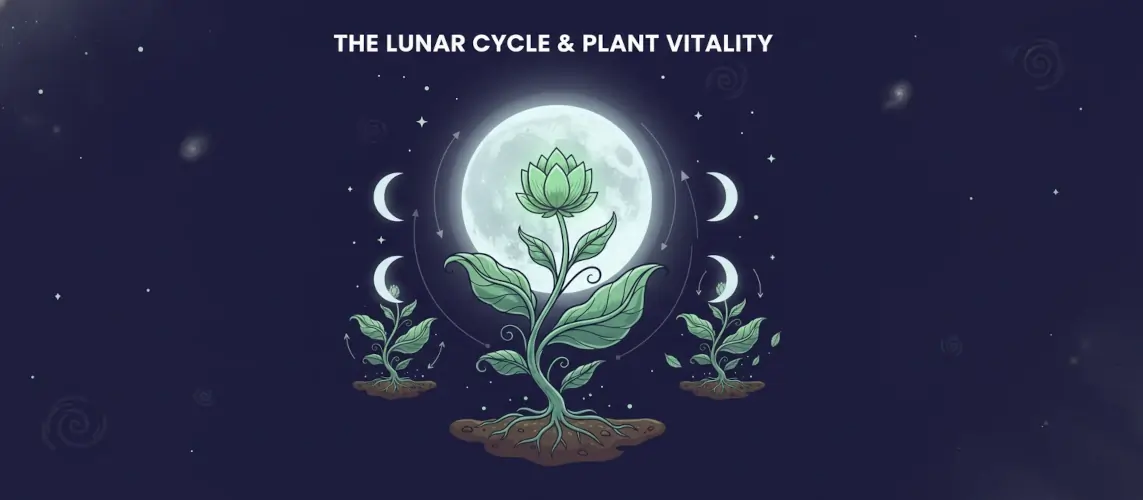
For millennia, humanity has looked to the moon as a celestial timekeeper, a guide for tides, and a predictor of the seasons. It’s little surprise that the full moon became deeply intertwined with agricultural practice. Farmers and gardeners across every culture have held that planting, pruning, and harvesting in sync with lunar cycles leads to better yields. But is there any scientific merit to these traditions, or are they persistent superstition? The truth lies in a fascinating interplay of observable phenomena, genuinely subtle effects, and enduring human stories.
A journey through lunar gardening: history and folklore
Lunar gardening — often called biodynamic gardening or planting by the moon — isn’t a new-age fad. Its roots stretch back thousands of years, predating modern science by millennia. Early agricultural societies, lacking precise calendars or detailed weather forecasts, relied on astronomical observation to guide their work. The moon, with its predictable and easily visible phases, became a natural and universal clock.
- Ancient civilisations: The Babylonians, Egyptians, and Romans all used lunar calendars to inform their farming. Pliny the Elder, the Roman naturalist, advised cutting timber during the new moon and planting crops during the full moon.
- Medieval Europe: Almanacs and agricultural guides throughout the Middle Ages and Renaissance regularly included lunar planting advice, passed down through generations as received wisdom.
- Indigenous cultures: Many indigenous communities around the world developed intricate lunar planting calendars, linking specific moon phases to the growth cycles of native plants and seasonal change.
- Modern revival: The early 20th century saw a resurgence of interest with the advent of biodynamic agriculture, championed by Rudolf Steiner, which integrates spiritual, ethical, and ecological approaches to farming — including lunar and planetary rhythms.
The underlying philosophy is intuitive: if the moon drives the massive tides of the ocean, surely it exerts some influence on the more delicate life forms on Earth. This reasonable-sounding leap led to a complex body of practice — dictating which crops to plant during waxing versus waning moons, and which activities were best suited to specific phases.
Examining the mechanisms: light, gravity, and beyond
Modern science approaches these claims by identifying the physical mechanisms through which the moon could plausibly influence plant life. Two hypotheses dominate the discussion: light and gravity. Both are real phenomena. Neither appears to be strong enough to matter.
The moonlight hypothesis: too dim to matter
The most obvious connection between the full moon and plant growth is light. A full moon bathes the night in a soft glow significantly brighter than other phases. Plants are highly sensitive to light — they use it for photosynthesis, and they use sophisticated photoreceptors called phytochromes to detect changes in light quality, intensity, and duration, which can influence germination, flowering, and circadian rhythms.
That gap — roughly five to six orders of magnitude — is the problem. While plants do respond to night illumination (streetlights, for instance, can disrupt flowering in some species), the light threshold required to trigger such responses is far above what the moon provides. Experiments comparing plant growth under full moon conditions versus complete darkness have consistently found no measurable difference attributable to natural moonlight. The energy simply isn’t there.
The gravitational hypothesis: subtle pulls, imperceptible effects
The moon’s gravitational pull undeniably drives ocean tides, and it also deforms the solid crust of the Earth — causing “solid earth tides” where the ground physically bulges by several centimetres. Proponents of the gravitational hypothesis suggest this tidal force could influence plant life through three pathways:
- Groundwater levels: Slight compression of the Earth’s crust could raise groundwater pressure, theoretically making more moisture available to plant roots during peak lunar gravitational pull at new and full moons.
- Sap flow and water uptake: Lunar gravity might influence the movement of water and nutrients within plants, in the same way it affects larger water bodies.
- Seed germination: Very subtle changes in pressure or moisture could, in theory, affect the imbibition phase — the initial water absorption that triggers germination.
The groundwater effect is real. Measurable fluctuations of 0.2–3 cm in unconfined aquifers are well-documented, driven by the same solid earth tide mechanism that deforms the crust. We’ve covered this in detail in our companion piece on how the moon affects groundwater levels. The problem is scale: these tiny fluctuations are largely dampened before reaching the root zone of most crops, and are trivial compared to the influence of rainfall, irrigation, soil composition, and evapotranspiration. No rigorous peer-reviewed study has demonstrated a causal link between these minute gravitational shifts and any statistically significant change in plant growth, yield, or health under controlled conditions.
Why the beliefs persist: beyond the science
If direct scientific evidence for lunar influence on plant growth is largely absent, why do these beliefs persist so strongly? Several factors explain the enduring appeal:
- Observational bias and anecdotal evidence: Gardeners who follow lunar calendars attribute successful harvests to the moon, overlooking other variables — weather, soil quality, pest control, or simply good practice. When a crop thrives, the lunar schedule gets the credit; when it fails, other factors are blamed.
- The gardener’s calendar effect: Following a lunar calendar imposes a regular structure on gardening tasks. A disciplined, scheduled approach to planting, weeding, and harvesting can lead to better outcomes than haphazard gardening — regardless of the moon’s phase. The discipline improves the results, not the moon.
- Holistic and spiritual appeal: For many, lunar gardening is part of a broader connection to nature. It’s less about empirical proof and more about aligning with natural rhythms and feeling connected to the cosmos. That intrinsic value is not diminished by a lack of measurable effect.
- The limits of current measurement: Some argue that there may be extremely subtle, complex interactions between celestial bodies and biological systems that current instruments and methodologies can’t yet detect. This remains firmly in the realm of hypothesis — but it’s not an unreasonable position to hold.
The scientific verdict: no detectable impact
Despite the rich history and passionate advocates, the consensus in mainstream agricultural science and botany is clear: there is no scientifically detectable or repeatable evidence that the moon’s phases directly affect plant growth, yield, or health in any significant way. Decades of controlled experiments — some specifically designed to test lunar planting claims — have failed to produce statistically significant results attributable to lunar phases.
The factors that genuinely dominate plant growth are:
- Sunlight intensity and duration
- Temperature, day and night
- Water availability — rainfall and irrigation
- Soil quality and nutrient content
- Presence of pests and disease
- The genetics of the plant variety
The scientific community generally regards lunar gardening as pseudoscience — or at best, a harmless tradition that offers organisational benefits rather than direct biological ones. That’s not a dismissal of those who practise it; it’s simply where the evidence currently sits.
Conclusion: a blend of science and spirit
Does the full moon affect plant growth? From a strict empirical standpoint, the answer is no — not in any measurable or significant way. The proposed mechanisms are either too weak to matter (light) or real but too small and too deep to reach the places that count (gravity).
But for many gardeners, the practice of lunar planting was never solely about scientific validation. It is about a connection to nature, a rhythm for daily life, and a personal relationship with the sky above the garden. There’s genuine value in tradition, in careful observation of natural cycles, and in the sense of alignment that comes from paying attention to the cosmos — even if the direct causal links don’t hold up under a microscope.
Understanding the science helps set realistic expectations and prioritise what actually moves the needle: good soil, consistent water, the right plant in the right place. But the history of lunar gardening adds a rich layer to humanity’s long relationship with both the Earth and its luminous companion. It reminds us that while science explains how things work, human experience has always found meaning and guidance in patterns that go beyond simple explanations.
Frequently Asked Questions: Lunar Gardening
Does the full moon really make plants grow faster?
No, scientific evidence does not support the claim that the full moon directly makes plants grow faster. While traditional beliefs suggest lunar influences, controlled scientific studies have not found any measurable or statistically significant difference in plant growth, yield, or health attributable to the full moon’s light or gravitational pull.
How does moonlight affect plants?
Moonlight is reflected sunlight, and even at its brightest during a full moon, its intensity (about 0.1–0.3 lux) is significantly too low to trigger plant growth responses like photosynthesis or photoreceptor activity. Plants primarily respond to much higher light thresholds, typically found in daylight or strong artificial illumination.
Can the moon’s gravity affect plant roots or water in the soil?
The moon’s gravity does cause “solid earth tides,” leading to tiny fluctuations (millimetres to a few centimetres) in groundwater levels. However, these effects are generally considered too minute and dampened by soil mechanics to have any measurable impact on the water available to plant roots or plant growth in the vast majority of agricultural settings.
Why do people still practice lunar gardening?
People continue to practice lunar gardening for various reasons, including cultural tradition, personal belief in aligning with natural rhythms, and the structured approach it provides to gardening tasks. While direct scientific benefits haven’t been proven, the discipline of following a lunar calendar can lead to more consistent gardening habits, which in turn can improve yields.
What is the scientific consensus on lunar gardening?
The scientific consensus among botanists and agricultural researchers is that there is no empirical evidence to support a direct, measurable influence of moon phases on plant growth or agricultural success. Factors like sunlight, temperature, water, soil quality, and genetics are overwhelmingly more impactful than any hypothesised lunar effect.