

Earth Phase Today
As seen from the lunar south pole
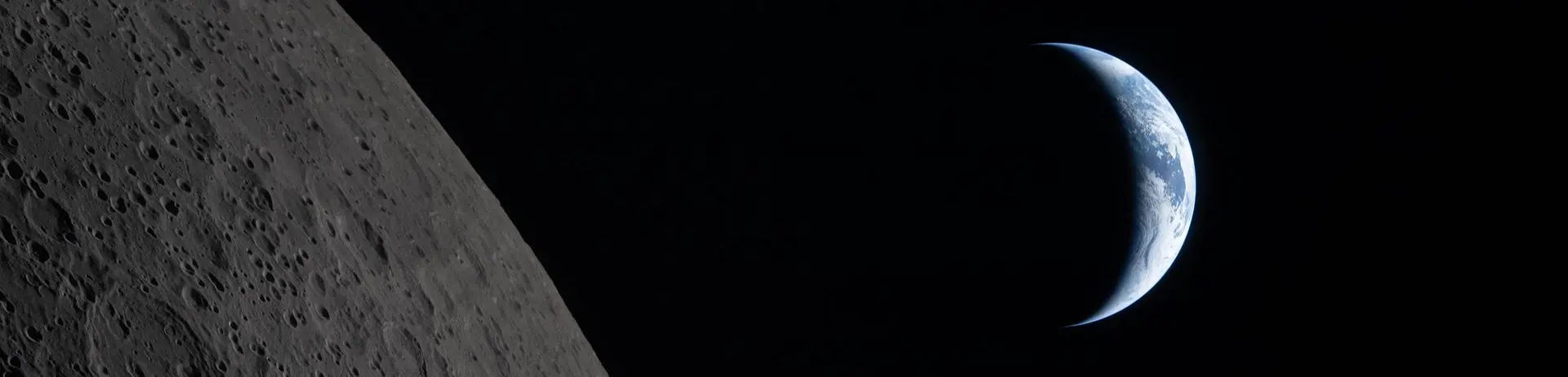
Earth's Phases
from the Moon
The complete scientific and practical guide for Artemis astronauts and future settlers — what our home planet looks like, how bright it shines, and why it stays low near the horizon from the lunar south pole.
A unique celestial vantage point
The Moon's south pole is not merely another landing site. Characterized by towering peaks receiving near-constant sunlight — including the Shackleton Crater rim, which is illuminated roughly 80–90% of the year — and permanently shadowed regions that may harbor substantial water ice, it is both the most strategically important and the most visually extraordinary location in the solar system for observing Earth.
Earth doesn't rise or set the way it does elsewhere on the Moon. It hangs low over the northern horizon, only slowly drifting up and down, cycling through its phases like a slow, magnificent clock.
From latitudes closer to the lunar equator, Earth would still bob above the horizon each month. But from near the south pole, the geometry pins it low and close to due north, at roughly 0–1.5° elevation on average. Because of lunar libration and the exact latitude and local topography of a given site, Earth's elevation oscillates over the month and, at some south-polar locations, can dip below the local horizon entirely rather than staying perpetually visible. This near-stationary quality is still one of the most psychologically distinctive features of life at this location — it simply isn't an absolute, unchanging fixture in the sky.
- A horizon dweller. Earth does not rise and set on a daily cycle from the lunar south pole the way it would near the equator. It stays close to a fixed point low in the northern sky, shifting slowly due to lunar libration — though depending on the observer's exact latitude and terrain, it can periodically sink below the horizon rather than remaining always visible. High-elevation sites, including the ridgelines of the Shackleton, Haworth, and Nobile crater complexes, offer the most consistent views.
- An inverted celestial dance. The phases of Earth are the direct inverse of the Moon's phases seen from Earth. When we see a New Moon, lunar settlers witness a spectacular Full Earth. When we gaze up at a Full Moon, they see a dark, unlit New Earth.
- A slowly rotating globe. Because the Moon is tidally locked, the same face always looks toward Earth. But Earth itself rotates once every 24 hours — so a lunar observer watches continents drift across the terminator in real time, a live global weather display available to no observatory on Earth.
Every phase, mirrored
The view from the Moon is a perfect complement to our own. What appears dark from Earth glows bright from the Moon, and vice versa. Illumination percentages are also inverted: a Moon that is 25% lit from Earth corresponds to an Earth that is 75% lit from the Moon.
| Moon phase (from Earth) | Earth phase (from Moon) | Earth illumination | |
|---|---|---|---|
| New Moon | → | Full Earth | ~100% |
| Waxing crescent | → | Waning gibbous Earth | ~75% |
| First quarter | → | Last quarter Earth | ~50% |
| Waxing gibbous | → | Waning crescent Earth | ~25% |
| Full Moon | → | New Earth | ~0% |
| Waning gibbous | → | Waxing crescent Earth | ~25% |
| Last quarter | → | First quarter Earth | ~50% |
| Waning crescent | → | Waxing gibbous Earth | ~75% |
The geometry behind the inversion
A "phase" is simply the fraction of the sunlit hemisphere visible from your vantage point. The Sun illuminates exactly half of Earth at any moment. When the Moon is positioned between the Sun and Earth (New Moon), a lunar observer looks at Earth's fully lit face — Full Earth. When the Moon is on the far side of Earth from the Sun (Full Moon), the lunar observer sees only Earth's night side — New Earth.
Because illumination fractions sum to 1.0, if the Moon is 30% lit from Earth, Earth is simultaneously 70% lit from the Moon. This is not approximate — it is geometrically exact, since both objects are lit by the same source from the same direction at the same moment.
There is no configuration in which both the Moon and Earth are simultaneously at a crescent phase, or both simultaneously at a gibbous phase. They are always phase complements. The Moon-Earth-Sun angle defines both phases simultaneously.
Earth in the lunar sky
Angular size: four times larger than our Moon
From the Moon, Earth subtends approximately 1.9° of arc — compared to the Moon's 0.5° as seen from Earth. This makes Earth nearly four times larger in apparent diameter. At Full Earth, it is not merely a bright object but a visually dramatic disk — large-scale weather systems, polar ice caps, and continental outlines are discernible to the naked eye, while finer structure would require optical aid.
Because the Moon's orbit is slightly elliptical, Earth's apparent size varies: from about 1.80° at apogee to 2.00° at perigee. This variation is directly observable over the course of a lunar month.
How bright is a Full Earth?
Earth is a far better reflector than the Moon. The Moon's surface is dark basaltic rock with an average albedo of just 0.11–0.12 — it reflects only about 11–12% of incoming sunlight. Earth's albedo averages around 0.30–0.37, but spikes much higher over bright cloud cover, ice sheets, and ocean glint regions.
Combined with the larger apparent disk, this produces a Full Earth roughly 43 to 64 times brighter than a Full Moon seen from Earth — NASA-affiliated estimates commonly cite a figure near 50×, with the exact value depending heavily on cloud cover and ice extent. Under Full Earth conditions, the lunar surface is well illuminated: shadows are sharp and a suited astronaut casts a clear shadow, though Earthlight alone is still far dimmer than sunlight and would supplement rather than replace dedicated lighting for surface work.
The Earthshine effect
Earthshine — also called the Old Moon in the New Moon's arms, or the "Da Vinci Glow" — is the faint glow on the unlit portion of the crescent Moon caused by sunlight reflecting off Earth. From the Moon's surface, an analogous effect works in reverse: during crescent and quarter Earth phases, the unlit side of Earth is faintly visible, illuminated by moonlight reflecting off the Moon back onto Earth's dark face.
Scientists have used Earthshine as a long-term climate monitor. By measuring the brightness of the Moon's unlit face from Earth over decades, researchers track changes in Earth's average albedo — a direct measure of planetary reflectivity and cloud cover. The Moon is, in this sense, already functioning as a passive climate sensor for our planet. Total earthshine irradiance reaching the Moon at full-Earth phase is estimated at roughly 0.15 W/m² — far less than direct sunlight, but well above what moonlight delivers to Earth.
Illuminance on the lunar surface by Earth phase
| Earth phase condition | Illuminance (lux) | Comparable to |
|---|---|---|
| Full Earth (peak, high cloud/ice cover) | ~5–10 | Bright twilight glow |
| Full Earth (average albedo) | ~3–6 | Well above full-Moon brightness |
| Gibbous Earth (75%) | ~2–4 | Bright moonlit night, and then some |
| Quarter Earth (50%) | ~1–2 | Comparable to a bright full Moon on Earth |
| Crescent Earth (25%) | ~0.1–0.5 | Dim moonlit night |
| New Earth (0%) | <0.01 | Starlight only |
Note: these figures scale full-Moon illuminance on Earth (commonly cited around 0.1–0.3 lux) by Earth's ~43–64× brightness advantage; NASA engineering assessments have cited full-Earth illumination as high as ~10 lux under favorable conditions, with actual values at a given south-polar site depending strongly on Earth's elevation, terrain slope, and surface reflectance.
Earth's subtle wobble in the sky
Although Earth appears nearly fixed from the lunar south pole, it is not perfectly stationary. The Moon's orbit is elliptical and its rotation axis is slightly tilted. The combination of three distinct libration effects causes Earth's position in the lunar sky to shift over each lunar month — roughly ±7.9° in the longitude direction and ±6.7° in latitude, tracing out a region a little over 13° by 15° around its mean position. From a fixed surface site near the pole, this shows up mainly as a slow rise and fall in Earth's elevation above the horizon, with the exact range and visibility depending on the site's precise latitude and local terrain.
Libration in longitude
The Moon rotates at a constant rate but orbits at a varying speed — faster at perigee, slower at apogee. This mismatch lets observers see slightly more of the eastern or western limb at different orbital positions, up to about ±7.9°. From the south pole, it makes Earth appear to swing left and right by a small but measurable amount each month.
Libration in latitude
The Moon's rotation axis is tilted about 6.7° relative to the axis of its orbital plane. This means we alternately see slightly more of the Moon's north or south pole over each orbit. From the lunar south pole, this shifts Earth's apparent elevation angle — sometimes lifting it higher above the local horizon, sometimes dropping it lower, or even briefly below the horizon, depending on exact polar latitude.
Diurnal libration
Earth's rotation causes observers on its surface to shift position by ±6,371 km over 24 hours. Since the Moon is only 384,400 km away, this parallax shifts our line of sight by about ±1°. Negligible for casual observation, but relevant for precision astrometry and laser ranging experiments.
Physical libration
The Moon is not a perfect sphere — it has mass concentrations (mascons) and tidal distortions that cause tiny real oscillations in its rotation, distinct from the geometric librations. These physical librations add fractions of a degree to the total apparent motion of Earth in the lunar sky.
The net result is that from a fixed south polar site, Earth traces a slow, irregular loop in the sky over each month — a lunar analog of the analemma — rather than either staying perfectly still or rising and setting like an ordinary celestial object. For colonists, the position of Earth in its wobble cycle will serve as a reliable visual indicator of where they are in the 29.5-day month.
When Earth becomes a ring of fire
Perhaps the most breathtaking celestial event visible from the lunar surface is the total solar eclipse — an event that, seen from the Moon, is nothing like an eclipse from Earth. When Earth passes directly between the Moon and the Sun, the Sun vanishes entirely behind our planet's disk. But the event doesn't go dark.
Earth's atmosphere refracts sunlight around its circumference, igniting the entire planetary rim in a simultaneous 360° sunset — a thin, glowing ring of orange and red visible to every observer on the Moon's near side.
The geometry of a lunar eclipse, reversed
Every lunar eclipse seen from Earth — where the Moon turns red passing through Earth's shadow — is simultaneously a total solar eclipse seen from the Moon. The two events are physically identical, simply observed from opposite sides. What we call a "blood moon" on Earth corresponds to an "Earth ring" event on the Moon.
The reddish color is caused by the same mechanism in both cases: all of Earth's sunrises and sunsets happening simultaneously, refracting long-wavelength red and orange light into the shadow zone. For a lunar astronaut, the entire limb of Earth glows in this ring for the duration of totality — up to roughly 100 minutes for the longest events.
Blood Moon
The Moon dims and turns red-orange as it passes through Earth's shadow. Umbral totality can last up to 107 minutes. The Moon does not disappear — it is bathed in refracted light from all of Earth's simultaneous sunrises and sunsets.
Earth's Ring of Fire
The Sun disappears behind Earth. A brilliant 360° ring of orange-red light ignites around Earth's entire limb as atmosphere refracts sunlight. The lunar surface dims dramatically. Stars appear. The solar corona may be visible around the ring.
Lunar eclipses — and therefore these solar eclipse events from the Moon — occur roughly 2 to 3 times per year on average globally, occasionally more, with total eclipses somewhat rarer. A south polar base would witness a proportional fraction depending on which hemisphere of the Moon is facing Earth's shadow track during each event.
Comparing planetary views across the solar system
Earth is not the only planet with a moon. But our Moon offers a uniquely compelling view of its parent world. Here is how the Earth-from-Moon perspective compares to other famous moon-planet pairings in our solar system.
| Moon | Parent planet | Angular size | Characteristic |
|---|---|---|---|
| Our Moon | Earth | 1.9° | Full phase cycle over 29.5 days. Nearly fixed low in the sky from the poles. Continents visible to naked eye. |
| Phobos | Mars | ~42° | Enormous in Mars' sky given Phobos' close orbit (~6,000 km above the surface). Orbits Mars in 7.6 hours — extremely rapid phase and position changes. |
| Io | Jupiter | ~20° | Jupiter fills 20° of sky — an overwhelming presence. No solid observing surface available. |
| Titan | Saturn | ~5.7° | Saturn's disk alone spans ~5.7° (the ring system, seen edge-on to varying degrees, can extend the visual footprint further). Spectacular ring geometry changes with orbital inclination. |
| Triton | Neptune | ~8° | About four times the angular size of our view of Earth, but Neptune receives roughly 900× less sunlight than Earth due to its much greater solar distance. |
Our Moon occupies a sweet spot: Earth is large enough to be visually magnificent yet small enough not to dominate the entire sky. The 29.5-day phase cycle is slow enough to observe meaningfully, yet fast enough to track changes within a human work rotation. Few other moon-planet pairings offer this particular balance for potential human habitation.
Astronomers studying exoplanets use Earth — as seen from lunar orbit — as a reference object for what a habitable world looks like at a distance. Seasonal vegetation changes (the "red edge" spectral signal), ocean glint patterns, cloud variability, and polar ice extent are all detectable biosignatures confirmed by studying Earth from space. The Moon's stable orbital platform makes it an ideal observatory for refining these protocols before applying them to other star systems.
How the phases work: orbital mechanics
Earth's phases are a direct consequence of the same orbital mechanics that produce lunar phases as seen from Earth. It is pure geometry — the changing alignment of Sun, Earth, and Moon.
- Solar illumination. At any moment, exactly half of both Earth and Moon are bathed in sunlight. The boundary between the lit and unlit hemispheres is the terminator.
- Perspective geometry. A "phase" is simply the proportion of the sunlit hemisphere visible from a specific vantage point. The Moon's phase from Earth is determined by the Sun-Earth-Moon angle. Earth's phase from the Moon is determined by the same angle, measured from the opposite direction.
- Complementary illumination. When the Moon is new — positioned between Sun and Earth — the Moon's entire Earth-facing hemisphere is in sunlight, giving lunar observers a Full Earth. When the Moon is full, Earth's shadowed hemisphere faces the Moon, creating New Earth. These facts define the inversion rule completely.
- The terminator's slow sweep. Unlike a terrestrial sunrise that crosses the horizon in seconds, the terminator sweeps across Earth over days as seen from the Moon. At quarter phase, the terminator bisects the disk vertically, maximizing surface detail through long shadows along coastlines, mountain ranges, and crater rims.
- Earth's rotation within the phase. Earth rotates once every 24 hours, directly visible from the Moon. Different continents and ocean basins move across Earth's face over the course of a day, while the overall illumination fraction changes much more slowly over weeks. A lunar observer effectively watches live global weather in real time.
How the Earth phase widget calculates it
The widget uses SunCalc.js for astronomical calculations, then derives Earth's appearance by inverting the lunar illumination data:
earthFraction = 1 − illum.fraction— Earth's illuminated percentage is the complement of the Moon's. A 25% lit Moon means Earth is 75% lit from the Moon's perspective.earthWaxing = moonPhase > 0.5— when the Moon is waning (past full, moving back toward new), Earth is waxing toward Full Earth from the Moon's perspective. The direction of phase change is inverted.- The terminator ellipse semi-axis is computed as
|1 − 2 × earthFraction|— approaching zero at quarter phase (straight-line terminator) and maximum at new or full (complete disk shadow). - The
illum.anglefrom SunCalc provides the terminator's rotational orientation, accounting for the Sun's current position relative to the Moon-Earth line.
Why this matters for the mission
Psychology and the overview effect
The Overview Effect — the profound cognitive shift experienced by astronauts when viewing Earth from space — has been extensively documented since the Apollo era. Astronauts consistently describe a sense of the planet's fragility, a heightened feeling of interconnection, and lasting perspective change at seeing the entire world simultaneously. For Apollo astronauts, this experience lasted hours. For permanent lunar residents, it would last years.
Multi-year missions will present unprecedented psychological challenges: isolation, communication delays of roughly 1.2 to 1.4 seconds one-way (about 2.4 to 2.7 seconds round-trip, varying with the Moon's orbital distance), sensory monotony, and separation from everyone the crew has ever known. The constant, visible presence of Earth — cycling through its phases overhead — provides a psychological anchor that no photograph or video call can replicate. Research on Antarctic overwinter stations, the closest terrestrial analog to lunar habitation, consistently identifies visual connection to the outside world as a key crew resilience factor.
The 29.5-day phase cycle itself creates a natural psychological calendar. For a fixed point on the lunar near side, Full Earth occurs around local lunar midnight at the sub-Earth point, while New Earth occurs around local lunar noon there — meaning the Earth-phase cycle and the local day/night cycle are two views of the very same rhythm. These natural rhythms align human cognition with the environment in a way that purely artificial timekeeping cannot.
Energy and operations planning
Away from the polar ridges, a typical lunar site experiences a night lasting approximately 14 Earth days, during which solar panels are non-functional. During this period, Earthlight becomes operationally significant. The south pole itself is different: select ridges near Shackleton, Malapert, and other peaks receive near-continuous sunlight for much of the year, while nearby crater floors sit in permanent shadow — so the 14-day blackout applies to lower-lying or non-ridge sites, not uniformly across a south-polar base.
- Nighttime EVA planning. Knowing the exact Earth phase allows mission controllers to model ambient illuminance before a surface excursion, supporting go/no-go EVA decisions. Full Earth conditions provide the most natural light of the lunar night — useful supplementary illumination for navigating between marked structures, though not a substitute for suit and area lighting.
- Equipment thermal management. Earthlight contributes a small but non-negligible thermal load on Earth-facing surfaces during the lunar night. Total Earthshine irradiance at full phase is on the order of 0.15 W/m² — small next to full sunlight, but relevant for precise thermal modeling of sensitive instruments.
- Habitat lighting and circadian rhythms. Earthlight supplements habitat viewport illumination during the lunar night, providing a gentle natural light cycle that supports circadian rhythm regularity — particularly critical during initial adaptation to the 29.5-day light schedule.
Navigation and orientation
Earth's slowly-shifting but generally low position in the south polar sky makes it a useful emergency navigation reference. Unlike the Sun — which appears to circle the horizon over 29.5 days — Earth stays roughly near due north, drifting through a modest range of elevation rather than circling the sky. During system failures, power outages, or dust obscuring landmarks, Earth can provide an approximate bearing visible to a suited astronaut without instruments, though its exact elevation on a given day depends on the libration cycle and would need to be cross-checked against a known ephemeris for precise navigation.
Scientific value: Earth as an exoplanet analog
A permanently crewed south polar base would be an exceptionally capable Earth-observation platform — not despite being on the Moon, but partly because of it. Earth's near-constant visibility from favorable sites and the complete absence of atmospheric interference make the Moon appealing for studying our planet as a proxy for habitable exoplanets.
- Spectral biosignatures. The "vegetation red edge" — a distinctive jump in reflectivity between red and near-infrared wavelengths caused by plant chlorophyll — is detectable from lunar orbit. Confirming this signal from a stable surface observatory establishes detection protocols directly applicable to exoplanet spectroscopy.
- Full-disk continuous monitoring. A lunar base with Earth-facing telescopes could provide extended full-disk Earth observation with far less orbital repositioning than a satellite requires. Cloud cover, hurricane formation, polar ice extent, and atmospheric aerosol loading could be tracked across many spectral bands with fewer interruptions than a typical polar orbit allows.
- Atmospheric windows. Earth's own atmosphere blocks most electromagnetic wavelengths from surface observatories. From the Moon, every spectral window is simultaneously available — infrared, ultraviolet, millimeter-wave — enabling observations of Earth's own atmospheric composition that are impossible from the ground.
Ice access and Earthlight-guided exploration
Understanding Earthlight levels during planned expeditions into permanently shadowed regions (PSRs) is useful safety information. PSRs — craters whose floors have not seen direct sunlight in billions of years — are estimated to hold substantial water ice: early neutron-spectrometer data from Lunar Prospector suggested roughly 10 to a few hundred million tonnes across the poles, and later orbital radar work has suggested the true total could be larger, though the amount, distribution, depth, and accessibility remain active areas of research. Accessing this ice requires descending from illuminated ridgelines into total darkness.
Earth phase charts allow mission planners to estimate the ambient Earthshine available during ice-retrieval EVAs — one factor among several (alongside suit lighting, battery duration, and safety margins) for descent into crater interiors where no other natural light source exists.
Things to know before you land
Earth wobbles on a 29.5-day schedule
Earth's slow, irregular libration pattern is a reliable monthly clock. Experienced colonists will learn to read where Earth sits in its small oscillation as a quick way to gauge where they are in the lunar phase cycle — even without instruments or a working display.
Earth eclipses the Sun — spectacularly
During lunar eclipses seen from Earth, colonists witness the reverse: Earth blocking the Sun entirely, its atmosphere glowing in a complete 360° ring of fire. The lunar surface dims dramatically. Stars appear overhead. The solar corona becomes visible around Earth's rim. No human has yet seen this from the surface.
Watch the continents rotate past
Earth rotates once every 24 hours, directly visible from the Moon. Americas emerge from shadow, then Europe and Africa, then Asia. Cloud systems evolve. Large storm systems track across ocean basins. It is one of the most complete pictures of Earth's live weather ever available to direct human observation.
No photograph has prepared you
Earth's apparent diameter is roughly four times that of the Moon seen from Earth. Quarter-phase Earth fills a dramatic arc of the polar sky. Full Earth is something no photograph, painting, or simulation has yet done justice to. Every Apollo astronaut who described Earth from space reported being overwhelmed — and a permanent, nearby view would only deepen that.
The dark side of Earth glows faintly
During crescent and quarter Earth phases, the unlit portion of Earth can be faintly illuminated by moonlight — sunlight bounced off the Moon and back onto Earth's dark face. City light clusters and aurora could in principle be detectable with sufficiently sensitive optical instruments, though a naked-eye view of them from the Moon is far less certain.
Rainbows cast by Earthlight cannot form
Rainbows require water droplets suspended in an atmosphere. The Moon has virtually none. Earthbows — rainbows cast by Earthlight — are geometrically impossible on the lunar surface. The photons arrive; the refracting medium does not exist. A peculiar, unexpected absence in an otherwise extraordinarily rich sky.
How we came to understand Earth's phases
The Greek philosopher correctly deduced that lunar phases result from the Moon's changing position relative to the Sun. He implied that from the Moon, Earth would show phases by the same logic — though no one pursued the idea for centuries.
In his Codex Leicester, Leonardo correctly reasoned that the faint glow on the dark part of the crescent Moon is sunlight reflected from Earth — what NASA credits as the first correct explanation of Earthshine, sometimes called the "Da Vinci Glow." He mistakenly attributed most of the reflection to Earth's oceans rather than clouds, but the core insight — that Earth illuminates the Moon much as the Moon illuminates Earth — was correct, and implies that Earth itself must appear brilliantly lit from the Moon.
Galileo described the same reflected-light explanation for Earthshine in Sidereus Nuncius, and continued to observe and discuss it — reinforcing and popularizing an insight Leonardo had reached roughly a century earlier, whose notebooks were not published in his lifetime.
The first humans to view Earth from the Moon captured the "Earthrise" photograph from lunar orbit. Astronaut Bill Anders called it "the most important photograph ever taken." The image resulted from the spacecraft rolling to reorient itself, bringing Earth into view, rather than from a true horizon "rise" — but it established the visual reality of Earth as a planet seen from another world.
Twelve humans observed Earth from the lunar surface. All reported it as a fixed, brilliant object rather than one that rises and sets. None landed near the poles for Earth to be truly stationary, but the visual impression of a planet suspended in permanent space left a lasting mark on every Moon walker.
During its first Earth gravity-assist flyby on 8 December 1990, NASA's Galileo spacecraft searched for signs of life using instruments designed for outer planets. Carl Sagan and colleagues published the results in Nature in 1993: the spacecraft detected water, oxygen, ozone, methane, and a vegetation-associated spectral signal — confirming that life-detection protocols based on Earth's spectral signatures were viable. The methodological foundation for using the Moon as an Earth-observation platform was established.
NASA's Lunar Reconnaissance Orbiter has extensively mapped polar illumination conditions, permanently shadowed regions, and Earth/Moon geometry from lunar orbit, building the illumination and terrain datasets that inform current EVA and landing-site planning — complementing dedicated Earthlight-irradiance modeling work by researchers such as Glenar and colleagues.
Under NASA's current architecture, Artemis III (targeted for 2027) will conduct crewed systems and docking tests in Earth orbit with commercial landers, while Artemis IV — targeted for early 2028 — is planned as the first crewed landing near the lunar south pole since the program's restructuring. Once astronauts are on the surface there, Earth's near-stationary, low-hanging presence over the northern horizon, cycling through its full phase sequence over 29.5 days, will finally be observed firsthand.