
L30 Schiller Crater
A 179 × 71 km lava-flooded formation in the southwestern highlands — the most distinctively shaped crater on the near side, a narrow “footprint” oval whose origin — oblique impact, multiple collision, or secondary strike — remains genuinely unresolved.
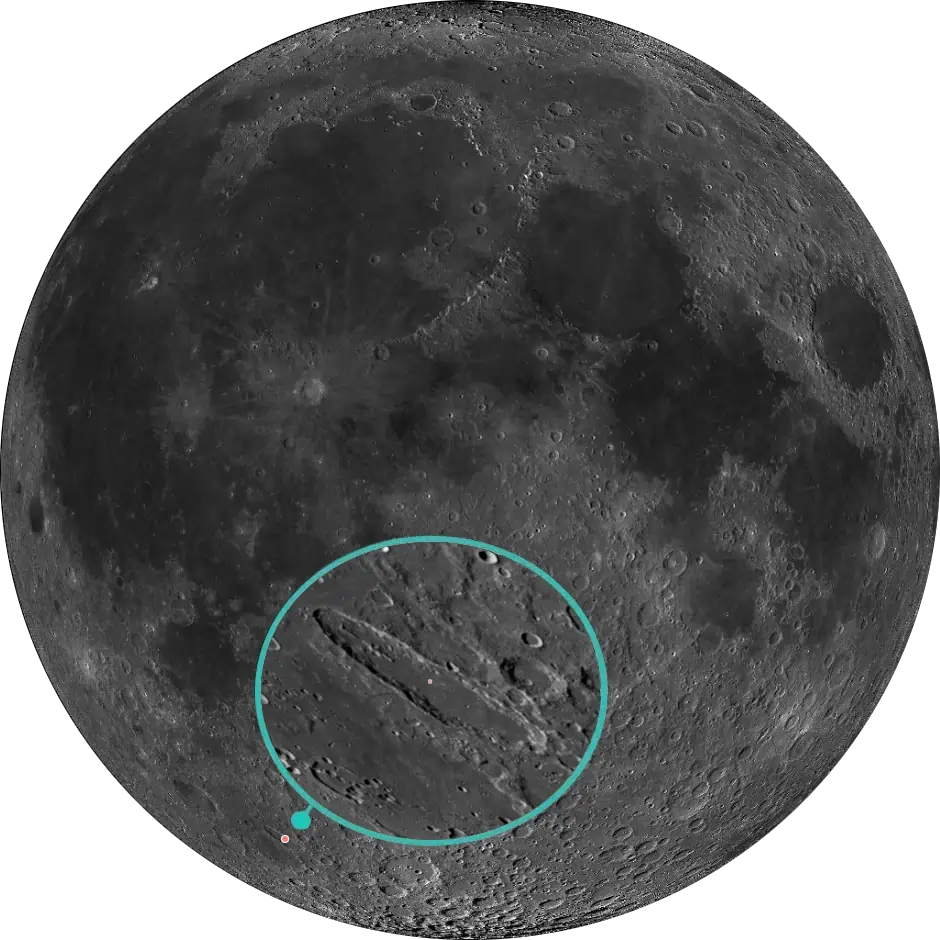
L30 Schiller
Southern Highlands📉 Vital Statistics
🔭 Field Notes
Schiller is one of the most visually distinctive craters on the near side — a long, narrow “footprint” shape unlike any other formation of comparable size. Its elongation results from two or more ancient craters merging, with subsequent lava flooding erasing interior walls and leaving a largely flat floor.
- ▶ Floor Ridge: A double ridge runs nearly linearly along the center of the northwest floor, dividing it in half — a subtle but rewarding detail at high magnification.
- ▶ Terraced Walls & Rampart: The rim is well-defined with a terraced inner wall and a slight outer rampart, contrasting sharply with the smooth lava-flooded interior.
- ▶ Bright Patches: Under high sun, bright patches are visible on the floor — most likely impact melt or highland material exposed through the lava surface.
📍 Nearby L100 Targets
- L59 Schiller-Zucchius Basin: A largely buried 325 km Pre-Nectarian peak-ring basin lying to the southwest of Schiller. Schiller sits on its northeast margin — look for the arc of low eroded ridges encircling the region.
- L6 Tycho: The Moon’s great rayed crater (85 km, 4.8 km deep), ~500 km to the northeast. Its brilliant white rays sweep past Schiller at Full Moon.
- L9 Clavius: The second-largest near-side crater (231 km), ~550 km to the northeast. A massive ancient highland walled plain with its famous floor crater arc.
🚀 Mission Log
Target Acquisition
Anchor on Tycho
Start at Tycho (L6) — the most conspicuous crater in the southern highlands, blazing white with an unmistakable ray system visible even in binoculars. It is your anchor for the entire southwestern region.
Sweep southwest to the “Footprint”
From Tycho, sweep southwest roughly 500 km toward the limb. You are looking for something unlike any other crater — an unmistakably long, narrow oval that looks nothing like its neighbours. That asymmetric, elongated shape is Schiller. At low power it reads as a lunar “footprint” or bathtub pressed into the highlands.
Read the floor at high magnification
Increase to 120x – 180x. The floor is largely flat due to ancient lava flooding — but look along the northwest half for a subtle double ridge running nearly end-to-end, dividing the floor in half. This linear feature is the key detail that separates a careful observation from a casual one.
Hunt the basin arc (L59)
Pull back to low power and look at the wider region southwest of Schiller. Schiller sits on the northeast margin of the ancient Schiller-Zucchius Basin (325 km, Pre-Nectarian). Under a low terminator Sun, a faint arc of worn ridges curves around the region — the barely-surviving rim of one of the most degraded basins on the near side.
📝 Observation Log — L30 Schiller
0/4 CompleteIs Schiller visible tonight?
Schiller is best seen when the terminator falls across the southwestern highlands — check if the Moon is approaching Waxing Gibbous (Day 10–11) or Waning Gibbous (Day 22–23).
Check Moon Phase Today
When to Observe Schiller
Schiller sits deep in the southwestern highlands at 40°W longitude — well past the terminator at First Quarter. The best views come a few days later, when low-angled sunlight catches the elongated rim and throws the floor into sharp relief. Its position close to the lunar limb also adds foreshortening that makes the crater appear even more stretched than its already dramatic 2.5:1 ratio.
- Best Viewing: 10–11 days after New Moon (Waxing Gibbous) or 22–23 days after New Moon (Waning Gibbous). The terminator crosses Schiller’s longitude at a colongitude of ~39°, roughly three days after First Quarter on the waxing side.
- Limb Foreshortening: Schiller’s southwestern position means its true 179 × 71 km footprint is compressed by perspective. This exaggerates the elongation at the eyepiece — part distortion, part spectacle.
What to Look For
At low power Schiller reads unmistakably as a pressed oval or shoe print — nothing on the near side at comparable scale looks like it. The long axis runs northwest–southeast with the wider end in the southeast, and there is a slight bend in the outline with the concave side facing northeast. Sweep past it once and you will not mistake it again.
The rim is well-defined with a terraced inner wall and a slight outer rampart. Under a low Sun these terraces cast stepped shadows onto the lava-flooded floor — a sharp contrast with the featureless interior beneath. The wider southeastern end shows the most terracing structure.
This is Schiller’s hidden detail and the real test of a careful observation. A nearly linear double ridge runs along the center of the northwest half of the floor, dividing it roughly in two. Under high magnification and steady seeing it casts a thin shadow — the feature that separates a tick-the-box sighting from a genuine study.
Near Full Moon, when shadow detail disappears, bright patches become visible on the otherwise dark lava floor — most likely highland material or impact melt exposed through the volcanic surface. These are the primary feature of interest under high illumination.
The Science: A Formation Nobody Fully Agrees On
Schiller is one of the most debated craters on the near side. Three competing theories have been seriously proposed — and the question remains genuinely open.
Theory 1 — Merged Multiple Impacts
The most widely cited explanation is that Schiller is a fusion of two or more craters, with subsequent lava flooding erasing the interior dividing walls. This accounts for the slight bend in the outline and the wider southeastern end, which suggests a second overlapping impact to the south.
Theory 2 — Oblique (Grazing) Impact
An alternative widely held today is that a single impactor struck at an extremely shallow angle, creating a series of elliptical overlapping depressions in one event. Hypervelocity impact experiments at the NASA Ames range (Gault & Wedekind, 1970s) demonstrated that very low-angle impacts can produce elongated craters — and those experiments even reproduced a central linear ridge similar to Schiller’s floor feature.
Theory 3 — Secondary Impact
A third possibility is that Schiller formed not from a primary impactor arriving from space, but from a large chunk of ejecta launched by a nearby basin-forming event and striking the surface at a shallow angle. The proximity of the ancient Schiller-Zucchius Basin makes this a plausible candidate source.
What all three theories agree on is the sequence that followed: whatever formed the outline, lava subsequently flooded the interior, buried any central structure, and left the smooth floor with its enigmatic double ridge that observers can still detect today.