
Clavius
The second-largest crater on the lunar near side — 231 km of ancient highlands, a famous floor arc, and a puzzle that has no satisfying answer: why does it look nothing like a basin?
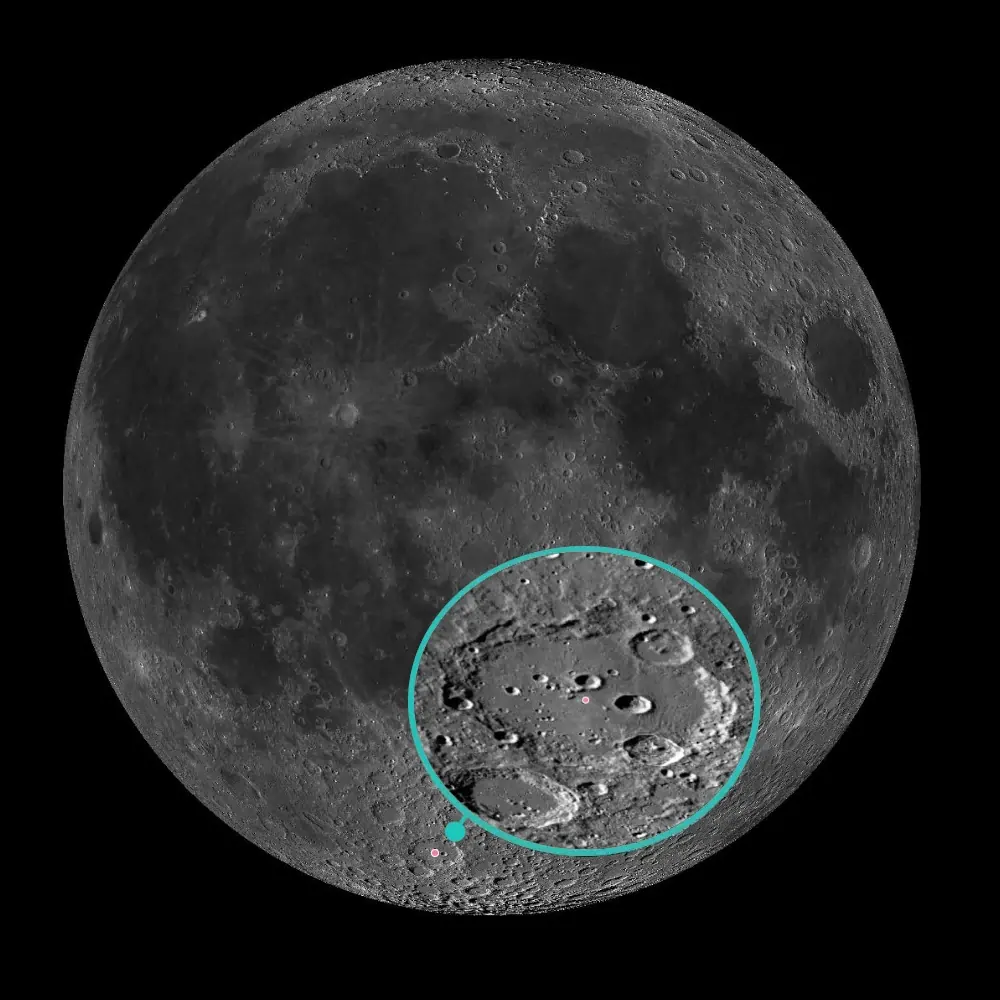
L9 Clavius
Southern Lunar Highlands📉 Vital Statistics
🔭 Field Notes
Clavius is the second-largest crater on the visible near side — yet its immense scale paradoxically deprived it of the central peaks and ring structures expected in an impact of this magnitude. Its L100 distinction is precisely that it lacks basin features despite its size. The floor hosts a famous arc of diminishing satellite craters useful for testing telescope resolution.
- ▶ Crater Arc: The chain of progressively smaller floor craters — Clavius D (28 km) down to Clavius J (12 km) — curves counterclockwise in a neat arc and serves as a classic resolution test for small telescopes.
- ▶ Water Discovery: In 2020, NASA’s SOFIA airborne observatory confirmed molecular H₂O on Clavius’s sunlit floor — the first confirmed water on a sunlit lunar surface, at 100–412 parts per million.
📍 Nearby L100 Targets
- L6 Tycho: The Moon’s most prominent rayed crater (~85 km, 4.7 km deep), lying ~200 km to the north. Its 1,500 km ray system and central peak make it a showpiece at any phase.
- L37 Bailly: The largest crater on the near side (303 km), hugging the SW limb at 66.8°S, 69.4°W. Heavily foreshortened and difficult to observe, it barely reads as a basin — the challenge is the point.
- L94 Drygalski: A massive 149 km crater at 79.3°S near the south polar limb. Partially lava-flooded with a central peak formation, visible only under favorable libration — one of the more demanding L100 targets in the south.
🚀 Mission Log
Target Acquisition
Anchor on Tycho
Start at Tycho (L6) — the most conspicuous crater in the southern highlands, blazing white with an unmistakable ray system. From Tycho, sweep roughly 200 km due south. The enormous walled plain that fills your field of view is Clavius.
Take In the Scale
At low power, the 231 km diameter means the floor curves noticeably — the far wall appears to sink below the local horizon due to the Moon’s curvature. The rim is low and heavily worn, lacking the sharp crest of a young crater. Two large satellite craters, Porter and Rutherfurd, bite into the northern and southern rim walls respectively.
Find the Crater Arc
Increase to 120x–200x and look across the floor for the famous arc of diminishing craters sweeping counterclockwise from south to north: Clavius D (28 km) → C (21 km) → N (13 km) → J (12 km). Resolving the full sequence is a reliable test of your telescope’s aperture and the steadiness of the seeing.
Check the Terminator Walls
Under a low Sun, the inner southern wall — the steepest section of the rim — casts a broad shadow across the floor. The convex floor becomes apparent as shadow pools differently in the eastern and western basins than at the central ridge. The remnant central massif between Clavius C and N catches early light as a small bright knob.
📝 Observation Log — L9 Clavius
0/4 CompleteIs Clavius visible tonight?
Check our real-time tool to see if the Moon is approaching First Quarter or Last Quarter — when the terminator falls across the southern highlands and the crater arc is at its most dramatic.
Check Moon Phase TodayWhen to Observe Clavius
Clavius sits deep in the southern lunar highlands, and unlike a mountain range it rewards observation differently at each phase. At the terminator it becomes a three-dimensional landscape of shadowed walls and lit floor. At higher Sun it reveals the full extent of its crater-pocked surface. Either way, timing is everything.
- Best Viewing: 8–9 days after New Moon (First Quarter / Waxing Gibbous) — the terminator falls across the southern highlands, throwing the crater walls and floor arc into sharp relief.
- Second Window: 21–22 days after New Moon (Waning Gibbous / Last Quarter) — shadows return from the opposite direction, revealing the western inner wall and illuminating the floor arc from a fresh angle.
- High Sun: Near Full Moon, Clavius loses shadow depth but the full scale of its heavily cratered floor becomes visible, with Porter and Rutherfurd standing out clearly against the worn rim.
What to Look For
1. The Crater Arc
Clavius’s floor hosts one of the most recognisable features in amateur lunar observing — a counterclockwise arc of progressively smaller craters sweeping from south to north. It begins with Rutherfurd (48 km) on the inner southern wall, then continues across the floor through Clavius D (28 km), C (21 km), N (13 km), and J (12 km). Despite the visual impression of a chain, the craters formed at different times through independent impacts — the arc is a coincidence of geometry, not a single event.
2. The Convex Floor
Clavius’s floor is not flat — it forms a convex plain that bulges slightly upward at the centre. Under a low Sun, shadow pools differently in the eastern and western sections of the floor than at the central ridge, making the curvature subtly visible. A small remnant central massif sits between craters C and N, catching first light as a tiny bright knob before the rest of the floor is illuminated.
3. Porter and Rutherfurd on the Rim
Two large craters have punched into Clavius since its formation. Rutherfurd (48 km) sits entirely within the southern rim, its sharp, well-preserved walls making it noticeably crisper than the worn Clavius rim around it. Porter (52 km) straddles the northeastern rim, its floor partially overlapping the interior. Comparing the two side by side illustrates relative age in a single glance — Rutherfurd is Copernican in age and much younger than the Nectarian-age Clavius and Porter.
The Science: Too Big to Form a Basin
Clavius presents a genuine geological puzzle. At 231 km across, it should by rights have formed a multi-ring basin with a prominent peak ring — the same process that created the vast ringed basins like Orientale and Imbrium. Instead, its floor is nearly featureless. This is its L100 distinction: lacks basin features in spite of its size.
- The Impact: Around 3.9 billion years ago, a large impactor struck the southern highlands during the Nectarian period. The crater was large enough that the transient cavity should have collapsed into a peak ring structure rather than a simple central peak.
- The Missing Ring: No peak ring is visible — and it remains unclear whether one ever formed or whether it lies buried beneath the crater’s impact melt and ancient volcanic infill that resurfaced the floor.
- Subsequent Bombardment: The heavily cratered floor reflects billions of years of continued impacts on a stable, ancient surface. Every named crater within Clavius postdates the original formation event by hundreds of millions of years or more.
The SOFIA water detection in 2020 added another dimension: molecular H₂O was confirmed on Clavius’s sunlit floor at 100–412 parts per million, trapped in tiny glass beads formed by micrometeorite impacts. Clavius is no longer just a geological curiosity — it is a benchmark site for understanding how water persists across the lunar surface far from the poles.
Return to the List
Ready to find the next target? Go back to the full map to see what else is visible tonight.
← Back to Lunar 100 Map