

Cosmic Background
Radiation
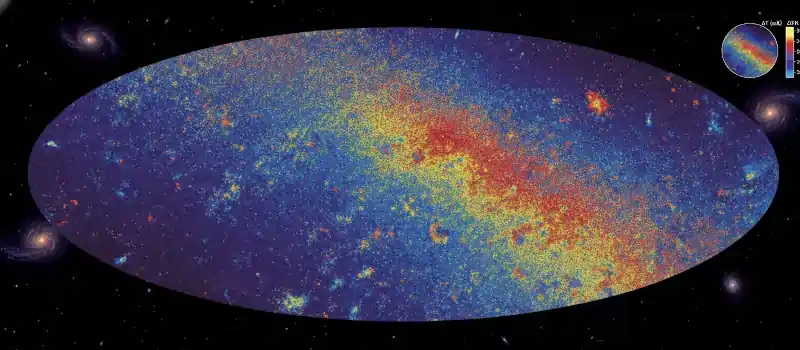
What fills the gaps between the stars?
The night sky looks black because our eyes are tuned to a narrow window of the electromagnetic spectrum. But that darkness is an illusion. Every cubic centimetre of space — including the air in this room — is saturated with ancient photons that have been travelling since the universe was 380,000 years old.
Radiation that predates everything you can see
The Cosmic Microwave Background (CMB) is thermal radiation filling the observable universe almost uniformly. It is a remnant from an early stage of the cosmos — specifically, the moment approximately 380,000 years after the Big Bang when the universe had cooled enough for protons and electrons to combine into neutral hydrogen atoms for the first time.
Before this moment — called recombination — the universe was a hot, opaque plasma. Photons and matter were coupled together in a constant storm of scattering. Light could not travel freely. Then, within a cosmological instant, the fog cleared. The photons that were released at that moment have been travelling through space ever since, and we detect them today as the CMB.
The CMB is the oldest light we can ever observe — a photograph of the universe as it looked 13.8 billion years ago, stretched by cosmic expansion into the microwave band.
Cosmological consensus — confirmed by COBE, WMAP & PlanckAn accidental detection that changed cosmology
In 1964, Arno Penzias and Robert Wilson at Bell Labs in New Jersey were attempting to use a large horn antenna for satellite communications. They discovered a persistent, uniform hiss of microwave noise that they could not eliminate — regardless of direction, season, or the removal of pigeon droppings from the antenna horn.
Meanwhile, Robert Dicke and his colleagues at Princeton were actively searching for exactly this signal. When Penzias and Wilson connected with Dicke’s group, the two teams immediately understood: the noise was the CMB — the thermal afterglow of the Big Bang, predicted decades earlier by George Gamow, Ralph Alpher, and Robert Herman.
The discovery dealt a decisive blow to the competing Steady State theory of cosmology, which held that the universe had no beginning. A universe born in a hot, dense state would inevitably leave behind exactly this kind of thermal radiation — and here it was, filling the sky in every direction.
Penzias and Wilson received the 1978 Nobel Prize in Physics for their discovery. The CMB remains the most precisely measured blackbody spectrum in nature, matching Planck’s law to better than one part in 10,000.
Three satellites have mapped it in detail
NASA’s COBE satellite (1989) first confirmed the CMB’s blackbody spectrum with exquisite precision and detected the anisotropies. WMAP (2001) mapped those temperature fluctuations at 13 arcminute resolution. The ESA’s Planck satellite (2009) produced the definitive map at 5 arcminutes — revealing the precise values of cosmological parameters including the age of the universe (13.799 ± 0.021 billion years), the Hubble constant, and the composition of matter and dark energy.
Big Bang
The universe begins in an extraordinarily hot, dense state. Inflation expands spacetime exponentially in a fraction of a second, seeding quantum fluctuations that will become the large-scale structure of the cosmos.
Nucleosynthesis
The universe cools enough for protons and neutrons to fuse into helium and trace amounts of lithium. The ratio of hydrogen to helium — roughly 3:1 by mass — is set permanently here.
Recombination
The universe cools to ~3,000 K. Electrons combine with protons to form neutral hydrogen. The universe becomes transparent. The photons released at this moment are what we detect as the CMB today — redshifted from 3,000 K to 2.725 K by 13.8 billion years of cosmic expansion.
Cosmic Dawn
The CMB’s tiny temperature fluctuations — 1 part in 100,000 — act as seeds. Gravity amplifies slight overdensities. The first stars and galaxies form in those regions, ending the cosmic dark ages.
Today
CMB photons permeate all of space at 2.725 K. Every microwave receiver — from radio telescopes to the component inside a microwave oven — detects a tiny fraction of this ancient light. The universe’s oldest electromagnetic signal surrounds us right now.
The seeds of every galaxy
The CMB’s temperature anisotropies — the small hot and cold patches across the sky — directly reflect the density fluctuations present in the early universe. Denser regions attracted more matter under gravity. Over billions of years, these became galaxy filaments, clusters, and the cosmic web we observe today.
Without these quantum fluctuations amplified by inflation and imprinted on the CMB, the universe would be perfectly uniform. There would be no stars, no planets, no observers.
A perfect blackbody in nature
The CMB’s frequency spectrum is the most perfect blackbody spectrum ever observed — more perfect than any source physicists can create in a laboratory. It deviates from an ideal Planck distribution by less than 50 parts per million, confirming that the early universe was in near-perfect thermal equilibrium.
The acoustic peaks in its power spectrum — the pattern of angular scales at which fluctuations are strongest — encode precise values for the density of ordinary matter, dark matter, and dark energy.
Evidence for an accelerating universe
The CMB power spectrum, combined with observations of distant supernovae, reveals that roughly 68% of the universe’s energy density is in the form of dark energy. Unlike ordinary matter or radiation, dark energy exerts negative pressure — meaning it acts in opposition to gravity, causing the expansion of space to accelerate rather than slow down over time. The CMB provides our best single constraint on this value.
The precise positions of the acoustic peaks also confirm that the universe’s overall geometry is flat — consistent with Euclidean geometry at cosmic scales to within 0.4%.
What we are still searching for
The next frontier is CMB polarisation — specifically the B-mode polarisation signature that would be produced by primordial gravitational waves generated during inflation. Detection would constitute direct evidence for inflation and constrain the energy scale at which it occurred.
Experiments like the Simons Observatory and CMB-S4 are on track to achieve the sensitivity needed to detect or rule out this signal. JAXA’s LiteBIRD satellite is also designed for this measurement, though its launch has slipped from its original target to a current expected window around the early 2030s.
Frequently asked questions
Common questions about cosmic background radiation, answered.
Cosmic background radiation is thermal radiation that fills the entire observable universe nearly uniformly. It is the electromagnetic afterglow of the Big Bang — specifically, the light released approximately 380,000 years after the universe began, when it had cooled enough for electrons and protons to combine into neutral hydrogen atoms for the first time. Before that moment the universe was an opaque plasma; afterwards, it became transparent, and those released photons have been travelling through space ever since. Today we detect them in the microwave band at a temperature of just 2.725 Kelvin.
Cosmic background radiation comes from the surface of last scattering — a spherical shell around us representing the state of the universe at recombination, approximately 380,000 years after the Big Bang. At that moment, the universe cooled to around 3,000 Kelvin, electrons and protons combined into neutral hydrogen, and the plasma that had previously scattered all light became transparent. The photons released at that instant decoupled from matter and have been travelling freely through space in all directions ever since. Because the universe is expanding, we receive these photons from every direction in the sky, giving the CMB its characteristic uniformity.
Cosmic background radiation was caused by the cooling of the early universe following the Big Bang. In the first hundreds of thousands of years, the universe was a hot, dense plasma so energetic that photons could not travel more than a tiny distance before being scattered by free electrons. As the universe expanded, it cooled. At around 380,000 years old — a transition called recombination — the temperature dropped to approximately 3,000 Kelvin. At this point electrons and protons combined into neutral hydrogen atoms for the first time, removing the particles that had been scattering light. The photons were suddenly free to travel unimpeded, and the radiation we detect today as the CMB is those same photons, cooled and stretched by cosmic expansion to 2.725 Kelvin.
Cosmic background radiation was accidentally discovered in 1964 by Arno Penzias and Robert Wilson, two radio astronomers working at Bell Labs in New Jersey. While calibrating a large horn antenna intended for satellite communications, they detected a persistent, uniform microwave hiss that could not be eliminated regardless of the direction they pointed the antenna or the time of year. After ruling out all terrestrial sources — including pigeon droppings inside the horn — they connected with a team at Princeton led by Robert Dicke, who was independently searching for exactly this signal. The two groups immediately recognised that Penzias and Wilson had found the thermal afterglow of the Big Bang. Penzias and Wilson were awarded the Nobel Prize in Physics in 1978 for the discovery.
Cosmic background radiation is evidence for the Big Bang because its existence, temperature, spectrum, and structure are all precisely predicted by Big Bang cosmology and cannot be explained by competing models. A universe that began in a hot, dense state and has been expanding and cooling for 13.8 billion years would inevitably produce a uniform thermal glow in the microwave band — exactly what we observe. The CMB’s blackbody spectrum matches Planck’s law to better than one part in 10,000, consistent only with a universe that was once in near-perfect thermal equilibrium. The competing Steady State model, which held that the universe has always existed in roughly its current form, predicted no such radiation and was effectively ruled out by the CMB’s discovery in 1965.
Cosmic background radiation indicates that the universe had a hot, dense beginning approximately 13.8 billion years ago and has been expanding and cooling ever since. More specifically, it indicates that the universe passed through a stage called recombination — when it was about 380,000 years old — at which point matter and radiation decoupled and the cosmos became transparent for the first time. The small temperature variations imprinted on the CMB indicate that the early universe was not perfectly smooth: it contained tiny density fluctuations, seeded by quantum processes during inflation, that gravity would later amplify into every galaxy, star, and planet we observe today. The overall pattern of the CMB also indicates that the geometry of the universe is spatially flat, and that its energy content is approximately 5% ordinary matter, 27% dark matter, and 68% dark energy.
Cosmic background radiation cannot be seen with the human eye because it falls in the microwave band of the electromagnetic spectrum, far below the frequencies our eyes can detect. It is observed using microwave-sensitive radio receivers and antennas. On Earth, dedicated radio telescopes can detect it, though ground-based observations are hampered by absorption and emission from the atmosphere. The most detailed maps have been produced by satellites placed above the atmosphere: NASA’s COBE (1989), WMAP (2001), and ESA’s Planck (2009) satellites each produced increasingly precise full-sky maps of the CMB. Interestingly, a small fraction of the static seen on analogue television sets tuned to an empty channel — typically around 1% — comes from CMB photons striking the antenna, making it one of the few ways a person can indirectly “see” this ancient light with everyday technology.
Technical Expansion
Analyze Further High-Fidelity Physics Intelligence
🌑 Why is Space Black?
Understand the technical solution to Olbers’ Paradox and how the expansion of space-time hides the early universe’s light.
🌌 Multiverse Theory
Analyze the “Level 2” multiverse theory, where CMB anomalies are interpreted as evidence of collisions between bubble universes.
🔦 Does Light Have Weight?
Study the relationship between photon momentum and energy density—the core physics that allows us to measure ancient light.