

Does Light Have Weight?
Photons have no mass — yet they can push a spacecraft across the solar system, bend around a black hole, and blow a comet’s tail millions of kilometres into space. In this article we explore the physics of radiation pressure, why massless particles carry momentum, and how NASA is using the weight of sunlight to propel real missions through deep space right now.
Solar Sail Propulsion Lab
Push the throttle to increase Solar Simulator intensity and watch radiation pressure propel the spacecraft.

NASA ACS3: Solar Sail in Orbit Now
The spacecraft in the simulator above is based on a real vehicle currently orbiting Earth. NASA’s Advanced Composite Solar Sail System (ACS3) launched aboard a Rocket Lab Electron rocket from New Zealand in April 2024. It uses no fuel — its entire propulsion system is a 9-metre-per-side square sail, roughly the size of a small apartment, pushed through space by the pressure of sunlight alone.
Does Light Have Weight?
Investigating the phenomenon of radiation pressure, photon momentum, and how light physically moves the universe.
The Massless Force
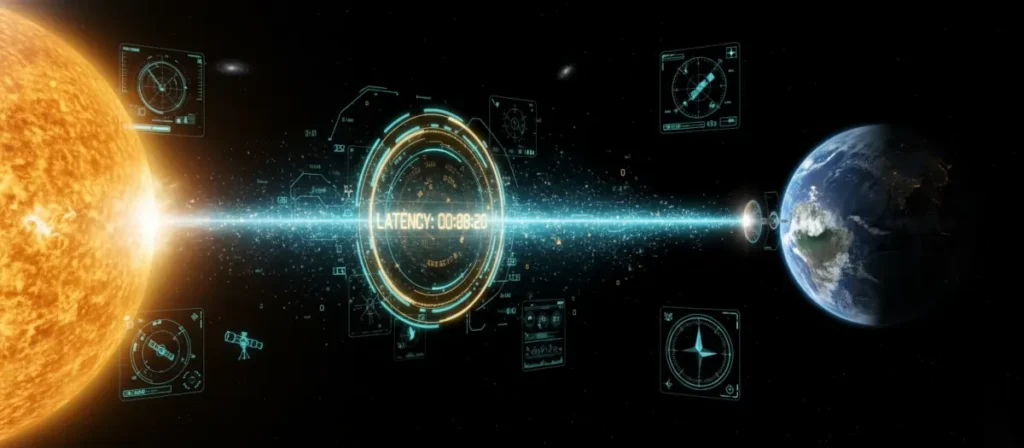
To answer the question of whether light has weight, we must first distinguish between rest mass and momentum. In classical physics, weight is the result of gravity acting on mass. Since photons (the particles of light) have zero rest mass, they technically have no “weight” in the traditional sense. However, as demonstrated in the simulator above, light carries momentum.
When a beam of light strikes an object, it doesn’t just pass through or disappear; it reflects or is absorbed. In that moment, it transfers its momentum to the object. This transfer creates a physical push known as radiation pressure. While this force is miniscule—the sunlight hitting your body exerts only about as much pressure as a single grain of sand—on a cosmic scale, it is powerful enough to shift the orbits of asteroids and propel vast interstellar sails.
Calculated by the formula p = h/λ. Even without mass, the energy and wavelength of a photon create a kinetic impact upon collision.
According to E=mc², energy and mass are interchangeable. Because light has high energy, it possesses an “equivalent mass” while in motion.
Named after the radiometer, this proves that a high-vacuum environment allows light to spin vanes purely through photon bombardment.
How Light Shapes the Cosmos
The “weight” or force of light is responsible for some of the most striking phenomena in the night sky. For example, have you ever wondered why a comet’s tail always points away from the Sun, regardless of the direction the comet is traveling? That is the result of solar radiation pressure physically blowing the dust and gas off the comet’s nucleus.
Technical Deep Dive: Solar Sails
Space agencies like NASA and JAXA are currently testing Solar Sails—massive, ultra-thin reflective sheets that use nothing but the pressure of sunlight to accelerate. Because there is no friction in a vacuum, the constant “weight” of photons hitting the sail allows a spacecraft to reach incredible speeds without a single drop of fuel.
Einstein and the “Weight” of the Sun
Because the Sun is constantly emitting light, it is actually losing weight. Every second, the Sun converts about 4 million tons of its own mass into energy in the form of sunlight. This energy radiates outward, carrying that original mass with it in the form of momentum. If you were to trap all the light inside a perfectly reflective box, the box would technically weigh more than it did when it was dark, because of the energy density contained within.
Practical Applications in Modern Science
- Optical Tweezers: Scientists use highly focused laser beams to physically pick up and move microscopic biological cells. This is “light-weight” manipulation in its most literal form.
- Asteroid Deflection: By painting one side of an asteroid white, scientists can use the pressure of sunlight to gradually “nudge” its orbit over decades, potentially preventing a collision with Earth.
- Laser Propulsion: Projects like Breakthrough Starshot aim to fire earth-based lasers at tiny probes, using intense photon pressure to reach 20% the speed of light.
So, does light have weight? If you stand on a scale and turn on a flashlight, the number won’t change. But if you are a spacecraft in the void of the solar system, or a comet orbiting the sun, the “weight” of light is the primary force that dictates your path through the stars. Light may be massless, but it is never powerless.
Frequently Asked Questions
The physics of photon mass, momentum, and radiation pressure — answered.
⚛️ Does light have mass? ▼
🌌 If light has no weight, why does gravity bend it? ▼
📦 If you trap light in a box, does the box get heavier? ▼
🔦 Does a flashlight weigh less when it is turned on? ▼
🌍 How much force does sunlight exert on Earth? ▼
🛸 Could a solar sail actually reach another star? ▼
Technical Expansion
Analyze related high-fidelity astronomical data
Sky Clarity & Bortle Scale
Understand the atmospheric interference that affects how we perceive the blackness of the night sky.
The Dark Side of the Moon
Is the ‘Dark Side’ actually dark? Technical recon on lunar rotation and solar illumination patterns.
Do Stars Move?
Trace the proper motion of stars and how galactic rotation affects their position in the dark void.
The Lunar 100 Guide
Transition from the blackness of deep space to the high-contrast geological reality of the Moon.
Moon Photography Masterclass
Technical settings for capturing brilliant lunar light against the pitch-black backdrop of space.
2026 Astronomy Calendar
Plan your next observation mission. A complete log of eclipses, meteor showers, and planetary events.