

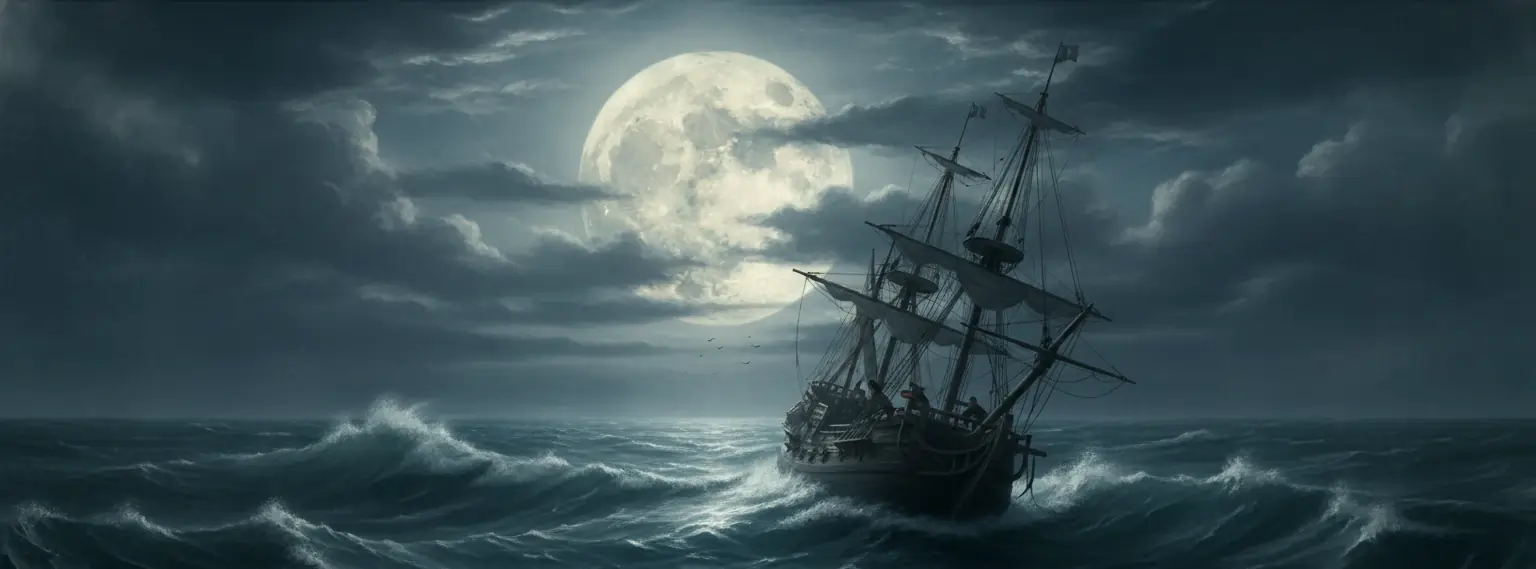
Why Sailors Feared the Full Moon
For the modern traveller, a full moon over the ocean is a scene of unparalleled beauty. For the men who sailed the wooden ships of the 18th and 19th centuries, that same silver glow was often met with dread.
To a seasoned mariner, the full moon was not a romantic light; it was a "thief of stars," a "maker of monsters," and a harbinger of the "lunacy" that could tear a crew apart. While we might dismiss their fears as mere superstition, a closer look at maritime history reveals that the sailors' terror was rooted in a sophisticated, if sometimes misunderstood, awareness of the natural world. Their fear wasn't just about ghosts — it was about physics, navigation, and the fragile state of the human mind under pressure.
The Invisible Giant: The Physics of the Spring Tide
The most immediate and practical reason a sailor feared the full moon lay beneath the hull of his ship. While sailors of old might not have had a textbook understanding of gravity, they were acutely aware of the Spring Tide. Contrary to its name, a Spring Tide has nothing to do with the season. It occurs twice a month — during the new moon and the full moon — when the Earth, Sun, and Moon align in a straight line. During this alignment, the gravitational pull of the sun reinforces the moon's pull, creating the month's most extreme tidal shifts.
For a captain navigating a heavy, wind-driven vessel, the full moon meant that the water was moving with a violence not seen at other times of the month. High tides became dangerously high, often pushing ships into coastal areas where they might clear a reef during the day, only to be trapped as the tide went out. Even more terrifying was the ebb — the extreme low tide. During a full moon, the water recedes further than usual, exposing sandbars, jagged rocks, and hidden shoals normally buried safely under several fathoms of water.
"Woke at 2 bells to find the ship hard upon a bar not three fathoms deep the night previous. The tide gone out monstrous far. Three hours of kedging to free her. Two men injured at the capstan. The moon was full and bright as a lantern. God save us from such light."
— Attributed to a British merchant captain, c. 1784
Historical logs are filled with accounts of ships "tiding over" — the grueling process of anchoring a ship to wait out a powerful current that the wind wasn't strong enough to overcome. During a full moon, these currents could reach speeds that would physically pull a ship backward or drag its anchor across the seabed. For a crew already exhausted by weeks at sea, the full moon didn't mean a peaceful night's rest; it meant back-breaking labour, constant vigilance, and the very real possibility of waking up to find their ship splintering against a rock that wasn't there the night before.
The Thief of Stars: The Navigational Nightmare
In the era before GPS and radar, a sailor's life depended on his ability to read the sky. Navigation was a sacred art, performed with a sextant and a deep knowledge of the constellations. The North Star and other navigational stars were the only reliable maps in a featureless wilderness of blue. And here the full moon presented an almost cruel irony — because in the 18th century, before accurate marine chronometers became widely available, the moon was also the solution to the hardest navigational problem of the age.
Determining longitude at sea was, for most of the 1700s, effectively impossible without measuring the angular distance between the moon and specific stars — a technique called "shooting the lunars." The method required a sharp view of the moon against a dark, star-filled sky. The full moon, by washing out those very stars with its own light, made the one calculation that could tell a captain where he was east-to-west completely unworkable. The navigator was left with dead reckoning — estimating position from speed, heading, and elapsed time — and praying the current hadn't dragged him somewhere he didn't expect.
The full moon compounded this by creating a "false horizon." To use a sextant accurately, a navigator needs a crisp, clean line where sea meets sky. Under the glare of a full moon, the horizon becomes a shimmering, hazy blur. Even small sextant errors compound over distance — in the treacherous waters of the Caribbean or the South China Sea, being a few miles off course was often the difference between safe passage and a fatal collision with a reef that didn't appear on any chart.
Even more subtly, the full moon ruined the night vision of the lookouts. Human eyes take nearly thirty minutes to fully adjust to deep darkness. On a moonlit deck, the lookouts' pupils remained constricted. When they peered into the deep shadows cast by the ship's sails or looked away from the moon's reflection on the water, they were effectively blind — they could miss the dim white foam of a distant breaker or the dark silhouette of an iceberg until it was far too late to turn.
The Biological Frenzy: Predators and the Living Sea
Beyond the physics and the navigation, there was the eerie behaviour of the ocean itself. Sailors were keen observers of nature, and they noticed that the sea changed under a full moon. Some modern research suggests the lunar cycle influences the behaviour of certain shark species, possibly because the increased light makes hunting easier in shallow water — though the evidence remains mixed and scientists debate how significant the effect is. To a sailor of the 1700s, none of that nuance mattered. Falling overboard was almost a guaranteed death sentence at the best of times, and during a full moon, the sight of dorsal fins cutting through the silver water added a layer of primal terror to an already lethal risk.
Then there was the bioluminescence. Certain types of plankton and jellyfish glow when disturbed, and their spawning cycles are often tied to the moon. Under a full moon, the wake of a ship could suddenly erupt in an otherworldly green or blue fire. To a modern scientist, this is a beautiful chemical reaction. To a 19th-century sailor, it was "the sea boiling" — a sign that the water was inhabited by spirits or sea monsters.
The "Lunacy" of the Long Voyage
Perhaps the most human reason for fearing the full moon was its perceived effect on the mind. The very word "lunacy" is derived from Luna, the Roman goddess of the moon. For centuries, it was a widely held belief — not just among sailors, but among physicians — that the moon's gravity pulled on the humors or fluids in the human brain just as it pulled on the tides of the ocean.
On a ship, this lunar influence was amplified by the environment. Sailors lived in cramped, damp, and high-stress conditions. They slept in hammocks on open decks or in berths with no curtains. During a full moon, the night was nearly as bright as a cloudy day. Sleep deprivation was rampant. Without sleep, irritability turned into aggression. Long-standing grudges between crewmates boiled over. Captains, many of whom were paranoid about mutiny, watched their crews with extra suspicion during the full moon.
"Three men in irons this morning. The boatswain says they simply went for each other in the middle watch. No cause apparent. The moon was full. I have lost four good men to the brig in the past fortnight, all of it under this accused light. I shall be glad when she wanes."
— Master's log, HMS Perseverance, c. 1801 (reconstructed)
While we now know that moonlight doesn't cause insanity, the psychological effect of the full moon was very real. The fear of sleeping under it was documented enough to earn its own entry in Admiral W.H. Smyth's Sailor's Word-Book of 1867, which defines "moon-blink" as a temporary night blindness brought on by sleeping in tropical moonshine — a real but poorly understood condition, probably linked to the vitamin A deficiency that plagued long-voyage crews. Sailors conflated this with the broader terror of lunar madness and went to extraordinary lengths to cover their faces with sailcloth while sleeping, convinced that "moonlight exposure" would addle their brains permanently. The combination of genuine sleep deprivation, eerie silver lighting, and the collective expectation that something bad was coming often led to a self-fulfilling prophecy. On a ship, belief was as dangerous as physics.
Omens and Apparitions: The Folklore of the Moon
Finally, the full moon was the centrepiece of a complex system of maritime omens. The most famous of these was the lunar halo — a bright ring of light that sometimes appears around the moon. While sailors saw this as a supernatural warning, it was actually a remarkably accurate piece of meteorology. These halos are caused by the refraction of light through ice crystals in high-altitude cirrus clouds, which are often the precursors to a warm front and an approaching storm.
The sailors' rhyme — "A ring around the moon / Means rain will be here soon" — was a survival rule. When that ring appeared, the crew knew they had to shorten sail and prepare for a battering. The light of the full moon also fed the most famous ghost ship sightings, though not quite in the way the legend tells it. The Flying Dutchman legend dates to the 17th century and is rooted in the Cape of Good Hope, where storms were catastrophic and losses routine — its first known written account appears in 1790 with no particular connection to the full moon. What the moonlit sea genuinely produced was the conditions for a natural optical phenomenon called Fata Morgana — a superior mirage in which layers of warm and cold air bend light across the horizon, causing distant ships to appear floating above the waterline, distorted and glowing, before vanishing entirely. Under a full moon, these mirages were vivid enough to send a lookout to his knees. The moon didn't conjure the Flying Dutchman. It just made the ocean look like it could.
The Silver Double-Edged Sword
In the end, the sailor's fear of the full moon was a rational response to a genuinely lethal environment. It is worth remembering that Lloyd's of London — the world's insurance market — was founded in 1688 specifically because maritime losses were so catastrophic and so routine that an entire financial industry existed to absorb them. These men were not superstitious fools. They were calculating risk in real time, on wooden ships, without instruments we now take for granted, in waters that killed the unlucky and the careless in equal measure. The moon was a double-edged sword: it provided the light they needed to work the ropes at night, but it also robbed them of the stars they needed to navigate, amplified the tides that could beach a ship by dawn, and stole the sleep that kept a crew functional and a captain sane.
We cross the oceans today in steel ships guided by satellites that do not care if the sky is bright or dark. We have forgotten the deep, visceral connection our ancestors had with the lunar cycle. But if you ever find yourself on the deck of a small boat in the middle of the ocean on a night when the moon is full, take a moment to look at the water. Notice the height of the waves, the speed of the current, and the way the shadows play tricks on your eyes. You might find that, just for a second, you feel that same ancient shiver that the sailors of old felt — a reminder that we are all, in some way, still governed by the silver lady in the sky.
"The moon was a double-edged sword: it provided the light they needed to work the ropes at night, but it also robbed them of their stars, messed with their tides, and stole their sleep."