

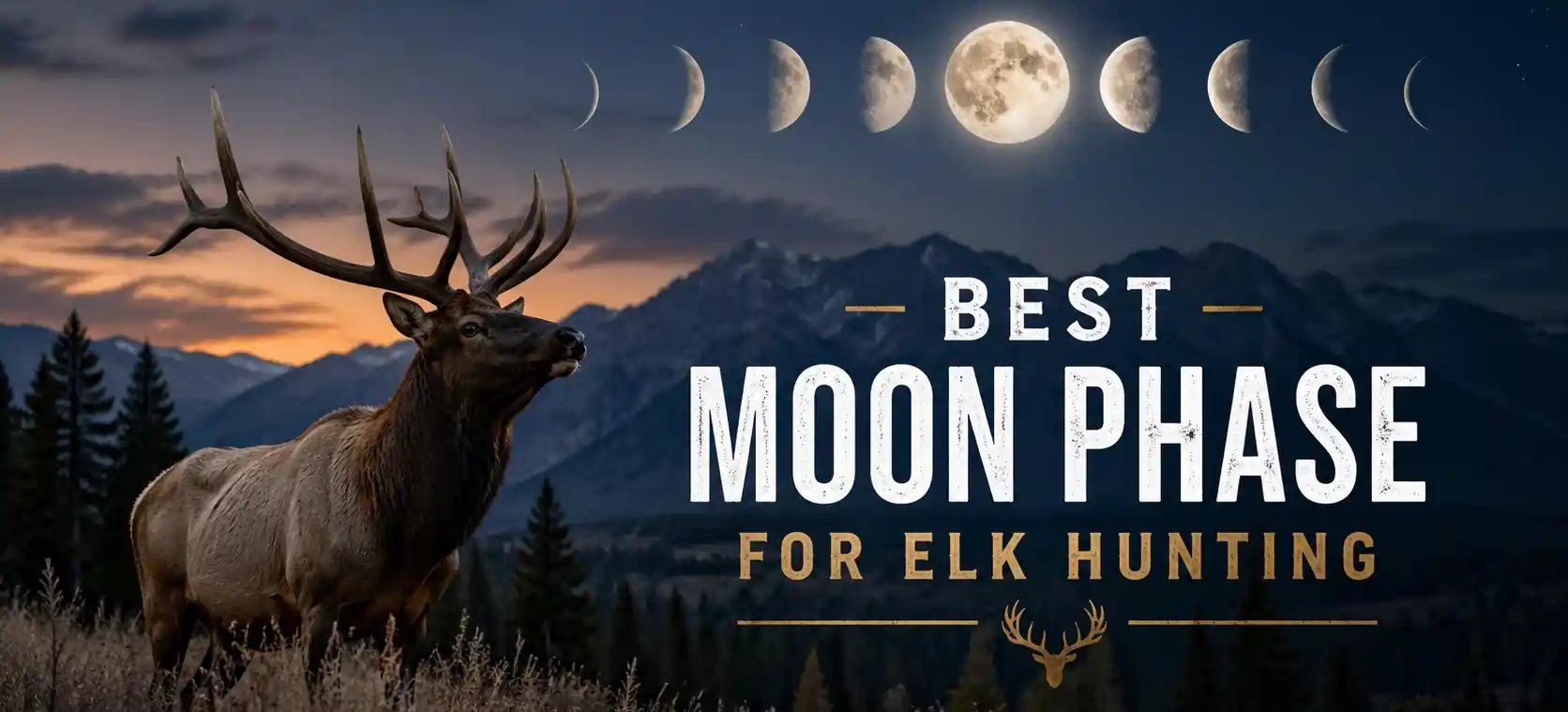
Best Moon Phase
for Elk Hunting
A complete guide to reading the lunar cycle and turning celestial timing into trophy bulls
Every elk hunter knows the mountain. The best ones also know the sky. This field manual decodes every phase of the lunar cycle — how it shapes elk feeding, movement, bugling, and bedding — and translates that knowledge into decisive, phase-specific hunting strategy.
The Science of Lunar Influence
Understanding moon phase hunting starts with biology, not folklore. The moon isn't magic — it controls light levels at night, which directly governs when elk feel safe enough to move and feed in the open.
Elk are crepuscular and, to some degree, nocturnal feeders when conditions allow. The critical insight is this: the moon doesn't change when elk need to eat — it changes when they feel safe enough to eat in the open. Brighter nights mean more nocturnal grazing, which depletes their daytime hunger and reduces movement during legal shooting hours. Darker nights force the feeding window into daylight, compressing elk activity into your hunting hours.
Secondary lunar effects include gravitational pull — often cited in the Solunar Theory developed by John Alden Knight in 1926 — which suggests that gravitational forces influence the feeding and movement of all wildlife, including elk. Whether this mechanism is fully proven is debated, but experienced guides consistently observe that elk activity peaks during major and minor Solunar periods, which correlate strongly with moon position overhead and underfoot.
"The moon is not a superstition. It is a light source. Change the light, and you change when prey animals feel safe. Change that, and you change everything about the hunt."
— Field observation, experienced wilderness guideFor practical hunters, the takeaway is straightforward: track the moon, adjust your setup locations and timing, calibrate your calling intensity, and you will put yourself in front of elk during legal light far more consistently than hunters who ignore it.
The Four Primary Windows
The lunar cycle is continuous, but four primary phases define the rhythm of elk behavior. Each creates a distinct behavioral signature — learn to read them and you will always know where to be and when.
Pitch-black nights force elk to complete most feeding during daylight, producing the most reliable and prolonged movement of any phase. Expect strong morning and evening pushes from bedding to feeding areas. Elk that would normally linger in open meadows after dark are compressed into tight, visible windows at first and last light. Bulls are more vocal and more willing to challenge, as reduced ambient light makes them feel less exposed. This is the phase for aggressive, ground-covering tactics — covering drainages, working pinch points, and calling hard.
Bright nights allow elk to feed and travel for hours before legal light even begins. By the time you're in the field, many bulls have already fed and bedded. Morning hunts are often quiet and frustrating; elk disappear into dark timber well before sunrise. The strategy shift is total: abandon the standard dawn-dusk approach and focus on mid-day water sources, wallow complexes, and deep-timber still-hunting. The full moon rewards patience and stealth over aggression. Calls should be whisper-soft; these animals are well-fed, rested, and alert.
The moon rises near midday and provides usable light through the early evening, making the latter half of the day disproportionately productive. Elk begin moving earlier in the afternoon than they would under a full moon, responding to the natural feeding impulse as the day cools. Focus your energy on the last three hours of light: glass transition zones from elevated vantage points, set up ambushes near wallows, and work soft cow calls as elk begin filtering from their beds. Mornings are average to slow, but evenings frequently come alive. Rearrange your camp schedule accordingly.
As the moon wanes and nights darken progressively, elk front-load their feeding into the final hours of moonlight and continue well into first light. This creates the most productive dawn hunts outside the new moon phase. Position yourself on feeding-to-bedding travel routes before gray light. Bulls moving back to their daylight beds at dawn are highly susceptible to aggressive bugling and challenge calls — they're vocal, on the move, and slightly hungry. Hit them hard in the first hour. Mid-day is dead. Evenings pick back up slightly as nights continue darkening toward the next new moon.
All Eight Phases at a Glance
The complete lunar cheat sheet. Score, prime window, and calling intensity for every phase — bookmark this and never leave camp without checking it.
| Phase | Score | Prime Window | Core Strategy | Calling Intensity |
|---|---|---|---|---|
| 🌑 New Moon | 90/100 | First light & last hour | Aggressive stalking, pinch points, bedding-to-feed transitions. Cover maximum ground. | Full bugling, challenge calls, herd talk. Go hard. |
| 🌒 Waxing Crescent | 75/100 | First light to 9 AM | Intercept feeding-to-bedding movement. Focus on thermal corridors and valley heads. | Standard bugles, estrus whines. Soften after 9 AM. |
| 🌓 First Quarter | 60/100 | 2 PM to dark | Evening ambush near water and wallows. Glass from elevation before moving in. | Soft cow calls, occasional contact bugles. Patient listening. |
| 🌔 Waxing Gibbous | 45/100 | Mid-day pressure only | Still-hunt dense dark timber and water sources. Elk in thick cover avoiding light. | Minimal. Subtle cow mews only. Focus on silent tracking. |
| 🌕 Full Moon | 30/100 | 10 AM – 2 PM | Deep timber still-hunts, quiet water approaches. This is a scouting day as much as a hunting day. | Very subtle calls. Prioritize visual spotting and silent stalks over calling. |
| 🌖 Waning Gibbous | 40/100 | 2 PM to dark | Glass large basins from vantage points. Intercept late movers heading to feed. | Locator bugles to confirm presence. Cow calls if rutting activity is apparent. |
| 🌗 Last Quarter | 65/100 | Dawn feeding return | Aggressive dawn intercept along feeding-to-bedding corridors. Fresh sign essential. | Strong bugling and challenge calls at first light. Herd talk to maintain engagement. |
| 🌘 Waning Crescent | 80/100 | First light & evening transition | Active stalking into drainages and dark timber at dawn. Be ready for responsive bulls. | Consistent bugling with herd talk. Aggressive calling often works as nights darken. |
Phase-by-Phase Deep Tactics
Knowing a phase's score is one thing. Knowing precisely what to do with your feet, your calls, and your eyes when you're in the field is another. Here's the granular approach for each major phase group.
Core Approach
Dark moon periods are your best overall hunting windows. Elk are behaviorally compressed into daylight activity, and the combination of hunger and darkness makes them more vocal and less cautious. Don't waste these days on conservative setups.
- Be on location at least 45 minutes before first legal light. Bulls may already be bugling in the dark, and you want to have your setup finalized before shooting light arrives.
- Focus your morning energy on the transition from feeding meadows back toward timber. Elk moving to bed are still receptive to calls and will veer off their route to investigate a challenge bugle.
- Work pinch points between open feeding areas and heavy timber. A bull funneled through a gap in the trees is a bull you can intercept without bumping the entire herd.
- Evening setups should mirror mornings in reverse: position between bedding cover and destination feeding, with thermals in your favor. Use herd talk (cow mews, calf calls, feeding sounds) to draw cautious cows that bring the bull with them.
- Don't over-call. Even in prime conditions, space your sequences with enough silence to hear a response. A bull circling downwind is silent — listen for footsteps, antler raking, and branch snapping.
Core Approach
Quarter phases require a timing split. First Quarter favors evenings; Last Quarter favors mornings. Hunters who don't adjust — and hit both ends of the day equally — consistently underperform hunters who shift their energy to the productive window and rest during the slow one.
- First Quarter mornings: Expect a slower start. Use the morning to scout — observe from a distance without pressure. Mark beds, confirm travel routes, find fresh rubs. Save your aggressive play for afternoon.
- First Quarter evenings: Begin setting up by 2:30–3:00 PM. The moon is overhead and elk begin stirring earlier than you might expect. Wallow ambushes and water sources can pay off in the 3–5 PM window before the traditional evening rush.
- Last Quarter dawns: This is a hunting morning. Be in position before gray light and call aggressively from legal light until 9:00–9:30 AM, when activity typically drops. Bulls returning to beds after a partial night of feeding are receptive, moving, and often willing to engage.
- Last Quarter evenings: Moderate activity. Worth hunting, but not the same energy as the morning. Glass first, then move into position if you spot bulls beginning to move.
Core Approach
Don't sit home during a full moon — adapt. The elk are still there. They've simply rearranged their schedule, and your job is to rearrange yours to match. The hunters who figure this out consistently fill tags that others leave behind.
- Sleep in. Seriously. The dawn rush on a full moon is often a ghost town. Use that time to cook a real breakfast and study your maps.
- Hit the timber hard between 10 AM and 2 PM. Elk that are bedded in dark, cool timber during mid-day can be still-hunted with patience and favorable thermals. Move slowly — five minutes of stillness for every minute of movement.
- Water sources are your best friend. Elk that fed all night will visit water holes mid-morning. Set up downwind of known springs and seeps by 8:00–9:00 AM and wait them out.
- Wallow hunting pays dividends. Wallows are used for thermoregulation, parasite control, and scent-marking. During warm early-season full moons, a wallow ambush in the shade during mid-day can be incredibly effective.
- Use this phase for aggressive scouting without bumping elk. Note where the herds are bedding, confirm rub lines, find the routes they're using at night. This intelligence becomes the foundation for your dark-moon setups.
Use full moon nights to scout without disturbing elk. The bright light lets you observe herd movements, locate bugling bulls, and identify transition routes from a safe distance — all while elk are doing their nighttime feeding. The intel you gather in these hours is worth more than a mediocre full-moon day hunt, because it directly informs your positioning during the next new moon.
Calibrating Your Calls to the Moon
Calling elk is as much about restraint as aggression. The moon tells you which direction to lean. Here's the complete calling toolkit organized by function — and when the lunar cycle says to deploy each one.
A full, aggressive bull bugle with chuckle. Deploy during dark moon phases when bulls are active and territorial. Use early in the morning to locate, then again to challenge a bull that has already responded. Over-calling with this sequence will educate mature bulls quickly — deploy it with purpose.
A single, clean bugle without chuckle. Used to reveal a bull's position without provoking an immediate challenge response. Effective in quarter-moon conditions when elk are moderately active but unpredictable. Good for mapping herd locations before committing to a direction.
A breathy, rising-falling cow call signaling a receptive female. Deadly during dark moon periods when bulls are moving and responsive. During rut peak, this call alone can pull a bull from 400 yards. Combine with cow mews and feeding sounds to create a convincing herd scenario.
A sequence of soft cow mews, calf chirps, and contact calls simulating a relaxed feeding herd. This is your primary tool during bright moon periods when aggressive calling pushes elk away. Creates curiosity rather than alarm. Use it to draw cautious cows, which bring satellite bulls.
Not a vocalization — antler raking on brush or a stick on a tree simulates a bull working a rub. The visual and auditory cue triggers territorial response in dominant bulls. Most effective during dark moon periods when bulls are bold. Combine with a challenge bugle for maximum effect.
The most underrated call in your arsenal. After any calling sequence, silence confirms the presence of something real. Elk that have been burned by over-calling will approach silently, circling downwind. Full moon periods demand long silences between sequences — let the elk come to you at their own tempo.
The golden rule of lunar calling: dark phases call for loud sequences; bright phases call for restraint. A bull that has fed all night under a full moon is not hungry, stressed, or searching. He's rested, alert, and highly tuned to anything that sounds off. A single poorly-timed challenge bugle in full-moon conditions can clear an entire drainage. Match your energy to the elk's energy, and the elk's energy is written in the sky.
When Weather & Rut Trump the Moon
The moon is a framework, not a law. Three forces routinely override lunar influence — and a skilled hunter must be ready to abandon the lunar playbook the moment any of them appear.
A rapidly falling barometer is arguably the single most powerful trigger for elk movement — stronger than any moon phase. Elk feed aggressively in the 12–24 hours before a significant cold front as instinct drives them to maximize energy reserves. Be in the field before the front arrives. After the storm breaks, the post-front surge can rival a new moon morning in intensity, as starving, restless elk flood out of cover to feed. Do not sit in camp during a breaking weather event regardless of moon phase.
At true rut peak, a bull elk is governed entirely by breeding biology. He will move through open meadows at midday, bugle through the afternoon, and cover miles in search of receptive cows — regardless of what the moon is doing. The biological imperative to breed overrides every other behavioral pattern. If you are hunting during peak rut (typically mid-September in most western states), the moon is secondary information. Prioritize cow concentrations, fresh wallows, and active rub lines over any lunar calculation.
Significant precipitation suppresses elk movement as animals seek thermal cover. Hunt the window immediately before the storm begins — you may catch elk feeding frantically — and be positioned when the weather breaks. The post-storm feeding surge is reliable and dramatic. Fresh snow is especially valuable: elk leave clear tracks and beds, revealing exactly where they went and how far they traveled. The information gained during a storm event can be worth more than any individual day's hunting.
Beyond these three major forces, hunting pressure is a silent fourth override. In units with high hunter density, elk learn to go completely nocturnal within days of season opening — regardless of moon phase. If your area is heavily pressured, the tactical response is to hunt further from roads and camp access, hunt later in the morning when most hunters have given up and elk begin relaxing, and use midday scouting sessions to find undisturbed pockets the pressure hasn't reached yet.
Food availability is another variable that can override the moon. In years with exceptional mast crops, lush late-season grasses, or areas with concentrated agricultural fields adjacent to public land, elk may feed more opportunistically throughout the day and night, making the lunar timing less decisive. Know your hunting ground's food situation each specific year — it will tell you how tightly elk are adhering to their standard behavioral patterns.
The Lunar Hunting Season Plan
Integrate the moon into your entire season — from summer scouting through late-season management hunts. Each phase of the season calls for a different lunar priority.
Schedule your summer scouting trips on full moon periods. The bright nights mean elk are feeding after dark and will be concentrated in predictable locations at dawn. Glass from ridge tops at first light to inventory bull quality without significant disturbance. Mark water sources, wallows, rub lines from prior seasons, and feeding areas. A full moon scouting trip in August is more valuable than two dark-moon trips because the elk are more patterned and less pressured.
Track the lunar calendar obsessively in these weeks. Pre-rut bulls are highly responsive to calling but also highly alert and pattern-disrupted by hunting pressure. Hunt new moon and waning crescent phases with full aggression. During full moon periods, shift to water source ambushes and midday timber hunting. This is when a hunter who understands the moon will consistently outperform one who hunts the same way every day regardless of lunar conditions.
The moon takes a backseat. During the 7–10 day peak rut window, hunt all day. Bulls checking cows, chasing, bugling, and fighting can appear anywhere at any hour. That said, even during rut peak, dark moon periods see more visible daytime activity than full moon periods — the moon amplifies or dampens but doesn't fully override rut behavior. If rut peak coincides with a new moon: this is your single best hunting window of the season. Be there.
Bulls are exhausted, lighter, and focused on caloric recovery before winter. They are less vocal and less responsive to calls but more focused on feeding — which makes the moon highly relevant again. Dark moon periods produce reliable feeding movement. Focus on feeding areas and natural food sources: late grasses, acorn draws, residual agricultural crops adjacent to public land. Patient water and mineral lick ambushes on dark moon evenings can be productive for tired, predictable bulls.
Cold, snow, and hunting pressure combine to make elk highly sensitive and nocturnal. The lunar calendar becomes your most reliable variable. Plan your peak effort days around new moon periods. If you have a rifle tag and time off, try to align your vacation days with a new moon coinciding with the first major cold snap of autumn — this combination historically produces exceptional elk movement regardless of season stage or pressure levels.
At the start of each year, download a full lunar calendar for your hunting months and mark every new moon, last quarter, full moon, and first quarter in red, green, yellow, and orange respectively. Overlay this with your state's season dates and your available vacation days. The goal is to schedule as many full hunting days as possible on new moon and waning crescent phases, and to plan rest days, travel days, or full-moon scouting days around bright phases. A hunter who aligns even 60% of their hunting days with dark moon phases will dramatically improve their annual success rate.
The moon is patient. It has been cycling overhead since long before elk evolved, and elk behavior has been shaped by its rhythms over millennia. When you begin hunting by the moon rather than simply under it, you stop fighting a pattern that's been millennia in the making and start working with it. The mountain will always be difficult. The moon is one force — finally — working in your favor.
Elk Moon Phase FAQs
Every question hunters ask about the lunar cycle and elk behavior — answered directly.
- Best Phase What is the best moon phase for elk hunting?
The new moon is the best moon phase for elk hunting. Pitch-black nights force elk to feed during daylight, compressing their activity into legal shooting hours. Bulls are bolder, more vocal, and more willing to commit to a call. The waning crescent runs a close second — each night gets progressively darker, building toward peak daytime movement as the new moon arrives.
- Full Moon How does a full moon affect elk hunting?
A full moon pushes elk feeding into the night, so by dawn they're already bedded deep in dark timber. Morning hunts go quiet. Shift to mid-day water sources and wallow ambushes, keep calling minimal, and use the bright nights for scouting rather than hunting. Elk are still there — they've just rearranged their schedule, and so should you.
- Behavior Does moon phase affect elk bugling?
Yes. Dark moon phases produce more daytime bugling because bulls are actively moving during legal hours and feel less exposed in low light. Full moon periods shift bugling almost entirely to nighttime. First quarter favors evening bugling as the moon rises and elk stir; last quarter produces strong morning bugling as bulls return from nocturnal feeding and are still vocal at dawn.
- Timing What is the best time of day to hunt elk during a full moon?
10 AM to 2 PM. Skip the dawn rush entirely — elk are already bedded. Focus on water holes and wallows mid-morning, and still-hunt dark timber very slowly. It's the opposite of every other phase, but it's where the action is. Set up downwind of known water by 9 AM and be patient.
- Strategy Should I still hunt elk during a full moon?
Yes — but change everything. Ditch the dawn setup, hunt water mid-day, still-hunt timber slowly, and call softly. Better yet, use full moon nights for scouting: the light lets you observe herd movements and map travel routes without disturbing daytime patterns, which pays directly into your dark-moon setups the following week.
- Rut Does the rut override moon phase?
Largely yes. At peak rut a bull is driven purely by breeding — he'll cross open ground at noon regardless of moon brightness. Hunt all day during that 7–10 day window and stop worrying about the moon. That said, dark moon phases still produce noticeably more visible daytime action even during rut. New moon coinciding with peak rut is the single best elk hunting window of the year.
- Theory What is the Solunar Theory and does it apply to elk?
Developed by John Alden Knight in 1926, the Solunar Theory holds that sun and moon positions create predictable feeding bursts — major periods when the moon is overhead or underfoot, minor periods at moonrise and moonset. Many experienced elk guides observe activity clustering around these windows consistently enough to take seriously. Free solunar apps are worth layering on top of your moon phase planning.
- Weather Does a cold front override moon phase for elk movement?
Yes — a dropping barometer may be the most powerful elk movement trigger of all. Elk feed aggressively in the 12–24 hours before a front hits, then surge again the moment it breaks. Never sit in camp during a breaking weather event regardless of what the moon is doing. The post-storm surge can rival a new moon morning in raw intensity.
- Calling What moon phase is best for elk calling?
New moon and waning crescent. Bulls are moving, bold, and responsive — deploy full challenge bugles, estrus whines, and raking sequences. During a full moon, pull back to soft herd talk and long silences. A well-fed, rested bull has no reason to respond to an aggressive bugle, and over-calling will push him out of the area entirely.
- Planning How do I plan my elk season around moon phases?
Pull up a lunar calendar, mark every new moon and waning crescent, then align your hunting days to those windows. Use full moon days for travel, camp setup, or scouting. Even shifting your trip by 3–5 days to hit a new moon instead of a full moon can be the difference between a productive week and a frustrating one.
- Archery vs Rifle Do moon phases affect archery and rifle elk hunting differently?
The moon affects elk the same way regardless of weapon, but archery season overlaps the rut — which partially overrides lunar timing. Rifle season falls post-rut, when feeding patterns the moon governs return in full force. Dark moon periods in October and November are among the most reliable and predictable elk movement windows of the entire year.
- Second Best What is the second best moon phase for elk hunting?
The waning crescent. Each night gets darker as it builds toward the new moon, and elk movement during daylight increases progressively day by day. A multi-day hunt starting on the waning crescent and running through the new moon gives you improving conditions each morning — often the most productive consecutive run of days in any given month.