

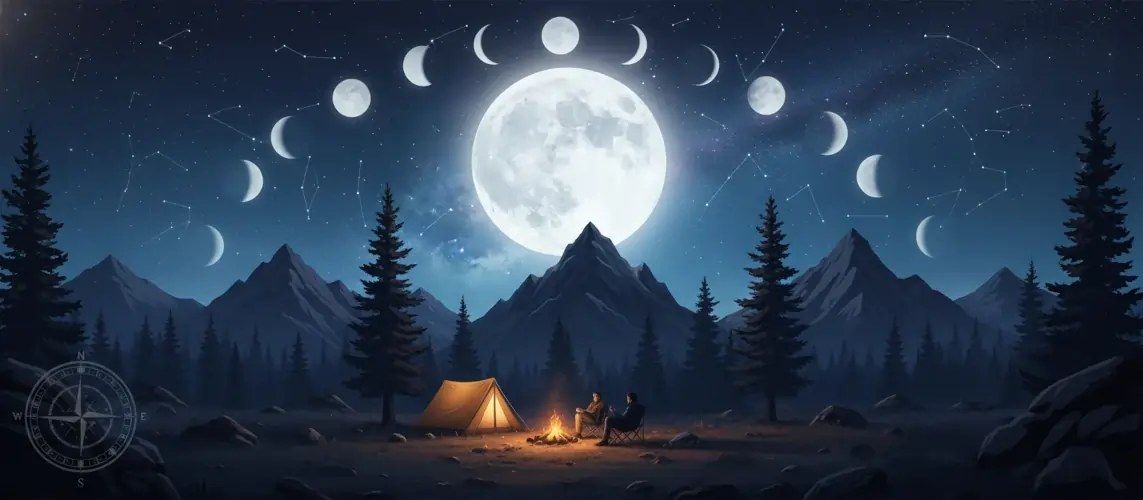
Plan your camping around the moon
The moon is the one weather variable you can predict perfectly a year in advance. Whether you're after dark skies for stargazing, natural light for a pre-dawn alpine start, or the biggest tides of the month for a coastal campsite, the lunar cycle determines all of it — and it repeats reliably every 29.5 days.
Most campers only think about weather and terrain when they're planning a trip. Moon phase is the overlooked third variable. A waning crescent night gives you near-new-moon darkness without committing to the exact new moon date. A full moon makes trail navigation easy but obliterates faint stars. A first or last quarter moon drives the highest tidal ranges of the month. Knowing which phase you're camping under takes ten seconds and changes how you pack, plan, and set expectations.
The calendar below shows every night of the year colour-coded by phase. Select any date to see what conditions that night offers — and what to leave at home.
How to use the calendar
Use the ‹ and › arrows to move between months, or tap Tonight to jump back to today.
Each cell shows a moon emoji and a coloured bar. The colour tells you the phase at a glance — see the legend at the bottom of the calendar.
Tap any date to load that night's full conditions: illumination, sky darkness, moon timing, and tidal behaviour.
The two panels below the facts row tell you which activities suit that night — and which are better saved for a different phase.
Quick reference: all eight phases
| Phase | Illumination | Best for | Avoid |
|---|---|---|---|
🌑 New Moon | 0–2% | Stargazing, astrophotography, meteor showers | Unlit trail navigation — no ambient light at all |
🌒 Waxing Crescent | 2–45% | Lunar detail viewing, late-night stargazing after moonset | All-night astrophotography sessions |
🌓 First Quarter | ~50% | Coastal camping, shore fishing, post-midnight stargazing | Pitching near the tideline — spring tides reach further |
🌔 Waxing Gibbous | 45–98% | General camping, evening walks on known trails | Stargazing, meteor shower watching |
🌕 Full Moon | 98–100% | Night hiking, coastal camping, fishing, moonscape photography | Stargazing — sky too bright for faint objects |
🌖 Waning Gibbous | 98–45% | General camping, brief early-evening stargazing window | All-night stargazing — moon rises and ruins the second half |
🌗 Last Quarter | ~50% | Alpine starts, first-half stargazing, coastal spring tides | All-night dark-sky sessions — only first half is truly dark |
🌘 Waning Crescent | 45–2% | Stargazing, astrophotography, nearly all-night dark skies | Pre-dawn hikes without a headlamp — moon too low and dim |
–
Good for
Not ideal for
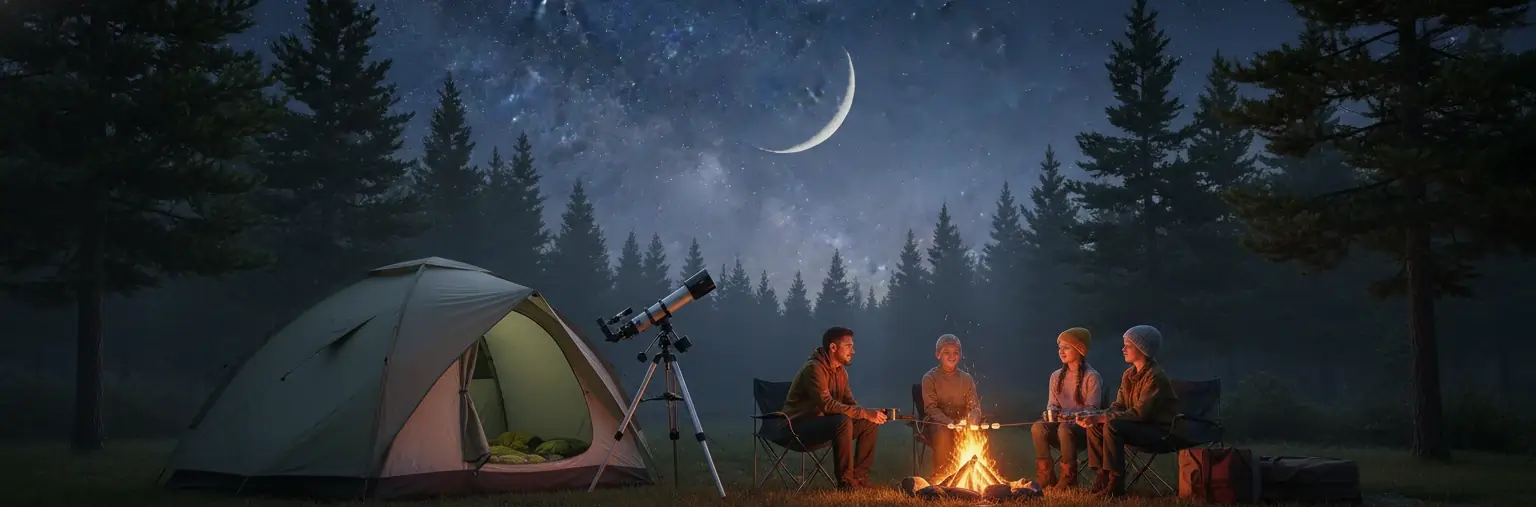
⭐ Camping Under the Stars — Gear Checklist
Everything you need for a night sky camping trip, from the essential tent pegs to the telescope eyepieces. Tick items off as you pack — your progress saves automatically in this session.
What else affects your night under the stars
Moon phase sets the ceiling — it tells you how much natural light you're working with and what tidal conditions to expect. But it's one variable in a three-part equation. Cloud cover, local sea conditions, and the physical properties of moonlight itself all determine whether a well-planned trip delivers what you came for. Understanding how these factors interact with the lunar cycle will make you a significantly sharper trip planner.
🌊 Tides for coastal campers
Spring tides — the strongest of the month — happen at new moon and full moon, twice in every 29.5-day lunar cycle. These are the moments when the sun, Earth, and moon align and their gravitational forces combine to push tidal range to its peak. On a spring tide night, low water is lower and high water is higher than at any other point in the cycle. For shore fishing and rock pooling, this is the window you're after: more of the intertidal zone is exposed for longer, and fish feeding activity concentrates along channels and headlands as large volumes of water move in and out.
The quarter phases — first quarter and last quarter — produce the opposite effect: neap tides, when the sun and moon are at right angles to each other and their gravitational forces partially cancel out. Neap tides have a reduced range and more predictable behaviour, making those nights better for families who want a quiet beach camp without worrying about being caught out by the tide. Regardless of the phase, always find the strand line — the uppermost line of dried seaweed and debris — and pitch above it. On a spring tide night, that strand line is a close approximation of the actual high water mark.
📈 Real-time NOAA tide charts →🔭 Getting the most from dark skies
A new moon night is the astronomical jackpot for deep-sky observing. The sky is as dark as it gets, faint objects like nebulae, distant galaxies, and star clusters become visible that would otherwise be washed out, and the Milky Way core is bright enough to photograph with a basic DSLR from any reasonably dark site. The waning crescent phase is only marginally less good — you get near-new-moon darkness for most of the night with the moon not rising until a couple of hours before dawn, which is often enough for a full night of shooting or observing.
But if you're bringing a telescope and want to observe the moon itself, the phase logic reverses. The terminator line — the boundary between the lit and dark portions of the lunar surface — throws craters and mountain ranges into sharp relief. Along the terminator, shadows are at their longest and geological features stand out dramatically. A waxing crescent a few days past new moon often delivers a more rewarding crater view than a full moon, where flat overhead illumination washes out most surface texture. For systematic observers, the Lunar 100 is a curated checklist of 100 of the most rewarding features visible from Earth, with different targets coming into view as the terminator sweeps across the surface through the cycle.
🌕 Interactive Lunar 100 map & field guide →💡 How bright is moonlight, really?
A full moon is bright enough to cast shadows and allow you to read large print outdoors. But it is roughly 400,000 times dimmer than direct sunlight, which is why moonlit photography always requires long exposures. The relationship between illumination percentage and actual light output is also non-linear and consistently surprises people. A first quarter moon at nominally 50% illumination produces only about 10% of the light of a full moon. This is a consequence of the opposition effect — at full moon, the sun is directly behind the observer, creating a highly efficient retroreflection across the entire lit surface. At the quarter phases, sunlight strikes the lunar surface at a severe angle and most of it scatters away from Earth.
The practical consequence is that a waxing crescent at 35–40% illumination will feel nearly as dark as a new moon for most purposes, despite the percentage sounding significant. The phases that provide genuinely usable ambient light for navigation are roughly the last three days of waxing gibbous through the first three days of waning gibbous — a window of about six to seven nights centred on the full moon. Outside that window, a headlamp is not optional equipment, it's essential. A red-light headlamp is worth the small extra cost for stargazing camps, as it preserves night vision far better than white light. Use the brightness calculator to get exact lux figures for any phase on any date.
🌟 Moonlight brightness calculator →⛅ Weather is the wildcard
You can plan perfectly for a new moon night and get completely clouded out. Cloud cover is the one factor the lunar calendar cannot account for, and it's frequently decisive. A single layer of high cirrus cloud will ruin astrophotography even when the moon is entirely absent. For coastal camping, wind direction and swell height matter more than tidal height on many shores — a spring tide with offshore winds and calm seas is far more usable than a neap tide with onshore gales rolling in. Dew point and atmospheric humidity also affect sky transparency; a warm, humid summer night can produce significant light scatter even at a remote site far from any town.
The widget below shows cloud cover percentage, visibility, and a sky conditions rating alongside the standard forecast for any location you search. Cloud cover under 20% generally means good astronomical conditions; above 50% and the sky is effectively closed for deep-sky work. Enter your campsite location or the nearest named settlement for the most relevant reading. It's worth checking both the evening before your trip and on the morning itself — conditions at remote highland or coastal campsites can diverge significantly from the nearest town forecast.
Sky & Weather Conditions
Check cloud cover and visibility for your campsite tonight
Detecting your location…
Frequently asked questions
What is the best moon phase for camping?
It depends entirely on what you plan to do. The new moon is the best phase for stargazing and astrophotography, since the sky is as dark as it gets all night. The full moon is best for night hiking and coastal camping — you have enough natural light to navigate safely and tides are at their maximum range. The last quarter is ideal for alpine starts, because the half-moon rises around midnight and illuminates the approach just when you need it. There is no single best phase for all camping; the calendar above is designed to help you match the phase to your specific plans.
Does the full moon affect sleep when camping?
Yes, and this is well documented. Tent fabric transmits significantly more light than a bedroom curtain, and the full moon is bright enough to disrupt melatonin production. Several studies have found that people — even in controlled indoor settings — take longer to fall asleep and sleep for less time around the full moon. The practical fix is straightforward: bring a sleep mask. It weighs nothing and solves the problem entirely. If you're sharing a tent, it's worth mentioning to companions too — disturbed sleep around the full moon is a common surprise for first-timers.
What moon phase is best for fishing?
The new moon and full moon produce the strongest spring tides, which drive more water movement and concentrate fish feeding activity along tidal channels and shorelines. Both are considered productive phases — partly because of tidal intensity, and partly because solunar theory, which tracks the gravitational influence of the moon on fish behaviour, places its major feeding periods near these phases. Shore fishing in particular benefits from the larger tidal range, which exposes and floods feeding grounds more dramatically. Check the NOAA tide charts for exact high and low times at your specific location.
What are spring tides and when do they happen?
Spring tides have nothing to do with the season. The name comes from the concept of the tide "springing forth" — they are the tides that leap higher and fall lower than average. They occur when the sun, Earth, and moon are roughly aligned, which happens at new moon and full moon — twice in every 29.5-day lunar cycle. The quarter phases produce the opposite effect: when the sun and moon are at right angles to each other, their gravitational forces partially cancel out, producing the weaker neap tides. For coastal campers, spring tide high water marks can be significantly further up the beach than the tideline visible at other points in the cycle, and the low tide exposes far more of the foreshore than usual.
Can I see the Milky Way on a camping trip?
You need three things: a new moon or waning crescent night for minimal moonlight, a dark sky site away from light pollution, and clear skies with low humidity. The Milky Way core is visible to the naked eye under these conditions from late spring through early autumn in the northern hemisphere. Light pollution is often a bigger limiting factor than moon phase — a site rated Bortle 4 or darker is needed to see the galactic band clearly. A warm, humid night can also produce significant sky glow even at a remote site. The weather widget above shows cloud cover and visibility for your specific campsite, which is worth checking the evening before and the morning of your trip.
Is a crescent moon bright enough to hike by?
No — not reliably. A thin crescent produces very little usable light and sets early in the evening, leaving the rest of the night completely dark. Even a first quarter half-moon at nominally 50% illumination produces only about 10% of the light of a full moon, because of the opposition effect — at full moon, sunlight retroreflects efficiently from the entire lit surface directly toward Earth, which doesn't happen at any other phase. The full moon is the only phase that gives consistent, navigable ambient light on open terrain. For any other phase, a headlamp is essential. A red-light headlamp preserves night vision far better than white light and is worth the small extra cost for a stargazing camp. See the moonlight brightness calculator for exact lux values by phase.
What is the Lunar 100 and why does it matter for camping?
The Lunar 100 is a curated list of 100 of the most interesting and identifiable features on the moon's near side, compiled as an observational challenge for amateur astronomers. The list ranges from easy craters visible in binoculars to subtle geological formations — rilles, domes, and ancient lava flows — that require a telescope and the right phase lighting to resolve clearly. For campers who bring a telescope, working through the Lunar 100 transforms any clear night into a structured project with purpose. Different features come into view as the terminator line sweeps across the lunar surface through the cycle, which means every phase from thin crescent to gibbous has something specific worth targeting. The interactive Lunar 100 map and field guide shows where each feature sits on the lunar surface and which phase provides the best view of it.