

Mission status
Altitude
0 km
Speed
0 km/h
Travel time
0.0 days
Controls
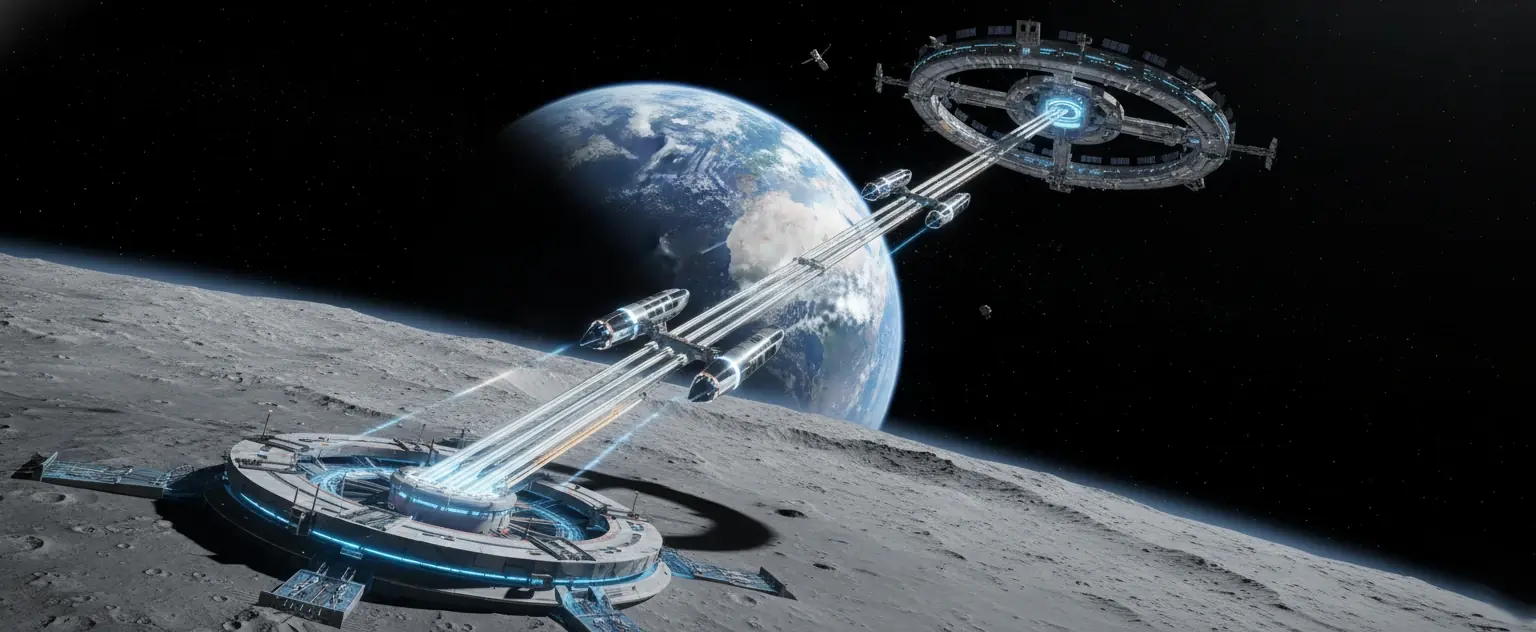
The idea of a space elevator has haunted engineers since the nineteenth century, always tantalizingly close to plausible and always just out of reach. The Earth version requires a material stronger than anything we can manufacture at scale. The lunar version requires only what is already sitting on a hardware shelf. That asymmetry is why a growing body of serious aerospace research now treats the lunar space elevator not as speculation but as a near-term engineering programme — one that could transform how humanity moves between the Earth and the Moon.
The core concept is disarmingly simple. Anchor one end of a long tether to the Moon's surface. Extend it outward through the Earth-Moon L1 Lagrange point — the gravitational balance point roughly 58,000 km above the lunar surface — and attach a counterweight beyond it. The competing pulls of lunar gravity, Earth's gravity, and centrifugal force keep the ribbon taut with no active propulsion required. A robotic climber grips the ribbon and ascends electrically, powered by solar panels. No combustion. No propellant. No expendable rocket stages.
tether length
to L1 climber
vs chemical rocket
The history of this idea stretches further back than most people expect. Soviet space pioneer Friedrich Zander conceived of a lunar space tower as early as 1910, though his papers were suppressed and only published posthumously in 1977. Jerome Pearson — whose 1975 paper in Acta Astronautica introduced the modern space elevator concept to the Western aerospace community — extended his theory to the Moon three years later, switching from geostationary orbit to Lagrange points as the natural anchor. Arthur C. Clarke read Pearson's work and turned it into The Fountains of Paradise.
The Earth elevator is held hostage by materials science. Its tether must support its own weight across 36,000 km against full Earth gravity — a requirement that demands a "breaking length" of roughly 4,700 km. Steel manages about 25 km. Carbon nanotubes might reach 5,000 km in theory, but the longest ever synthesised measure a few centimetres. Atomic-scale defects reduce real-world strength to 10–30% of the theoretical maximum.
The lunar elevator can be built with current technology using commercially available tether polymers. It doesn't need unobtanium.
— Eubanks & Radley, Space Policy, 2016The Moon changes the arithmetic entirely. Surface gravity is one-sixth of Earth's. The tether terminates at L1, not at geostationary orbit. High-performance polymers — M5 fibre, Zylon, and Spectra are the leading candidates, all commercially available — have breaking lengths sufficient for the task under lunar gravity. Pearson's NIAC study specified M5 fibre as the preferred ribbon material; Penoyre and Sandford's 2019 Spaceline design validated Zylon. There is no atmosphere to cause icing, no orbital debris belt to slash through, no 200-metre-per-second winds at the anchor point.
| Factor | Earth elevator | Lunar elevator |
|---|---|---|
| Tether material needed | Carbon nanotubes / graphene (not yet manufacturable at scale) | M5 · Zylon · Spectra — available now |
| Orbital debris risk | Severe — crosses all inclinations | Minimal — no debris environment |
| Atmospheric interference | Wind, icing, lightning, weather | None — airless environment |
| Gravity at anchor | 9.8 m/s² | 1.62 m/s² |
| Earliest realistic build | 2050–2075 (material breakthrough req.) | 2030s–2040s with political will |
NASA's Artemis programme envisions a permanent base camp near the lunar south pole — a location chosen for its proximity to water ice deposits and near-continuous sunlight on nearby ridges. An elevator anchor placed at or near that base would turn the south pole into the gateway node for the entire cislunar economy: payloads climbed to L1 could be released into free-return trajectories toward Earth, captured into lunar orbit, or flung on trans-Mars injection burns — all without a single drop of propellant from the Moon's surface.
Pearson's NIAC study calculated that lunar regolith — the loose surface rock — could be bagged and climbed to L1 as radiation shielding for deep-space vehicles, cheaper per kilogram than launching equivalent mass from Earth. Silicon-rich lunar soil could supply raw material for orbital solar panels. The elevator does not merely move people; it transforms the Moon from a destination into a supply depot.
The tether is effectively a 58,000 km elastic string — longer than one and a half times the diameter of the Earth. It is subject to the Moon's slow rotation (one revolution every 27.3 days), gravitational perturbations from Earth and the Sun, and the constantly shifting mass of climbing vehicles moving along its length at any given moment.
Uncontrolled resonance is the primary structural risk. Small oscillations that go undamped can amplify over time into lateral whipping motions that place enormous tensile stress on the ribbon. The physics here are not unlike the Tacoma Narrows Bridge collapse — except the structure is half a continent long and sits in vacuum, where there is no air resistance to bleed off energy naturally.
Pearson's 2005 NIAC report found that active electromagnetic damping systems must be built into the ribbon structure itself, and that climber scheduling should be deliberately staggered to avoid resonant loading patterns. The ribbon's braid geometry can also be engineered to shift the structure's natural frequency away from the most dangerous excitation modes driven by tidal forcing.
A space elevator cannot be built from the ground up. If you anchor one end and simply pay out the ribbon upward, gravity pulls the whole thing down before centrifugal tension can develop. The ribbon must instead be deployed simultaneously in both directions from L1 — one end descending toward the lunar surface, a counterweight ascending beyond — so competing forces remain balanced throughout.
LiftPort Group's engineering plan proposed unreeling the ribbon from a spacecraft that slowly lowers itself toward the surface. The anchor crew on the Moon would then secure the terminal end to the regolith — literally catching a cable dropped from 58,000 km up. Getting the deployment mass to L1 in the first place requires an estimated 10 to 40 launches, which is why the concept becomes far more viable with reusable heavy-lift vehicles flying routinely.
The Moon has no atmosphere to burn up incoming debris. Micrometeorites — particles from dust grains to sand-grain size, travelling at 10–20 km/s — continuously bombard the lunar environment. Over a 58,000 km ribbon, the cumulative exposed cross-section is enormous. The design response is a multi-strand braided ribbon: individual strands can be severed without total failure, much like a suspension bridge cable tolerates broken wires. Pearson's design specifies enough redundant cross-section to absorb expected strikes over a 30-year operational life.
Autonomous repair robots — climbers carrying splicing tools and replacement strand material — would conduct routine maintenance passes. The ribbon's total mass is measured in tonnes, not megatonnes, keeping replacement costs manageable.
Climbers cannot carry enough battery mass for a 5–12 day, 58,000 km ascent. Power must be supplied externally — beamed from the surface via laser or microwave, or relayed from orbital platforms. Solar panels on the climber are simple but limit climb speed. Laser beaming delivers concentrated power but requires precise tracking over vast distances. Microwave is more tolerant of pointing error but demands heavier ground equipment.
The south-pole anchor is partly chosen for this reason. Ridges near the lunar south pole receive near-continuous solar illumination — roughly 80–90% of every lunar cycle — providing stable power for beaming infrastructure year-round, and conveniently co-locating with water ice deposits that would supply the base itself.
Lunar regolith is electrostatically charged, glassy, and abrasive — its particles have never been rounded by wind or water. Every Apollo mission saw regolith migrate into seals, coatings, and optical surfaces it had no business reaching. The tether anchor, climber drive wheels, ribbon-gripping rollers, and surface power equipment all face this threat. Seals that last decades on Earth may fail within months.
Engineering responses include magnetic suspension systems that avoid contact with contaminated surfaces, positive-pressure enclosures, and components designed for replacement rather than indefinite service life. Every Apollo dust lesson must be designed in from the start — not retrofitted after first failures.
Every kilogram sent from Earth to lunar orbit today costs between $10,000 and $30,000 using the most capable current launchers. A lunar elevator's marginal cost per kilogram is dominated by the electricity to run the climber — potentially under $100/kg once infrastructure is amortised across thousands of trips. The capital cost of building the elevator is large but one-time. The operating cost trends toward zero.
Radley's 2017 analysis argued that an elevator could break even against chemical rockets after fewer than 200 trips, assuming a modest 500 kg payload per climber. At that crossover point, every subsequent trip is essentially free compared to the alternative. For the kind of sustained logistics that a permanent lunar base requires — tonnes of food, water, equipment, and eventually return cargo — the elevator stops being ambitious infrastructure and starts being the obvious choice.
These systems promise major reduction in transport costs versus chemical rockets, in a rapid timeframe, for a modest investment. Science will thus benefit as well as commercial activities.
— Radley, ResearchGate, 2017The counterintuitive conclusion of nearly every serious study is the same: the lunar space elevator is not a distant dream contingent on breakthroughs in materials science. It is an engineering programme waiting for a decision. The physics is solved. The materials exist. What the concept lacks — the thing that would actually build it — is a line in a budget somewhere.