

Anadromous Fish Migration: How the Moon's Tides Guide the Journey
Hey fellow anglers! Ever wonder why some of the best fishing for species like salmon, striped bass, or shad happens at certain times of the month? It's not just luck — it comes down to anadromous fish migration, and the Moon is quietly running the schedule. Many of these species are anadromous fish—fish that spend most of their lives in the saltwater ocean but migrate into freshwater rivers to spawn. One of the important environmental cues influencing the timing of this journey is the Moon, through its effect on tides and tidal currents. Let's take a closer look at how the Moon plays a silent but powerful role in when and how anadromous fish make their way upriver.
Table of Contents
- What are "Anadromous Fish" Anyway?
- The Moon's Invisible Hand: How Tides Drive Anadromous Fish Migration
- The Power of Moon Phases: Spring Tides and Neap Tides
- More Than Just Tides: Other Lunar Cues
- Case Studies: Fish and the Moon
- Put It to Practice: Your Angler's Advantage!
- Today's Moon & Best Fishing Times
- Osmoregulation: How Anadromous Fish Survive the Journey
- Beyond the Fish: Why This Matters for Ecosystems
- Go Deeper: More Lunar Fishing Tools
- FAQ: Anadromous Fish and the Moon's Influence
What are "Anadromous Fish" Anyway?
First things first, what's an anadromous fish? It's a fancy scientific word for a very cool type of fish.
"Anadromous" means "upward running."
These fish live most of their adult lives in the saltwater ocean.
But when it's time to have babies, they make an incredible journey upstream into freshwater rivers and streams to spawn.
Think of it like us going on a road trip from our home to a special birthing center! Famous examples include Atlantic and Pacific Salmon, Striped Bass, Shad, River Herring, and Sturgeon.
Two of the less-famous runs are worth knowing if you fish the East Coast: River Herring (alewife and blueback herring) push into coastal rivers earliest in spring, often weeks before shad show up, and Atlantic Sturgeon — some pushing past 100 years old — still make the same upriver journey their ancestors made long before dams and cities existed. Both runs answer to the same tidal clock as salmon and stripers.
The Moon's Invisible Hand: How Tides Drive Anadromous Fish Migration
So, how does the Moon, roughly 239,000 miles away, tell a fish it's time to move? It all comes down to tides and currents.
The Moon's Gravity = Tides: The Moon's gravity pulls on the Earth, especially on our oceans. This pull creates the daily rise and fall of ocean water we call tides.
Tides Create Currents: As water moves in and out with the tides, it creates strong currents, especially in river mouths and estuaries (where rivers meet the sea).
Anadromous fish use these tidal cues like a highway system, telling them when to start their journey and even helping them conserve energy!
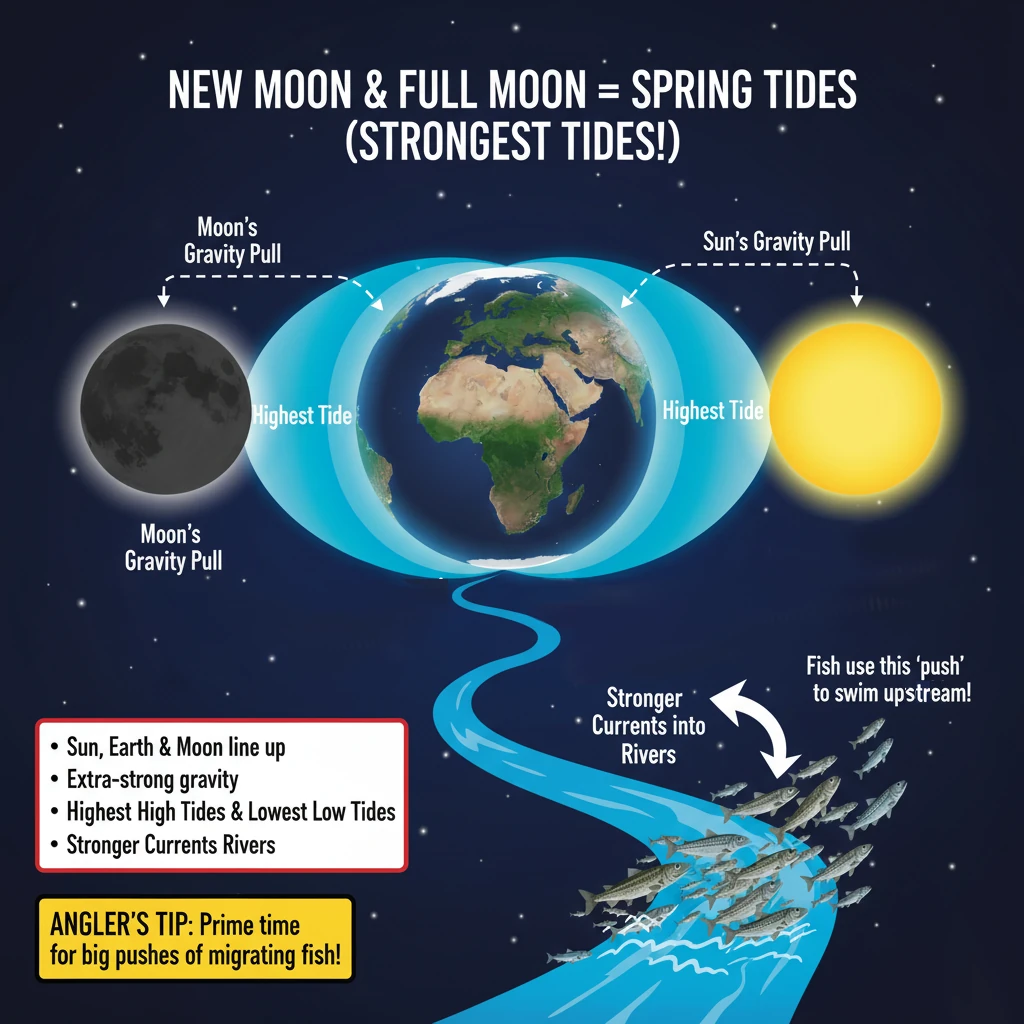
The Power of Moon Phases: Spring Tides and Neap Tides
The Moon doesn't just create tides; its phases change how strong those tides are. This is where it gets really interesting for fish migration.
| Tide Type | Moon Phase | Tidal Range | What It Means for Migrating Fish |
|---|---|---|---|
| Spring Tide | New Moon & Full Moon | Largest (highest highs, lowest lows) | Strongest push upriver — prime time for big migration runs |
| Neap Tide | First Quarter & Last Quarter | Smallest (mild highs and lows) | Weaker currents — fish often hold in deeper pools and wait |
New Moon & Full Moon = Spring Tides (Strongest Tides!)
When the Sun, Earth, and Moon line up closely (during a New Moon and a Full Moon), their combined gravity creates extra-strong pulls.
This means higher high tides and lower low tides.
These powerful tides create stronger currents pushing water into river mouths.
Why it matters for fish: Many anadromous fish, especially species like Shad and Striped Bass, use these strong currents as a "push" to help them swim upstream. The higher water levels also give them easier access over obstacles and into shallower spawning grounds.
Angler's Tip: Often, the days leading up to and right after the New and Full Moons can be prime times for observing big pushes of migrating fish!
Quarter Moons = Neap Tides (Weakest Tides)

When the Sun and Moon are at right angles to each other (during the First Quarter and Last Quarter Moons), their gravitational pulls work against each other.
This results in weaker tides – lower high tides and higher low tides.
The currents are less intense.
Why it matters for fish: During neap tides, migrating fish might slow down their journey or hold in deeper pools, waiting for the stronger spring tides to return. Some species might prefer these calmer periods for certain parts of their migration, but often the big pushes are tied to stronger tides.
Angler's Tip: Fishing might be a bit slower during neap tides for actively migrating fish, but it can be a good time to target fish that are resting or feeding in specific spots.
For the full breakdown of why these two tide types happen — including the geometry between the Sun, Moon, and Earth — see our dedicated guide on spring tides vs. neap tides.
More Than Just Tides: Other Lunar Cues
While tides are the biggest factor, the Moon might also provide other signals:
Moonlight for Night Travel: For fish that migrate at night, the amount of moonlight can be a factor. A bright full moon might offer more visibility for some, while a new moon's darkness might provide cover for others.
Biological Clocks: Fish have internal "clocks" (like ours that tell us when to sleep and wake up) that are incredibly sensitive. These internal rhythms may synchronize with recurring lunar cycles, helping them prepare for their big journey, though the exact mechanisms behind this are still an active area of research.
Case Studies: Fish and the Moon
Anadromous fish migration looks a little different species by species — here's how it plays out on the water:

Salmon: Many salmon enter estuaries during favorable tidal conditions, which help them navigate river mouths, although river flow, water temperature, and rainfall are usually the stronger determinants of overall migration timing.

Striped Bass: "Stripers" are highly tidal. They often use incoming tides to move into estuaries and up rivers to feed and spawn. Big schools can be observed pushing upriver on strong spring tides.

Shad: American and Hickory Shad are famous for their strong spring runs. These fish also commonly use strong tidal currents to enter and ascend rivers, especially during the spring full and new moons.
River Herring: Alewife and blueback herring are often the first sign of spring on the water, pushing into coastal rivers on the same spring-tide schedule, sometimes weeks ahead of the shad runs.
Sturgeon: Slower and less showy than the others, sturgeon runs often coincide with periods of stronger tidal exchange — a pattern that has held for millions of years, long before there were any anglers around to notice it.
| Species | Typical Run Timing | Moon Phase Preference |
|---|---|---|
| River Herring | Early spring | Spring tides (New/Full Moon) |
| American & Hickory Shad | Spring | Spring tides (New/Full Moon) |
| Striped Bass | Spring, with a fall run in many rivers | Strongest on incoming spring tides |
| Salmon | Varies by species and river, generally late summer–fall | Higher tides ease river-mouth entry |
| Atlantic Sturgeon | Spring and late summer | Often associated with stronger tidal periods |
Put It to Practice: Your Angler's Advantage!
Understanding how anadromous fish migration follows the Moon gives you a powerful edge:
- Check the Moon Calendar: Before your next trip, look up the Moon phase. If it's near a New or Full Moon, prepare for potentially strong currents and active fish runs.
- Target Spring Tides: If you're chasing migrating anadromous fish in tidal waters, aim your efforts around the stronger spring tides (New and Full Moons). This is often when the biggest pushes of fish occur.
- Watch the Water Movement: Pay attention to how the tide is flowing. Fish often move with the strongest part of the current, especially in river mouths. An incoming tide can bring new fish into your area. Not sure how to read the graph on a tide station report? Our tide charts guide breaks it down.
- Observe Local Runs: Every river system is a little different. Keep a fishing log! Note the Moon phase, tide, weather, and your success. Over time, you'll start to see patterns specific to your favorite fishing spots — our Solunar Fishing Calendar can help you track major and minor feeding windows automatically.
Today's Moon & Best Fishing Times
Note: these feeding windows are a simplified illustration based on Moon phase alone. True solunar periods also depend on moonrise, moonset, lunar transit, and your specific location — for a location-adjusted forecast, use our Solunar Fishing Calendar.
Osmoregulation: How Anadromous Fish Survive the Journey
One of the wildest things about anadromous fish is that they can move between saltwater and freshwater — something most fish cannot survive. This superpower comes down to something called osmoregulation, which is just a fancy word for how fish control the balance of salt and water inside their bodies.
Here's the simple breakdown:
- In the Ocean: Saltwater pulls water out of a fish's body. So anadromous fish drink lots of seawater and use their gills and kidneys to actively remove extra salt.
- In Freshwater: Freshwater pushes water into their bodies. So the fish stop drinking, and instead their kidneys flush out excess water while their gills help keep important salts inside.
Their bodies literally reprogram themselves during migration.
This switch isn't random — it's triggered by:
- Changing day length
- Water temperature
- And environmental conditions associated with migration, including tidal cycles in some species
Their internal biology prepares them just before they enter the river, like changing gear before climbing a hill.
Why this matters: This ability allows salmon, shad, striped bass, and others to grow big in the nutrient-rich ocean, then return to suitable freshwater spawning habitat to spawn safely. It's one of the most incredible survival strategies in the natural world — a built-in life cycle upgrade powered by evolution, instinct, and environmental cues.
Beyond the Fish: Why This Matters for Ecosystems
The Moon's role in fish migration is more than just a cool fishing fact. It's vital for entire ecosystems.
Food for Wildlife: When fish like salmon or herring run upstream, they become a crucial food source for bears, eagles, ospreys, and other animals. Without these migrations, many animals would struggle to find enough food.
Nutrient Cycling: The bodies of fish that spawn and then die in freshwater rivers release valuable nutrients back into the ecosystem, feeding insects, plants, and other life forms.
Healthy Rivers: Strong, healthy runs of anadromous fish are a sign of a clean, connected river system. Protecting these fish and their ability to migrate is super important for the health of our planet. NOAA Fisheries tracks the health of these runs across the U.S. and works on habitat and fish-passage restoration to keep them intact.
Go Deeper: More Lunar Fishing Tools
- Solunar Fishing Calendar & Forecast — track major and minor feeding windows for your exact location
- Spring Tides vs. Neap Tides — the full geometry behind why tidal range swings every two weeks
- Fishing Tide Charts — real-time NOAA tide data by U.S. coastal location
- How the Moon Affects Ocean Tides — the basic science, explained simply
The Takeaway
The next time you're out on the water, take a moment to look up at the Moon (or imagine it there during the day!). Remember that its silent, distant pull is orchestrating one of nature's most incredible journeys beneath the waves — anadromous fish migration, timed to the rhythm of the tides. By understanding this lunar connection, you not only become a smarter fisherman but also gain a deeper appreciation for the amazing, interconnected world we live in.
FAQ: Anadromous Fish and the Moon's Influence
1. What are anadromous fish?
Anadromous fish are species that live most of their adult lives in saltwater but migrate into freshwater rivers to spawn. This "upstream journey" is a key part of their life cycle. Examples include salmon, striped bass, shad, river herring, and sturgeon.
2. Why do anadromous fish migrate?
These fish migrate to lay their eggs in freshwater, where there are fewer predators and more stable conditions for young fish to grow. After spawning, many species return to the ocean, while some (like Pacific salmon) die and provide nutrients to the ecosystem.
3. How do anadromous fish survive moving between saltwater and freshwater?
They use a process called osmoregulation, which allows them to adjust the salt and water balance inside their bodies. In saltwater, they remove excess salt through their gills and kidneys. In freshwater, they hold onto salt and release extra water. This adaptation is what makes their migration possible.
4. How do the Moon and tides influence anadromous fish migration?
The Moon's gravity creates tides and tidal currents. During New and Full Moons, strong "spring tides" help push anadromous fish into river mouths and upstream, making migration easier. Many big fish runs happen around these phases.
5. Why are dams a problem for anadromous fish?
Dams can block migration routes, preventing fish from reaching their spawning grounds. Even with fish ladders, many species still struggle to pass. When migration is disrupted, fish populations decline and entire river ecosystems can lose vital nutrients.
6. What is the best moon phase for salmon fishing?
The days around the New Moon and Full Moon tend to be best, since the stronger spring tides push more fish into river mouths at once. Neap tides around the quarter moons are usually slower for actively migrating fish, though resting fish can still be caught in deeper holding pools.
7. Do all fish species migrate on a lunar schedule?
Not exclusively. Anadromous and catadromous fishes often show strong tidal timing, but many entirely marine species also exhibit lunar spawning or feeding rhythms — grunion, groupers, and coral reef fishes among them.
Happy Fishing, and may the Moon be with you!