
Moon Phase Today New York
Tonight in New York, New York, the moon is a Waxing Crescent at 19% illumination — day 4.3 of the 29.5-day lunar cycle. The next full moon is in 11 days on Sep 26. Moonrise: 11:35 AM · Moonset: 9:10 PM
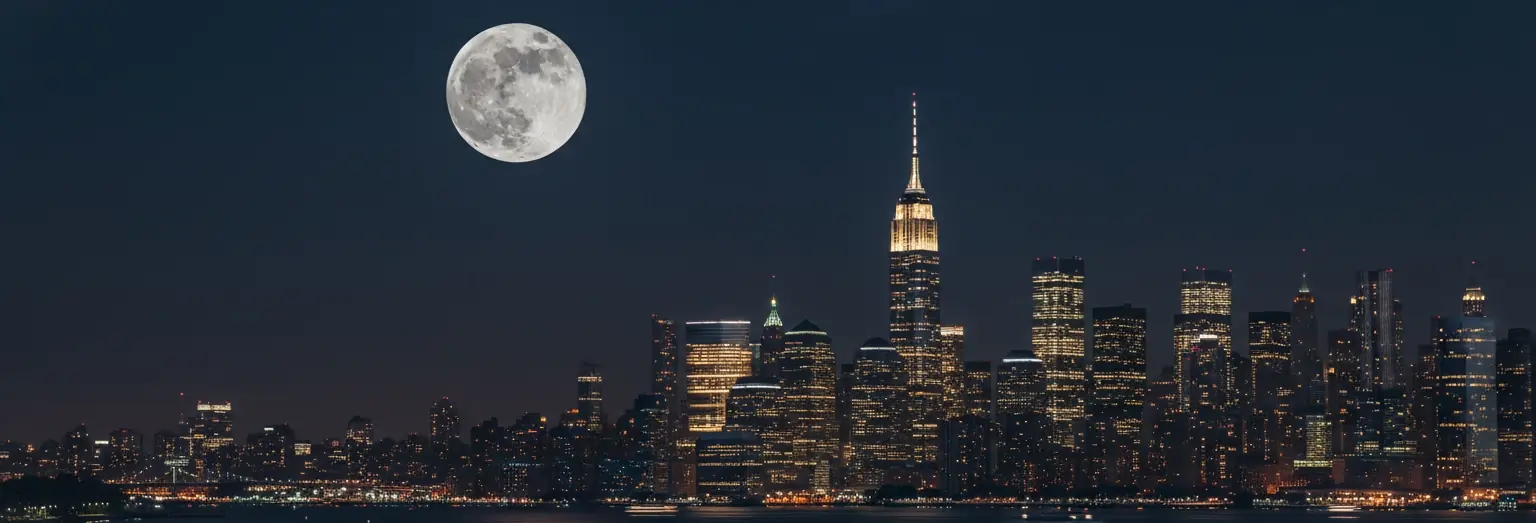
☽ Best Places to View the Moon in New York
New York City's light pollution is severe — among the worst of any city in the United States — but the moon is bright enough to cut through it entirely, and the payoff is a skyline that no other city can match as a foreground. The key is geometry: the moon rises in the east, Manhattan runs roughly north–south, and the waterfronts of New Jersey, Brooklyn, and Queens all look west across the Hudson and East Rivers directly at the island. Positioned on those shores, you have the full Manhattan skyline stacked between you and the rising moon. October through February is the prime window — the moon's arc sits lower and more southerly, aligning it with the skyscraper canyon rather than climbing over it. The city's density means competition for the best spots on full moon nights is real; arriving 45 minutes early is not optional, it is the plan.
Hoboken Waterfront Walkway – New Jersey
The Hoboken Waterfront Walkway is the most celebrated Manhattan moonrise viewpoint — a mile-long esplanade on the New Jersey side of the Hudson directly opposite Midtown and Lower Manhattan. The moon rises dead-centre above the skyline on many dates, clearing the Empire State Building or One World Trade Center depending on the time of year, and reflects in the Hudson below. The wide promenade gives space to set up without crowding other photographers. Nearest transit: Hoboken Terminal (PATH, NJ Transit, NY Waterway ferry). Free, open 24/7.
Brooklyn Bridge Park – Fulton Ferry Landing
Brooklyn Bridge Park's Fulton Ferry Landing section gives the most architecturally complex moonrise composition in the city — the moon rising between the Brooklyn Bridge and Manhattan Bridge cable spans, with the Lower Manhattan financial district towers behind them and the East River below. The two bridges frame the moon in a way no other city viewpoint replicates. Slightly darker than the Hoboken waterfront. Nearest transit: York St F train or High St A/C. Free, open 24/7; the pebble beach at Pier 1 gives the best low-angle bridge reflection shots.
Gantry Plaza State Park – Long Island City, Queens
Gantry Plaza State Park in Long Island City offers an elevated waterfront esplanade with a 180-degree panorama of Midtown Manhattan — the Chrysler Building, Empire State Building, and the full Midtown skyline arrayed directly in the moon's path on many evenings. The iconic Pepsi-Cola sign and the park's restored gantries add distinctive foreground elements. Notably less crowded than the Brooklyn Bridge Park on full moon nights. Nearest transit: Vernon Blvd-Jackson Ave 7 train. Free, open dawn to dusk (the esplanade section accessible later).
Governors Island – Harbor Overlooks
Governors Island sits in New York Harbor between Manhattan and Brooklyn, and its south-facing hills give unobstructed panoramic views over the harbor toward the Statue of Liberty. The moon rises with the statue and the Lower Manhattan skyline as a combined foreground — a composition unavailable from any mainland viewpoint. The island is quieter and greener than any Manhattan-adjacent alternative. The Trust for Governors Island operates ferries year-round from the Battery Maritime Building at 10 South Street in Lower Manhattan; Brooklyn ferry service is seasonal (weekends/holidays only). Check govisland.com for current schedules and to reserve tickets in advance.
South Street Seaport – East River Promenade
The South Street Seaport and the adjacent East River Promenade at Pier 17 put you on the Manhattan side looking southeast — the moon rises behind the Brooklyn Bridge and over the Brooklyn waterfront, with the bridge cables and towers as a close foreground. In winter, when the moon's arc sits lower and more southerly, the alignment is especially direct. The Seaport district has restaurants and bars that stay active late, making this a practical option for mid-evening moonrise visits without a special trip. Free waterfront access; Pier 17 rooftop access varies by event schedule.
Liberty State Park – Jersey City, New Jersey
Liberty State Park in Jersey City is the least crowded of the major New York moonrise viewpoints and arguably the most dramatic for telephoto work. The park's open waterfront looks east across the harbor toward the Statue of Liberty, Ellis Island, and the Lower Manhattan skyline — relatively dark skies for the metro area and a completely unobstructed eastern horizon. A 300–400mm lens from the park's southern lawn compresses the moon against Lady Liberty and the skyline in a single frame. Accessible by car or via Liberty Landing Ferry from the Battery Park City Ferry Terminal at Brookfield Place in Manhattan. Free; open daily sunrise to sunset.
◉ Best Times for Moon Photography
📷 Quick Photography Tips
New York operates on EST (UTC−5) in winter and EDT (UTC−4) during daylight saving time, which runs from the second Sunday in March to the first Sunday in November. Apps like PhotoPills, The Photographer's Ephemeris, or Stellarium set to New York handle the offset automatically — essential for calculating the narrow blue-hour window when the moon rises behind the skyline from your chosen waterfront.
For the moon phase in any other city worldwide, visit our Dynamic Moon Phase Calculator for instant lunar data tailored to wherever you are.
The moon phase today in New York, NY is shown in detail above — complete with exact illumination percentage, moonrise/set times, and the best local spots to see it. For the moon phase today in any other city or location worldwide, visit our Dynamic Moon Phase Calculator on the home page.
◐ What the Experience Actually Feels Like
There is a particular kind of patience required to photograph the moon over New York. You have crossed the river, found your spot on the Hoboken waterfront or the Brooklyn pebble beach, set up the tripod, and now you wait — watching the sky behind the Empire State Building shift from deep blue to violet to a warm amber that the city produces on its own, independent of the sun, simply because eight million people leave their lights on. The moon has not appeared yet. The skyline is doing the work.
When it does appear — when it clears whatever roofline it has chosen for the night — it does so in the context of the most photographed skyline in human history, and somehow that does not diminish it. The moon is indifferent to being photographed in front of the Empire State Building. It rises at the angle it rises at, moves at the speed it moves at, and is brighter than everything the city has built. From the Hoboken waterfront on a clear October night, with the Hudson between you and the towers and the moon just clearing the midpoint of the skyline, it is possible to feel what the photographers who discovered this viewpoint felt when they first set up here: that the city, for all its ambition, has arranged itself into the perfect foreground for something much older.
The geometry changes by season in ways that reward attention. In summer the moon rises high and fast, clearing the skyline quickly and becoming just another bright object in a hazy sky. In winter it takes a lower arc, stays longer in the sweet spot behind the towers, and the cold air has dried out enough to give the city skyline the sharpness it deserves. The photographers who know this come back in October, November, December. They check the phase calendar. They check the wind forecast. They cross the river on a Tuesday night in January and stand on a cold waterfront with the whole city glittering in front of them and the moon rising exactly where the app said it would, and the image they come home with is one that could only be made in this city, in this light, at this particular moment in a 29.5-day cycle.
"The moon is indifferent to being photographed in front of the Empire State Building. It rises at the angle it rises at, is brighter than everything the city has built, and the skyline — for all its ambition — has arranged itself into the perfect foreground for something much older."
✓ Your New York Moon Chase Checklist
Before You Go
- Check the moonrise time and phase on this page — target the 48–72 hour window before full moon for the best blue hour alignment with the skyline
- Use PhotoPills AR mode set to your chosen viewpoint to confirm the exact azimuth — the moon's alignment with specific towers shifts by several degrees each night and planning the date matters
- Target October through February for the lowest, most southerly arc — the moon stays behind the skyscraper line longer in winter than in summer
- For Governors Island, check govisland.com for the current ferry schedule and reserve tickets in advance — Manhattan service runs year-round from the Battery Maritime Building, but Brooklyn service is seasonal weekends only
- Check the wind forecast for the Hudson — river winds at the Hoboken waterfront can be sharp, especially in January and February, and a cold wind makes a 45-minute setup wait significantly harder
What to Bring
- Sturdy tripod — Hudson and East River winds are persistent and any movement at longer focal lengths ruins the shot
- A lens between 300–500mm for Hoboken and Liberty State Park skyline compression shots — the longer the glass, the larger the moon appears relative to the towers
- A wide-angle lens (16–35mm) for Brooklyn Bridge Park — the bridge spans and cable geometry reward a wider frame that captures both structures simultaneously
- Serious cold-weather layers from October through March — waterfront positions on the Hudson and East River channel wind and are consistently colder than street level
- A MetroCard or transit app loaded and ready — most of these viewpoints are best reached by subway or PATH train, and parking near the Hoboken waterfront on full moon nights is scarce
On the Night
- Arrive at your waterfront 45 minutes before moonrise — prime positions at Hoboken and Brooklyn Bridge Park fill up on full moon nights, and the blue hour sky behind the towers starts 30 minutes before the moon appears
- Shoot RAW and bracket exposures — the dynamic range between a bright moon and a lit skyline reflected in dark water requires blending multiple frames; single exposures clip one end or the other
- Stay 20 minutes after moonrise — the compositions evolve fast as the moon climbs above the roofline and the colour balance shifts from warm amber to cool silver
- For Liberty State Park, position on the southern lawn for the Statue of Liberty alignment — this requires a 300mm+ lens and the exact position varies by date; check PhotoPills beforehand
- At Brooklyn Bridge Park's pebble beach, shoot during the rising phase for water reflections — as the moon climbs, the angle of reflection shifts off the water and the shot becomes purely about the bridges and sky
- In summer, manage expectations — humidity creates a warm glow around the moon and softens the skyline; the shot is still worth making, but winter gives significantly sharper results at the same locations
? New York Moon Phase — Frequently Asked Questions
Q. What is the moon phase in New York, NY today?
The current moon phase for New York, updated automatically for today's date, is shown in the widget at the top of this page along with the exact illumination percentage and moon age in days. New York's coordinates (40.7128° N, 74.0060° W) and its Eastern Time zone are already factored in, so the phase and times shown are accurate for the city without any adjustment needed.
Q. What time does the moon rise in New York today?
Moonrise changes daily and is calculated live for New York in the info panel above. Tap any date on the calendar to see the phase and moonrise time for that specific day.
Q. Where is the best place to view the moon in New York?
The Hoboken Waterfront Walkway in New Jersey is the classic spot — the moon rises dead-centre above the Manhattan skyline from directly across the Hudson. Brooklyn Bridge Park frames the moon between the Brooklyn and Manhattan Bridge cables, and Liberty State Park in Jersey City gives the quietest, darkest option with the Statue of Liberty and the skyline in the same frame.
Q. Why is winter the best season for moon photography in New York, of all places?
New York's light pollution is intense year-round, but the moon's path changes with the seasons. From October through February, the moon rises on a lower, more southerly arc that keeps it behind the skyline for longer, rather than climbing quickly above it the way it does in summer. Winter air is also drier, which cuts through the haze that softens the skyline in warmer months.
Q. When is the next full moon in New York?
The date of the next full moon is calculated live and shown in the "Next Full Moon" card above.
Q. Does New York observe daylight saving time?
Yes. New York runs on Eastern Standard Time (EST, UTC−5) in winter and switches to Eastern Daylight Time (EDT, UTC−4) from the second Sunday in March to the first Sunday in November. All times shown on this page already account for the correct offset.
Q. What's the best time of year for moon photography in New York?
October through February gives the lowest, most southerly moon path and the sharpest skyline detail, since the air is drier and less hazy than in summer. The 48–72 hour window before full moon is also worth targeting, since the moon rises during blue hour while the skyline is still lit against a darkening sky.
Q. Does this page work for cities besides New York?
This page is set up specifically for New York, NY. For the moon phase in any other city or location worldwide, use the Dynamic Moon Phase Calculator on the moonphase.today home page.
✦ Explore Further
Moon Photography Guide
Camera settings, lenses, and techniques for shooting sharp, well-exposed moon shots.
🌗Why Does the Moon Rise and Set?
The simple science behind moonrise and moonset, and why the timing shifts every day.
🌝The Moon Illusion, Explained
Why the moon looks so much bigger near the horizon — exactly what you'll see behind the skyline.
📖Moon Dictionary
Plain-language definitions for lunar terms like syzygy, libration, terminator, and more.
NASA Moon Phase & Libration Gallery
NASA's Scientific Visualization Studio's daily renders of the moon's exact phase, libration, and orientation, straight from official mission data.