
L94 Drygalski
One of the toughest targets on the entire list, a massive complex crater hugging the Moon’s extreme southern limb so tightly that even the most favorable libration only brings it into view edge-on — a crater you don’t so much observe as barely manage to resolve.
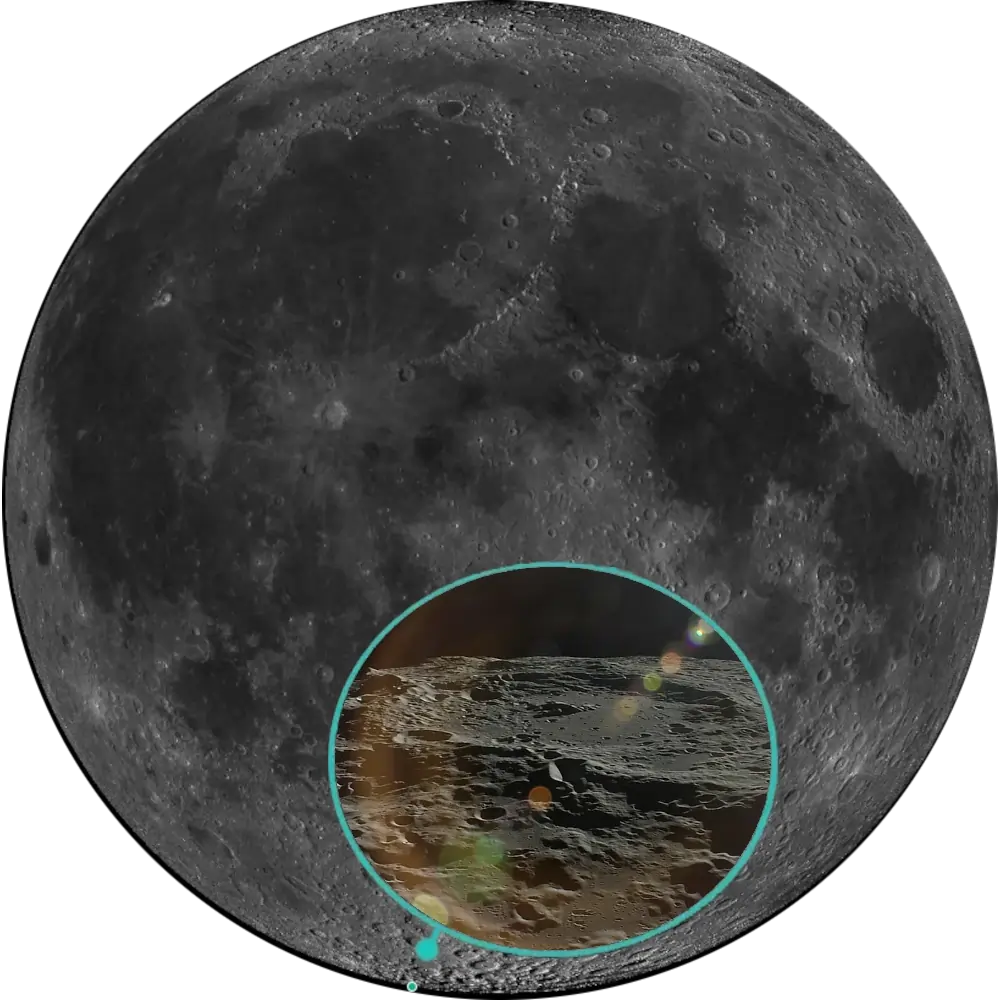
L94 Drygalski Crater
South Polar Limb · Far Side Border📉 Vital Statistics
🔭 Field Notes
Drygalski sits about as far from the middle of the visible disk as a named crater can get, straddling the Moon’s southern limb where the near side gives way to the far side. Even under the most favorable libration it is only ever seen edge-on and lit at a shallow, raking angle, which is exactly why it ranks near the difficult end of the Lunar 100 — a genuine test of both timing and technique rather than a target you can casually pick out on any given night. Although not itself inside the permanently shadowed polar region, Drygalski lies on the fringe of the Moon’s south polar highlands, an area now intensively studied for its potential water-ice deposits and its importance for future lunar exploration.
- ▶ One of the Moon’s Toughest Craters: Drygalski’s location so close to the pole and so far around the limb means it appears heavily foreshortened even under the most favorable libration, with only part of its interior ever visible face-on. The Sun always remains relatively low in the sky here compared with equatorial craters, placing Drygalski among the rugged south-polar terrain that includes many permanently shadowed craters nearby — though Drygalski itself is not one of them.
- ▶ A Complicated Naming History: Long before it carried its current name, this formation went by several others — Johann Schröter labeled it Casatus, Julius Franz called it Cabeus, and the original IAU nomenclature filed it as Casatus G, since Casatus and Cabeus were already in use elsewhere. The name Drygalski, honoring the German polar scientist, was proposed by Philipp Fauth, appeared in the 1963 Rectified Lunar Atlas, and was formally adopted by the IAU in 1964.
- ▶ Straddling Near Side and Far: Drygalski’s western rim overlaps the crater Ashbrook, a similar-sized formation that lies entirely on the far side and can never be seen from Earth at all — more than half of Ashbrook’s floor is buried under Drygalski’s outer ramparts and ejecta. A small crater chain arcs from Drygalski’s northern rim toward the neighboring crater Boltzmann, and portions of Drygalski’s own floor have been resurfaced flat by later lava, most notably in its southern and eastern reaches.
📍 Nearby L100 Targets
- L37 Bailly: A vast, lava-flooded walled plain roughly 440 km north-northeast, still deep in the rugged southern highlands but noticeably easier to observe than Drygalski since it sits farther from the extreme limb. It marks a natural next step for an observer working outward from the pole toward the visible disk.
- L9 Clavius: One of the Moon’s largest and most famous craters, roughly 1,000 km northeast, its floor scattered with an arcing chain of subsidiary craters. Clavius sits comfortably within easy telescopic reach, a striking contrast to Drygalski’s limb-hugging near-invisibility just a few Rükl charts away.
- L6 Tycho: The Moon’s brightest, most conspicuous rayed crater, roughly 1,500 km northeast and effectively at the opposite extreme from Drygalski in observing difficulty. Together the three form a rough sequence from center-disk showpiece to pole-hugging challenge object.
🚀 Mission Log
Target Acquisition
Push all the way to the edge — Drygalski sits right on the limb
Look toward 79.3°S, 84.9°W, about as far from disc center as a named crater gets, lying on the extreme southern limb close to the near-side/far-side transition. Don’t expect the clean, face-on view you’d get from a crater near the center of the disk — this is a limb target through and through, and you’ll be working against extreme foreshortening from the moment you find it.
Favorable libration gets you close, not comfortable
Even under the best southern libration, Drygalski is still viewed from the edge — but favorable libration can expose more of the crater’s profile and surrounding terrain than you’d get on an average night. Check a libration calendar and wait for the south polar region to be presented as favorably as possible, but go in knowing this is a genuine test of timing and technique, not a target you casually pick out on any given evening.
Use low-angle sunlight to bring out the relief
Because the Sun remains low over this high-latitude region, oblique illumination can throw Drygalski’s rugged rim and interior relief into strong contrast. Use the shadows to help define the crater’s shape rather than expecting a bright, evenly lit floor — though be aware that same low angle can also bury parts of the interior in shadow on a given night.
From Drygalski to Bailly, Clavius, and Tycho
Roughly 400 km north-northeast, Bailly (L37) is a vast, lava-flooded walled plain — still deep in the rugged southern highlands, but noticeably easier to observe once you’ve stepped back from the extreme limb. About 900 km northeast, Clavius (L9), one of the Moon’s largest and most famous craters, sits comfortably within easy telescopic reach, a striking contrast to Drygalski’s limb-hugging near-invisibility. And roughly 1,350 km northeast, Tycho (L6), the Moon’s brightest and most conspicuous rayed crater, sits at effectively the opposite extreme of observing difficulty — together the three trace a rough sequence from center-disk showpiece to pole-hugging challenge object.
📝 Observation Log — L94 Drygalski
0/4 CompleteIs Drygalski visible tonight?
Drygalski sits on the extreme southern limb near 79.3°S, 84.9°W, about as far from disc center as a named crater gets. Even under the best conditions it’s viewed edge-on, so you’ll want a night of favorable southern libration to bring as much of its floor into view as possible, combined with low-angle sunlight to throw its rugged rim and interior into shadow-defined relief.
Check Moon Phase TodayReturn to the List
Ready to find the next target? Go back to the full map to see what else is visible tonight.
← Back to Lunar 100 Map
When to Observe Drygalski
There’s no comfortable angle here and no phase that fixes the problem entirely. This is one L100 target defined almost as much by where it sits on the globe as by anything inside its rim — a genuine test of timing and technique rather than a target you casually pick out on any given night.
- Push to the Edge: Drygalski sits at 79.3°S, 84.9°W, about as far from disc center as a named crater gets, straddling the near-side/far-side transition on the extreme southern limb. Don’t expect the clean, face-on view you’d get from a crater nearer the center of the disk — this is a limb target through and through.
- Favorable Libration Gets You Close, Not Comfortable: Check a libration calendar and wait for the south polar region to be presented as favorably as possible. Even under the best conditions Drygalski is still viewed edge-on, with only part of its interior ever visible face-on.
- For Orientation: Center your search around 79.3°S, 84.9°W, but understand you’re working against extreme foreshortening from the moment you find it — one of the toughest entries on the whole list.
What to Look For
Drygalski’s location so close to the pole and so far around the limb means it appears heavily foreshortened even under the most favorable libration. The Sun always remains relatively low in the sky here compared with equatorial craters, and while Drygalski itself is not permanently shadowed, it sits at the edge of a south-polar highland region riddled with craters that are.
Because the Sun stays low over this high-latitude region, oblique illumination can throw Drygalski’s rugged rim and interior relief into strong contrast. Use the shadows to help define the crater’s shape rather than expecting a bright, evenly lit floor — though that same low angle can also bury parts of the interior in shadow on a given night.
Long before it carried its current name, this formation went by several others — Johann Schröter labeled it Casatus, Julius Franz called it Cabeus, and the original IAU nomenclature filed it as Casatus G, since Casatus and Cabeus were already in use elsewhere. The name Drygalski, honoring the German polar scientist, was proposed by Philipp Fauth, appeared in the 1963 Rectified Lunar Atlas, and was formally adopted by the IAU in 1964.
Drygalski partly overlies the crater Ashbrook to the west, a similar-sized formation that lies entirely on the far side and can never be seen from Earth at all — more than half of Ashbrook’s floor is covered by Drygalski’s outer ramparts and ejecta. An arcing catena of tiny craterlets connects Drygalski’s northern rim with neighboring Boltzmann, and portions of Drygalski’s own floor have been resurfaced flat by later lava, most notably in its southern and eastern reaches.
The Science: A Genuine Test of Timing and Technique
Drygalski isn’t contested the way some L100 targets are — there’s no rival theory about what it is. What makes it a target at all is where it sits: a large, ordinary complex crater turned into one of the Moon’s hardest observing challenges purely by geography.
Vital Statistics
Centered at 79.3°S, 84.9°W on Rükl chart 72, VI, Drygalski measures 149 km across and roughly 4.0 km deep. It’s named for Erich von Drygalski (1865–1949). Its type is a large, worn complex crater, and its L100 distinction is simply stated: a large south-pole region crater, and one of the most difficult on the entire list to observe well.
A Formation Built From Overlap
Drygalski isn’t a clean, isolated bowl — its identity is tied up with its neighbors. It partly overlies the far-side-only crater Ashbrook to the west, burying more than half of that crater’s floor, an arcing catena of tiny craterlets links it northward to Boltzmann, and later lava has resurfaced parts of its own floor. Even its name took decades to settle, cycling through Casatus, Cabeus, and Casatus G before Drygalski was formally adopted in 1964.
Mission Record
The Lunar Orbiter Program’s photography in 1966–67 provided the first detailed views of Drygalski and its overlap with Ashbrook, imagery difficult to obtain from Earth given the crater’s extreme limb position. Clementine’s global imaging and altimetry in 1994 improved mapping of the south polar limb region, including the Drygalski-Ashbrook-Boltzmann cluster, that Earth-based observation alone could never resolve face-on. The ongoing Lunar Reconnaissance Orbiter mission has since supplied precise LOLA topography, allowing accurate measurement of the crater’s depth and morphology alongside thousands of others.
Most Lunar 100 targets reward patience with detail once you find them. Drygalski rewards patience with the find itself — a crater whose science is unremarkable next to its neighbors, but whose position makes simply resolving it a genuine achievement.