
L82 Linné Crater
A small, fresh crater on Mare Serenitatis that 19th-century astronomers watched seemingly vanish before their eyes — a century-long controversy finally settled by a spacecraft camera.
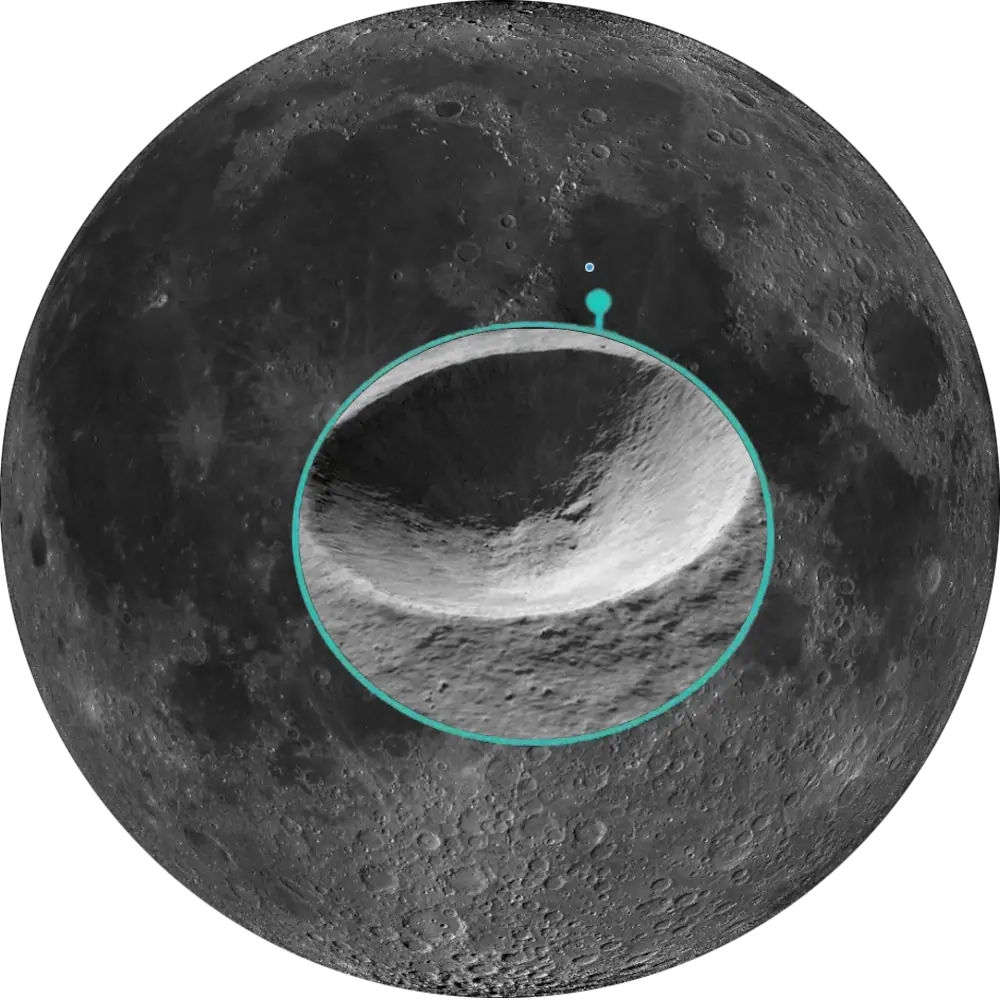
L82 Linné Crater
Western Mare Serenitatis · Historic Controversy📉 Vital Statistics
🔭 Field Notes
Linné’s appearance changes dramatically with the angle of sunlight, which is exactly what makes it interesting. Near the terminator, look for a tiny shadow-filled pit sitting on top of a low, pale mound. Under a higher sun, that same pit can all but wash out into the surrounding bright ejecta, leaving little more than a whitish smudge. This isn’t a trick of your equipment — it’s the same effect that convinced a generation of 19th-century astronomers something had genuinely gone wrong here.
- ▶ The Crater That Vanished (Almost): Early 19th-century lunar maps treated Linné as a conspicuous crater roughly 8–10 km across; in 1834, Lohrmann called it the second most conspicuous crater on the Moon. Johann Schmidt drew it as a normal crater in eight of eleven observations between 1840 and 1843. Then, on October 16, 1866, Schmidt announced that the crater had lost all appearance of one, leaving only a small dark spot inside a bright nimbus — a claim that, given Schmidt’s reputation, was taken seriously by astronomers internationally as possible evidence that the Moon was still geologically active.
- ▶ A Century of Disagreement: Mädler himself re-observed Linné in 1867 and said it looked just as it had in 1831. Other observers disagreed with each other for decades: in 1868 a shallow depression was reported at its center, Secchi later estimated a tiny craterlet only half a mile across, and Huggins measured it at two miles. The argument wasn’t settled until 1961, when astronomer Patrick Moore observed an entirely ordinary crater through multiple telescopes on one night, confirmed the sighting with another observer, and concluded that earlier reports of dramatic change were most likely the product of unusual lighting rather than any real transformation.
- ▶ Resolved by Spacecraft: When Lunar Orbiter photographed Linné, its images showed no obscuration of the crater pit whatsoever. Modern LRO topographic studies have gone further, finding that roughly 85% of Linné’s rim relief is uplifted mare basalt, with only about 15% built from ballistic ejecta — a young, well-preserved simple crater whose dramatic swings in visibility are a lighting effect, not a geological one.
📍 Nearby L100 Targets
- L41 Bessel Ray: The 16 km crater Bessel and its mysterious high-albedo ray, roughly 245 km southeast — the largest crater lying entirely within Mare Serenitatis, and the source of a ray whose true origin remains genuinely disputed among selenographers.
- L71 Sulpicius Gallus Dark Mantle: A dark pyroclastic deposit roughly 250 km south-southwest, marking explosive volcanism of an entirely different character than Linné’s simple impact origin.
- L89 Valentine Dome: The largest dome on the Moon, roughly 100 km north-northwest, an intrusive volcanic structure that takes on a heart-like shape under favorable low-sun lighting — a much larger, much older feature than the tiny, dramatically lit crater at Linné.
🚀 Mission Log
Target Acquisition
Scan the open floor of western Mare Serenitatis
Sweep the smooth, dark floor of Mare Serenitatis on Rükl chart 23 — Linné, at 27.7°N, 11.8°E, is a tiny 2.4 km pit with no other conspicuous crater nearby to confuse it with. Look for a small bright patch standing out against the darker mare surface; that patch of ejecta is your marker even before the crater itself resolves.
Observe it twice — once near the terminator, once under high sun
Linné is worth catching under two completely different lighting conditions on purpose. Near the terminator, look for a tiny shadow-filled pit sitting on a low, pale mound. Return under a higher sun and the shadow contrast largely disappears against the bright ejecta blanket, leaving the crater much harder to distinguish as a distinct pit — under the most extreme historical accounts, 19th-century observers described it as fading to little more than a round white spot. The contrast between the two views is the whole point — it’s the same lighting effect that convinced a generation of astronomers something had physically changed here.
Bring enough aperture, then push magnification
At 2.4 km across, Linné is a genuinely small target — at lunar distance that’s little more than an arcsecond, right at the resolving limit of modest telescopes. This is exactly the kind of target that has historically fooled small apertures: Schmidt’s famous 1866 observation, made near the very limit of his 6-inch refractor’s resolution, is a cautionary tale. Bring enough aperture and good seeing before pushing magnification to tease the shadow-filled pit apart from the bright mound and ejecta blanket around it. Under favorable low-sun conditions, note how the crater sits on its own low hill of uplifted basalt rather than simply punched into the flat mare floor — that raised setting is part of what makes its lighting swings so dramatic.
From Linné to Bessel, Sulpicius Gallus, and Valentine Dome
Southeast, roughly 245 km away, Bessel and its ray (L41) form the largest crater lying entirely within Mare Serenitatis, trailing a high-albedo ray whose true origin is still genuinely disputed. South-southwest, about 250 km off, the Sulpicius Gallus Dark Mantle (L71) is a dark pyroclastic deposit marking explosive volcanism — a different eruptive story entirely from Linné’s simple impact origin. And north-northwest, roughly 100 km away, the Valentine Dome (L89) is the largest dome on the Moon, taking on a heart-like shape under favorable low-sun lighting — a much larger, much older feature standing in contrast to the tiny, dramatically lit crater at Linné.
📝 Observation Log — L82 Linné Crater
0/4 CompleteIs Linné visible tonight?
Linné sits on the floor of Mare Serenitatis near 27.7°N, 11.8°E, and it’s worth catching under two different kinds of light. Near the terminator it shows as a tiny shadow-filled pit on a low mound; under a higher Sun that same pit largely washes out against its own bright ejecta blanket — the very effect that fooled 19th-century observers into thinking it had vanished. At only 2.4 km across, bring enough aperture before pushing magnification.
Check Moon Phase TodayReturn to the List
Ready to find the next target? Go back to the full map to see what else is visible tonight.
← Back to Lunar 100 Map
When to Observe Linné
Linné is a small, unglamorous-looking target on paper — a 2.4 km pit on the floor of Mare Serenitatis — but it’s worth observing twice under deliberately different lighting, because the contrast between those two views is the whole reason it made the Lunar 100.
- Observe It Twice: Near the terminator, look for a tiny shadow-filled pit sitting on a low, pale mound. Return under a higher sun and the shadow contrast largely disappears against the bright ejecta blanket — the same lighting effect that fueled a century-long dispute over whether Linné had physically changed.
- Bring Enough Aperture, Then Push Magnification: At 2.4 km across, Linné sits right at the resolving limit of modest telescopes. Bring enough aperture and good seeing before pushing magnification to tease the shadow-filled pit apart from the bright mound and ejecta blanket around it.
- For Orientation: Sweep the smooth, dark floor of Mare Serenitatis at 27.7°N, 11.8°E — few nearby craters are as conspicuous, making Linné’s bright ejecta patch an excellent landmark even before the crater itself resolves.
What to Look For
Near the terminator, look for a tiny shadow-filled pit sitting on top of a low, pale mound — this is Linné at its most crater-like.
Under a higher sun, watch that same pit all but wash out into the surrounding bright ejecta, leaving little more than a whitish smudge — the same effect that convinced 19th-century astronomers something had genuinely gone wrong here.
Note that Linné sits on its own low hill of uplifted basalt rather than simply being punched into the flat mare floor — a raised setting that’s part of what makes its lighting swings so dramatic.
Look for the crisp, bright ejecta blanket capping the mound — evidence, along with the crater’s fresh appearance, that Linné is geologically very young by lunar standards.
The Science: The Crater That (Almost) Vanished
Linné’s real interest isn’t its size but its role in one of the longest-running controversies in the history of lunar observation — a dispute settled not by better eyes, but by a spacecraft camera.
Vital Statistics
Located at 27.7°N, 11.8°E, on Rükl chart 23, Linné is a small, fresh simple impact crater 2.4 km across, sitting on a low hill of uplifted basalt capped by a bright ejecta blanket, on the floor of Mare Serenitatis. Named for Carl Linnaeus, the Swedish botanist and taxonomist, it’s very young by lunar standards — probably less than 10 million years old. Its L100 distinction: one of the most famous claimed cases of lunar surface change in the history of selenography, a controversy that ran for nearly a century.
The Crater That Vanished (Almost)
Early 19th-century lunar maps treated Linné as a conspicuous crater roughly 8–10 km across; in 1834, Lohrmann called it the second most conspicuous crater on the Moon. Johann Schmidt drew it as a normal crater in eight of eleven observations between 1840 and 1843. Then, on October 16, 1866, Schmidt announced that the crater had lost all appearance of one, leaving only a small dark spot inside a bright nimbus — a claim that, given Schmidt’s reputation, was taken seriously by astronomers internationally as possible evidence that the Moon was still geologically active.
A Century of Disagreement
Mädler himself re-observed Linné in 1867 and said it looked just as it had in 1831. Other observers disagreed with each other for decades: in 1868 a shallow depression was reported at its center, Secchi later estimated a tiny craterlet only half a mile across, and Huggins measured it at two miles. The argument wasn’t settled until 1961, when astronomer Patrick Moore observed an entirely ordinary crater through multiple telescopes on one night, confirmed the sighting with another observer, and concluded that earlier reports of dramatic change were most likely the product of unusual lighting rather than any real transformation.
Resolved by Spacecraft
When Lunar Orbiter photographed Linné, its images showed no obscuration of the crater pit whatsoever. Modern LRO topographic studies have gone further, finding that roughly 85% of Linné’s rim relief is uplifted mare basalt, with only about 15% built from ballistic ejecta — a young, well-preserved simple crater whose dramatic swings in visibility are a lighting effect, not a geological one.
Mission Record
Lunar Orbiter photography from 1966–1967 showed no obscuration of the crater pit, providing decisive evidence that helped close the century-long debate over its supposed 1866 disappearance. Orbital photography from Apollo missions between 1969 and 1972 added further high-resolution views of Linné and its surrounding bright ejecta blanket under varying illumination. High-resolution LROC imagery and topographic analysis from the Lunar Reconnaissance Orbiter confirmed Linné’s fresh, youthful morphology — including the discovery that its cross-section is closer to an inverted cone than the classic simple-crater bowl shape.
Most Lunar 100 targets are chosen for a feature you can see. Linné was chosen for a dispute nobody could settle from Earth — proof that even a century of careful observation can be led astray by nothing more than the angle of the Sun.