

Face on Mars
For centuries, humanity has looked up at the Red Planet and wondered if we are alone in the universe. In the late 19th century, Percival Lowell imagined vast canals engineered by a dying civilization. In 1938, Orson Welles terrified the radio-listening public with a fictional invasion. But in 1976, the fantasy seemed to collide with reality.
During the Viking 1 mission, NASA captured an image of the Martian surface in the Cydonia region that stopped the world in its tracks. Staring back from the rusty regolith was a face—humanoid, symmetrical, and miles wide.
This single frame, 35A72, sparked a thirty-year war between conspiracy theorists, who saw it as proof of ancient alien architects, and scientists, who saw a trick of light and shadow. It became the most famous image ever taken of another world, inspiring movies, books, and a deep-seated suspicion of government secrecy. This is the comprehensive story of the Face on Mars: how it was found, why we believed it was real, and what modern science eventually revealed.
01. The Viking Revelation
DATE: July 25, 1976
FRAME: 35A72
RESOLUTION: 43 meters/pixel
On July 25, 1976, NASA’s Viking 1 Orbiter was scanning the northern hemisphere of Mars near the 40th parallel. Its primary mission was utilitarian: to map the surface and find a safe, flat landing site for the incoming Viking 2 lander. The camera technology of the time was primitive by modern standards, relying on vidicon tubes that transmitted data back to Earth in a slow, line-by-line stream.
When the data from orbit 35 arrived at the Jet Propulsion Laboratory (JPL), Gerry Soffen, the Viking project scientist, noticed a peculiar formation. It was a mesa, roughly 2 kilometers (1.2 miles) long, casting long shadows in the late afternoon Martian sun. The interplay of light and dark created the distinct impression of two eyes, a nose, and a mouth.
Soffen and his team immediately recognized it as a trick of light—a phenomenon later classified as Pareidolia. This is the psychological phenomenon where the human brain, hard-wired to recognize social cues, perceives faces in random stimuli (like seeing shapes in clouds or a face on a piece of toast).
NASA released the image to the press with a lighthearted caption describing a “huge rock formation… which resembles a human head.” They intended it as a curiosity, a fun example of Martian geology. They had no idea they had just birthed a legend. The public did not see a trick of light; they saw a monument staring back at them.

The Monuments of Mars: Building a Myth
In the years following the Viking mission, NASA moved on to other projects, but a subculture of independent researchers became obsessed with Frame 35A72. The low resolution of the image (43 meters per pixel) meant that details were blurry enough to allow the imagination to fill in the gaps.
Two computer engineers, Vincent DiPietro and Gregory Molenaar, discovered a second image of the Face (Frame 70A13) in the Viking archives with a slightly different sun angle. They claimed the facial features persisted, arguing against the optical illusion theory. This caught the attention of science writer Richard Hoagland, who would become the Face’s biggest evangelist.
Hoagland and his team didn’t just see a face; they saw a ruined metropolis. They analyzed nearby geological features—pyramidal hills and fractured mesas—and claimed they were artificial structures. They dubbed this area “The City.” Hoagland published The Monuments of Mars, arguing that the layout of the Face and the City encoded hyperdimensional physics and mathematical constants like pi and e.
The conspiracy theory was seductive: NASA was allegedly scrubbing data to hide proof of a lost civilization that perhaps even colonized Earth. This narrative permeated pop culture throughout the 1990s, influencing The X-Files and the movie Mission to Mars. For a generation, Cydonia was the capital of alien intrigue.
Scientific Clarity: The High-Resolution Era
The debate over the Face on Mars persisted for over twenty years for one simple reason: no spacecraft had returned to Mars to check. The Viking orbiters went silent in 1980, and the failure of the Mars Observer in 1993 only fueled conspiratorial fires. However, science eventually returned to Cydonia.
1998: Mars Global Surveyor (MGS)
In April 1998, NASA’s Mars Global Surveyor finally arrived. The pressure from the public was so intense that NASA prioritized a re-imaging of Cydonia. On April 5th, MGS snapped a picture with a resolution ten times sharper than Viking. The result was sobering for believers: the “Face” looked like a heavily eroded hill. However, clouds and poor contrast (the “Catbox” image) left just enough wiggle room for die-hard theorists to claim the data was manipulated.
2001 & 2003: The 3D Models
Mars Odyssey (2001) and the European Space Agency’s Mars Express (2003) provided the next layer of truth. Mars Express used its High Resolution Stereo Camera to create a Digital Terrain Model (DTM). By rotating the data in 3D, scientists showed that the structure was a flat-topped mesa with ancient debris slides—features common in the arid landscapes of the American West, but alien to a “sculpted” monument.
2007: The Definitive HiRISE Image
The final nail in the coffin arrived via the Mars Reconnaissance Orbiter (MRO). Its camera, HiRISE, is the most powerful ever sent to another planet, capable of resolving objects as small as a coffee table (30cm per pixel).
The HiRISE image of the Face is a masterpiece of geology. It revealed that the “eyes” were nothing more than rocky depressions. The “mouth” was a shadow cast by a jagged ridge. The “hairline” was a series of stratified rock layers. The illusion of a face only exists when the sun is low on the horizon, casting long, forgiving shadows that blur the sharp, jagged reality of the rock.
The Power of Resolution
Comparing the 1976 mystery against the 2007 reality.
 1976 (VIKING 1) 43m/pixel resolution. Low sun angle creates the illusion.
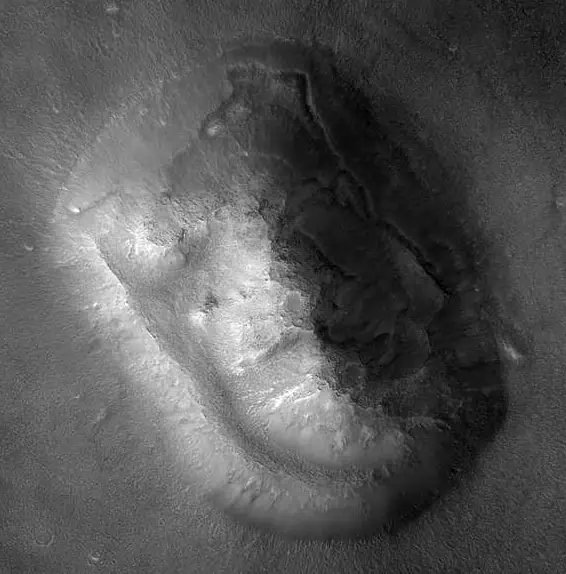 2007 (MRO HiRISE) 30cm/pixel resolution. Geological reality revealed.
The Legacy of Cydonia
In the end, the Face on Mars was not a message from the stars, but a mirror reflecting our own hopes and loneliness. We looked into the chaotic geology of another world and, desperate for company, we found ourselves.
Yet, the reality is no less awe-inspiring. The Cydonia mesa is a testament to the ancient, watery past of Mars—a landform that has survived billions of years of erosion. While the aliens may have vanished with the high-resolution pixels of the HiRISE camera, the drive to explore remains. Cydonia stands as a reminder of the power of perspective, and the importance of looking closer before we believe what we see.