

Searching for “supermoon dates in 2026” or “when is the next supermoon in 2026”? You’ve come to the right place. This comprehensive guide provides a detailed supermoon calendar for 2026, including exact dates, times, and types of supermoons. Whether you’re an astronomy enthusiast planning your stargazing sessions, a photographer seeking the perfect shot, or simply curious about these celestial wonders, we’ll cover everything from the science and history to practical tips, myths, and related events. In 2026, expect five supermoons—three full and two new—offering multiple opportunities to witness the moon at its most impressive. Read on for your complete supermoon 2026 schedule and how to make the most of it.
Table of Contents
- What is a Supermoon?
- The Science Behind Supermoons
- Supermoon Dates in 2026
- Click a 2026 Supermoon to See More Info
- Cultural and Historical Significance of Supermoons
- Myths and Facts About Supermoons
- Related Astronomical Events in 2026
- 🌕 Upcoming Lunar Eclipse
- 2026 Meteor Shower Calendar
- Frequently Asked Questions
- Conclusion
What is a Supermoon?
A supermoon happens when a full or new moon aligns with the moon’s perigee, its closest point to Earth in its elliptical orbit. This proximity makes the moon appear up to 14% larger and 30% brighter than an average full moon at apogee (farthest point). The term “supermoon” was popularized by astrologer Richard Nolle in 1979, who defined it as a full or new moon occurring within 90% of perigee. Astronomers sometimes refer to it as a “perigee full moon,” but supermoon has become the common name.
Full supermoons are the visible spectacles, while new supermoons are invisible as the moon sits between Earth and the sun. Common misconceptions include the idea that supermoons are dramatically larger to the naked eye—the difference is subtle without direct comparison. Another myth is that they cause extreme natural disasters, but their effects are limited to slightly higher tides, known as “perigean spring tides.”

The Science Behind Supermoons
The moon’s orbit around Earth is elliptical, not circular, causing its distance to vary from about 221,500 miles (356,500 km) at perigee to 252,700 miles (406,700 km) at apogee. When a full or new moon occurs near perigee, we get a supermoon. This alignment enhances the moon’s gravitational influence, resulting in higher-than-normal tides but no significant increase in earthquakes or volcanic activity—despite popular myths.

Compared to a regular full moon, a supermoon’s apparent size increase is due to its proximity, and the “moon illusion” makes it seem even larger near the horizon. Supermoons happen 3-5 times a year on average, with 2026 featuring five events, making it a noteworthy year for lunar observers. The exact distance for 2026’s supermoons varies slightly, but they all qualify under Nolle’s definition.
Supermoon Dates in 2026
2026 brings an exciting lineup of supermoons, with three visible full supermoons and two invisible new ones. The full ones will be particularly striking, appearing larger and brighter. Below is the complete supermoon calendar for 2026, with times in UTC (adjust for your local time zone using tools like TimeandDate.com). Note that visibility depends on weather and location—full supermoons are best seen at moonrise or moonset for the illusion effect.
Click a 2026 Supermoon to See More Info

January 3

May 16
June 15
November 24
December 24
For precise moonrise/moonset times in your area, use astronomy apps or websites. These dates are based on astronomical calculations and are accurate as of October 2025.
Viewing and Photography Tips
To fully appreciate the supermoon in 2026, choose a location with minimal light pollution and a clear horizon view. The best time is during moonrise or moonset when the moon appears largest due to the optical illusion. Use binoculars or a telescope for detailed views of craters and maria. Always check weather forecasts and dress appropriately, especially for January’s cold Wolf Moon.
Best Locations Worldwide for Viewing Supermoons in 2026
Seek dark-sky sites like national parks or rural areas. Top spots include:
- United States: Joshua Tree National Park (California) for clear deserts, or the Grand Canyon for dramatic horizons.
- Europe: Scottish Highlands or the Alps for elevated views.
- Asia: Himalayan foothills or Australian Outback for minimal pollution.
- Global Tip: Beaches or mountains offer unobstructed sights; avoid cities unless photographing urban silhouettes.
Advanced Photography Tips
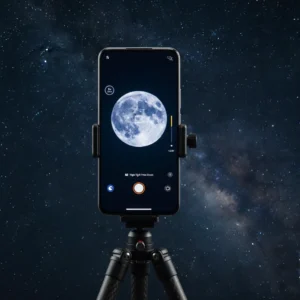
Capture stunning shots with a DSLR, mirrorless camera, or advanced smartphone on a tripod to avoid shake. Recommended settings: ISO 100-400, aperture f/8-f/11, shutter speed 1/125-1/250 sec (adjust for brightness). Use a telephoto lens (200mm+) for close-ups or wide-angle for landscapes. Scout locations in advance with apps like PhotoPills to align the moon with landmarks. For composites, shoot the moon separately and blend, but for authenticity, capture in one frame. Turn off VR/IBIS on tripods and use a remote shutter.
Super Full Moon – Wolf Moon on January 3, 2026
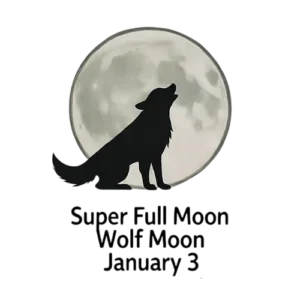
The Super Full Moon on January 3, 2026, known as the Wolf Moon, occurs at 10:04 AM UTC. This is the first supermoon of the year, when the moon is at its perigee (closest point to Earth), appearing up to 14% larger and 30% brighter than a typical full moon. Named for the howling of wolves in winter, as per Native American traditions, this moon offers a spectacular sight for astronomers and moon enthusiasts alike.
Visibility
- Global Visibility: Visible worldwide, with optimal viewing in the evenings of January 2 and 3. The moon will be high in the sky during evening hours in most regions, though the morning peak may favor daytime observation in some time zones.
- Best Viewing Locations: North America, Europe, and parts of Asia will have excellent evening views. In the Southern Hemisphere, the moon will appear lower but still striking.
- Conditions: Clear, cold winter skies in the Northern Hemisphere enhance visibility, making it ideal for stargazing.
Observation Tips
- Equipment: No telescope is needed; the naked eye or binoculars will reveal the moon’s enhanced size and brightness. A small telescope (4–6 inch aperture) can showcase craters like Tycho and Copernicus in sharp detail.
- Photography: Use a DSLR or smartphone with a telephoto lens (200mm+) for stunning shots. Set a fast shutter speed (1/250s) and low ISO (100–200) to capture the moon’s details without overexposure.
- Timing: Observe in the early evening when the moon rises, as the “moon illusion” makes it appear even larger near the horizon. Check local moonrise times for your location.
- Companion Objects: Look for bright stars like Aldebaran in Taurus or the Pleiades cluster nearby, adding context to your stargazing session.
Significance
- Astronomical: The moon will be approximately 356,000 km from Earth, closer than the average 384,400 km, enhancing its tidal effects and visual impact.
- Cultural: The Wolf Moon is steeped in folklore, symbolizing survival and community in harsh winter months. It’s a great opportunity to connect with cultural stories about the moon.
- Scientific: Supermoons are excellent for studying lunar libration (the moon’s slight wobble), which reveals different edge features over time.
Fun Fact
The Wolf Moon’s name comes from Native American tribes who associated January’s full moon with wolves howling in hunger. Combine your observation with a cozy night of storytelling about lunar myths!
Back to SuperMoon Dates
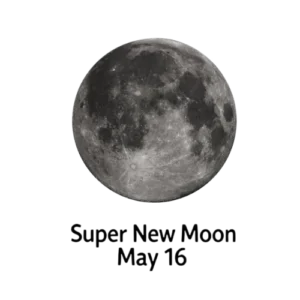
Super New Moon (May 16, 2026)
Overview
The Super New Moon on May 16, 2026, occurring at 8:03 PM UTC, marks a moment when the moon is at its perigee, or closest approach to Earth, rendering it invisible as it aligns between Earth and the sun. This supermoon, though hidden from view, creates exceptionally dark skies, making it a prime opportunity for astronomers and amateur moon lovers to observe faint celestial objects like stars, galaxies, and meteors. It’s a perfect night to explore the cosmos beyond the moon’s glow.
Visibility
- Global Visibility: As a new moon, it’s invisible worldwide, but the absence of moonlight enhances the visibility of other celestial objects. The dark skies are ideal for stargazing in any region with clear weather.
- Best Viewing Locations: Rural areas, national parks, or designated dark-sky sites (e.g., those certified by the International Dark-Sky Association) offer the best conditions. Urban observers should seek locations with minimal light pollution.
- Conditions: In the Northern Hemisphere, late spring provides mild temperatures, ideal for extended observing sessions. In the Southern Hemisphere, autumn skies may be crisp, enhancing clarity if clouds are absent.
Observation Tips
- Equipment: A telescope with a 6–8 inch aperture is excellent for viewing deep-sky objects like the Andromeda Galaxy (M31), the Triangulum Galaxy (M33), or globular clusters such as M13 in Hercules. Binoculars (10×50 or stronger) are great for brighter objects like the Pleiades.
- Stargazing: The dark skies are perfect for meteor watching. While no major meteor showers peak on May 16, stragglers from the Eta Aquariids (active early May) may be visible. Lie back with a wide view of the sky to spot faint meteors.
- Photography: Capture the Milky Way or star fields with a DSLR or mirrorless camera on a tripod. Use a wide-angle lens (14–24mm), high ISO (800–3200), and long exposures (15–30 seconds) for best results. A star tracker can enhance deep-sky shots.
- Timing: Start observing after astronomical twilight (1–2 hours after sunset) for the darkest skies. In many regions, this will be around 10 PM local time, aligning with the moon’s invisibility.
Significance
- Astronomical: At approximately 356,500 km from Earth, this Super New Moon is closer than the average lunar distance (384,400 km), amplifying tidal effects slightly. Its proximity enhances its gravitational influence, though it’s not visible.
- Scientific: The absence of moonlight reduces sky brightness, making it ideal for observing faint objects. Astronomers can study galaxies, nebulae, or variable stars with greater clarity, as lunar glare is eliminated.
- Cultural: New moons often symbolize renewal or new beginnings in various cultures, from lunar calendars to spiritual practices. This supermoon is a chance to reflect while gazing at the star-filled sky.
Fun Fact
The term “Super New Moon” is less common than “Supermoon” for full moons, but it’s just as significant for astronomers. The dark skies on May 16, 2026, make it an excellent night to host a stargazing event—invite friends, bring a telescope, and explore the universe’s hidden treasures!
Back to SuperMoon Dates
Super New Moon (June 15, 2026)

Overview
The Super New Moon on June 15, 2026, at 2:56 AM UTC, occurs when the moon is at its perigee, making it invisible as it aligns between Earth and the sun. This supermoon creates exceptionally dark skies, offering astronomers and amateur moon lovers a fantastic opportunity to observe faint celestial objects such as galaxies, star clusters, and meteors. Its proximity to the summer solstice adds a special seasonal context to this astronomical event.
Visibility
- Global Visibility: As a new moon, it is invisible worldwide, but the absence of moonlight enhances the visibility of stars, planets, and deep-sky objects. This makes it a prime night for stargazing across all regions.
- Best Viewing Locations: Dark-sky sites, such as rural areas, national parks, or observatories with minimal light pollution, provide the best conditions. Urban astronomers should travel to darker locations for optimal viewing.
- Conditions: In the Northern Hemisphere, early summer offers warm nights, ideal for prolonged observation. In the Southern Hemisphere, winter skies can be crisp and clear, enhancing visibility if weather permits.
Observation Tips
- Equipment: A telescope with a 6–8 inch aperture is ideal for deep-sky objects like the Sombrero Galaxy (M104) or the Hercules Cluster (M13). Binoculars (10×50 or 15×70) are great for sweeping views of star fields or bright clusters like the Beehive (M44).
- Meteor Watching: The June Bootids meteor shower peaks around June 22–23, so early meteors may be visible on June 15. Set up a reclining chair or blanket, face east, and keep a wide view of the sky to catch faint streaks.
- Photography: Capture the Milky Way, prominent in June, with a DSLR or mirrorless camera on a tripod. Use a wide-angle lens (14–24mm), high ISO (1600–3200), and 20–30 second exposures. A star tracker can improve results for longer exposures.
- Timing: Observe after midnight, especially in the pre-dawn hours (around 3–5 AM local time), when the sky is darkest and the moon is fully below the horizon.
Significance
- Astronomical: At roughly 356,000 km from Earth, this Super New Moon is closer than the average lunar distance of 384,400 km, slightly amplifying tidal effects. Its proximity makes it a notable event, even though it’s invisible.
- Scientific: The dark skies are perfect for studying faint celestial objects, such as distant galaxies or nebulae, as the lack of lunar glare enhances contrast and visibility.
- Cultural: New moons are often linked to renewal and introspection across cultures, from lunar calendars to spiritual traditions. This supermoon, close to the June solstice (June 20, 2026), ties into seasonal celebrations of light and growth.
Fun Fact
The June 15, 2026, Super New Moon occurs just days before the summer solstice, making it a great time to observe summer constellations like Scorpius, Sagittarius, or the bright star Vega in Lyra. Plan a late-night stargazing session to celebrate the longest days of the year!
Back to SuperMoon Dates
Super Full Moon – Beaver Moon (November 24, 2026)

Overview
The Super Full Moon on November 24, 2026, known as the Beaver Moon, peaks at 2:55 PM UTC. Named for the beaver trapping season in Native American tradition, this supermoon occurs when the moon is at its perigee, appearing up to 14% larger and 30% brighter than a typical full moon. Its striking appearance makes it a must-see for astronomers and amateur moon lovers, offering a brilliant centerpiece for late autumn stargazing.
Visibility
- Global Visibility: The Beaver Moon is visible worldwide, with optimal viewing in the evening hours of November 24. The afternoon peak favors daytime observation in some regions, but evening views are best in the Americas and Europe, where the moon will be high in the sky.
- Best Viewing Locations: Urban and rural areas with clear skies will offer great views. The Americas and Europe are particularly well-positioned for evening observation, while Asia and Australia may see it better in the early morning of November 25.
- Conditions: Late autumn in the Northern Hemisphere brings crisp, cool nights, ideal for lunar observation. In the Southern Hemisphere, spring conditions may provide mild weather for comfortable viewing.
Observation Tips
- Equipment: No equipment is needed to enjoy the moon’s enhanced size and brightness, but binoculars or a small telescope (60–100mm aperture) will reveal stunning details like the Sea of Serenity or the bright crater Aristarchus. A 4–6 inch telescope can highlight finer features.
- Photography: Capture the supermoon with a DSLR or smartphone using a telephoto lens (200mm+). Use a tripod, ISO 100–400, and a shutter speed of 1/200s to avoid overexposure. Include foreground elements like trees or buildings for dramatic compositions.
- Timing: Observe at moonrise on November 24, when the “moon illusion” makes the moon appear larger near the horizon. Check local moonrise times for your location. Evening hours are ideal for most regions.
- Companion Objects: Look for nearby constellations like Taurus (with the bright star Aldebaran) or Gemini, which may frame the moon beautifully in the evening sky.
Significance
- Astronomical: At approximately 356,700 km from Earth, this supermoon is closer than the average lunar distance of 384,400 km, enhancing its visual impact and slightly amplifying tidal effects.
- Cultural: The Beaver Moon reflects historical practices of preparing for winter, as beavers were trapped for their pelts during this season. It’s a great opportunity to explore Native American lunar naming traditions and share stories under the night sky.
- Scientific: The bright illumination of a supermoon is ideal for studying lunar surface features, such as craters and maria (lunar seas), in high contrast. It’s also a chance to observe lunar libration, which reveals slightly different edge features.
Fun Fact
The Beaver Moon coincides closely with Thanksgiving in the U.S. (November 26, 2026), making it a perfect focal point for festive stargazing gatherings. Set up a telescope at your holiday event to share the moon’s brilliance with family and friends!
Back to SuperMoon Dates
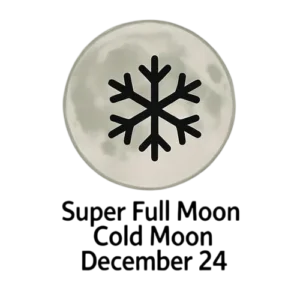
Super Full Moon – Cold Moon (December 24, 2026)
Overview
The Super Full Moon on December 24, 2026, known as the Cold Moon, occurs at 1:29 AM UTC, coinciding with Christmas Eve. Named for the chilly winter season in Native American tradition, this supermoon appears up to 14% larger and 30% brighter due to its perigee position, making it a dazzling holiday spectacle for astronomers and amateur moon lovers. Its festive timing adds a magical glow to the night sky.
Visibility
- Global Visibility: The Cold Moon is visible worldwide, with prime viewing in Asia, Australia, and the Pacific during the evening of December 24. In the Americas, it’s best observed in the early morning or evening of December 23–24, while Europe may see it best in the early hours of December 24.
- Best Viewing Locations: Areas with clear skies, especially in Asia, Australia, and the Pacific, will offer stunning evening views. Urban settings with holiday lights can add charm, but rural areas with minimal light pollution are ideal for detailed observation.
- Conditions: Winter skies in the Northern Hemisphere provide crisp, clear conditions for viewing, while summer skies in the Southern Hemisphere offer warm, comfortable nights for stargazing.
Observation Tips
- Equipment: The naked eye will capture the moon’s enhanced brilliance, but binoculars or a small telescope (60–100mm aperture) will reveal details like the Mare Imbrium or the bright crater Tycho. A 4–6 inch telescope can highlight intricate lunar features.
- Photography: Use a DSLR or smartphone with a telephoto lens (200–400mm) on a tripod. Set ISO 100–200 and a shutter speed of 1/250s to avoid overexposure. Frame the moon with holiday decorations or winter landscapes for festive shots.
- Timing: Observe at moonrise on December 24, when the “moon illusion” enhances its apparent size near the horizon. Check local moonrise times for precision. In Asia and Australia, evening hours are optimal; in the Americas, try pre-dawn or early evening on December 23–24.
- Companion Objects: Look for winter constellations like Orion, Canis Major (with the bright star Sirius), or Taurus near the moon, creating a beautiful celestial backdrop for holiday viewing.
Significance
- Astronomical: At approximately 356,200 km from Earth, this supermoon is closer than the average lunar distance of 384,400 km, amplifying its visual impact and tidal effects slightly.
- Cultural: The Cold Moon, coinciding with Christmas Eve, symbolizes light and hope during the darkest time of the year in the Northern Hemisphere. It’s a perfect opportunity to share lunar folklore and holiday traditions with loved ones.
- Scientific: The bright illumination is ideal for studying lunar topography, with high contrast revealing craters, maria, and mountain ranges like the Apennines. It’s also a chance to observe subtle lunar libration effects.
Fun Fact
This Christmas Eve supermoon is a rare event, last occurring in 2007, making it a special holiday treat. Host a telescope viewing party during your Christmas Eve celebrations to share the moon’s brilliance and create lasting memories!
Back to SuperMoon Dates

Cultural and Historical Significance of Supermoons
Supermoons have captivated cultures for millennia, symbolizing fertility, transformation, and omens in folklore. The Wolf Moon evokes Native American tales of winter hunger, while the Beaver Moon signals preparation for cold months. In ancient times, supermoons were linked to gods like Artemis or Luna. Historically, the December 24, 2026, Cold Moon on Christmas Eve echoes rare alignments like the 2015 full moon on Christmas. Astrologically, they intensify emotions, though this lacks scientific backing.
Myths and Facts About Supermoons
Myth: Supermoons cause earthquakes and disasters. Fact: While they amplify tides, no evidence links them to seismic events. Myth: They make people “lunatic” or crazy. Fact: Studies show no correlation with human behavior. Myth: All supermoons are equally “super.” Fact: Proximity varies; winter ones appear slightly larger due to Earth’s tilt. **Fact: The moon illusion isn’t supermoon-specific—it’s psychological.
Related Astronomical Events in 2026
Enhance your supermoon viewing by noting other lunar highlights. 2026 features two lunar eclipses: a total on March 3 (visible in Americas, Europe, Africa) and a partial on August 28. Solar eclipses include an annular on February 17 and a total on August 12. Meteor showers like the Perseids (August) may coincide with new supermoons for darker skies.
