
Moon Phase Today Washington, D.C.
On Friday, October 9, 2026, the moon in Washington is a New Moon with 0% illumination. Moon age: 28.9 days.
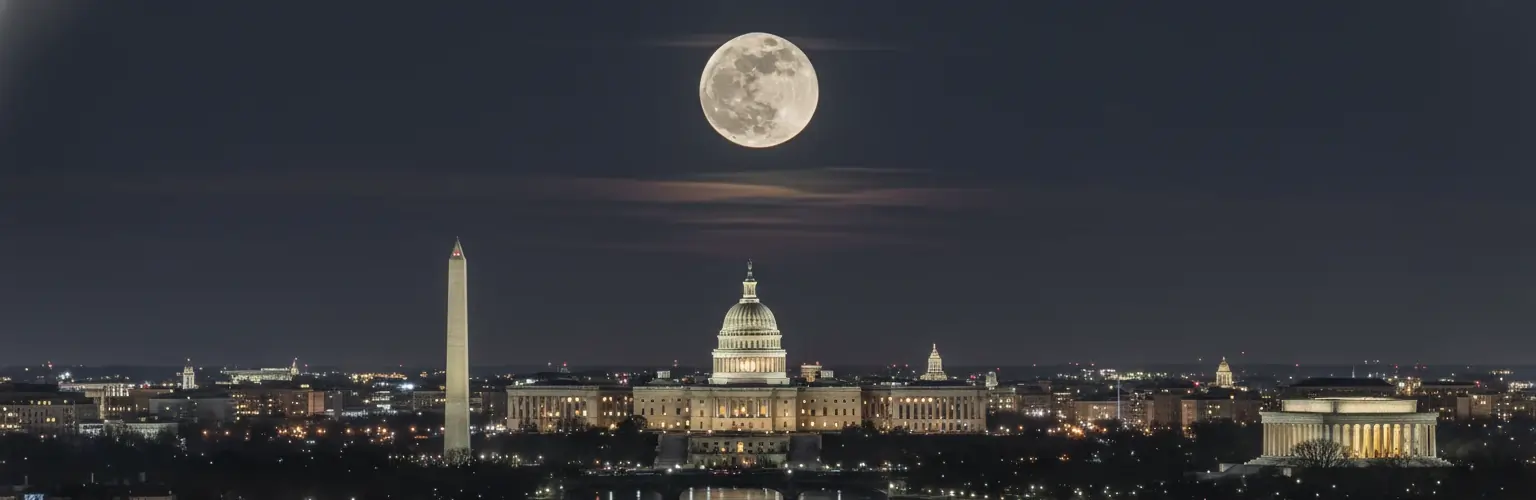
☽ Best Places to View the Moon in Washington, D.C.
Washington, D.C.’s monumental skyline and wide Potomac River create iconic moonrises – especially when the moon aligns with the Capitol, Washington Monument, or Lincoln Memorial. The nation's capital offers unparalleled opportunities for photographers seeking to capture lunar events against a backdrop of historic landmarks. Perfect alignments, while rare, can be truly spectacular — use PhotoPills to plan the exact date and location for your chosen shot. All spots are free and accessible 24/7 unless otherwise noted.
United States Capitol – East Lawn / Pennsylvania Avenue
The classic #1 D.C. moonrise icon. The moon rises over the eastern horizon, and on specific dates, can align dramatically behind the illuminated Capitol dome. From the East Steps or the Ulysses S. Grant Memorial, careful planning can yield stunning, symmetrical compositions. Best for telephoto shots that compress the moon with the dome. Easily accessible, but check for potential security restrictions.
Lincoln Memorial – Reflecting Pool West End
An iconic National Mall view: from the west end of the Reflecting Pool (near the Lincoln Memorial), the moon can rise behind the Washington Monument obelisk, often reflecting perfectly in the long pool. With precise timing, this spot is renowned for stunning telephoto compression shots that make the moon appear massive over the monument. Calm evenings are crucial for clear reflections. Free, open daily.
Jefferson Memorial – Tidal Basin South Shore
From the Tidal Basin's south shore, you look north towards the domed memorial. The moon rises over the water with the Jefferson Memorial in the foreground, and the Washington Monument visible behind it. During peak season, cherry trees can frame the shot beautifully (magical during bloom season remnants). Tidal Basin reflections are often mirror-like on calm nights, adding depth. Accessible with parking nearby.
Netherlands Carillon / Iwo Jima Memorial (Arlington)
An elevated Arlington viewpoint across the Potomac River. The moon rises behind D.C.'s iconic skyline, with the Lincoln Memorial, Washington Monument, and Capitol potentially aligning in a panoramic row on specific dates. This spot offers a slightly darker sky and a sweeping view, ideal for wide-angle to mid-telephoto lenses to capture the monumental vista. Free, open daily.
Gravelly Point (Arlington – near Reagan Airport)
This riverside park is famous for planes flying overhead, adding a unique element to moon shots. The moon rises straight over the Potomac, and with proper planning, can align with the Washington Monument and Capitol. The water foreground provides excellent opportunities for reflections. It's a a popular spot, so be prepared for some activity. Free, open daily.
Hains Point – East Potomac Park (Tip of the Island)
A southern peninsula offering a 180° open eastern horizon. The moon rises over the water with the full sweep of the Mall monuments (Jefferson Memorial, Washington Monument, Capitol) visible in the distance. This location is very quiet and relatively dark, providing a serene experience for capturing grand, unobstructed views. Accessible via car with ample parking.
◉ Best Times for Moon Photography
📷 Quick Photography Tips
Washington, D.C. operates on EST (UTC-5) in winter and EDT (UTC-4) in summer. Clocks go forward on the second Sunday in March and back on the first Sunday in November. Apps like PhotoPills or Stellarium set to D.C. handle the offset automatically — moonrise times shift by several minutes daily, and planning exact alignments with the iconic monuments requires precise local time.
For the moon phase in any other city worldwide, visit our Dynamic Moon Phase Calculator for instant lunar data tailored to wherever you are.
The moon phase today in Washington, D.C. is shown in detail above — complete with exact illumination percentage, moonrise/set times, and the best local spots to see it. For the moon phase today in any other city or location worldwide, visit our Dynamic Moon Phase Calculator on the home page.
◐ What the Experience Actually Feels Like
There is an undeniable grandeur to a moonrise in Washington, D.C. Imagine standing on the East Lawn of the Capitol, the giant dome bathed in golden light, and as the last vestiges of sunset fade, a vast, luminous orb begins to ascend over the eastern horizon. While perfect alignments are rare and require meticulous planning, on those special nights, the moon can appear to hang directly behind the Capitol. Or perhaps you're at the west end of the Reflecting Pool, witnessing the moon majestically clear the Washington Monument, its light stretching across the water towards you. These are not just photographic opportunities; they are moments that connect the natural world with the enduring symbols of a nation, creating a profound sense of awe.
D.C.'s geography—its wide avenues, expansive National Mall, and the Potomac River—is perfectly suited for capturing these monumental scenes. From the Capitol, you look west towards the full sweep of the Mall. From the Lincoln Memorial area, your gaze extends eastward, taking in the Washington Monument and the Capitol in a powerful visual line. The Potomac River and Tidal Basin act as immense mirrors, doubling the light of the moon and the illuminated structures on calm evenings. The geometry is often long, straight, and deeply symbolic, making for compositions that feel both epic and historically significant, even when the moon is simply a beautiful backdrop.
The cooler months, from October to March, are often the most rewarding for D.C. moon photography. The skies tend to be clearer, and the moon's more southerly path allows for those critical geometries that can lead to tight alignments with the city's key monuments. Crisp winter air enhances the clarity of both the moon and the distant floodlit buildings. Spring, particularly during the brief but spectacular cherry blossom season, offers unique opportunities to frame the moon with delicate floral foregrounds around the Tidal Basin. Summer brings warmer, hazier evenings, where the moon might rise into a sky still glowing with the last colours of dusk.
"Witnessing the moon majestically clear the Washington Monument, its light stretching across the water towards you. These are moments that connect the natural world with the enduring symbols of a nation, creating a profound sense of awe."
✓ Your Washington, D.C. Moon Chase Checklist
Before You Go
- Check the moonrise time and phase on this page — D.C.'s iconic monument alignments are highly seasonal and require precise planning
- Use PhotoPills or The Photographer's Ephemeris to verify the moon's path relative to the Capitol, Washington Monument, or Lincoln Memorial on your chosen date. Understand that perfect alignments are rare and need specific planning, not a guarantee on any full moon.
- Target the 48–72 hour window before full moon if possible — the moon rises during civil twilight, bathing the monuments in beautiful golden/blue hour light
- Check wind forecasts for the Potomac River and Tidal Basin — calm evenings are absolutely critical for clear reflections
- Scout your chosen location during the day — assess parking, pedestrian access, security checkpoints (especially near the Capitol), and potential obstructions
What to Bring
- Sturdy tripod — the open expanse of the National Mall and riverfront areas are very exposed to wind, which can easily ruin long exposures
- A telephoto lens (e.g., 200–400mm) is highly recommended for tight compression shots of the moon with the Washington Monument or Capitol dome
- Layers of clothing, especially in cooler months — waiting outdoors on the Mall or by the river can be surprisingly cold and damp
- A wide-angle lens (e.g., 16–35mm) for broader environmental shots incorporating multiple monuments and the vastness of the Mall
- Remote shutter release or self-timer — to avoid camera shake during long exposures, especially critical for sharp moon details
- A flashlight or headlamp — paths on the Mall and in parks can be poorly lit after dark, and you may need to check camera settings
On the Night
- Arrive at your viewpoint 45–60 minutes before moonrise — the pre-moonrise twilight offers unparalleled light on the monuments before the moon appears
- At the Reflecting Pool, position yourself carefully at the west end (near the Lincoln Memorial) to capture the moon rising behind the Washington Monument, with its reflection in the water
- Shoot RAW — the extreme dynamic range between a bright moon and floodlit monuments requires significant post-processing for optimal results
- Stay 30–45 minutes after moonrise — as the moon climbs, the compositions shift, and the quality of light on the monuments changes dramatically
- Be respectful of other photographers and visitors — D.C.'s iconic spots are popular, so find your place without obstructing others' views
? Washington, D.C. Moon Phase — Frequently Asked Questions
Q. What is the moon phase today in Washington, D.C.?
The moon phase today in Washington, D.C. is a New Moon with 0% illumination (moon age: 28.9 days). Full details are shown in the widget at the top of this page. D.C.'s coordinates (38.8951° N, 77.0364° W) are already factored in, so the phase and times shown are accurate for the city without any adjustment needed.
Q. What time does the moon rise and set in Washington, D.C. today?
Moonrise and moonset both change daily and are calculated live for Washington, D.C. in the info panel above. Tap any date on the calendar to see the phase and rise/set times for that specific day.
Q. Where is the best place to view the moon in Washington, D.C.?
The U.S. Capitol's East Lawn is the signature spot, where the moon can occasionally align dramatically behind the illuminated dome. The west end of the Reflecting Pool near the Lincoln Memorial is a strong alternative, with the moon clearing the Washington Monument and reflecting in the water, while the Jefferson Memorial's Tidal Basin shore and the Netherlands Carillon in Arlington offer wider panoramic views of the monuments.
Q. Are there any access restrictions to know about near the Capitol?
Yes — the Capitol grounds have security checkpoints and restricted areas, so it's worth scouting your exact spot during the day beforehand rather than arriving for the first time after dark. Most of the other monument viewpoints, like the Reflecting Pool and Tidal Basin, remain freely accessible at all hours.
Q. Why is Washington, D.C. known for such dramatic moon-and-monument alignments?
D.C.'s National Mall was designed with long, deliberate sightlines between its monuments — the same geometry that makes the city feel monumental on foot also happens to line up beautifully with the moon on certain dates. Combine that with wide-open water at the Reflecting Pool, Tidal Basin, and Potomac River for mirror-like reflections, and you get alignments that are genuinely rare but especially striking when they happen.
Q. When is the next full moon in Washington, D.C.?
The date of the next full moon is calculated live and shown in the "Next Full Moon" card above.
Q. Does Washington, D.C. observe daylight saving time?
Yes. Washington, D.C. runs on Eastern Standard Time (EST, UTC−5) in winter and switches to Eastern Daylight Time (EDT, UTC−4) from the second Sunday in March to the first Sunday in November. All times shown on this page already account for the correct offset.
Q. What's the best time of year for moon photography in Washington, D.C.?
October through March puts the moon on a more southerly path, which is when the tightest monument alignments tend to be possible, and winter skies are often the clearest. Late March into early April adds cherry blossoms around the Tidal Basin, which pair beautifully with a rising moon if the timing lines up.
Q. Does this page work for cities besides Washington, D.C.?
This page is set up specifically for Washington, D.C. For the moon phase in any other city or location worldwide, use the Dynamic Moon Phase Calculator on the moonphase.today home page.
✦ Explore Further
Moon Photography Guide
Camera settings, lenses, and techniques for shooting sharp, well-exposed moon shots.
🌆Blue Hour Calculator
Time your visit to the Capitol or Reflecting Pool so moonrise lines up with that golden-to-blue twilight window.
🔭Photography Field of View Calculator
Work out the focal length you'll need to compress the moon tightly behind the Washington Monument or Capitol dome.
📖Moon Dictionary
Plain-language definitions for lunar terms like syzygy, libration, terminator, and more.
NASA Moon Phase & Libration Gallery
NASA's Scientific Visualization Studio's daily renders of the moon's exact phase, libration, and orientation, straight from official mission data.