
Moon Phase Today Vienna
On Saturday, October 10, 2026, the moon in Vienna is a New Moon with 0% illumination. Moon age: 28.9 days.
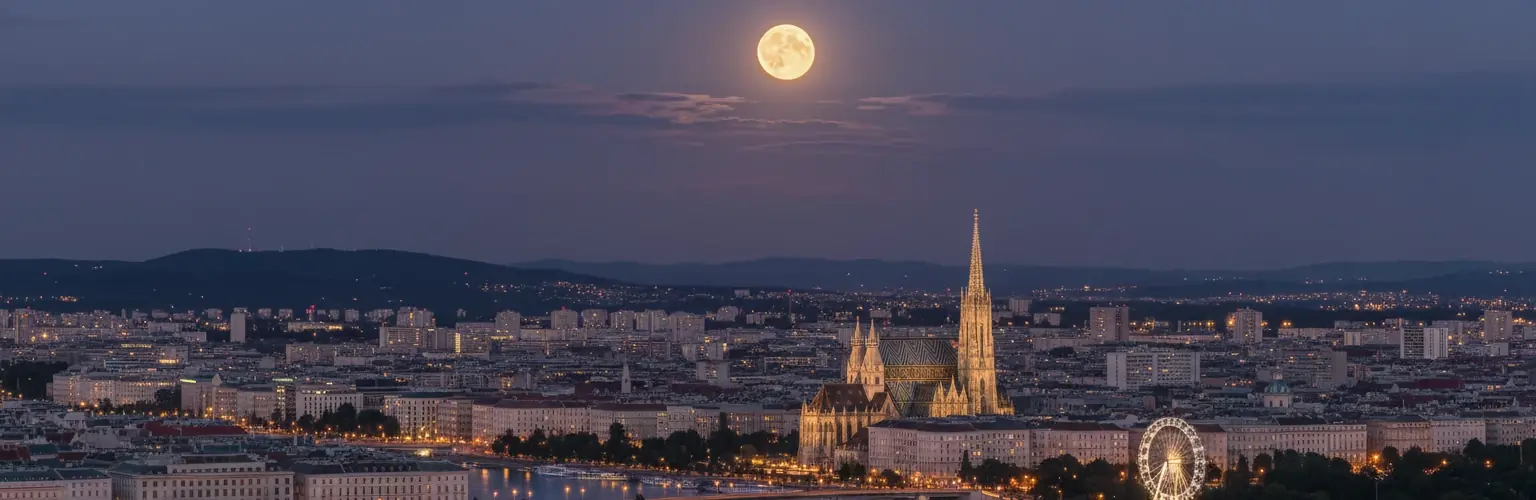
☽ Best Places to View the Moon in Vienna
Vienna is a city of Imperial horizons, where the manicured gardens of the Habsburgs meet the untamed Vienna Woods (Wienerwald) and the sweeping Danube valley. At 48° North latitude, moon photography here is an exercise in elegance, whether you are framing the moon behind Romanesque-Gothic spires or capturing its reflection in the Neue Donau. From the vineyard-covered hills of the 19th district to the futuristic skyline of Donau City, Vienna offers a unique blend of Old World symmetry and celestial wonder.
Kahlenberg Panorama Terrace
The undisputed #1 moonrise viewpoint. At 484m, it offers a massive panorama over the city bowl and Danube. The moon rises centrally over the skyline, illuminating the Grinzing vineyards below. Accessibility: The hilltop is freely accessible 24/7, though the adjacent restaurant and cafe have set business hours. Accessible via the 38A bus from Heiligenstadt.
The Gloriette (Schönbrunn Hill)
Situated on the hill overlooking Schönbrunn Palace, this Baroque monument provides perfect imperial symmetry. The moon rises behind the palace and city rooftops. Access Note: The palace gardens have strictly enforced seasonal closing hours (varying from 6:30 PM to 9:00 PM). Confirm the official seasonal schedule before planning an evening shoot.
Leopoldsberg Church Terrace
The twin hill to Kahlenberg (425m), offering a tighter, more dramatic angle on the Danube bend. From here, the moon rises over the river with the castle-like church as a powerful foreground element. It is typically darker and more secluded than Kahlenberg, making it a favorite for tripod-carrying photographers looking for a quiet, atmospheric vantage point.
Donauturm (Danube Tower)
Austria’s tallest structure (~252m) offers a 360° view from its observation decks. The moon rises over the eastern plains and the Danube, with the city twinkling below. Operating Hours: The tower closes at 10:30 PM, with the last ascent at 9:45 PM. Ticket entry is approx €18.00. Ideal for telephoto shots that compress the moon against the 1st District spires.
DC Tower 1 / Neue Donau
For a modern aesthetic, head to the banks of the Neue Donau. DC Tower 1 is Austria’s tallest building (~250m) and its sleek, wavy facade reflects the lunar glow. The calm waters of the "New Danube" provide perfect mirror reflections, especially during the blue hour. The river banks are free, open 24/7, and offer massive space for expansive gear setups.
Jubiläumswarte (Ottakring)
Located on the western edge of the city at 450m elevation, this observation tower in the 16th district provides a unique angle looking east over the city. Seasonal Note: The tower itself is typically closed during the winter months (Nov-Mar) for safety due to ice. During open seasons, it offers a dark-sky alternative to the more popular eastern hills.
◉ Best Times for Moon Photography
📷 Quick Photography Tips
Vienna operates on CET (UTC+1) in winter and CEST (UTC+2) during summer. DST begins the last Sunday in March and ends the last Sunday in October. At 48°N, the moon's seasonal path varies significantly; winter full moons ride high and fast, while summer moons skim the horizon in an elongated twilight.
The moon phase today in Vienna is shown in detail above. For the moon phase today in any other city or location worldwide, visit our Dynamic Moon Phase Calculator on the home page.
◐ What the Experience Actually Feels Like
There is a particular majesty to a moonrise over Vienna. Standing on the Kahlenberg terrace as the sun dips behind the rolling hills of the Vienna Woods, you watch the city transition from a golden Imperial glow to a deep, velvety indigo. The first hint of the moon appearing over the Donau-Auen feels like a clockwork event—ordered, precise, and profoundly beautiful. The wind carries the faint scent of the vineyards, and the city lights of the 1st District begin to sparkle like a jewelry box.
In winter, the experience is sharp and crystalline. The air is often so clear that the moon appears to have a physical texture, its craters visible to the naked eye. As it tracks over the spires of the Stephansdom and the historic Riesenrad, the moon acts as a spotlight, picking out the Baroque details of the city’s many palaces. It is a silent, silver witness to a city that has spent centuries perfecting the art of the evening.
Summer nights are softer and more social. On the banks of the Neue Donau, the moonrise is often shared with locals enjoying the late twilight. The water remains still, creating a perfect duplicate of the moon on its surface. From the heights of the Donauturm, the city feels like a living map, with the moon guiding the eye along the curve of the Danube and out toward the dark horizon of the Marchfeld.
"The moon acts as a spotlight, picking out the Baroque details of the palaces. It is a silent, silver witness to a city that has spent centuries perfecting the art of the evening."
✓ Your Vienna Moon Chase Checklist
Before You Go
- Check the moonrise time on this page — the horizon is relatively low, so the data is highly accurate
- Verify Schönbrunn garden hours; the gates lock at dusk and the Gloriette hill is strictly inaccessible at night
- Note the Donauturm hours: 10:30 PM close with last ascent at 9:45 PM
- Check the 38A bus schedule for Kahlenberg; services are frequent but taper off after 10:00 PM
- Download PhotoPills or Stellarium to track the exact arc relative to the DC Tower or St. Stephen's spire
What to Bring
- A telephoto lens (200mm-400mm) for "compressing" the moon behind the city’s landmark towers
- Serious windproof layers — hilltop temperatures at Leopoldsberg can be significantly lower than in the city
- A remote shutter release or use a 2-second timer to prevent tripod shake during long exposures
- Spare camera batteries — the cold air on the Vienna hilltops will drain lithium power quickly
- A red-light headlamp for navigating the darker forest paths near Jubiläumswarte or Leopoldsberg
- Carry small change (Euro coins); while many machines take cards, some legacy parking or turnstiles in the woods are cash-only
On the Night
- Arrive at Kahlenberg or the Neue Donau 30 minutes early to capture the "Imperial Blue" hour transition
- Focus manually on the moon’s edge; city-center light pollution can sometimes confuse autofocus systems
- Bracket your exposures — take one for the bright lunar disc and one for the darker city shadows
- At the Danube banks, wait for the water to be still; even a passing boat can ruin a moon reflection
- Stay for 20 minutes after moonrise; the composition evolves as the moon clears the lower horizon haze
? Vienna Moon Phase — Frequently Asked Questions
Q. What is the moon phase today in Vienna?
The moon phase today in Vienna is a New Moon with 0% illumination. The next full moon is in 17 days, on Oct 26. Moonrise is at 6:57 AM and moonset at 5:56 PM.
Q. Where is the best place to view the moon in Vienna?
Kahlenberg Panorama Terrace, at 484m, is the undisputed #1 moonrise viewpoint, with a massive panorama over the city bowl and Danube as the moon illuminates the Grinzing vineyards below. The Gloriette above Schönbrunn Palace provides perfect Baroque symmetry, Leopoldsberg Church Terrace offers a tighter, more secluded angle on the Danube bend, and the Donauturm, DC Tower 1's riverbank, or the Jubiläumswarte add further high-altitude, reflective, or dark-sky alternatives.
Q. Are there closing times or seasonal restrictions to plan around?
Yes, several. The Schönbrunn palace gardens close on a strict seasonal schedule (6:30pm–9:00pm depending on time of year), locking the Gloriette hill at night — check the official schedule before planning an evening shoot there. The Donauturm closes at 10:30pm with last ascent at 9:45pm (around €18 entry). The Jubiläumswarte tower is typically closed November–March for safety due to ice.
Q. Does Vienna observe daylight saving time?
Yes. Vienna operates on CET (UTC+1) in winter and CEST (UTC+2) during summer, with DST beginning the last Sunday in March and ending the last Sunday in October. The times shown on this page are already adjusted for whichever period applies today.
Q. What's the best time of year for moon photography in Vienna?
November through February brings the sharpest air quality and the tightest skyline alignments. September and October give harvest moonrises over the golden vineyards of Grinzing, while June through August's persistent twilight past 10pm keeps the moon low and orange for longer. Hilltop winds at Kahlenberg can be deceptively strong, so a weighted tripod is worth bringing regardless of season.
Q. Does this page work for cities besides Vienna?
This page is set up specifically for Vienna, Austria. For the moon phase in any other city or location worldwide, use the Dynamic Moon Phase Calculator on the moonphase.today home page.
✦ Explore Further
World Moon Phase Directory
Browse the moon phase today in hundreds of other cities and locations around the world.
📍Moon Phase Today: Budapest
Check tonight's moon phase and best viewpoints in Budapest, downriver along the Danube.
📐Looney 11 Exposure Calculator
Dial in the exact f-stop, ISO, and shutter speed for a full moon — the same rule used in our Kahlenberg tips.
🌆Blue Hour Calculator
Find tonight's exact "Imperial Blue" hour window to time your Kahlenberg moonrise shots.
NASA Moon Phase & Libration Gallery
NASA's Scientific Visualization Studio's daily renders of the moon's exact phase, libration, and orientation, straight from official mission data.