
Moon Phase Today Venice
On Saturday, October 10, 2026, the moon in Venice is a New Moon with 0% illumination. Moon age: 28.9 days.
☽ Best Places to View the Moon in Venice
Venice is a city built upon petrified wood and Istrian stone, an architectural miracle emerging from the anaerobic silt of the Venetian Lagoon. At 45.4° North latitude, the city offers a theatrical advantage for moon gazers: its primary waterfront, the Riva degli Schiavoni, faces South-East, providing the perfect stage for moonrises over the Adriatic. At night, the "Queen of the Adriatic" undergoes a spectral shift: the dark, winding canals reflect the lunar path between Byzantine domes and Gothic palaces. Whether it is the autumn *nebbia* (fog) or the seasonal *acqua alta* turning St. Mark's Square into a massive mirror, Venice rewards the observer who understands that in this city, the moon is always doubled by the water.
Riva degli Schiavoni
The #1 classic moonrise location. Facing South-East, the promenade offers a front-row seat as the moon rises over the lagoon, silhouetting the island of San Giorgio Maggiore. In winter, the moon appears closer to the Lido; in summer, it shifts right to align with the Palladian bell tower. The bobbing gondolas in the foreground provide the quintessential Venetian silhouette.
Ponte dell'Accademia
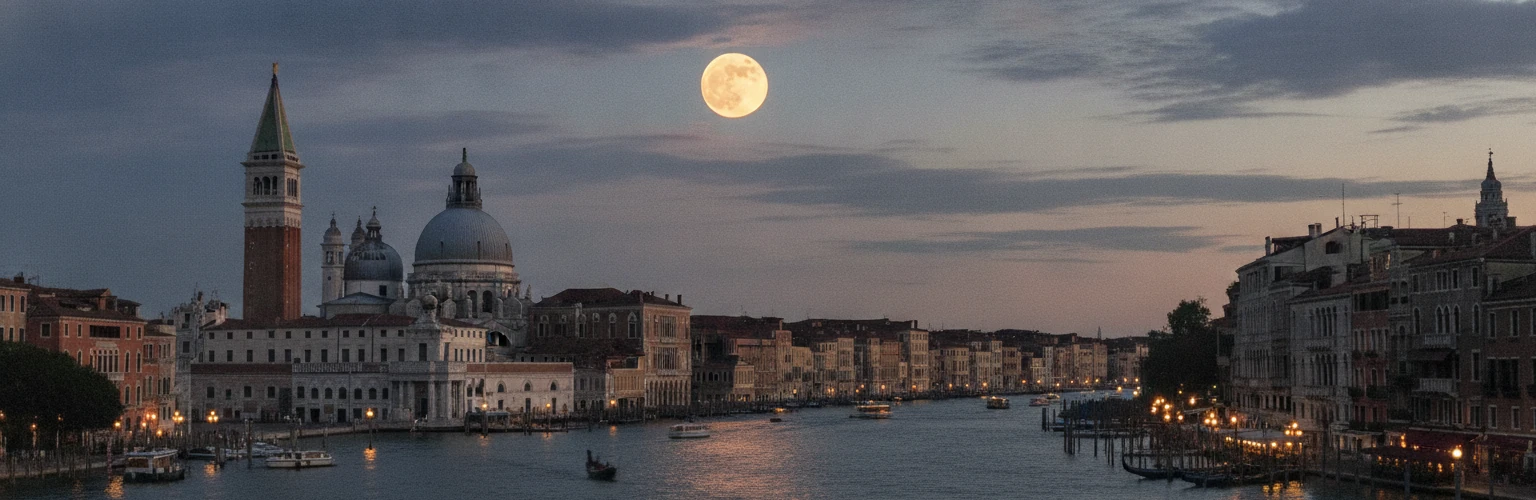
The most famous Grand Canal view. Looking South-Southeast from this purely wooden bridge, the canal opens toward the massive dome of Santa Maria della Salute. The moon rises behind the church or the Punta della Dogana. Note: Because the bridge is entirely wooden, it is exceptionally prone to vibration; time your shots carefully between waves of pedestrians.
Punta della Dogana
The triangular tip where the Grand Canal meets the Giudecca Canal. This spot offers a 270-degree panorama of the San Marco basin. It is one of the darkest spots in the center, as streetlights are sparse on the point. Watch the moon rise over the Lido and track across the sky toward the Doge’s Palace, reflecting in the deep, churning waters of the basin.
Lido di Venezia – Blue Moon Beach
The "Adriatic Horizon" view. Just a 15-minute vaporetto ride from San Marco (Lines 1 or 5.1). Walk to the public beaches on the eastern side for a completely unobstructed sea horizon. This is the premier spot to witness the "Moon Illusion," where the disc appears gargantuan as it breaks the waterline of the sea with zero architectural interference.
San Giorgio Maggiore Quay
Take the #2 vaporetto across the water for the "reverse" view. From the island's quay, you see the moon rising behind the Campanile di San Marco and the Doge's Palace. Warning: The island's bell tower closes strictly by 6:00 PM in winter; ground-level viewing is best for late moonrises when the higher towers are inaccessible.
Sant'Elena – Parco delle Rimembranze
A hidden gem at the far eastern tip of the main island. This quiet pine forest park faces the lagoon entrance. It offers a peaceful, dark-sky environment far from the tourist crowds. Watch the moon rise over the Certosa island and the Lido, reflecting in the calmest part of the lagoon. It is an intimate, atmospheric alternative to the busy stone quays.
◉ Best Times for Moon Photography
📷 Quick Photography Tips
Venice operates on CET (UTC+1) in winter and CEST (UTC+2) during summer. Critical Note: Full moons coincide with syzygy tides. Between October and April, check the Hi!Tide Venice app; high moon and high water often go hand-in-hand here, changing your access options overnight.
The moon phase today in Venice is shown in detail above. For the moon phase today in any other city worldwide, visit our Dynamic Moon Phase Calculator on the home page.
◐ What the Experience Actually Feels Like
There is a specific, quiet majesty to a moonrise in Venice. Standing on the Riva degli Schiavoni as the sun dips behind the Giudecca, you hear the city transition from a tourist hub into a silent, aquatic labyrinth. The air carries the scent of salt and the damp stone of ancient foundations. When the moon finally breaks the horizon over the Lido, it creates a shimmering silver path (*scia di luna*) across the dark water, pointing directly to the gondola moorings.
In winter, the experience is defined by the *nebbia*. The thick Adriatic fog pools in the canals, and a full moon turns the entire city into a monochromatic dreamscape. The spires of the Basilica di San Marco poke through the mist, catching the light like ghosts. It is a moment of profound stillness, where the lack of car traffic makes the moon seem like the only living thing in a city made of stone and water.
During the summer, the moonrise is shared with the night-time bustle of the Grand Canal. From the Accademia bridge, you watch the moon climb above the Salute dome, its light competing with the warm amber glow of palace windows. The water below is never truly still; the wakes of passing boats tear the moon's reflection into golden ribbons. It is a reminder that Venice is a city of two souls—one rooted in history, and one living in the liquid present.
"The moon creates a shimmering silver path across the dark water, pointing directly to the gondola moorings. In this city, the silver light makes the stone glow like velvet."
✓ Your Venice Moon Chase Checklist
Before You Go
- Check moonrise times on this page — the Adriatic horizon is flat, making data highly accurate for the quays
- Download a Tide App: Essential for monitoring *acqua alta* levels between October and April
- Download PhotoPills or Stellarium to track the exact arc relative to the San Giorgio Maggiore tower
- Check the vaporetto schedule; Line 2 and Line 1 run frequently, but late-night "Notturno" routes vary
- Ensure your camera sensor is clean; long exposures against a black sky show every speck of dust
What to Bring
- A telephoto lens (200mm+) to "compress" the moon behind the Salute dome from the quays
- A remote shutter release or use a 2-second timer to avoid "finger-tap" shake on the wooden bridges
- Spare camera batteries — the damp, cold air of the lagoon in winter will drain lithium power quickly
- A small lens cleaning cloth; salt spray from the lagoon can create a film on your glass within minutes
- Rubber boots (Galosce): Mandatory if visiting in peak flood season for shooting in wet squares
- A weighted tripod bag; the wind at Punta della Dogana can be surprisingly gusty on open nights
On the Night
- Arrive at your viewpoint 45 minutes early; the "Blue Hour" transition is the peak for water reflections
- Focus manually on the moon’s edge; the bright floodlights of the palaces can confuse autofocus systems
- Bracket your exposures — take one for the bright lunar disc and one for the darker shadows of the masonry
- At the Riva, time your shots for when the gondolas are still to avoid blurring them in long exposures
- Stay for 20 minutes after moonrise; the composition sharpens as the moon clears the horizon haze
? Venice Moon Phase — Frequently Asked Questions
Q. What is the moon phase today in Venice?
The moon phase today in Venice is a New Moon with 0% illumination. The next full moon is in 17 days, on Oct 26. Moonrise is at 7:10 AM and moonset at 6:16 PM.
Q. Where is the best place to view the moon in Venice?
Riva degli Schiavoni is the #1 classic moonrise location, facing southeast so the moon rises over the lagoon and silhouettes the island of San Giorgio Maggiore. Ponte dell'Accademia frames the moon behind the dome of Santa Maria della Salute, Punta della Dogana offers one of the darkest spots in the center with a 270° panorama of the San Marco basin, and the Lido's beaches, San Giorgio Maggiore's quay, or Sant'Elena's pine forest park add further open-horizon, reverse-view, or hidden-gem alternatives.
Q. Are there any access notes or timing quirks worth knowing?
Yes — the San Giorgio Maggiore bell tower closes strictly by 6:00pm in winter, so ground-level viewing from the quay is the better bet for late moonrises. The Ponte dell'Accademia is entirely wooden and vibrates constantly with foot traffic, so timing your shots between waves of pedestrians (or shooting at midnight when crowds vanish) helps keep exposures sharp.
Q. Does Venice observe daylight saving time?
Yes. Venice operates on CET (UTC+1) in winter and CEST (UTC+2) during summer, in line with the rest of Italy and the European Union. The times shown on this page are already adjusted for whichever period applies today.
Q. Does the full moon affect flooding in Venice?
Yes, and it's worth planning around. Full moons coincide with syzygy tides, and between October and April, a high moon and high water (acqua alta) often go hand-in-hand — checking a tide app like Hi!Tide Venice is essential during this window, as flooding can change your access options overnight. On the flip side, the moon reflecting in a few inches of water on St. Mark's Square during a flood is considered a bucket-list shot.
Q. What's the best time of year for moon photography in Venice?
November through January brings nebbia (fog) season, when the moon creates a ghostly, Gothic glow through the mist over the canals. The winter solstice sees the moon follow its highest arc over the palaces. Whatever the season, salt spray from the lagoon can film over a lens within minutes, so a cleaning cloth is worth carrying.
Q. Does this page work for cities besides Venice?
This page is set up specifically for Venice, Italy. For the moon phase in any other city or location worldwide, use the Dynamic Moon Phase Calculator on the moonphase.today home page.
✦ Explore Further
Moon Phase Today: Pisa
Check tonight's moon phase in Pisa, about 175 miles south-west.
📷Moon Photography Guide
Camera settings, lenses, and techniques for shooting sharp, well-exposed moon shots.
📐Looney 11 Exposure Calculator
Dial in the exact f-stop, ISO, and shutter speed for a full moon — the same rule used in our Riva degli Schiavoni tips.
🌆Blue Hour Calculator
Find tonight's exact blue hour window to time your Santa Maria della Salute moonrise shots.
NASA Moon Phase & Libration Gallery
NASA's Scientific Visualization Studio's daily renders of the moon's exact phase, libration, and orientation, straight from official mission data.