
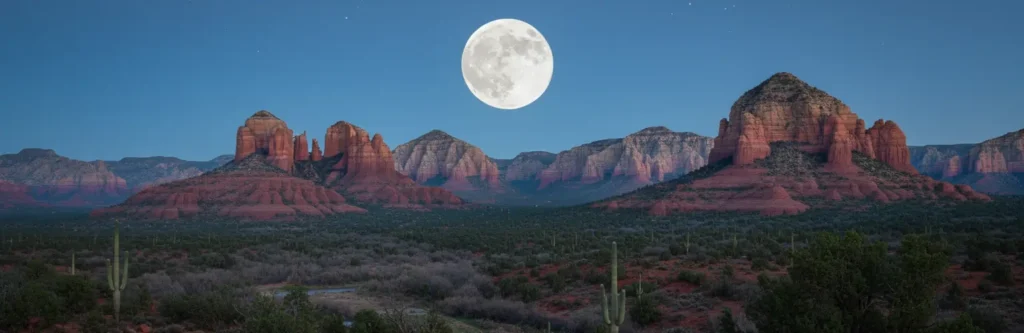
Best Places to View the Moon in Sedona
Sedona is a certified International Dark Sky Community, one of a select group of places worldwide recognized for exceptional starry nights. The combination of high-altitude clear air (approximately 4,500 feet), strict light pollution laws, and the glowing red sandstone formations makes it a premier destination for lunar photography. When the moon’s light hits the iron-rich rocks, they glow with an almost supernatural intensity. Here are the top spots to capture that magic. Note that while some areas are free, many trailheads and access points require fees, and access times may vary.
Airport Mesa (Airport Vortex)
The absolute #1 viewpoint for accessibility and scope in Sedona. This high table-top mesa sits centrally, offering expansive views across town and of major rock formations (Thunder Mountain, Coffee Pot Rock, Chimney Rock). The main overlook is directional, but the 360-degree loop trail provides diverse perspectives. The moon rising over the distant Mogollon Rim or setting behind the red rocks is spectacular. Note: Parking in the upper lot costs a fee (~$3). It gets very crowded at sunset but typically thins out significantly for moonrise.
Red Rock Crossing (Crescent Moon Ranch)
This is the classic postcard shot of the Southwest, located along Oak Creek with Cathedral Rock towering overhead. The goal here is to capture the moon rising near Cathedral Rock and its reflection in the creek, creating truly iconic compositions. Access: This is a US Forest Service concessionaire site. Access requires the Coconino Pass (daily rate ~$12/vehicle at the gate). Gates to the picnic area close at dusk; for night access, park at the Baldwin Trailhead (Red Rock Pass required, $5/day) and hike the Red Rock Crossing Trail to the creek.
Bell Rock & Courthouse Butte
Located in the Village of Oak Creek (south of main Sedona), these massive formations offer dark skies and distinctive silhouettes. From the Bell Rock Pathway, you can frame the moon rising directly alongside the impressive bell-shaped formation. The wide open spaces here allow for great “tiny human, giant moon” composition shots using a telephoto lens. This is also a known “upflow” vortex site, attracting many who come to meditate under the moon.
Schnebly Hill Road (Lower sections)
For those who want to get away from the streetlights completely, Schnebly Hill Road provides an excellent option. While the upper sections are very rough, the lower paved sections create a natural amphitheater of red walls. The steep cliffs here mean the moon “pops” over the ridge suddenly and dramatically, offering a truly immersive dark-sky experience. It’s an ideal spot for wide-field astrophotography as well, capturing more of the night sky alongside the moon.
Boynton Canyon & Long Canyon Trailheads
While often associated with its powerful vortex, the trails around Boynton Canyon, and the separate but adjacent Long Canyon Trailhead, offer incredible views of the moon rising or setting over the canyon walls and surrounding red rock formations. The towering cliffs create dramatic silhouettes against the lunar glow. Access requires a Red Rock Pass ($5/day), and mindful hiking is essential, especially at night.
Midgley Bridge & Wilson Canyon Trail
North of Sedona, the area around Midgley Bridge offers unique perspectives looking back towards the red rocks. The Wilson Canyon Trailhead provides access to trails where the moon can be framed against the distant formations or rising through a canyon. The elevation here provides a slightly different angle, allowing for diverse compositions away from the most crowded spots. A Red Rock Pass is required for parking.
Best Times for Moon Photography
Quick Photography Tips
The moon phase today in Sedona, AZ, is shown in detail above — complete with exact illumination percentage, moonrise/set times, and the best local spots to see it. For the moon phase today in any other city or location worldwide, visit our Dynamic Moon Phase Calculator on the home page.
What the Experience Actually Feels Like
There’s a profound silence that settles over Sedona as night falls, a quiet broken only by the whispers of the desert wind. Being an International Dark Sky Community, the absence of light pollution is immediately noticeable, allowing the stars to blaze forth with astonishing clarity. When the moon begins to ascend, it doesn’t just appear in the sky; it transforms the landscape. The iron-rich red rocks, so vibrant in daylight, catch the lunar glow with an almost incandescent intensity, casting dramatic shadows and revealing textures you might miss under the sun. It’s a surreal, almost spiritual experience, standing amidst these ancient formations bathed in silver light.
The geology of Sedona profoundly shapes the moon-viewing experience. You’re often not just looking at the moon, but at the moon interacting with towering mesas, sculpted spires, and deep canyons. From Airport Mesa, the town’s lights twinkle far below, a modest counterpoint to the cosmic display above. At Red Rock Crossing, the gentle flow of Oak Creek creates perfect reflections, mirroring Cathedral Rock and the moon in a classic tableau. The challenge here is patience: waiting for the moon to clear the often-obstructing red rock formations, which can be 30-45 minutes after the official horizon moonrise. But that moment when it finally crests a ridge, huge and luminous, is truly unforgettable.
Each season offers a unique lunar spectacle. The full moon in winter, with its crisp, dry air, provides unparalleled clarity for lunar details and, on rare occasions, a breathtaking contrast of snow-capped red rocks against the moonlit sky. Monsoon season (mid-June through September) can bring dramatic afternoon thunderstorms that clear just in time for moonrise, leaving behind magnificent cloud formations and even distant lightning to frame the moon. Spring and autumn offer milder temperatures and generally clear conditions, perfect for comfortable night photography. Regardless of the season, the desert night is alive – demanding respect for its wildlife and terrain, and rewarding those who venture out with a celestial show unlike any other.
“When the moon begins to ascend, it doesn’t just appear in the sky; it transforms the landscape. The iron-rich red rocks catch the lunar glow with an almost incandescent intensity, casting dramatic shadows.”
Your Sedona Moon Chase Checklist
Before You Go
- Check the moonrise time and phase on this page, but remember Sedona’s tall rocks mean the moon will clear the horizon significantly later than official times
- Use PhotoPills (or similar app) to accurately calculate when the moon will clear the specific rock formations at your chosen viewpoint
- Target the 48–72 hour window before full moon if possible — the moon rises during golden/blue hour, providing a stunning balance of lunar glow and twilight colors on the red rocks
- Verify access and fees for your chosen location; many popular trailheads require a Red Rock Pass ($5/day) or specific entry fees (e.g., Crescent Moon Ranch)
- Research specific trail conditions if planning to hike at night; some trails can be challenging in the dark.
What to Bring
- Sturdy tripod — essential for sharp images in low light and stability against any desert breezes
- A red-light headlamp or flashlight — strictly adhere to Dark Sky principles to preserve night vision and be respectful of others
- Layers of clothing — desert nights can get surprisingly cold, even after a warm day
- Plenty of water and snacks — always important for any desert excursion, day or night
- Telephoto lens (200-400mm) for compressing the moon against distant rock formations; wide-angle lens (16-35mm) for expansive landscape and astrophotography
- Trail map and compass/GPS app — essential for navigating trails safely in the dark
On the Night
- Arrive at your viewpoint at least 45-60 minutes before the *calculated* moon-over-ridge time — this allows time to set up and capture the beautiful pre-moonrise twilight
- At popular spots like Airport Mesa, expect crowds at sunset but be prepared for them to thin out significantly as night falls
- Shoot RAW — the dynamic range between a bright moon and moonlit landscape requires the flexibility of RAW files for post-processing
- Expose for the moon, then gently bring up the shadows in post-production to reveal detail in the surprisingly well-lit red rocks
- Stay vigilant for wildlife (rattlesnakes, javelina) and plant hazards (jumping cholla) if stepping off marked paths