
Moon Phase Today Santiago
On Friday, October 9, 2026, the moon in Santiago is a New Moon with 0% illumination. Moon age: 28.9 days.
☽ Best Places to View the Moon in Santiago
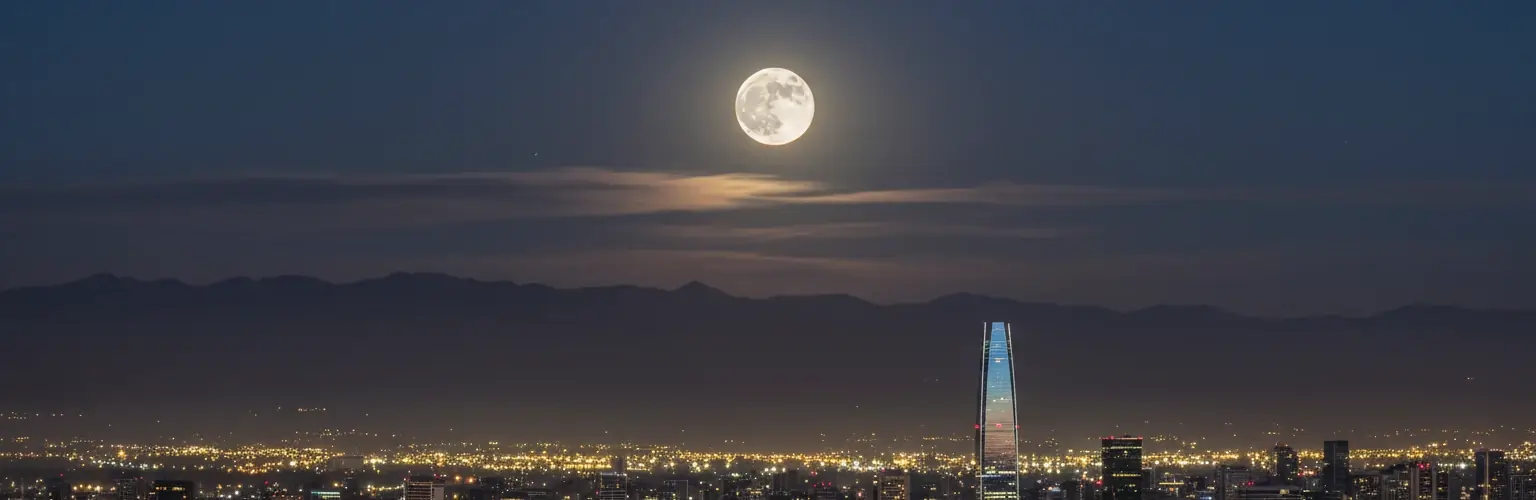
Santiago’s dramatic Andes backdrop and urban skyline create breathtaking moonrises – especially from elevated viewpoints where the moon emerges over the city lights with snow-capped peaks silhouetted. The city rewards photographers who embrace its unique topography and clear high-altitude skies. Depending on the season, the moon can align strikingly over the city center or appear majestically behind the Andes — use PhotoPills to plan the exact alignment for your chosen date. All spots are free and accessible 24/7 unless otherwise noted.
Cerro San Cristóbal – Virgin Mary Terrace (Parque Metropolitano)
The absolute #1 Santiago moonrise viewpoint for its iconic views. This hill rises ~300 m above Santiago (880 m above sea level) and offers stunning panoramic views over the city bowl and skyline. The moon rises eastward, often appearing grandly behind the city lights with the iconic Virgin statue in the foreground. Access via funicular or cable car (fees apply; current round-trip tickets ~CLP 4,500–5,850 for adults). Important: The funicular closes in early evening (around 18:45 in winter, 19:45 in summer), so foot access or driving (if permitted to upper parking) are required for most moonrise viewing. Ideal for wide-angle to mid-telephoto shots of the moon and cityscape.
Cerro Santa Lucía
A central, historic hill (~70 m rise) in downtown Santiago with charming terraces and structures. From its eastern overlooks, the moon rises behind the city skyline and the Mapocho River. The castle-like architecture and fountains provide beautiful foreground elements. Very accessible on foot, offering a more intimate moonrise experience within the urban core. Free, accessible daily until late evening.
Sky Costanera – Observation Deck (Gran Torre Santiago)
Located on the 61st–62nd floors of the Gran Torre Santiago, the tallest building in South America (~300 m). This observation deck offers unparalleled 360° views. The moon rises over the eastern city and the majestic Andes. This spot provides a unique opportunity for dramatic telephoto shots of the moon appearing above the mountain range or city lights. Entry fee ~CLP 15,000–20,000, open late. Verify hours as they can vary.
Parque Bicentenario / Vitacura Riverside
A modern park situated along the Mapocho River in the upscale Vitacura district. The moon rises over the water, with the distinct profile of the Costanera Center skyline providing a prominent backdrop. Calm waters offer beautiful reflections of the moon and city lights. This location provides open space and easy access for a relaxed moon-gazing experience. Free and open daily.
Los Dominicos / Apoquindo Viewpoints
These areas, located in the eastern foothills of Santiago, provide elevated viewpoints looking towards the Andes. Here, the moon rises directly behind the imposing mountain range. The higher elevation offers darker skies and a dramatic natural foreground of the Andes, often with snow-capped peaks. Accessible by drive-up or short hike, this spot is ideal for capturing the moon's grandeur over the mountains. Check local access regulations.
Cerro Renca
An imposing western hill (~900 m above sea level, making it taller than Cerro San Cristóbal) that provides panoramic views eastward over the entire Santiago city bowl. From its summit, the moon rises over the sprawling urban landscape, offering a less crowded and truly expansive perspective. Accessible by car, this viewpoint is excellent for wide-angle compositions that capture the vastness of the city under lunar light. Note: roads can be steep and unpaved in sections; check conditions.
◉ Best Times for Moon Photography
📷 Quick Photography Tips
Santiago operates on CLT (UTC-4) in winter and CLST (UTC-3) during daylight saving time. Clocks typically move forward on the first Sunday in September at 1:00 AM and move back on the first Saturday in April at 11:00 PM. Apps like PhotoPills or Stellarium set to Santiago handle the offset automatically — moonrise and moonset times shift by several minutes daily, and planning exact alignments with the Andes or cityscape requires precise local time.
For the moon phase in any other city worldwide, visit our Dynamic Moon Phase Calculator on our home page for instant lunar data tailored to wherever you are.
The moon phase today in Santiago, Chile is shown in detail above — complete with exact illumination percentage, moonrise/set times, and the best local spots to see it. For the moon phase today in any other city or location worldwide, visit our Dynamic Moon Phase Calculator on the home page.
◐ What the Experience Actually Feels Like
There is an undeniable grandeur to a moonrise in Santiago that few other cities can match. Imagine standing on the upper terraces of Cerro San Cristóbal as the sun dips behind the distant coastal mountains. The sprawling city below begins to glow, a tapestry of warm lights filling the valley. Then, a silent luminescence appears over the eastern peaks of the Andes. The moon, often appearing immense and golden, ascends into the clear, high-altitude sky, casting its light over the snow-capped giants and the vibrant metropolis. It's a breathtaking convergence of urban life and raw, majestic nature.
Santiago's geography, nestled in a valley with the Andes to the east and the smaller coastal range to the west, dictates the experience. From the eastern hills like Cerro San Cristóbal or the Sky Costanera, you are positioned to look directly towards the rising moon as it clears the formidable Andes. On truly clear nights, the moon will emerge from behind jagged, snow-dusted peaks, creating compositions that are uniquely Chilean. From lower riverfront parks, the Mapocho River can act as a shimmering mirror, reflecting the moon and the modern skyline. The city encourages you to look up, to see the vastness of the sky above, framed by the constant, watchful presence of the mountains.
Summer (October to March) is generally considered the prime season for moon photography in Santiago. These months bring clearer skies, less rain, and higher moon paths that often align dramatically with the Andes. The air is typically warmer, making evenings more comfortable for extended viewing. While winter (April to September) can bring the occasional clear night and the added bonus of more snow on the Andes, it also comes with increased chances of cloud cover and potential for temperature inversions that can trap smog in the valley. Regardless of the season, a clear night with low haze offers an unforgettable spectacle of the moon over the Chilean capital.
"A silent luminescence appears over the eastern peaks of the Andes. The moon, often appearing immense and golden, ascends into the clear, high-altitude sky, casting its light over the snow-capped giants and the vibrant metropolis."
✓ Your Santiago Moon Chase Checklist
Before You Go
- Check the moonrise time and phase on this page — the moon's alignment with Santiago's skyline and the Andes is seasonal and needs careful planning
- Use PhotoPills or Stellarium to verify whether the moon will rise behind specific Andes peaks or city landmarks on your chosen date
- Target the 48–72 hour window before full moon if possible — the moon often rises during civil twilight, providing a beautiful balance of natural light and city glow
- Check weather and air quality forecasts — clear skies and low smog levels are crucial for sharp views of the moon and the distant Andes
- For Cerro San Cristóbal, be aware the funicular closes in early evening; plan for foot access or driving (if permitted) for late-night viewing
What to Bring
- Sturdy tripod — strong winds can sweep through Santiago's hills and elevated viewpoints, requiring a stable platform for sharp long exposures
- A telephoto lens (e.g., 200-400mm) is highly recommended for dramatic compression shots of the moon rising over the Andes or tightly framed against skyscrapers
- Layers of clothing — even in summer, temperatures can drop significantly in the evening, especially at higher elevations
- A wide-angle lens (e.g., 16-35mm) for expansive panoramic shots of the city under lunar light from viewpoints like Cerro San Cristóbal or Cerro Renca
- Binoculars or a small telescope — the clear skies and high elevation can offer exceptional views of lunar details and distant Andes features
- Plenty of water and snacks, especially if planning a longer stay at remote viewpoints or accessing Cerro San Cristóbal after funicular hours
On the Night
- Arrive at your viewpoint 45–60 minutes before moonrise — this allows time to secure a good spot, set up equipment, and capture the beautiful twilight colours over the Andes
- At Cerro San Cristóbal, experiment with compositions that include the Virgin Mary statue or the diverse city lights spreading below
- Shoot RAW — the extreme dynamic range between a bright moon, illuminated city, and dark Andes requires significant flexibility in post-processing
- Stay 30–45 minutes after moonrise — as the moon ascends, its position relative to the Andes and skyline shifts, creating new compositional opportunities
- Be patient for clear moments — while Santiago enjoys many clear nights, occasional haze or clouds can add drama or require waiting for optimal visibility
? Santiago Moon Phase — Frequently Asked Questions
Q. What is the moon phase today in Santiago?
The moon phase today in Santiago is a New Moon with 0% illumination. The next full moon is in 17 days, on Oct 26. Moonrise is at 6:27 AM and moonset at 7:16 PM.
Q. Where is the best place to view the moon in Santiago?
Cerro San Cristóbal, rising 300m above the city with a summit funicular, gives the classic view of the moon over the Andes and the full Santiago basin. Cerro Santa Lucía offers a smaller, more central hilltop with colonial-era fortifications as foreground, and the Costanera Center's Sky Costanera observation deck adds a modern high-rise vantage, alongside the Bicentennial Park's open lawns and the Barrio Lastarria rooftop cafés.
Q. Why does the moon look so dramatic over Santiago?
Santiago sits in a valley walled in by the Andes to the east and the Chilean Coast Range to the west, so the moon frequently rises or sets behind genuine mountain silhouettes rather than a flat horizon. In the Southern Hemisphere, the moon also appears mirror-flipped compared to how it looks in the Northern Hemisphere.
Q. Does Santiago observe daylight saving time?
Yes. Chile shifts to Chile Summer Time (UTC−3) from September through April and back to Chile Standard Time (UTC−4) for the rest of the year, roughly the opposite schedule to Northern Hemisphere countries.
Q. What's the best time of year for moon photography in Santiago?
May through August, the Southern Hemisphere winter, brings the clearest, driest air and the sharpest views of the Andes, though the peaks are also snow-capped and especially striking against the moon during these months. Summer (December–February) can bring more haze and smog trapped in the valley.
Q. Does this page work for cities besides Santiago?
This page is set up specifically for Santiago, Chile. For the moon phase in any other city or location worldwide, use the Dynamic Moon Phase Calculator on the moonphase.today home page.
✦ Explore Further
Moon Phase Today: San Pedro de Atacama
Check tonight's moon phase under some of the world's darkest skies in San Pedro de Atacama.
📷Moon Photography Guide
Camera settings, lenses, and techniques for shooting sharp, well-exposed moon shots.
📐Looney 11 Exposure Calculator
Dial in the exact f-stop, ISO, and shutter speed for a full moon over the Andes.
🌗Waxing vs Waning Moon
How to tell which is which — and why it's mirror-flipped here in the Southern Hemisphere.
NASA Moon Phase & Libration Gallery
NASA's Scientific Visualization Studio's daily renders of the moon's exact phase, libration, and orientation, straight from official mission data.