
Moon Phase Today Riyadh
On Saturday, October 10, 2026, the moon in Riyadh is a New Moon with 0% illumination. Moon age: 28.9 days.
☽ Best Places to View the Moon in Riyadh
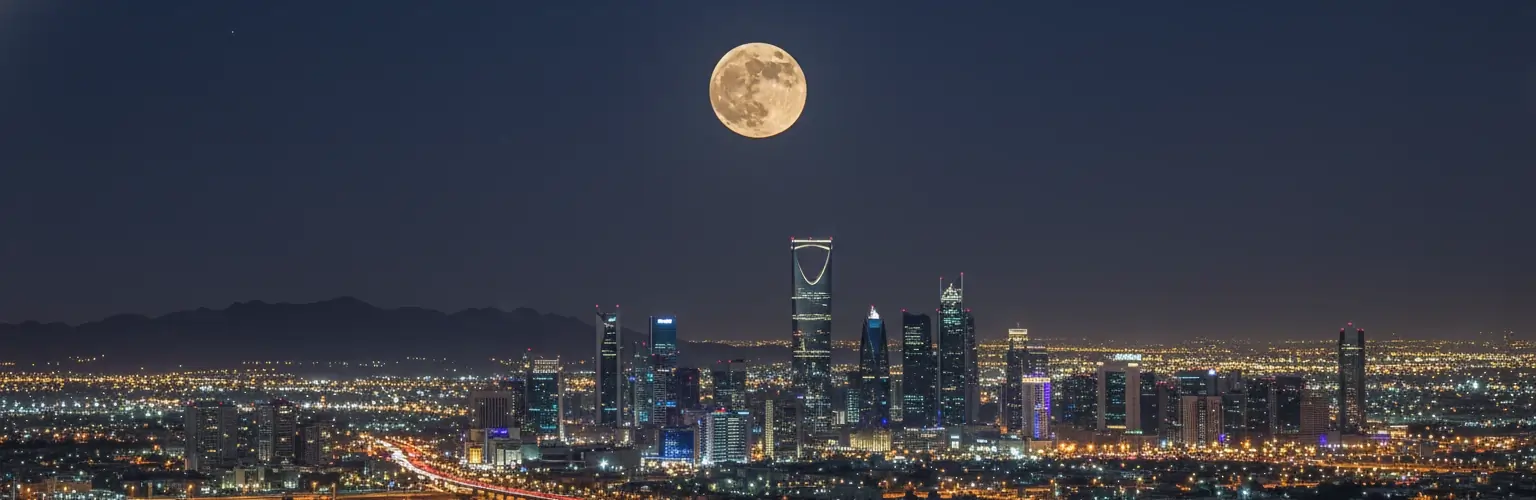
Riyadh sits on the Najd plateau at roughly 600 metres above sea level, surrounded by one of the driest, flattest desert landscapes on earth — and that desert is the moonrise's greatest gift to photographers here. The city offers two completely distinct modes: the gleaming Olaya skyline with its paired icons of Kingdom Centre and Al Faisaliah Tower catching the moon above a sea of city lights, and the ancient emptiness of the Tuwaiq Escarpment ninety kilometres to the northwest where the same moon rises over 300-metre cliffs into a horizon that has looked like this for millions of years. Riyadh is one of the few capital cities in the world where you can chase the moon from a 302-metre sky bridge one night and from a prehistoric cliff edge the next — both within the same weekend, both extraordinary.
Edge of the World (Jebel Fihrayn) – Tuwaiq Cliffs
The finest moonrise escape within range of any Middle Eastern capital. Jebel Fihrayn is a 300-metre cliff dropping straight down from the Tuwaiq Escarpment into an ancient ocean bed — approximately 90–100 km northwest of Riyadh, 1.5–2 hours by 4x4 depending on traffic and the 30–40 km of rough off-road at the end. The moon rises over the vast, unobstructed desert plain from the cliff top with genuinely dark skies — no city within range. Popular for camping; the Sadus Dam route is open daily, the Acacia Valley route on weekends only. No facilities; bring all water, food, and fuel. A 4x4 vehicle is essential — low-clearance cars will not make it.
Kingdom Centre Tower – Sky Bridge
Riyadh's most dramatic urban elevated viewpoint. Kingdom Centre stands 302 metres tall — the distinctive "bottle opener" shape with a glass sky bridge spanning the inverted arch at the top. From the sky bridge, the 360° view takes in the entire Riyadh skyline, the Olaya district towers, and the flat desert plateau extending in every direction to the horizon. The moon rises over the eastern city and beyond into empty Najd. Entry approximately SAR 69; open late into the evening, making it one of the few indoor elevated positions available after dark in Riyadh.
Al Faisaliah Tower – Observation Deck & The Globe
Saudi Arabia's first skyscraper and still one of its most architecturally distinctive. Al Faisaliah Tower rises 267 metres in a tapering pyramid crowned by a 24-metre golden glass sphere — the Globe Restaurant — which sits at 200 metres above street level. The public observation deck below the globe gives a panoramic city view; the Globe Restaurant above it requires a reservation. Entry to the observation deck approximately SAR 69. The moon rises over the eastern city with Kingdom Centre visible to the south — the two towers make natural counterparts for photography from ground level or rooftop positions nearby.
Wadi Hanifah – Restored Valley Trails
Riyadh's most significant urban green corridor — a 120 km wadi running through the city that was comprehensively restored from 2001 onwards into a network of trails, parks, and riparian landscapes. From the high banks and escarpment edges of Wadi Hanifah, the moon rises over the city lights to the east with a natural, tree-lined foreground that no other urban Riyadh position offers. The wadi walls provide genuine visual separation from the city grid — a surprisingly dark and quiet position for a landscape inside the metropolitan area. Free, open 24/7; multiple access points throughout the city.
Boulevard Riyadh City – Elevated Terraces
Riyadh's flagship entertainment district and one of the Riyadh Season venues, Boulevard Riyadh City occupies a large development with open plazas, elevated walkways, and rooftop terraces giving unobstructed views of the Olaya skyline. The moon rises over the city to the east with Kingdom Centre and Al Faisaliah Tower lit in the western skyline frame — an urban composition with more life and movement than the tower observation decks. Access and specific terrace availability vary by event season; the exterior promenades are generally open. Free access to the outer areas; paid venues inside vary.
Al Rajhi Grand Mosque – Surrounding Grounds
One of the largest mosques in the world, Al Rajhi Grand Mosque occupies an enormous footprint in southwestern Riyadh with open surrounding grounds and a dramatic minaret cluster that provides a distinctively Islamic architectural foreground for moonrise compositions. The moon rises over the city to the east behind the minarets. The open space around the mosque is accessible to respectful visitors; modest dress is required. The surrounding neighbourhood is quieter than the Olaya business district and gives a more traditional Riyadh character to the frame. Free access to exterior grounds.
◉ Best Times for Moon Photography
📷 Quick Photography Tips
Riyadh operates on AST — Arabia Standard Time (UTC+3) year-round. Saudi Arabia does not observe daylight saving time; the offset is fixed at UTC+3 throughout the year, making moonrise calculations straightforward. Apps like PhotoPills or Stellarium set to Riyadh apply the correct offset automatically.
For the moon phase in any other city worldwide, visit our Dynamic Moon Phase Calculator for instant lunar data tailored to wherever you are.
The moon phase today in Riyadh is shown in detail above — complete with exact illumination percentage, moonrise/set times, and the best local spots to see it. For the moon phase today in any other city or location worldwide, visit our Dynamic Moon Phase Calculator on the home page.
◐ What the Experience Actually Feels Like
There are two Riyadh moonrises, and they require two completely different versions of yourself. The first is the city version — standing on the Kingdom Centre sky bridge at 300 metres, or on the Al Faisaliah observation deck inside a 24-metre golden glass sphere, watching the moon come up over a grid of city lights that stretches in every direction across the Najd plateau until it fades into the dark. Riyadh from this altitude is vast and luminous and slightly surreal — a city that didn't exist at any meaningful scale fifty years ago now covering hundreds of square kilometres of ancient desert with towers and highways and the particular brightness of a place that has been built almost entirely with electric light. The moon rises into this and is briefly orange, then white, and the Kingdom Centre arch frames a section of it if the geometry is right and you have planned the date correctly.
The second Riyadh moonrise requires ninety kilometres of highway and then thirty kilometres of rough desert track that will test your 4x4 and your patience in approximately equal measure. Jebel Fihrayn rewards this. The Tuwaiq Escarpment is a cliff system that drops 300 metres straight down from the plateau to a plain that was, a hundred and fifty million years ago, a tropical sea — and the fossils of that sea are still in the rock under your feet. The moon rises over that plain with nothing between you and the horizon, in genuinely dark skies, and the scale of the desert absorbs the light and gives it back softer and more completely than any city position can. Camels move somewhere in the valley below. The silence is actual rather than relative.
The best Riyadh moon photography trip combines both: plan a full moon that rises aligned with Kingdom Centre from a ground-level position on Olaya Street in the early evening, then drive to Jebel Fihrayn to photograph the same moon later that night from the cliff edge. The city and the desert are ninety minutes apart and a geological epoch apart and both are genuinely extraordinary at full moon. That combination — the ultramodern and the ancient in the same night, under the same moon — is what makes Riyadh distinctive as a photography destination in a way that most of its Gulf peers are not.
"The Tuwaiq Escarpment drops 300 metres straight down to a plain that was, 150 million years ago, a tropical sea — and the moon rises over it with nothing between you and the horizon, in genuinely dark skies, and the scale absorbs the light and gives it back softer than any city can."
✓ Your Riyadh Moon Chase Checklist
Before You Go
- Check the moonrise time and phase on this page — use PhotoPills to identify dates when the moon rises aligned with Kingdom Centre or Al Faisaliah from specific Olaya street positions; the geometry is very precise and shifts significantly through the year
- For Jebel Fihrayn, plan your visit between October and March — summer heat (45°C+) makes the off-road drive and cliff walk genuinely dangerous; the cooler months are not just comfortable but necessary
- Check the Jebel Fihrayn route before setting out — the Acacia Valley approach is open weekends only; the Sadus Dam route is open daily; both require a 4x4 and GPS, and neither has any services once you leave the main road
- For Kingdom Centre sky bridge and Al Faisaliah deck, verify current hours and book tickets in advance where possible — both are popular and can queue at peak evening times
- Dress modestly at all outdoor locations in Riyadh; at the Al Rajhi Grand Mosque grounds, appropriate dress is required; at the towers and entertainment districts, smart-casual is appropriate
What to Bring
- Sturdy tripod — essential at Jebel Fihrayn where desert wind at the cliff edge can gust unexpectedly, and useful at the Kingdom Centre sky bridge and Al Faisaliah deck where vibration from other visitors is a factor
- A telephoto lens (300–500mm) for compressing the moon against Kingdom Centre or Al Faisaliah from street level — and for shooting the moon large against the desert horizon from Jebel Fihrayn, where a long lens reveals the escarpment detail below
- A wide-angle lens (16–24mm) for capturing the full cliff edge panorama at Jebel Fihrayn — the scale of the 300-metre drop and the desert plain below suits short focal lengths that emphasise the vastness
- Significant water reserves for Jebel Fihrayn — a minimum of 3–4 litres per person for the trip; there are no shops, no water sources, and no services from Sadus onward; dehydration risk is real even in cooler months
- A full tank of fuel plus an understanding of range — the off-road section alone adds significant consumption; do not leave Riyadh without a full tank and top up again in Sadus
- A headlamp and spare batteries for Jebel Fihrayn — the cliff path is unlit and the descent in post-moonrise darkness requires care; a torch is also useful for locating the car on the desert flat
On the Night
- Arrive at your viewpoint 30–45 minutes before moonrise — the sky over Riyadh's eastern horizon transitions through a deep amber-to-indigo gradient, and the city tower lights or cliff silhouette against the pre-moonrise sky are compositions worth capturing before the moon appears
- At Jebel Fihrayn, position yourself back from the cliff edge by several metres for safety — the rock at the lip is uneven and there are no barriers; the best compositions do not require you to be at the absolute edge and the view is equivalent from 5–10 metres back
- At Kingdom Centre, face east from the sky bridge for the moon rising over the city; face west for Kingdom Centre's own arch lit against the night sky with the desert plateau behind it — both directions reward different lenses
- Shoot RAW throughout — the dynamic range between the bright moon, the dense Riyadh city light grid, and the dark desert horizon is extreme and cannot be captured in a single exposure; plan to blend at least two frames in post
- Stay 20–30 minutes after moonrise at every position — the moon clears the eastern horizon haze quickly in clear winter air, and the tower and cliff compositions shift and improve as it climbs above the ambient glow and sharpens
? Riyadh Moon Phase — Frequently Asked Questions
Q. What is the moon phase today in Riyadh?
The moon phase today in Riyadh is a New Moon with 0% illumination. The next full moon is in 17 days, on Oct 26. Moonrise is at 5:30 AM and moonset at 5:20 PM.
Q. Where is the best place to view the moon in Riyadh?
Edge of the World (Jebel Fihrayn), a 300m cliff on the Tuwaiq Escarpment roughly 90–100km northwest of the city, is the finest moonrise escape in reach of any Middle Eastern capital, with genuinely dark skies over an ancient desert plain. Kingdom Centre's 302m Sky Bridge gives a 360° view over the Olaya skyline, Al Faisaliah Tower's observation deck frames Kingdom Centre as a natural counterpart, and Wadi Hanifah, Boulevard Riyadh City, or the Al Rajhi Grand Mosque grounds add further alternatives.
Q. What do I need to visit Jebel Fihrayn safely?
A 4x4 vehicle is essential — low-clearance cars will not make it through the rough off-road at the end. There are no facilities beyond Sadus, so bringing all water, food, and fuel is necessary, and October through March is the only practical window, since summer daytime temperatures exceed 45°C.
Q. Does Riyadh observe daylight saving time?
No. Riyadh operates on AST (Arabia Standard Time, UTC+3) year-round — Saudi Arabia does not observe daylight saving time. The times shown on this page never need a seasonal adjustment.
Q. What's the best time of year for moon photography in Riyadh?
November through February brings the lowest humidity, clearest air, and a more southerly moon path for the best cliff and tower shots. Compressing the moon against Kingdom Centre or Al Faisaliah from street level requires very precise planning, since the alignment geometry shifts significantly through the year.
Q. Does this page work for cities besides Riyadh?
This page is set up specifically for Riyadh, Saudi Arabia. For the moon phase in any other city or location worldwide, use the Dynamic Moon Phase Calculator on the moonphase.today home page.
✦ Explore Further
Moon Phase Today: Doha
Check tonight's moon phase and best viewpoints across the Gulf in Doha, Qatar.
🔭Astronomy Tools & Data
Additional stargazing data for the genuinely dark skies at Jebel Fihrayn.
📅Moon Calendars & Events
Plan a Kingdom Centre or Al Faisaliah alignment shot well in advance.
🌍World Moon Phase Directory
Browse the moon phase today in hundreds of other cities and locations around the world.
NASA Moon Phase & Libration Gallery
NASA's Scientific Visualization Studio's daily renders of the moon's exact phase, libration, and orientation, straight from official mission data.