
Moon Phase Today Panama City
On Friday, October 9, 2026, the moon in Panama City is a New Moon with 0% illumination. Moon age: 28.9 days.
☽ Best Places to View the Moon in Panama City
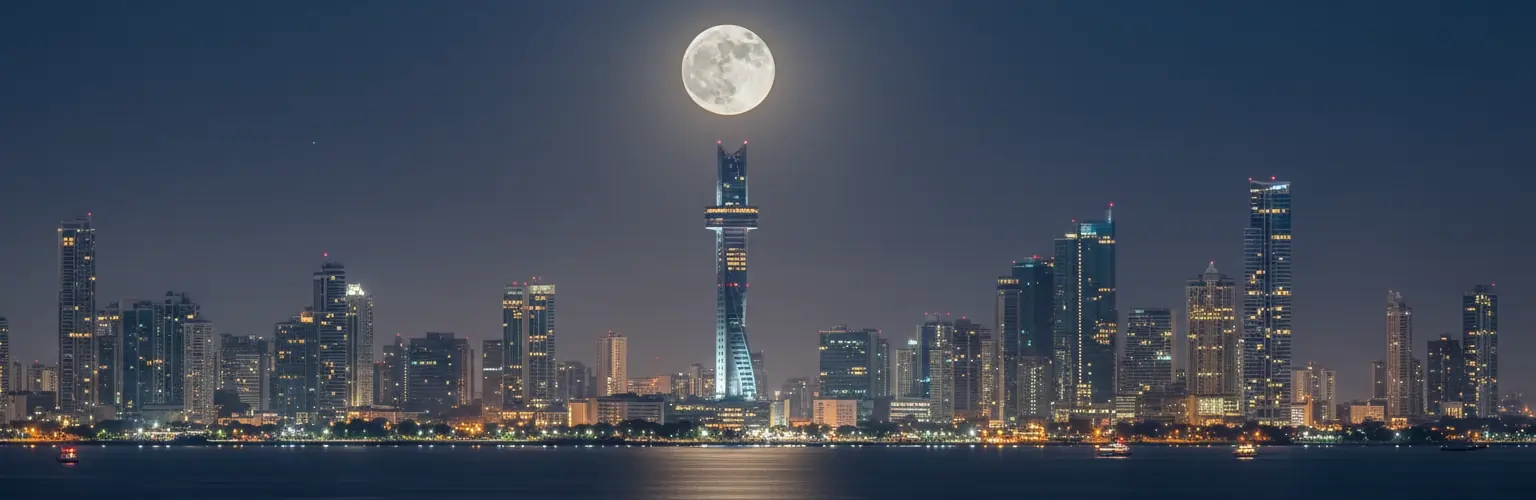
Panama City’s dramatic skyline, Pacific horizon, and the iconic Cinta Costera create stunning moonrises – especially when the moon rises over the water behind the modern towers or aligns with the Bridge of the Americas. The city’s unique geography, with direct access to the Pacific Ocean, provides expansive and often unobstructed eastern views. Depending on the season, the moon can rise to align directly with key landmarks like the F&F Tower or the Bridge of the Americas — use PhotoPills to plan the exact alignment for your chosen date. All spots are free and accessible 24/7 unless otherwise noted.
Cinta Costera – Phase 3 promenade & viewpoints
The absolute #1 Panama City moonrise viewpoint. This long seaside boardwalk offers an open eastern horizon over the Pacific. The moon rises majestically over the water, often framing the modern skyline including the iconic F&F Tower (“The Screw”) and the JW Marriott. Iconic palm trees and shimmering water reflections add to the composition. It's very popular for evening strolls and provides wide, accessible views for photographers.
Casco Viejo – rooftop terraces or Plaza de Francia
Panama City's historic old town offers elevated views, especially from its charming rooftop terraces or the scenic Plaza de Francia. From here, the moon rises over the modern skyline and the distant Bridge of the Americas, creating beautiful compositions with colonial architecture in the foreground. Many rooftop bars offer extended evening access with comfortable viewing spots. Ideal for blending historical charm with futuristic cityscapes.
Amador Causeway – Flamenco Island end
This causeway connects the mainland to several reclaimed islands, offering a unique perspective. From the Flamenco Island end, the moon rises over the Pacific entrance to the Canal and the distant city skyline. The open horizon is perfect for capturing spectacular moon illusions, where the moon appears enormous as it clears the sea. Yacht marinas and the distinctive Biomuseo can add interesting foreground elements. Ideal for expansive, unobstructed views.
Ancon Hill (Cerro Ancón)
Ancon Hill, standing at approximately 200 meters, offers a panoramic lookout over the city. From its summit, the moon rises over the city bowl and the winding Panama Canal. The elevation provides noticeably darker skies compared to the city center, and the historical flag monument can be incorporated as a strong foreground element. Access is via a short hike or a drive up to the designated parking areas. Offers a commanding, elevated perspective.
Calzada de Amador – bike/pedestrian paths
Similar to the Amador Causeway, the dedicated bike and pedestrian paths along the Calzada de Amador provide excellent vantage points. The moon rises over the tranquil waters, with the city skyline and the lights of the Bridge of the Americas visible in the distance. Calm evenings offer perfect reflections, and the lack of vehicle traffic on the pedestrian paths makes it a peaceful spot for photography. Easy access and flat terrain.
Albrook Mall rooftop or nearby parks
The modern Albrook Mall area, particularly its rooftop parking (check access) or surrounding parks, provides open views toward the city's eastern horizon. The moon rises over the urban landscape, offering a less crowded and quieter alternative to the more popular coastal spots. While lacking the direct ocean view, it allows for unique urban foregrounds and can be a good choice for those staying in the Albrook area. Accessibility may vary for specific rooftop areas.
◉ Best Times for Moon Photography
📷 Quick Photography Tips
Panama City operates on EST (UTC-5) year-round and does not observe daylight saving time. This simplifies planning, as moonrise times are consistent relative to local clock time throughout the year. Apps like PhotoPills or Stellarium set to Panama City handle the offset automatically — moonrise times shift by several minutes daily, and planning exact alignments with the city's landmarks requires precise local time.
For the moon phase in any other city worldwide, visit our Dynamic Moon Phase Calculator for instant lunar data tailored to wherever you are.
The moon phase today in Panama City is shown in detail above — complete with exact illumination percentage, moonrise/set times, and the best local spots to see it. For the moon phase today in any other city or location worldwide, visit our Dynamic Moon Phase Calculator on the home page.
◐ What the Experience Actually Feels Like
There's an undeniable allure to a Panama City moonrise, a dramatic spectacle where the modern marvels of the skyline meet the ancient rhythm of the Pacific. Imagine standing on the Cinta Costera, the salty breeze in your hair, the city's towers beginning to glitter. As the sun dips, painting the western sky in fiery hues, all eyes turn east. Slowly, majestically, the moon emerges from the vast expanse of the Pacific, often appearing enormous as it clears the horizon, perfectly aligning behind the F&F Tower's "screw" shape or the elegant arc of the Bridge of the Americas. The water reflects its light, creating a shimmering path to the city, a truly captivating blend of natural beauty and human ambition.
Panama City's geography is defined by its dramatic Pacific coastline and the strategic Panama Canal. This means your moon viewing experience is almost always framed by water. From the Amador Causeway, you look out over the bay entrance, with distant ships often adding a sense of scale to the rising moon. The open horizon here is a gift for photographers, allowing for those stunning "supermoon" illusions. In contrast, Casco Viejo offers a blend of old and new: from a colonial rooftop, the moon ascends over a backdrop of historic charm with the glittering modern towers beyond, a testament to Panama's rich past and dynamic future. Even from Ancon Hill, the commanding views place the moon above the entire city and the monumental Canal, providing a unique sense of perspective.
The dry season, from November to February, is arguably the best time for moon photography in Panama City. The skies are clearest, humidity is at its lowest, and the air is crisp, allowing for the sharpest lunar details and vibrant colors in twilight shots. During these months, the moon's path can also lead to more direct and striking alignments with the city's famous landmarks. While the rainy season can bring dramatic clouds and thunderstorms, it also means higher humidity and less predictable clear evenings. Nevertheless, even a fleeting glimpse of the moon through broken clouds over this incredible skyline is a sight to behold, a reminder of Panama's vibrant energy under any sky.
"Slowly, majestically, the moon emerges from the vast expanse of the Pacific, often appearing enormous as it clears the horizon, perfectly aligning behind the F&F Tower's 'screw' shape or the elegant arc of the Bridge of the Americas."
✓ Your Panama City Moon Chase Checklist
Before You Go
- Check the moonrise time and phase on this page — the moon's alignment with Panama City landmarks is seasonal and requires careful planning
- Use PhotoPills to verify whether the moon will rise near the F&F Tower, Bridge of the Americas, or other key landmarks on your chosen date
- Target the 48–72 hour window before full moon if possible — the moon rises during civil twilight, bathing the city in beautiful golden and blue tones
- Check weather forecasts for clear skies and low humidity, especially during the dry season (Nov-Feb) for optimal viewing conditions
- Scout your chosen location during the day for parking, access points, and potential obstructions, particularly along the Cinta Costera and Amador Causeway
What to Bring
- Sturdy tripod — the Pacific sea breeze along the coastal areas can be significant, necessitating a stable setup for sharp long exposures
- A lens between 200–300mm for tight compression shots — the skyline towers and Bridge of the Americas frame well at this range from coastal viewpoints
- Hydration and light clothing — Panama City is warm year-round, even in the evenings, so stay hydrated and comfortable
- A wide-angle lens for Cinta Costera or Amador Causeway — the expansive ocean and city panorama reward a 16–35mm range for environmental compositions
- Lens cloth — high humidity can cause condensation on camera gear, especially when moving between air-conditioned spaces and the outdoors
- A headlamp or flashlight for Ancon Hill and less-lit parts of the Amador Causeway — paths can be dark after sunset
On the Night
- Arrive at your viewpoint 30–45 minutes before moonrise — the eastern horizon over the Pacific often shows beautiful colors before the moon appears
- At Cinta Costera Phase 3, position yourself to frame the moon with the iconic F&F Tower ("The Screw") and other skyline elements
- Shoot RAW — the vast dynamic range between a bright moon, the city lights, and the ocean requires careful exposure blending in post-production
- Stay 20–30 minutes after moonrise — as the moon climbs, the compositions shift, and reflections in the Pacific become more defined and dramatic
- Watch for passing ships in the bay or canal if viewing from Amador Causeway or Ancon Hill — they can add unexpected and dynamic elements to your shots
? Panama City Moon Phase — Frequently Asked Questions
Q. What is the moon phase today in Panama City?
The moon phase today in Panama City is a New Moon with 0% illumination. The next full moon is in 17 days, on Oct 25. Moonrise is at 5:13 AM and moonset at 5:31 PM.
Q. Where is the best place to view the moon in Panama City?
The Cinta Costera promenade is the top spot, with the moon rising straight out of the Pacific behind the F&F Tower and the rest of the skyline. Casco Viejo's rooftop terraces and Plaza de Francia add colonial architecture to the same view, and the Amador Causeway gives a wide-open horizon over the canal's Pacific entrance with ships adding scale to the scene, alongside Ancon Hill's elevated panorama and the Calzada de Amador's quieter waterfront paths.
Q. Why does the moon look so dramatic over Panama City?
Panama City sits at just under 9° N, close enough to the equator that the moon climbs on a steep, high arc rather than the shallower path seen further from the equator. Combine that with a skyline that sits right on the Pacific, and on the right dates the moon lines up directly behind landmarks like the F&F Tower or the Bridge of the Americas.
Q. Does Panama City observe daylight saving time?
No. Panama stays on Panama Time (UTC−5) year-round and does not observe daylight saving time. The times shown on this page never need a seasonal adjustment.
Q. What's the best time of year for moon photography in Panama City?
November through February is the dry season and gives the clearest skies and lowest humidity of the year, which sharpens both the skyline and the moon itself. The 48–72 hours before a full moon are also worth targeting, when the moon rises during golden and blue hour over the water.
Q. Does this page work for cities besides Panama City?
This page is set up specifically for Panama City, Panama. For the moon phase in any other city or location worldwide, use the Dynamic Moon Phase Calculator on the moonphase.today home page.
✦ Explore Further
Moon Phase Today: San José
Check tonight's moon phase in San José, Costa Rica, about 340 miles west.
📷Moon Photography Guide
Camera settings, lenses, and techniques for shooting sharp, well-exposed moon shots.
🔭Photography Field of View Calculator
Work out the focal length you'll need to line the moon up with the F&F Tower or the Bridge of the Americas.
🌆Blue Hour Calculator
Time your visit to Casco Viejo or the Amador Causeway for the richest twilight before moonrise.
NASA Moon Phase & Libration Gallery
NASA's Scientific Visualization Studio's daily renders of the moon's exact phase, libration, and orientation, straight from official mission data.