
Moon Phase Today Milwaukee
On Friday, October 9, 2026, the moon in Milwaukee is a New Moon with 0% illumination. Moon age: 28.9 days.
☽ Best Places to View the Moon in Milwaukee
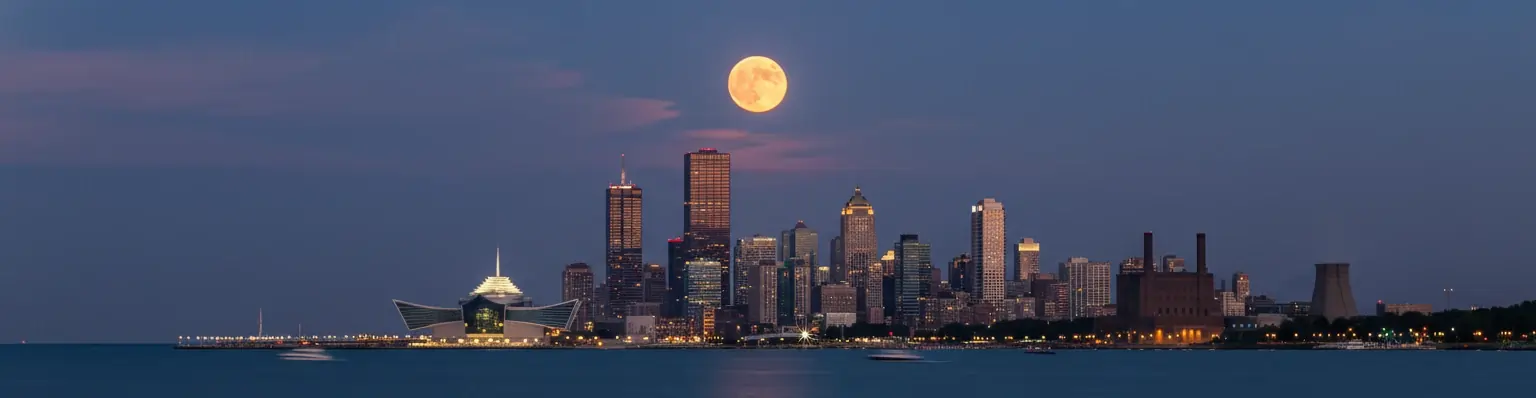
Milwaukee sits at 43° North on the western shore of Lake Michigan, a Great Lakes city whose entire eastern edge is defined by one of the largest bodies of fresh water on earth. The lake creates what coastal cities create — an unobstructed eastern horizon over open water — but with a freshwater clarity that, on calm nights, produces reflections as clean as any ocean. The Milwaukee Art Museum with its signature Calatrava wings, the arc of the Daniel Hoan Memorial Bridge, and the compact downtown skyline are the city's defining compositional anchors, and the moon rises behind all of them from the eastern lakefront. Milwaukee also has something most Great Lakes cities lack: a purpose-built photographic platform in Lakeshore State Park, an island park connected by a causeway that gives a 360° lake view with the skyline to the west and open water in every other direction. Winter brings ice formations at the shoreline that transform the same compositions entirely; summer brings sailing regattas and the Summerfest lakefront. Neither is a bad time to photograph the moon here.
Lakeshore State Park
Lakeshore State Park is Milwaukee's premier moonrise viewpoint — an island park connected to the lakefront by a causeway, surrounded by Lake Michigan on three sides with the downtown skyline and the Milwaukee Art Museum visible to the west. The moon rises over open water to the east with no obstructions, and the Hoan Bridge arc is visible to the south. On calm evenings the lake surface doubles the scene in reflection. The most consistently recommended spot for lakefront photography in the city. Free; accessible year-round via the causeway from the Summerfest grounds area.
Veterans Park & McKinley Marina
Veterans Park and McKinley Marina sit north of the downtown lakefront and give a direct view east over the lake with the Milwaukee Art Museum's Calatrava wings visible to the south. The moon rises over the water with the Art Museum as a graphic foreground element — on specific dates it rises directly above the distinctive brise soleil wings, creating one of Milwaukee's signature compositions. Sailboat masts in the marina and the War Memorial Center add foreground layers. Free, open daily; accessible from Lincoln Memorial Drive.
Discovery World & Pier Wisconsin
Discovery World and the adjacent Pier Wisconsin sit directly on the lakefront south of the Art Museum, with a broad promenade facing east over Lake Michigan. The moon rises over the water with the downtown skyline to the northwest and the Art Museum to the north — a wider, more architectural composition than the marina spots. The pier extends into the lake and gives a sense of being surrounded by water on three sides. Free access to the exterior promenade; accessible year-round from the lakefront path.
Bradford Beach & North Point
Bradford Beach north of Veterans Park gives ground-level access to the lake with an open eastern horizon and the sandy shoreline as foreground. The moon rises over Lake Michigan from the beach with the downtown skyline visible to the southwest. On calm evenings the lake surface reflects the moon in a long bright line toward the horizon — Lake Michigan has no meaningful tides, so reflections depend on wind conditions rather than tidal cycles. Free, open daily; the North Point bluffs just north of the beach add an elevated alternative.
Lake Park – Ravine Trails & Bluffs
Lake Park, designed by Frederick Law Olmsted in the 1890s, occupies a bluff above Lake Michigan north of Bradford Beach and gives elevated views over the water with the park's mature tree canopy as foreground. The moon rises over the lake from the bluff-edge paths with noticeably darker skies than the central lakefront. The North Point Lighthouse within the park adds a historic foreground element at longer focal lengths. Free, open daily; the ravine trails are unlit after dark — carry a headlamp.
Hoan Bridge Overlook – South Lakefront
The south lakefront area near the Daniel Hoan Memorial Bridge gives one of Milwaukee's most distinctive compositions — the bridge's long arc spanning the Milwaukee Harbor with the downtown skyline behind it and Lake Michigan to the east. The moon rises over the lake and the bridge cables catch the city glow in a graphic, industrial silhouette. The lakefront path below the bridge and the adjacent parkland give multiple angles on the same scene. Free, open daily; accessible from the South Shore area or the lakefront trail.
◉ Best Times for Moon Photography
📷 Quick Photography Tips
Milwaukee operates on CST (UTC−6) in winter and CDT (UTC−5) during daylight saving time. Clocks go forward on the second Sunday in March and back on the first Sunday in November. Wisconsin observes DST statewide. Apps like PhotoPills or Stellarium set to Milwaukee handle the offset automatically — useful for calculating exact moonrise times relative to sunset throughout the year.
For the moon phase in any other city worldwide, visit our Dynamic Moon Phase Calculator for instant lunar data tailored to wherever you are.
The moon phase today in Milwaukee, WI is shown in detail above — complete with exact illumination percentage, moonrise/set times, and the best local spots to see it. For the moon phase today in any other city or location worldwide, visit our Dynamic Moon Phase Calculator on the home page.
◐ What the Experience Actually Feels Like
There is a particular quality to moonrise in Milwaukee that people who have never stood on a Great Lakes shore at night are not prepared for. The lake is enormous — 118 miles wide at this point, and it looks it — and the eastern horizon is as clean and flat as any ocean, with no land, no light, and no interruption between the Milwaukee shoreline and the Michigan coast. When the moon comes up over that horizon on a clear October evening, it comes up over what looks like a sea, and the skyline of Milwaukee — the Art Museum's white wings, the Hoan Bridge's long arc, the compact downtown — stands to the west in silhouette against a sky that is still holding its last blue. It is one of those scenes that makes you understand why people choose to live in Great Lakes cities.
Milwaukee at 43 degrees north gives the moon a strong seasonal variation — the winter full moon rides high and the Great Lakes air in October through March is at its clearest, when the summer humidity has gone and the lake hasn't yet frozen over. The ice season (typically January through March) transforms the lakefront entirely: the shoreline at Bradford Beach and the Lakeshore State Park causeway develops ice formations that glow in the moonlight and serve as foreground elements unlike anything available in the warmer months. Experienced Milwaukee photographers plan their winter full moon sessions specifically for this: the lake ice, the cold clear sky, and the skyline lit behind it all.
What Milwaukee has that most cities this size cannot offer is the Art Museum. Santiago Calatrava's 2001 addition — the Burke Brise Soleil, a moveable sunscreen of white steel fins that opens and closes like a wingspan — is one of the most photographically distinctive pieces of architecture in the Midwest, and its relationship to the rising moon changes on every visit depending on the date and the angle. From Veterans Park looking south, the moon rises above the wings on certain dates and beside them on others; from Lakeshore State Park looking north, the whole building floats above the causeway in a composition that looks composited but is entirely real. Planning these alignments with PhotoPills is a Milwaukee lakefront photographer's essential habit.
"The lake is enormous — 118 miles wide at this point — and when the moon comes up over that horizon it comes up over what looks like a sea, and the Milwaukee skyline stands to the west in silhouette."
✓ Your Milwaukee Moon Chase Checklist
Before You Go
- Check the moonrise time and phase on this page — the moon's exact alignment with the Art Museum wings or the Hoan Bridge arc changes by date and rewards precise planning
- Target the 48–72 hour window before full moon if possible — the moon rises during blue hour when the Art Museum and skyline are still lit and the lake contrast is richest
- Check wind conditions before heading to the lakefront — Lake Michigan has no tides, so water reflections depend entirely on wind; calm nights give the mirror-perfect lake surfaces that define the best shots
- In winter, check whether Bradford Beach and the Lakeshore State Park causeway have ice formations — January through March can produce extraordinary shoreline ice for foreground
- Use PhotoPills or Stellarium set to Milwaukee to find exact dates when the moon rises aligned with the Art Museum wings from Veterans Park
What to Bring
- Sturdy tripod — Lake Michigan wind along the open causeway at Lakeshore State Park and the Bradford Beach shoreline is strong and persistent; lightweight tripods will vibrate
- A lens between 100–200mm for Art Museum compression shots from Veterans Park — the distance across the lagoon to the Calatrava wings rewards longer glass significantly
- Serious cold-weather layers from November through March — Great Lakes wind chill along the exposed lakefront drops felt temperatures sharply, and winter sessions at the water's edge are genuinely cold
- Microspikes or ice cleats from January through March — the Lakeshore State Park causeway and Bradford Beach shoreline can be glassy with ice and are dangerous without traction
- A wide-angle lens for Lakeshore State Park — the island setting with the skyline to the west and open lake in all other directions works best with wider focal lengths for the full panoramic context
- Spare batteries in a chest pocket — cold drains lithium batteries quickly and a dead battery while the moon is still low and amber over the lake is a particular frustration
On the Night
- Arrive at Lakeshore State Park or Veterans Park 30–45 minutes before moonrise — the sky above the eastern lake horizon transitions through amber and blue as the moon approaches
- At Veterans Park, position yourself south of the marina entrance for the best combined view of the Art Museum wings and the open lake — moving north or south along the shore shifts the relationship between them
- Shoot RAW — the dynamic range between the bright moon, the lit Art Museum, and the dark lake surface requires separate exposures blended in post for a clean final image
- Stay 20–30 minutes after moonrise — as the moon climbs above the lake horizon haze it sharpens and brightens, and the compositions evolve from warm and atmospheric to clean and graphic
- At Lake Park, use the bluff-edge paths rather than the ravine trails for moonrise — the elevated position above the tree line gives an open view over the lake that the lower trails cannot
? Milwaukee Moon Phase — Frequently Asked Questions
Q. What is the moon phase today in Milwaukee?
The moon phase today in Milwaukee is a New Moon with 0% illumination. The next full moon is in 17 days, on Oct 25. Moonrise is at 5:58 AM and moonset at 5:46 PM.
Q. Where is the best place to view the moon in Milwaukee?
Lakeshore State Park is the standout spot — an island park surrounded by Lake Michigan on three sides, with the moon rising over open water and the downtown skyline visible to the west. Veterans Park and McKinley Marina give a similar lakefront view with the Milwaukee Art Museum's Calatrava wings as foreground, and Bradford Beach offers easy ground-level access to the same open horizon.
Q. Does Lake Michigan have tides that affect moon-viewing conditions?
No — Lake Michigan is a freshwater lake and has no meaningful tides, so unlike an ocean city, reflections along Milwaukee's lakefront depend entirely on wind rather than a tidal cycle. Calm evenings, not a particular tide time, are what give Lakeshore State Park and Bradford Beach their mirror-like water.
Q. Does Milwaukee observe daylight saving time?
Yes. Milwaukee runs on Central Standard Time (CST, UTC−6) in winter and switches to Central Daylight Time (CDT, UTC−5) from the second Sunday in March to the first Sunday in November. All times shown on this page already account for the correct offset.
Q. What's the best time of year for moon photography in Milwaukee?
October through March brings the clearest skies and a more southerly moon path that lines up well with the Art Museum and the Hoan Bridge. September and April are milder and still reliably calm on the lake. January and February add a bonus: shoreline ice formations that make for striking foreground you won't see any other time of year.
Q. Does this page work for cities besides Milwaukee?
This page is set up specifically for Milwaukee, WI. For the moon phase in any other city or location worldwide, use the Dynamic Moon Phase Calculator on the moonphase.today home page.
✦ Explore Further
Moon Phase Today: Chicago
Check tonight's moon phase in Chicago, about 90 miles south along the same Lake Michigan shoreline.
📷Moon Photography Guide
Camera settings, lenses, and techniques for shooting sharp, well-exposed moon shots.
🌗Why Does the Moon Rise and Set?
The simple science behind moonrise and moonset, and why the timing shifts every day.
🌝The Moon Illusion, Explained
Why the moon looks so much bigger near the horizon — exactly what you'll see over Lake Michigan.
NASA Moon Phase & Libration Gallery
NASA's Scientific Visualization Studio's daily renders of the moon's exact phase, libration, and orientation, straight from official mission data.
✦ Explore Further
Moon Photography Guide
Camera settings, lenses, and techniques for shooting sharp, well-exposed moon shots.
🌗Why Does the Moon Rise and Set?
The simple science behind moonrise and moonset, and why the timing shifts every day.
🌝The Moon Illusion, Explained
Why the moon looks so much bigger near the horizon — exactly what you'll see over Lake Michigan.
📖Moon Dictionary
Plain-language definitions for lunar terms like syzygy, libration, terminator, and more.
NASA Moon Phase & Libration Gallery
NASA's Scientific Visualization Studio's daily renders of the moon's exact phase, libration, and orientation, straight from official mission data.