
Moon Phase Today Louisville
On Friday, October 9, 2026, the moon in Louisville is a New Moon with 0% illumination. Moon age: 28.9 days.
☽ Best Places to View the Moon in Louisville
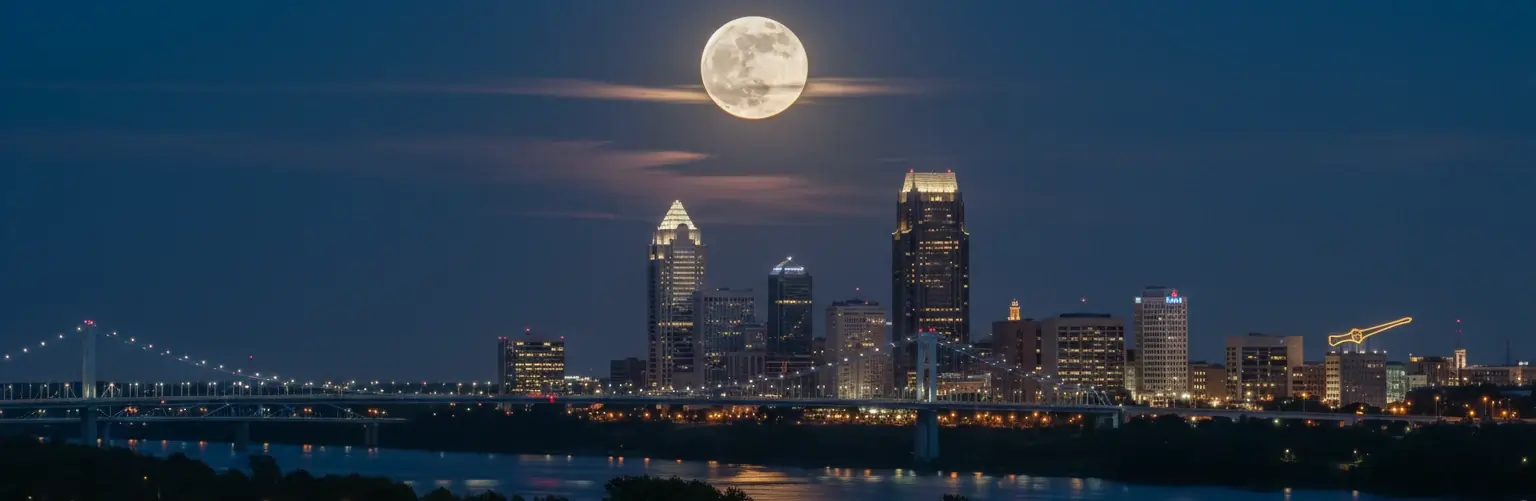
Louisville sits on the south bank of the Ohio River at the Kentucky–Indiana border, and that geography defines everything about moonrise photography here. The river runs roughly west to east through the city, and the Indiana side — Jeffersonville and Clarksville directly across the water — looks due south at the full Louisville skyline, making it the finest moonrise vantage point for the city's distinctive tower cluster. That skyline is anchored by 400 West Market — Kentucky's tallest building at 549 feet, topped by an illuminated Romanesque dome — flanked by the glass-and-steel PNC Tower and the pink granite Humana Building, one of the most celebrated works of postmodern architecture in America. On calm evenings the Ohio River doubles the entire composition below. To the south, the Iroquois Park summit — designed by Frederick Law Olmsted — gives the reverse view: the full city spread below from a wooded hilltop, the moon rising to the east and tracking north above the skyline.
Jeffersonville Riverfront – Indiana Side
The premier Louisville moonrise viewpoint. The Jeffersonville waterfront on the Indiana north bank looks directly south across the Ohio River at the full Louisville skyline — 400 West Market's lit dome, the PNC Tower, the Humana Building, and the twin lighthouse towers of Waterfront Plaza all visible in a single frame. On calm evenings the river surface mirrors the entire composition below. The moon rises to the east and tracks south above the city from this vantage. Open green space along the waterfront gives room to move and recompose as the moon tracks above the skyline. Free, open 24/7.
Big Four Bridge – Pedestrian Walkway
The Big Four Bridge is a repurposed 1895 railroad bridge now serving as a pedestrian and cycling crossing between Louisville and Jeffersonville. Walking out onto the bridge spans gives a mid-river position with the Louisville skyline to the south and the Indiana bank behind — the moonrise composition from the bridge deck combines bridge steel, river, and the full skyline in a layered frame available nowhere else in the metro. The bridge is lit at night and accessible 24/7. Both ends of the bridge (Louisville's Waterfront Park and Jeffersonville's riverfront) provide their own ground-level compositions.
Waterfront Park – Great Lawn & Harbor Lawn
Louisville Waterfront Park runs along the Kentucky south bank of the Ohio and its open Great Lawn and Harbor Lawn areas give direct riverfront access to the moonrise from the Louisville side — looking northeast across the water with the moon rising behind the Indiana hills and the city skyline visible along the bank. The park's proximity to the river means calm evenings produce water reflections from this side too. The Big Four Bridge is visible to the east and the downtown towers frame the western edge. Free, open 24/7; well-maintained paths throughout.
Iroquois Park – North Overlook
Iroquois Park is a 725-acre Olmsted-designed park on a forested knob in South Louisville, rising about 250 feet above the surrounding area. Its North Overlook gives a panoramic southward — and on the north face, northward — view of the entire Louisville city bowl with the Ohio River visible beyond the downtown towers. The moon rises to the east and tracks north above the city from this elevated wooded position. Darker skies than the riverfront. Note: vehicle access to the summit is restricted to Wednesdays, Saturdays, and Sundays (April–October); the overlook is accessible on foot year-round. Free.
Falls of the Ohio State Park – Jeffersonville
Falls of the Ohio State Park in Jeffersonville gives a dramatically different foreground for the Louisville moonrise — ancient fossil beds exposed on the riverbank, some of the most extensive Devonian fossil deposits in the world, with the Louisville skyline visible across the water to the south. The moon rises over the Kentucky hills to the east and the rocky foreground is unique in American moon photography. The interpretive center hosts occasional public evening events. Free outdoor access to the fossil beds; interpretive center has separate admission.
Clarksville Overlook – Ashland Park Area
The Ashland Park area and nearby elevated ground in Clarksville, Indiana give a slightly elevated Indiana-side view across the Ohio River at the Louisville skyline — a wider-angle perspective than the Jeffersonville waterfront, with more open sky above the city. The hilltop position gives better foreground separation between the river and the towers. Popular with local photographers who want a less crowded alternative to the Jeffersonville riverfront on busy full-moon evenings. Free, open 24/7.
◉ Best Times for Moon Photography
📷 Quick Photography Tips
Louisville operates on EST (UTC−5) in winter and EDT (UTC−4) during daylight saving time. Clocks go forward on the second Sunday in March and back on the first Sunday in November. Kentucky observes DST statewide. Apps like PhotoPills or Stellarium set to Louisville apply the correct offset automatically — useful for timing exact moonrise alignments with the downtown skyline and the Ohio River bridges across the seasons.
For the moon phase in any other city worldwide, visit our Dynamic Moon Phase Calculator for instant lunar data tailored to wherever you are.
The moon phase today in Louisville, KY is shown in detail above — complete with exact illumination percentage, moonrise/set times, and the best local spots to see it. For the moon phase today in any other city or location worldwide, visit our Dynamic Moon Phase Calculator on the home page.
◐ What the Experience Actually Feels Like
There is a particular quality to a moonrise over Louisville that you do not fully understand until you are standing on the Jeffersonville waterfront on a still October evening with the Ohio River in front of you and the city across the water. The river is wide here — the Louisville skyline is far enough away that the full tower cluster fits in a frame — and on a calm evening the water holds the entire composition below your feet: 400 West Market's dome, the PNC Tower, the Humana Building's pink granite stepped crown, all inverted in the dark water. And then the moon rises to the east behind the Kentucky hills, climbs above the skyline, and the river holds three things at once: the towers, their reflections, and the moon rising between them.
Louisville's skyline is distinctive in a way that rewards close study. The three most visible towers are each from a different era and a different architectural philosophy — the International Style glass-and-steel of PNC Tower, the postmodern pink granite of the Humana Building (one of the ten best buildings of the 1980s according to Time magazine), and the neo-Romanesque dome of 400 West Market rising above them all. At night, with 400 West Market's dome lit from within and the Humana Building's curved observation deck silhouetted against the sky, the skyline is as readable and as photographically compelling as any mid-sized American city's profile.
The Falls of the Ohio changes the scale of the evening. A few hundred metres upstream from downtown, Devonian-era fossil beds extend across the river edge at low water — 375 million years of geological time exposed at your feet, the Louisville towers visible in the background, and the moon rising over the Kentucky hills to the east. It is a foreground that has nothing to do with architecture or urbanity and everything to do with the deep time the river has been running through this particular bend in the valley. On a clear full-moon night, with the fossil limestone pale in the moonlight and the skyline lit behind it, the Falls gives a Louisville moonrise photograph that no other viewpoint in the city can match.
"The river holds three things at once: the towers, their reflections, and the moon rising between them — 400 West Market's dome inverted in the dark Ohio water below the lit skyline above."
✓ Your Louisville Moon Chase Checklist
Before You Go
- Check the moonrise time and phase on this page — the moon's alignment with the Louisville skyline from the Jeffersonville waterfront shifts seasonally; use PhotoPills to find the specific date when the moon rises centred on 400 West Market's dome
- Target the 48–72 hour window before full moon if possible — the moon rises during civil twilight and the warm Kentucky sky gives the skyline its most atmospheric colour before full dark
- Check Ohio River conditions before heading to the Indiana bank — calm, windless evenings only produce the mirror reflection; river wind or a significant current break will eliminate it
- For Iroquois Park, note that vehicle access to the summit is restricted to Wednesdays, Saturdays, and Sundays from April–October — walkers can access the North Overlook on foot year-round via the park trails
- Check the Ohio River level if planning the Falls of the Ohio — the fossil beds are only accessible when water levels are low; the interpretive centre website posts current conditions
What to Bring
- Sturdy tripod — Ohio River wind is persistent at the Jeffersonville waterfront and the Big Four Bridge; a lightweight travel tripod will not hold steady for longer exposures in the river corridor
- A lens between 200–400mm for tight Indiana-side compositions — compressing the moon against 400 West Market's dome or the Humana Building from across the river requires significant focal length
- A wide-angle lens (16–24mm) for the Big Four Bridge and Waterfront Park — the bridge steel, river, and full skyline panorama reward environmental compositions that include the foreground and the full skyline spread
- Layers from October through March — Louisville winters are damp and cold at the river, and the open Indiana waterfront and the Iroquois summit positions are windier than street level in the city
- Lens cloth — Ohio River humidity creates condensation on cold glass quickly in autumn and winter; the temperature drop between sunset and full dark at the waterfront is steeper than it feels in the city
- A headlamp for the Iroquois Park trail to the North Overlook — the forested path is unlit and the rocky sections of the approach are genuinely difficult in full dark without a light
On the Night
- Arrive at the Jeffersonville waterfront 30–45 minutes before moonrise — the eastern sky above the Kentucky hills warms to amber before the moon clears the horizon, and that pre-moonrise glow reflected in the Ohio is often the best compositional light of the evening
- On the Big Four Bridge, position yourself on the span rather than at either end for the most dramatic mid-river perspective — the bridge steel frames the skyline from this position in a way the shore viewpoints cannot
- Shoot RAW throughout — the dynamic range between the bright moon, 400 West Market's lit dome, the dark river, and the reflection below requires multiple exposures blended carefully in post
- Stay 20–30 minutes after moonrise — as the moon climbs above the Kentucky hills it sharpens and brightens, and the skyline alignments from the Indiana bank become more precise and more dramatic
- At the Falls of the Ohio, check your footing carefully — the fossil limestone is uneven and can be slippery when wet; use a headlamp for the walk out onto the fossil beds and stay well back from the river edge
? Louisville Moon Phase — Frequently Asked Questions
Q. What is the moon phase today in Louisville?
The moon phase today in Louisville is a New Moon with 0% illumination. The next full moon is in 17 days, on Oct 26. Moonrise is at 6:48 AM and moonset at 6:41 PM.
Q. Where is the best place to view the moon in Louisville?
The Jeffersonville riverfront on the Indiana side of the Ohio River is the top spot, looking straight across at the full Louisville skyline — 400 West Market's lit dome, the PNC Tower, and the Humana Building — with the moon rising behind it. The Big Four Bridge gives a mid-river vantage with the same skyline framed in steel, and Iroquois Park's Olmsted-designed hilltop offers a quieter, elevated view over the whole city.
Q. Why does the moon look so good over the Louisville skyline?
The Ohio River runs wide enough here that the entire Louisville tower cluster fits in one frame from the Indiana bank, and on calm evenings the river doubles the whole scene in reflection — towers, moon, and all. How well that works shifts night to night with the wind on the water and season to season with exactly where the moon lines up behind the skyline.
Q. Does Louisville observe daylight saving time?
Yes. Louisville runs on Eastern Standard Time (EST, UTC−5) in winter and switches to Eastern Daylight Time (EDT, UTC−4) from the second Sunday in March to the first Sunday in November. All times shown on this page already account for the correct offset.
Q. What's the best time of year for moon photography in Louisville?
October through March brings the most southerly moon path, which tightens the alignment with the skyline from the Indiana bank, along with clearer air and less humidity haze. Whatever the season, check the river for wind before you go — only calm water gives the mirror reflection that makes the Jeffersonville shot work.
Q. Does this page work for cities besides Louisville?
This page is set up specifically for Louisville, KY. For the moon phase in any other city or location worldwide, use the Dynamic Moon Phase Calculator on the moonphase.today home page.
✦ Explore Further
Moon Phase Today: Cincinnati
Check tonight's moon phase in Cincinnati, another Ohio River city about 100 miles northeast.
📷Moon Photography Guide
Camera settings, lenses, and techniques for shooting sharp, well-exposed moon shots.
🔭Photography Field of View Calculator
Work out the focal length you'll need to line the moon up with 400 West Market's dome.
🌆Blue Hour Calculator
Time your visit to the Big Four Bridge or Waterfront Park for the richest twilight before moonrise.
NASA Moon Phase & Libration Gallery
NASA's Scientific Visualization Studio's daily renders of the moon's exact phase, libration, and orientation, straight from official mission data.