
Moon Phase Today Las Vegas
On Friday, October 9, 2026, the moon in Las Vegas is a New Moon with 0% illumination. Moon age: 28.9 days.
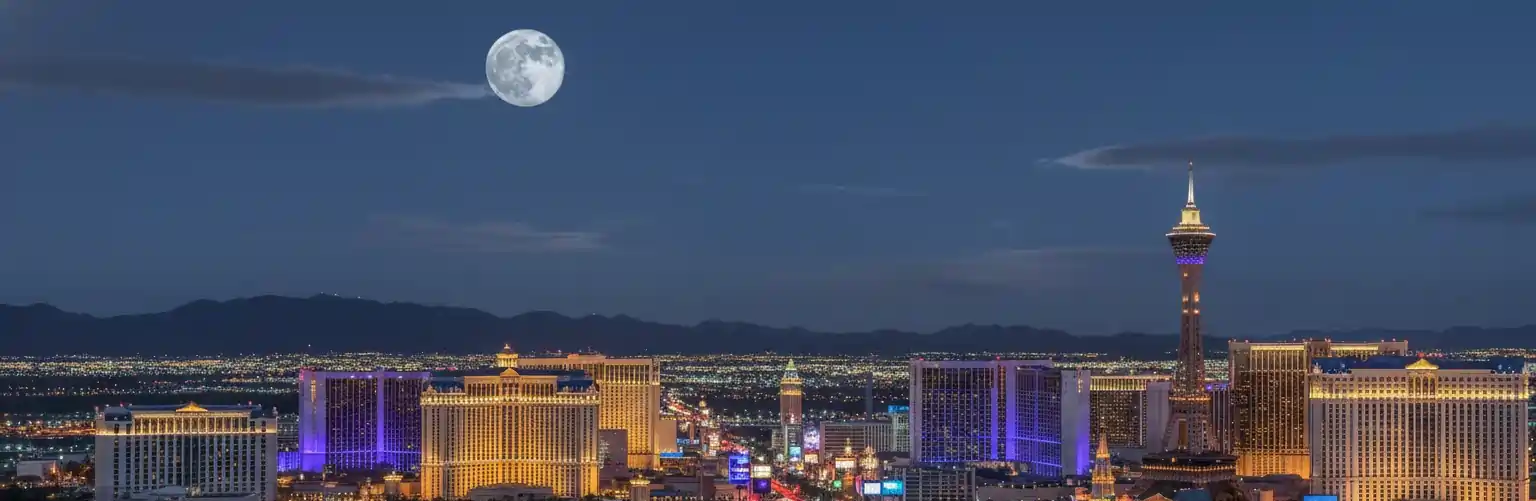
☽ Best Places to View the Moon in Las Vegas
Las Vegas sits in the Mojave Desert at approximately 2,000 feet (610 m) elevation in the broad Vegas Valley, ringed by mountain ranges on all sides — the Spring Mountains to the west topping out at 11,918 ft at Charleston Peak, the River Mountains to the southeast, and Frenchman Mountain anchoring the east. The desert air is among the driest and clearest in the continental United States, with low humidity year-round and roughly 294 sunny days per year, making it one of the most reliably moon-visible cities on the planet. What makes Las Vegas genuinely unique for lunar photography is the contrast: within 20 minutes of the Strip's neon canyon you can be in near-total darkness watching the moon rise over sandstone formations that predate the casino by 180 million years. No other major city offers that range so quickly.
Red Rock Canyon – Calico Hills & High Point Overlook
Just 17 miles west of the Strip, Red Rock Canyon National Conservation Area is the definitive Las Vegas dark-sky escape. The Calico Hills — vivid Aztec sandstone formations in burnt orange and cream — glow under a rising moon, and from the High Point Overlook the distant Strip lights sit low on the eastern horizon like a second sunset that never fully fades. The 13-mile scenic loop road is one-way and closes at dusk, but parking outside the fee station gives access to trailheads year-round. Entry fee applies; timed reservations are required October 1–May 31 for Scenic Drive entry between 8 AM–5 PM — book in advance at Recreation.gov and check current pricing before visiting. Arrive before sunset to secure a position; the best rock-foreground compositions are from the Calico Hills trailhead parking area looking east.
Pinnacle Point / Black Mountain Overlook – Henderson
The Black Mountain area above Henderson on the southeast edge of the valley offers elevated desert viewpoints with the entire Strip spread across the valley floor to the northwest — Bellagio, High Roller, and the Strat tower visible simultaneously in a single frame. The moon rises in the east and tracks across a sky noticeably darker than the city floor, with the full neon panorama below providing a foreground that no studio set could replicate. Multiple pull-outs along the access roads give drive-up access without hiking. Free; roads accessible after dark.
The STRAT Observation Deck
At 1,149 feet (350 m) above street level, The STRAT's observation deck puts you above the roofline of every other building on the Strip — the moon rises to the east and the entire city spreads below you as an illuminated grid stretching to the dark desert edges. From this height, telephoto shots compress the moon against individual casino towers rather than the full skyline, which is a fundamentally different compositional challenge and reward. Indoor and outdoor deck access. Entry approximately $25–30; open until 1 AM most nights, making it one of the few viewpoints accessible for late moonrise times. Check the website for current hours and pricing.
Lake Las Vegas – Reflection Bay & MonteLago Marina
Lake Las Vegas — a 320-acre man-made reservoir about 17 miles east of the Strip in Henderson — is the valley's best water-reflection moonrise spot. The lake sits in a desert canyon setting with the MonteLago Village development giving a warm-lit foreground of Mediterranean-style architecture and palm trees. The moon rises over the eastern ridge and reflects cleanly across the calm lake surface, with the faint amber glow of Las Vegas visible above the hills to the west. Significantly quieter and darker than any Strip-adjacent location. The marina walkway and Reflection Bay Golf Club shoreline give the best unobstructed sightlines. Free access to the lakeside path.
Seven Magic Mountains – Jean Dry Lake Bed
Seven Magic Mountains — Ugo Rondinone's landmark public art installation of neon-painted stacked boulders rising 30–35 feet from the desert floor — sits about 10 miles south of the city along I-15, with the Jean Dry Lake Bed stretching flat around it. The moon rises behind the coloured columns and the distant Strip glow provides a faint horizon reference without washing out the sky. The installation has no artificial lighting after dark — the moon becomes the only light source, which for lunar photography is exactly the point. The boulders silhouette dramatically against the sky, and on a full moon night the colours are faintly visible as the moonlight picks up the paint. The lake bed foreground gives wide compositional options for positioning the columns relative to the rising moon. Free, open 24 hours; roadside parking along Las Vegas Boulevard South. Bring a red headlamp for navigation — the site is unlit and the ground is uneven.
Frenchman Mountain – Summit Viewpoint
Frenchman Mountain on the eastern edge of the valley rises to approximately 4,055 feet (1,236 m) — around 2,000 feet above the valley floor — and offers one of the most complete panoramas available anywhere near Las Vegas. From the summit, Lake Mead is visible to the southeast, the entire valley spreads west, and the Spring Mountains frame the horizon beyond the Strip. The moon rises from behind the Muddy Mountains to the east and arcs across the full sky above the city below. One of the darkest accessible viewpoints near the urban core. A moderate-to-strenuous hike of approximately 3.5 miles round trip with 1,800 feet of elevation gain; start before sunset and carry a headlamp. Free; trailhead off Hollywood Boulevard.
◉ Best Times for Moon Photography
📷 Quick Photography Tips
Las Vegas operates on PST (UTC−8) in winter and PDT (UTC−7) during daylight saving time, which runs from the second Sunday in March to the first Sunday in November. Nevada observes DST statewide — unlike neighbouring Arizona, which does not. Apps like PhotoPills or Stellarium set to Las Vegas handle the offset automatically, essential for calculating the narrow window when the moon rises behind specific Strip towers from your chosen viewpoint.
For the moon phase in any other city worldwide, visit our Dynamic Moon Phase Calculator on our home page for instant lunar data tailored to wherever you are.
The moon phase today in Las Vegas, NV is shown in detail above — complete with exact illumination percentage, moonrise/set times, and the best local spots to see it. For the moon phase today in any other city or location worldwide, visit our Dynamic Moon Phase Calculator on the home page.
◐ What the Experience Actually Feels Like
Las Vegas is a city built on the premise that artificial light can substitute for natural beauty, and for 30 years that bet has paid off. But there is a specific hour — about 45 minutes after sunset on a clear October night — when the premise fails completely and something else takes over. The moon rises in the east, clears the ridge of Frenchman Mountain, and begins tracking across a sky that the desert has kept clean and dark despite everything the city has tried to do to it. The neon is still there. It just stops being the main event.
What photographers discover when they drive 20 minutes west to Red Rock Canyon is that Las Vegas has a second identity that runs parallel to the first — older by several hundred million years, indifferent to the Strip, and at its most extraordinary when lit by a rising full moon. The Calico Hills sandstone turns from burnt orange to pale silver as the moon climbs, the shadows deepen in the crevices, and the faint amber dome of the city sits low on the eastern horizon like a campfire seen from a long way away. You drove from that to this in 20 minutes. That compression of worlds is uniquely Las Vegas.
The other thing the desert gives you is atmosphere — or rather, the absence of it. Dry air does not scatter light the way humid air does, which means the moon over Las Vegas is sharper, colder, and more detailed than the same moon seen from Houston or Miami on the same night. On a still December night from Frenchman Mountain, the lunar surface is clear enough that experienced observers can identify the maria with the naked eye. The city below is a grid of coloured light, the Spring Mountains are silhouettes, and the moon is doing something that has nothing to do with the odds on the casino floor 2,000 feet below.
"There is a specific hour when the premise of Las Vegas fails completely and something else takes over. The moon rises, clears Frenchman Mountain, and begins tracking across a sky the desert has kept dark despite everything the city has tried to do to it."
✓ Your Las Vegas Moon Chase Checklist
Before You Go
- Check the moonrise time and phase on this page — you need the moon to rise during blue hour for the best neon-and-moonlight balance, which means targeting the 48–72 hour window before full
- For Red Rock Canyon, check the NPS website for seasonal gate hours — the scenic loop road closes at dusk, but trailhead parking outside the fee station is accessible after dark
- Use PhotoPills AR mode set to Las Vegas to pre-visualise the exact alignment between the rising moon and your chosen Strip tower from Henderson or Pinnacle Point — the geometry changes significantly by date
- For Frenchman Mountain, check trail conditions — the upper section can be icy in January and February after rare winter storms, and the descent in the dark is technical without microspikes
- Target October through April for the sharpest telephoto results — summer heat shimmer at the desert surface softens distant Strip shots from elevated viewpoints
What to Bring
- Sturdy tripod — desert wind accelerates after dark at any elevated site, and longer focal lengths require complete stability for sharp results
- A 300–500mm lens for Henderson overlook and STRAT deck shots — compressing the moon against individual casino towers is the signature Las Vegas telephoto composition
- A wide-angle lens for Red Rock and Seven Magic Mountains — the sandstone foregrounds and installation boulders reward 16–35mm for environmental context
- Layers for any desert site outside the city — Las Vegas winter nights drop fast after sunset; Red Rock and Frenchman Mountain can be 15–20°F colder than the Strip
- Water — even on cool nights, the dry desert air dehydrates faster than you expect; carry more than you think you need for the Frenchman Mountain hike
- A red headlamp for Red Rock trailheads and Frenchman Mountain — white light kills dark adaptation and the return trail in the dark requires hands-free navigation
On the Night
- Arrive at your desert viewpoint 45 minutes before moonrise — Mojave twilight fades quickly and the warm sandstone colour at Red Rock only holds for a short window before going cool
- At Seven Magic Mountains, position yourself to the south or southeast of the installation so the moon rises behind the boulders rather than beside them — use PhotoPills to confirm the exact angle for your chosen date
- From the STRAT deck, shoot during the first 20 minutes after moonrise when the sky still has colour — once the sky goes fully dark the moon becomes a bright point against black and the Strip becomes the only light source
- At Lake Las Vegas, check the water surface before setting up — if there is any ripple, move to the most sheltered section of the marina walkway; even small wind textures break the reflection
- Shoot RAW and bracket exposures — the neon-to-moon dynamic range in Las Vegas is among the widest of any city on this site, and HDR blending in post is often the only way to retain both
- For Frenchman Mountain, begin your descent no later than one hour after moonrise — the trail is exposed and the return in full dark without knowing the route is not recommended
? Las Vegas Moon Phase — Frequently Asked Questions
Q. What is the moon phase today in Las Vegas?
The moon phase today in Las Vegas is a New Moon with 0% illumination. The next full moon is in 17 days, on Oct 25. Moonrise is at 5:50 AM and moonset at 5:42 PM.
Q. Where is the best place to view the moon in Las Vegas?
Red Rock Canyon, just 17 miles west of the Strip, is the top dark-sky escape, with the moon lighting up the Calico Hills sandstone. For a Strip-and-moon shot in one frame, the Pinnacle Point overlook above Henderson or The STRAT's observation deck both work well. Seven Magic Mountains and Frenchman Mountain are the picks for photographers who want the moon as the only light source.
Q. Why is the moon so clear and sharp over Las Vegas?
Las Vegas sits in the Mojave Desert, one of the driest, clearest parts of the continental United States, with around 294 sunny days a year and very little humidity to soften or blur the view. That dry air is why the moon looks noticeably crisper here than over a humid city on the same night — and why a 20-minute drive out to Red Rock Canyon puts you under some of the darkest skies near any major U.S. city.
Q. Does Las Vegas observe daylight saving time?
Yes. Las Vegas runs on Pacific Standard Time (PST, UTC−8) in winter and switches to Pacific Daylight Time (PDT, UTC−7) from the second Sunday in March to the first Sunday in November. Nevada observes DST statewide — unlike neighboring Arizona, which does not — so all times on this page already account for the correct seasonal offset.
Q. What's the best time of year for moon photography in Las Vegas?
October through April brings the clearest desert air and the sharpest telephoto results, since summer heat shimmer at the surface can soften distant Strip shots from elevated viewpoints. The 48–72 hours before a full moon are especially good, when the moon rises during blue hour and the neon and moonlight balance evenly.
Q. Does this page work for cities besides Las Vegas?
This page is set up specifically for Las Vegas, NV. For the moon phase in any other city or location worldwide, use the Dynamic Moon Phase Calculator on the moonphase.today home page.
✦ Explore Further
Moon Phase Today: Borrego Springs
Check tonight's moon phase in Borrego Springs, another desert Dark Sky destination about 200 miles southwest.
📷Moon Photography Guide
Camera settings, lenses, and techniques for shooting sharp, well-exposed moon shots.
🌵Sky Clarity Forecast
Check cloud cover before the drive out to Red Rock Canyon or Frenchman Mountain.
🌝Supermoon Dates 2026
When the moon will look biggest and brightest over the desert this year.
NASA Moon Phase & Libration Gallery
NASA's Scientific Visualization Studio's daily renders of the moon's exact phase, libration, and orientation, straight from official mission data.