
Moon Phase Today Lahore
On Saturday, October 10, 2026, the moon in Lahore is a New Moon with 0% illumination. Moon age: 28.9 days.
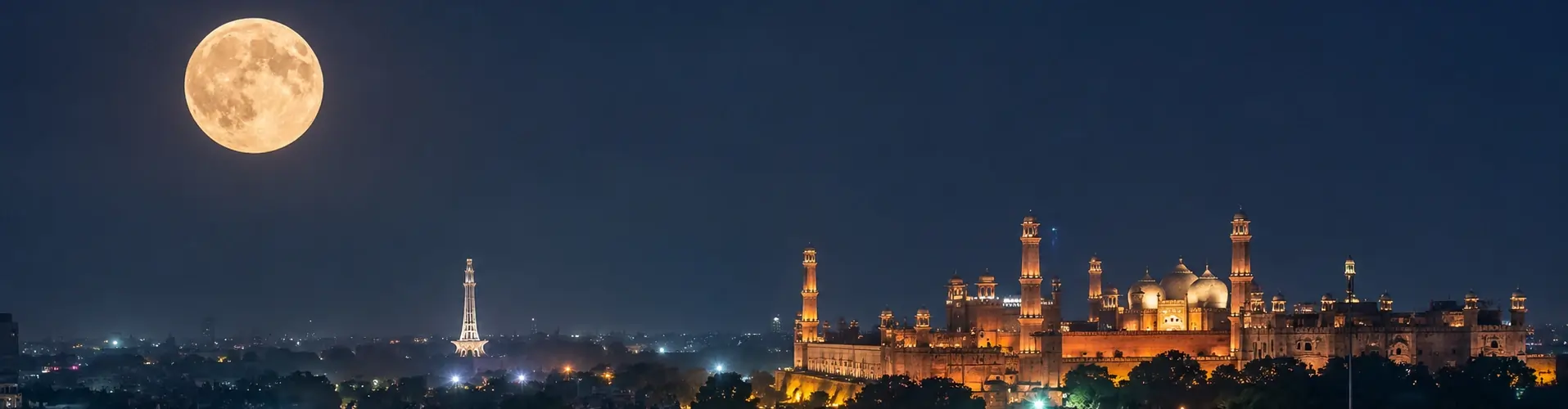
☽ Best Places to View the Moon in Lahore
Lahore, the cultural heart of Pakistan, offers a moonrise experience shaped by Mughal-era monuments set against the flat Punjab plains. With no natural elevation anywhere in the city, the best views generally rely on historic monuments or rooftop vantage points to break the horizon. Here are the top spots.
Fort Road Food Street rooftops
A cluster of restored havelis — including Haveli Restaurant, Andaaz, and Cuckoo's Den — with open-air rooftop dining facing the Badshahi Mosque and Lahore Fort. On a clear night the moon can rise over the Walled City, lighting up the mosque's marble domes and the fort's red sandstone walls.
Greater Iqbal Park / Minar-e-Pakistan
A large urban park between the Fort and the Ravi River, home to the 70-metre, petal-shaped Minar-e-Pakistan monument. It gives rare open sky for a congested city, with room to line the moon up near the illuminated Minar or the nearby Tomb of Hafeez Jalandhari on the right night.
Grand Jamia Mosque, Bahria Town
One of the largest mosques in the world, in the newer, southern part of the city. Bahria Town generally sees somewhat clearer air than the old city core. The moon can appear between the mosque's four towering minarets or near its central dome, mixing modern lighting with celestial glow.
Wazir Khan Mosque
Deep in the narrow streets of the Walled City (Androon Lahore), famed for its intricate kashi-kari tile work. The street level blocks the horizon, so a high vantage point or courtyard access (with permission) is needed — but moonlight on the mosque's glazed blue-and-yellow minarets is one of the most atmospheric sights in the city.
Eiffel Tower replica, Bahria Town
A full-scale replica tower popular for creative, "Parisian"-style moon shots. The surrounding plaza is wide, flat, and built for festivals, giving plenty of room to move and line the moon up near the tip of the tower or through its lattice structure.
Shalimar Gardens
A Mughal-era garden complex of terraces, marble pavilions, and reflecting pools, built in the 17th century. Quieter and greener than the city center, its still water surfaces can pick up the moon's reflection alongside the garden's own night lighting.
◉ Best Times for Moon Photography
📷 Quick Photography Tips
Timezone: Lahore operates on Pakistan Standard Time (PKT, UTC+5) year-round, with no daylight saving adjustment.
Direction: The moon rises in the east. From the Food Street rooftops, that generally means over the direction of the Walled City, though exactly how it lines up with the Badshahi Mosque shifts with the season and your specific vantage point.
◐ What the Experience Actually Feels Like
From a Food Street rooftop, moonrise arrives over a wall of history rather than an open horizon. Below, the Walled City hums with traffic and vendor calls even after dark, while the Badshahi Mosque's warm floodlighting washes over its marble domes. When the moon clears the rooftops, it settles into a sky that's rarely fully black — more often a soft, hazy grey-purple, the city's dust and smog acting as an unintentional filter.
Inside the Walled City, near Wazir Khan Mosque, the experience is more intimate and enclosed. The narrow lanes block any real view of the sky until you find a rooftop or step into the mosque courtyard, where moonlight catches the glazed blue-and-yellow tilework in a way that streetlights never quite manage. It's a slower, more deliberate kind of moon viewing than the open rooftops offer.
Out at Shalimar Gardens, the mood shifts again — quieter, greener, and closer to how the space might have felt in Mughal times. The terraced pools catch both the garden's own lighting and, on a clear night, the moon itself, while the traffic noise of the city fades into the background. During Eid, this contrast between old and new Lahore becomes sharper still, as mosques across the city light up for the crescent sighting that marks the holiday.
"The moon here doesn't rise into an empty sky — it rises into centuries of Mughal stonework, warm floodlight, and a haze that turns even a clear night faintly golden."
✓ Your Lahore Moon Chase Checklist
Before You Go
- Check the moonrise time on this page, and the current smog forecast if visiting between November and January
- Book a rooftop table at Food Street ahead of time, especially on weekends or around the full moon
- Download PhotoPills or Stellarium to check whether the moonrise will line up with a specific minaret or monument on your date
- Confirm mosque courtyard access and photography rules in advance if you want to shoot from inside Wazir Khan or the Grand Jamia Mosque
- Aim for September–October if clear air matters most to your shoot
What to Bring
- A telephoto lens (200–400mm) to compress the moon behind a minaret or the Minar-e-Pakistan from a distance
- A polarizing filter to help cut through Lahore's characteristic haze, though it won't fully remove it
- Modest clothing if you plan to enter any mosque courtyard for photography
- A compact tripod for rooftop use, plus a backup handheld setup for mosque interiors where tripods are often restricted
- Cash for rooftop restaurant reservations and minimum orders
On the Night
- Arrive at your rooftop table early to secure a railing-side spot with a clear line to the mosque or fort
- Balance your white balance carefully — the Badshahi Mosque's warm floodlighting can shift the moon's color if you're not careful
- Focus manually on the moon's edge; haze and mosque lighting can both confuse autofocus after dark
- Bracket your exposures — one for the moon, one for the floodlit domes and minarets below it
- Be patient in smog season; the moon often clears up and sharpens once it's higher in the sky
? Lahore Moon Phase — Frequently Asked Questions
Q. What is the moon phase today in Lahore?
The moon phase today in Lahore is a New Moon with 0% illumination. The next full moon is in 17 days, on Oct 26. Moonrise is at 5:39 AM and moonset at 5:20 PM.
Q. Where is the best place to view the moon in Lahore?
Fort Road Food Street's restored haveli rooftops are the top pick, facing the Badshahi Mosque and Lahore Fort with the moon rising over the Walled City to light up the mosque's marble domes. Greater Iqbal Park gives rare open sky around the 70-metre Minar-e-Pakistan monument, the Grand Jamia Mosque in Bahria Town offers somewhat clearer air in the newer part of the city, and Wazir Khan Mosque, the Eiffel Tower replica, or Shalimar Gardens add further intimate, novelty, or Mughal-era-garden alternatives.
Q. Do I need to book ahead for the Food Street rooftops?
Yes, ideally — most historic views require a restaurant rooftop table, and booking ahead is worth it for weekends or full moon nights to secure a railing-side spot. Mosque courtyards, including Wazir Khan and the Grand Jamia Mosque, often restrict tripods without prior permission, though handheld shooting is generally fine.
Q. Does Lahore observe daylight saving time?
No. Lahore operates on Pakistan Standard Time (PKT, UTC+5) year-round, with no daylight saving adjustment. The times shown on this page never need a seasonal adjustment.
Q. What's the best time of year for moon photography in Lahore?
September through October is the post-monsoon sweet spot, when rain clears dust and pollution for sharper skies. November through January is Lahore's smog season, sometimes called "the fifth season," when the moon can look hazy or reddish near the horizon but usually clears once higher in the sky.
Q. Does this page work for cities besides Lahore?
This page is set up specifically for Lahore, Pakistan. For the moon phase in any other city or location worldwide, use the Dynamic Moon Phase Calculator on the moonphase.today home page.
✦ Explore Further
Moon Phase Today: Karachi
Check tonight's moon phase in Karachi, about 745 miles south on the Arabian Sea coast.
📷Moon Photography Guide
Camera settings, lenses, and techniques for shooting sharp, well-exposed moon shots.
📐Looney 11 Exposure Calculator
Dial in the exact f-stop, ISO, and shutter speed for a full moon over the Badshahi Mosque.
🌍World Moon Phase Directory
Browse the moon phase today in hundreds of other cities and locations around the world.
NASA Moon Phase & Libration Gallery
NASA's Scientific Visualization Studio's daily renders of the moon's exact phase, libration, and orientation, straight from official mission data.