
Moon Phase Today Lagos
On Friday, October 9, 2026, the moon in Lagos is a New Moon with 0% illumination. Moon age: 28.9 days.
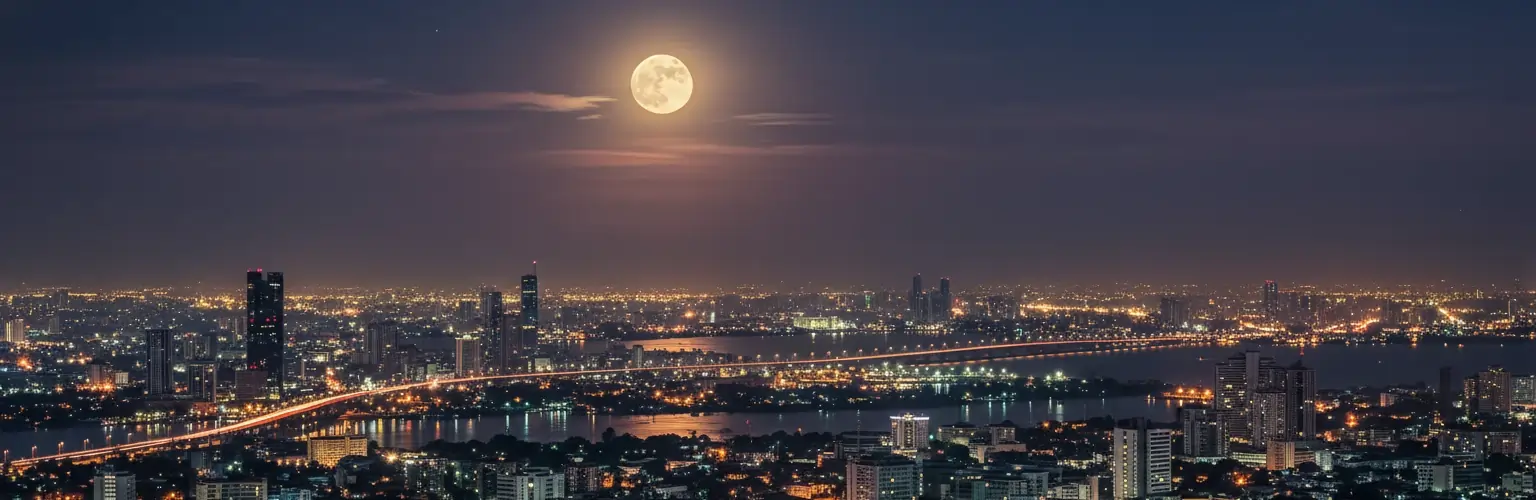
☽ Best Places to View the Moon in Lagos
Lagos is a city of intense tropical energy, where the humid air of the Bight of Benin meets a rapidly rising vertical skyline. Situated at 6° North latitude, the moon here climbs almost vertically toward the zenith. While light pollution in West Africa's largest megacity is significant, the moon remains a powerful subject as it rises over the Atlantic Ocean and reflects in tidal inlets. From the architectural cables of the Ikoyi Link Bridge to the untamed coastal dunes of Tarkwa Bay, Lagos rewards photographers who can navigate its complexity to capture the moon against a backdrop of rainforest, water, and steel.
Lekki-Ikoyi Link Bridge
The definitive modern Lagos landmark. This cable-stayed bridge spans Five Cowries Creek, providing a graphic, symmetrical foreground as the moon rises over the Ikoyi skyline. Logistics: Currently free to access as tolls are suspended, though it remains a gazetted toll bridge. Use the pedestrian path for stability, but shoot in a group for safety. Free access 24/7.
Elegushi / Alpha Beach
Coastal spots along the Lekki corridor offer an unobstructed eastern horizon where the moon rises directly out of the Atlantic Ocean. At low tide, the receding waves leave a thin film of water on the sand, creating a perfect duplicate mirror reflection. Palm trees along the dunes provide a classic tropical silhouette. Note that Elegushi is a private royal beach; a small entry fee applies.
Tarkwa Bay Island
Accessible only by a 15-minute boat ride from Victoria Island. Tarkwa Bay offers noticeably darker skies and cleaner air. From the sea walls, the moon rises over the Bight of Benin with the distant Lagos harbor lights as a middle-ground element. It is a peaceful alternative to the mainland buzz. Boat transfers range from NGN 2,000–5,000; ensure you arrange a return trip with your pilot in advance.
Lekki Conservation Centre (LCC)
Home to a 401-meter-long canopy walkway. Access Note: The center closes at 5:00 PM (6:00 PM on weekends). Because moonrise often occurs after closing, photography from the walkway is typically limited to specific seasonal windows or late-afternoon lunar sightings. Entry is N1,500 plus N1,500 for the canopy walk (N3,000 total).
Landmark / Oniru Beach
These urban beaches in Victoria Island combine the Atlantic horizon with a modern, "Lagos nightlife" vibe. The moon rises over the ocean while the skyscrapers of Eko Atlantic City begin to glow to the west. It is one of the safest coastal spots for evening photography due to the high density of security and well-lit boardwalks. Entry fees apply for beach access.
Nike Art Gallery Rooftop
Located in Lekki, the rooftop of this legendary five-story gallery offers a rare elevated view of the residential skyline. The moon rises over the sprawling Lekki peninsula, and the terrace is dotted with traditional Nigerian sculptures. Access is usually 10:00 AM – 6:00 PM, though hours should be verified locally. Check for special evening events or exhibition nights for later access.
◉ Best Times for Moon Photography
📷 Quick Photography Tips
Lagos operates on WAT (West Africa Time, UTC+1) year-round. Nigeria does not observe daylight saving time. At 6°N, the sun and moon rise and set relatively quickly compared to northern latitudes. Use PhotoPills to catch the brief 15-minute window when the sky holds blue hour color as the moon breaks the horizon.
The moon phase today in Lagos is shown in detail above. For the moon phase today in any other city worldwide, visit our Dynamic Moon Phase Calculator on the home page.
◐ What the Experience Actually Feels Like
There is a particular, heavy warmth to a Lagos moonrise. Standing on the shore at Elegushi, the experience begins with the rhythmic boom of the Atlantic surf. The air is thick with salt and humidity, making the moon appear massive and copper-colored as it first breaks the horizon. It doesn't just rise; it pushes through the haze of the Bight of Benin, eventually turning a brilliant, clinical white as it climbs into the high tropical sky.
On the Lekki-Ikoyi Link Bridge, the experience is urban and electric. You hear the distant thrum of traffic and the hum of a city that never truly sleeps. The moon reflects in the dark waters of Five Cowries Creek, caught between the steel cables of the bridge. It is a moment of architectural serenity in the middle of West Africa’s most chaotic metropolis—a reminder of the precision that exists even within the "Lagos hustle."
During the Harmattan months, the experience is surreal. The Saharan dust creates a soft, diffused sky that turns the moon into a glowing orb of deep orange. From the island of Tarkwa Bay, looking back toward the mainland, the city lights flicker through the dust, and the moon hangs above it all like a silent guardian. It is a landscape of extremes—the wild ocean, the dense jungle, and the steel skyline, all unified for a few hours under a silver tropical light.
"The moon pushes through the haze of the Bight of Benin, eventually turning a brilliant white as it climbs into the tropical sky. It is a moment of architectural serenity."
✓ Your Lagos Moon Chase Checklist
Before You Go
- Check moonrise times on this page — the tropical horizon is often hazy, so the moon may not be visible for the first 5 mins of rise
- Check tide charts for Elegushi or Alpha Beach; low tide is essential for reflection shots on the sand
- Note the LCC closing time: 5:00 PM (6:00 PM weekends). Moonrise photography from the walkway is only possible during specific times of the year
- Check the weather for rain; Lagos downpours are sudden and can completely obscure the sky for hours
- Arrange a reliable ride via Uber or Bolt; parking can be chaotic near the popular beach clubs
What to Bring
- Sturdy tripod — mandatory for the windy Atlantic coastline and pedestrian bridge walkways
- A telephoto lens (200mm+) to "compress" the moon against the Ikoyi Link Bridge or the Eko Atlantic towers
- Insect repellent — mosquitoes are highly active near Five Cowries Creek and the LCC area after dark
- Lens cleaning cloth — tropical humidity and sea salt will create a film on your glass within minutes
- A high-capacity power bank — ensure your devices are fully charged before heading out to remote beach areas
- Closed shoes for the LCC canopy walkway or bridge trek; sandals for the beach
On the Night
- Arrive 30 minutes early; the transition from tropical dusk to moonrise is very fast at 6°N latitude
- Focus manually on the moon’s edge; high humidity can sometimes cause autofocus to "hunt" or blur
- Bracket your exposures — take one for the lunar disc and one for the darker shadows of the waves or bridge cables
- If at Tarkwa Bay, ensure you have arranged your return boat pilot's contact info for the night transfer
- Stay in well-lit, populated areas; Lagos photography is best enjoyed with a high degree of situational awareness
? Lagos Moon Phase — Frequently Asked Questions
Q. What is the moon phase today in Lagos?
The moon phase today in Lagos is a New Moon with 0% illumination. The next full moon is in 17 days, on Oct 26. Moonrise is at 5:30 AM and moonset at 5:52 PM.
Q. Where is the best place to view the moon in Lagos?
The Lekki-Ikoyi Link Bridge is the definitive modern Lagos landmark, with the moon rising over the Ikoyi skyline above the cable-stayed span across Five Cowries Creek. Elegushi and Alpha Beach give an unobstructed Atlantic horizon with wet-sand reflections at low tide, Tarkwa Bay Island offers noticeably darker skies via a short boat ride, and Landmark/Oniru Beach or the Nike Art Gallery rooftop add further well-lit-coastal or elevated alternatives.
Q. Is it safe to shoot on the beaches at night?
Sticking to well-lit, populated areas is the safest approach — Landmark and Oniru Beach are among the best-secured coastal spots for evening photography, while isolated stretches are best avoided after dark.
Q. Does Lagos observe daylight saving time?
No. Lagos operates on WAT (West Africa Time, UTC+1) year-round — Nigeria does not observe daylight saving time. The times shown on this page never need a seasonal adjustment.
Q. What's the best time of year for moon photography in Lagos?
December through February, the Harmattan season, brings Saharan dust that creates deep red moonrises, while March through October is the rainy season, which can produce spectacular clarity between downpours. Whatever the month, low tide matters for the best wet-sand mirror effects on the Lekki beaches.
Q. Does this page work for cities besides Lagos?
This page is set up specifically for Lagos, Nigeria. For the moon phase in any other city or location worldwide, use the Dynamic Moon Phase Calculator on the moonphase.today home page.
✦ Explore Further
Moon Phase Today: Accra
Check tonight's moon phase in Accra, about 430 miles west along the Gulf of Guinea coast.
📷Moon Photography Guide
Camera settings, lenses, and techniques for shooting sharp, well-exposed moon shots.
📐Looney 11 Exposure Calculator
Dial in the exact f-stop, ISO, and shutter speed for a full moon over the Ikoyi Link Bridge.
🌆Blue Hour Calculator
Find tonight's exact (and short) equatorial blue hour window to time your Elegushi Beach moonrise shots.
NASA Moon Phase & Libration Gallery
NASA's Scientific Visualization Studio's daily renders of the moon's exact phase, libration, and orientation, straight from official mission data.