
Moon Phase Today Jackson
On Friday, October 9, 2026, the moon in Jackson is a New Moon with 0% illumination. Moon age: 28.9 days.
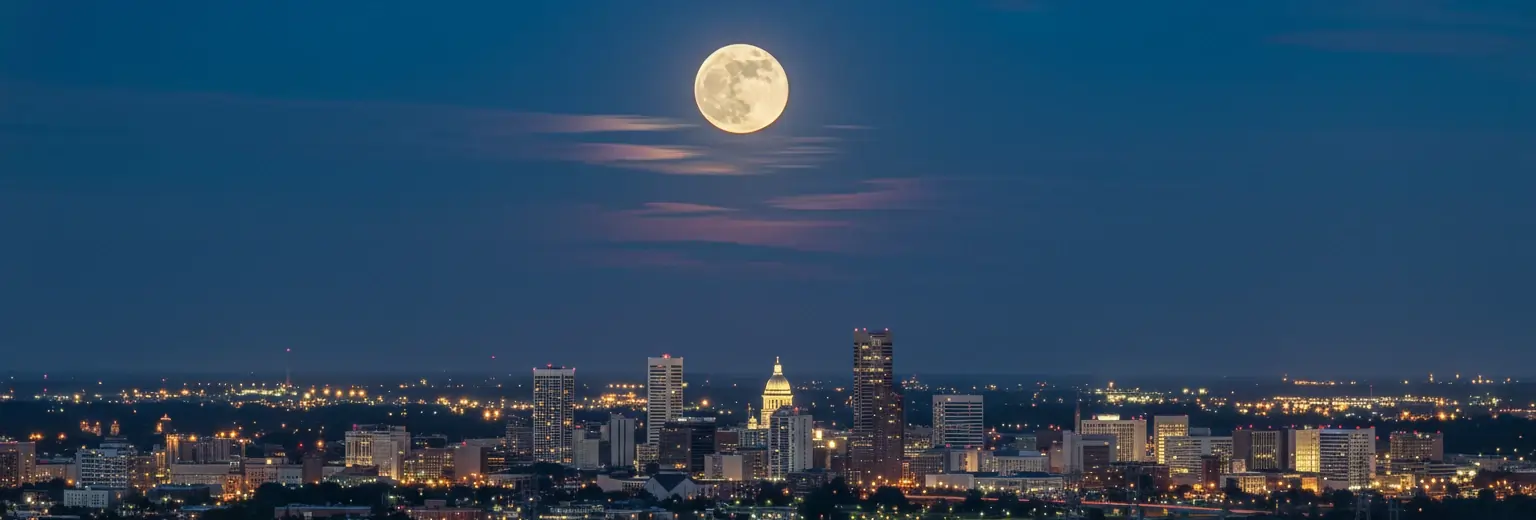
☽ Best Places to View the Moon in Jackson
Jackson, Mississippi sits on the flat blackland prairie of the Deep South, where the Pearl River winds through wooded corridors and the city opens onto wide skies in every direction. This is not a city of dramatic skylines or towering landmarks — it is a Southern state capital of antebellum parks, Civil War battlefields, 50-acre urban lakes, and a magnificent domed Capitol building that has commanded Capitol Street since 1903. Moonrises here are quiet and honest. The moon comes up over the eastern horizon with the Mississippi State Capitol dome in silhouette, or over the still surface of Mayes Lake with Spanish-moss framed trees at the edge of the frame, or over the wide Pearl River from one of the city's many open parks. Jackson rewards the photographer who understands that understatement is its own kind of beauty — that the Deep South at full moon, away from the noise of the largest cities, produces a particular quality of Southern night sky that no coastal metropolis can replicate.
Smith Park – Downtown Capitol District
The most historically resonant moonrise position in Jackson. Smith Park is a 2.4-acre downtown green space donated to the city in 1838 — one of the oldest continuously-used antebellum city parks in America — and it sits on Capitol Street with the Mississippi Governor's Mansion on one side and the Capitol district behind. The moon rises over the downtown cluster — Regions Plaza, the Walter Sillers State Office Building, and surrounding towers — from a historically layered foreground. Paved paths and lit pavilion for evening use. Free, open 24/7; exercise personal safety awareness as downtown Jackson is quiet at night.
Mississippi State Capitol Grounds
The Mississippi State Capitol, completed in 1903 and modelled after the US Capitol in Washington, has one of the finest domes in the American South. From Capitol Street looking east, or from the grounds themselves, the moon rises or sets against a composition anchored by that dome. The exterior grounds are accessible at all hours; the building itself is open weekdays 8am–5pm. From the south side on Mississippi Street, the moon rises over the tree-lined approach while the dome is lit in the foreground. Free; street parking available most evenings.
LeFleur's Bluff State Park – Mayes Lake
Jackson's finest water-reflection moonrise position. LeFleur's Bluff covers 305 acres of Pearl River bottomland within the city limits, and its 50-acre Mayes Lake offers the stillest, most photogenic water in the metro area. The moon rises over the tree line and reflects in the lake surface on calm evenings — a composition that reads more like rural Mississippi than a state capital two miles from the interstate. Entry fee: $4 per vehicle; park gates close around 5pm daily. Overnight camping is available if you want to stay for a later moonrise.
Ross Barnett Reservoir – Shoreline Access
The Ross Barnett Reservoir is a 33,000-acre impoundment of the Pearl River north of Jackson in Madison and Rankin counties — the largest recreational water body in central Mississippi. From the various shoreline parks and launch areas along its western and southern edges, the moon rises over a wide open water horizon with no far shore in sight. The scale is genuinely large: 105 miles of shoreline and open water. On calm nights in autumn, when the summer humidity has broken and the air clears, the Reservoir produces the best moonrise reflections in the region. Multiple free public access points; many areas accessible 24/7 from road shoulders and day-use areas.
Battlefield Park – West Jackson
Battlefield Park is Jackson's oldest and largest city park at 54 acres, established in 1927 on ground where Civil War battles were fought in May and July 1863. Two acres are deliberately preserved as battlefield, with intact earthworks that are among the most tangible remains of the Civil War fortifications around the city; the remaining acreage is recreational open space with ball fields and walking paths. The moon rises over the open eastern fields with the city skyline faint in the distance. Note: multiple recent visitor accounts describe the surrounding area as high-crime; visit during daylight or with awareness, and check current local conditions before planning an evening session. Free, open 24/7.
Fondren Neighbourhood – Elevated Viewpoints
Jackson's most creative and walkable neighbourhood, Fondren sits just north of the medical district on North State Street and offers the city's best collection of independent restaurants, galleries, and bars — along with some of the most interesting elevated urban viewpoints in the metro. The neighbourhood's higher ground gives partial skyline views and tree-framed eastern horizons where the moon rises over the city. A more social, local-atmosphere alternative to the parks; the Fondren community is active in the evenings and the neighbourhood is well-lit and walkable. Free; street parking throughout.
◉ Best Times for Moon Photography
📷 Quick Photography Tips
Jackson operates on CST (UTC−6) in winter and CDT (UTC−5) during daylight saving time. Clocks go forward on the second Sunday in March and back on the first Sunday in November. Mississippi observes DST statewide. Apps like PhotoPills or Stellarium set to Jackson apply the correct offset automatically — useful for calculating exact moonrise times against the Capitol dome and park horizons throughout the year.
For the moon phase in any other city worldwide, visit our Dynamic Moon Phase Calculator for instant lunar data tailored to wherever you are.
The moon phase today in Jackson, MS is shown in detail above — complete with exact illumination percentage, moonrise/set times, and the best local spots to see it. For the moon phase today in any other city or location worldwide, visit our Dynamic Moon Phase Calculator on the home page.
◐ What the Experience Actually Feels Like
Jackson moonrises do not compete with the great American skyline cities, and they do not try to. What they offer instead is something quieter and, in its own way, more complete — the particular quality of a Southern night in a city that has been continuously lived in since 1822, where the old parks have real trees and the Capitol dome has a century of history behind it and the Pearl River still moves through the city the same way it moved past the Choctaw trading post at LeFleur's Bluff two hundred years ago. On a clear October evening at Mayes Lake, the moon comes up over the wooded eastern shore and the Spanish moss catches it, and the water goes completely still, and the only sound is frogs. It is not dramatic. It is very good.
The Ross Barnett Reservoir, north of the city, is where Jackson's moonrise photography scales up. Thirty-three thousand acres of Pearl River impoundment stretch north until the far shore disappears, and from the southern dam area or the western shoreline the moon rises over what appears to be open water with no far shore in sight. On calm nights in October and November, when the summer humidity has finally broken and the air over central Mississippi clears, the Reservoir produces the best moonrise reflections in the region: a full moon rising over 33,000 acres of still water, with no city lights in the frame.
Battlefield Park carries a different weight — 54 acres on ground where Civil War battles were fought in the spring and summer of 1863, with two acres of the original earthworks still intact and visible as low ridges in the open field. The moon rises over those earthworks the same way it would have risen over the soldiers who built them, which is to say indifferently and on schedule, and that indifference is part of what makes it worth seeing. There is no dramatic skyline to frame it, no famous bridge or lighthouse. There is just the moon coming up over Mississippi, which turns out to be sufficient.
"On a clear October evening at Mayes Lake, the moon comes up over the wooded eastern shore and the Spanish moss catches it, and the water goes completely still, and the only sound is frogs. It is not dramatic. It is very good."
✓ Your Jackson Moon Chase Checklist
Before You Go
- Check the moonrise time and phase on this page — in a city without a dramatic skyline, precise timing matters more; the Capitol dome and tree-line horizons require the moon to be at the right height for the best compositions
- Target the 48–72 hour window before full moon — the moon rises during golden and blue hour, and the warm Mississippi light on the Capitol dome and park trees gives the scene its richest colour
- If planning LeFleur's Bluff State Park, note the park gates close around 5pm and there is a $4 vehicle entry fee; overnight camping is available if you want to stay for a later moonrise
- Check wind conditions for Mayes Lake and the Ross Barnett Reservoir — even a gentle breeze will break the water surface; calm nights only for mirror reflections
- Research current safety conditions before visiting Battlefield Park or Smith Park at night — both the surrounding Battlefield Park area and downtown Jackson are consistently noted in visitor accounts as requiring personal safety awareness after dark
What to Bring
- Sturdy tripod — essential at every water position; even light wind breaks the Mayes Lake and Reservoir reflections that are Jackson's most distinctive moonrise element
- A telephoto lens (200–400mm) for the Capitol dome compositions — compressing the moon against the dome from the Capitol grounds or Capitol Street rewards longer glass significantly
- A wide-angle lens (16–35mm) for Mayes Lake and Battlefield Park — the tree lines, earthworks, and water foreground suit shorter focal lengths that include sky, moon, and reflective surface in one frame
- Insect repellent from April through October — LeFleur's Bluff, Battlefield Park, and the Pearl River corridor have significant mosquito activity after dark in warm months; the Reservoir is somewhat more exposed and breezy
- Water and snacks for longer sessions at the Reservoir — the shoreline access points are spread out and there are no facilities at most informal moonrise positions along the water's edge
- A torch for Battlefield Park — the earthworks and uneven ground are not lit at night and require care when moving between positions in the dark
On the Night
- Arrive at your viewpoint 30–45 minutes before moonrise — the sky over Jackson's eastern horizon transitions through a warm amber-to-indigo gradient, and the Capitol dome or tree line against the pre-moonrise sky is a composition worth capturing before the moon appears
- At Mayes Lake, position yourself on the western shore facing east for the best combined view of the water reflection and the wooded eastern tree line — the moon rises above the tree canopy and drops into the lake surface simultaneously
- At the Capitol grounds, try the south side of the building on Mississippi Street — the moon rises to the east while the dome is lit and visible to the west, giving a front-lit dome against a darkening sky
- Shoot RAW throughout — the dynamic range between the bright moon, the faint city glow, the dark tree lines, and the water surface requires separate exposures blended in post for the full scene
- Stay 20–30 minutes after moonrise — the moon clears the Mississippi tree-line horizon haze quickly in autumn and winter; the Capitol dome night lighting also improves as full dark arrives
? Jackson Moon Phase — Frequently Asked Questions
Q. What is the moon phase today in Jackson?
The moon phase today in Jackson is a New Moon with 0% illumination. The next full moon is in 17 days, on Oct 25. Moonrise is at 6:04 AM and moonset at 6:03 PM.
Q. Where is the best place to view the moon in Jackson?
The Mississippi State Capitol grounds are Jackson's signature moonrise spot, with the moon rising or setting against the 1903 dome. LeFleur's Bluff State Park's Mayes Lake gives the city's best water reflection, the Ross Barnett Reservoir offers a genuinely open-water horizon north of town, and Smith Park and Battlefield Park add historic downtown and Civil War-era foregrounds.
Q. Why does moon visibility change so much in Jackson through the year?
Jackson sits at roughly 32.3° N, so it doesn't see the extreme seasonal daylight swings of far-northern cities. What changes visibility here is Mississippi's humidity: summer brings thick, warm haze that softens the moon into a large orange disc low on the horizon, while the drier air from October through March gives sharper, clearer views over the Capitol dome and the lakes.
Q. Does Jackson observe daylight saving time?
Yes. Jackson runs on Central Standard Time (CST, UTC−6) in winter and switches to Central Daylight Time (CDT, UTC−5) from the second Sunday in March to the first Sunday in November. All times shown on this page already account for the correct offset.
Q. What's the best time of year for moon photography in Jackson?
October through March offers the lowest humidity and the clearest skies, with the moon riding higher and more southerly for the tightest alignments with the Capitol dome. April and September add mild temperatures and lush green park foregrounds, while summer's heat and humidity tend to haze the moon near the horizon.
Q. Does this page work for cities besides Jackson?
This page is set up specifically for Jackson, MS. For the moon phase in any other city or location worldwide, use the Dynamic Moon Phase Calculator on the moonphase.today home page.
✦ Explore Further
Moon Phase Today: Baton Rouge
Check tonight's moon phase in Baton Rouge, about 185 miles south.
📷Moon Photography Guide
Camera settings, lenses, and techniques for shooting sharp, well-exposed moon shots.
📐Looney 11 Exposure Calculator
Dial in the exact f-stop, ISO, and shutter speed for a full moon — the same rule used in our Jackson tips.
🌫️Sky Clarity Forecast
Check tonight's cloud cover and wind before heading to Mayes Lake or the Reservoir shoreline.
NASA Moon Phase & Libration Gallery
NASA's Scientific Visualization Studio's daily renders of the moon's exact phase, libration, and orientation, straight from official mission data.