
☽ Best Places to View the Moon in Honolulu
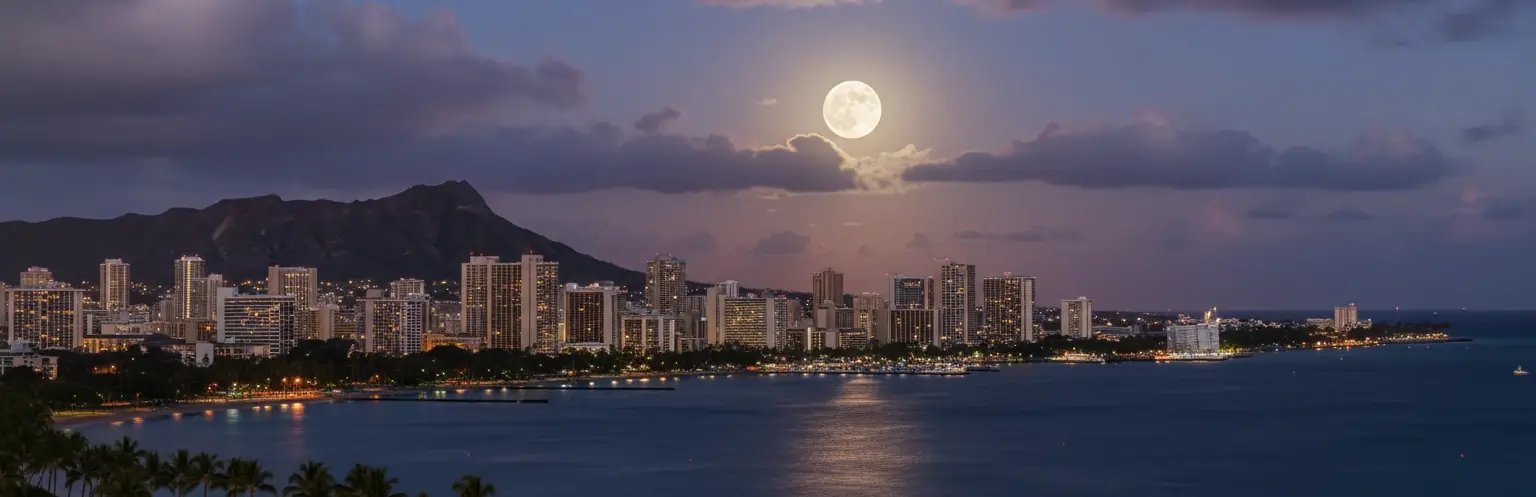
Honolulu sits at 21° North on the southeastern shore of Oʻahu, the most photographically distinctive city in the United States — a tropical skyline backed by the Ko'olau Mountains, fronted by the Pacific Ocean, and anchored to the east by Diamond Head, the 760-foot tuff cone that is the most recognisable natural landmark in Hawaii. The moon rises over open ocean from almost every vantage point in the city, and at this latitude it climbs steeply and quickly rather than the low, lingering arcs of higher-latitude cities. Honolulu also has something no continental American city has: no daylight saving time, which means moonrise times stay consistent relative to sunset throughout the year and planning is simpler. The ocean reflections at Waikiki Beach, the panoramic crater rim of Diamond Head, and the elevated darkness of Tantalus give photographers three completely different moonrise experiences within thirty minutes of each other — all of them genuinely extraordinary, and all of them deeply specific to this island.
Diamond Head – Summit Trail
Diamond Head State Monument is the premier Honolulu moonrise viewpoint. The 1.6-mile round-trip trail climbs to the crater rim at approximately 760 feet with panoramic views across the Pacific, the Waikiki skyline, and the Ko'olau range behind. The moon rises over open ocean from the summit lookout — the crater walls create a natural amphitheatre and the 360° view allows for compositions in multiple directions. Entry $5 per person plus $10 per vehicle if driving; reserve timed entry online at gostateparks.hawaii.gov up to 30 days in advance — walk-up availability for non-residents is extremely limited. The park closes at 6 pm daily (last reservation at 4 pm), so moonrise photography from the summit is only viable in winter months when the moon rises before 6 pm — check moonrise times against park hours carefully before booking.
Tantalus Lookout – Puu Ualakaa State Park
Puu Ualakaa State Wayside on the Tantalus ridge sits at approximately 1,048 feet and gives a sweeping north-facing panorama across the entire Honolulu basin — Waikiki, Diamond Head, the downtown skyline, Pearl Harbor, and the Ko'olau Mountains all visible simultaneously. The moon rises over the city bowl with Waikiki's hotels and Diamond Head's silhouette below. Noticeably darker skies than any in-city spot. Drive-up access via Round Top Drive; a parking fee applies as of early 2026. Hours vary seasonally — approximately 7 am to 6:45 pm in winter and 7 am to 7:45 pm in summer; the gate locks at closing, so check current hours on the DLNR website before visiting.
Makapuu Point Lighthouse Trail
The Makapuu Point Lighthouse Trail on the southeastern tip of Oʻahu is a 2-mile paved out-and-back path along dramatic sea cliffs that ends at a lookout above the 1909 lighthouse. The moon rises directly out of the Pacific from this exposed eastern headland — no buildings, no city glow, just open ocean horizon and the lighthouse below. One of the most dramatic moonrise compositions in Hawaii. Free; the trail is open during daylight hours. Check DLNR for current access as hours and conditions can change.
Waikiki Beach – Duke Kahanamoku Statue
The iconic beachfront of Waikiki Beach near the Duke Kahanamoku statue gives ground-level access to the most recognisable moonrise in Hawaii — the moon rising over open ocean with Diamond Head's silhouette to the southeast and the lights of the Waikiki hotels behind you. At low tide the wet sand reflects the moon in a long bright line toward the horizon. The most accessible and vibrant spot on this list; active and well-lit at any hour. Free, open 24/7; the beach is a short walk from almost any Waikiki hotel.
Magic Island – Ala Moana Beach Park
The Magic Island peninsula at Ala Moana Beach Park juts into the ocean west of Waikiki and gives a wide, lagoon-sheltered view toward the east with the moon rising over the harbor and the Waikiki skyline. The calm lagoon water produces strong reflections on still evenings; palm trees and sailboat masts add tropical foreground. Less crowded than Waikiki Beach and slightly darker. Free, open daily; accessible from Ala Moana Boulevard with plentiful parking.
Lanikai Pillbox Hike – First Pillbox
The Lanikai Pillbox Trail on the windward side of Oʻahu is a steep 30-minute hike to two World War II observation posts above the town of Lanikai. From the first pillbox the moon rises over the Mokulua Islands — two small offshore islets — with the deep blue of Kailua Bay below and the distant Honolulu glow faintly visible to the west. The darkest skies of any spot on this list; the view is genuinely remote-feeling despite being accessible from a residential street. Free; parking in the Lanikai neighbourhood is limited — arrive early or use ride-share.
◉ Best Times for Moon Photography
📷 Quick Photography Tips
Honolulu operates on HST (UTC−10) year-round — Hawaii does not observe daylight saving time, making it one of only two US states that stays on standard time all year. This means moonrise times in Honolulu shift more gradually across the seasons than in mainland cities that change clocks, and apps like PhotoPills or Stellarium set to Honolulu will always reflect the correct offset without seasonal adjustment.
For the moon phase in any other city worldwide, visit our Dynamic Moon Phase Calculator for instant lunar data tailored to wherever you are.
The moon phase today in Honolulu, HI is shown in detail above — complete with exact illumination percentage, moonrise/set times, and the best local spots to see it. For the moon phase today in any other city or location worldwide, visit our Dynamic Moon Phase Calculator on the home page.
◐ What the Experience Actually Feels Like
There is a particular quality to moonrise in Honolulu that has no equivalent anywhere in the continental United States. You stand on Waikiki Beach at dusk — the water warm, the trade winds steady, Diamond Head's silhouette darkening against the eastern sky — and then the moon comes up out of the Pacific. Not from behind buildings. Not from behind mountains. From the ocean itself, enormous and orange at the horizon, and the wet sand at your feet catches it in a line of reflected light that runs from the waterline to the horizon. The hotels behind you go dark against the sky. Diamond Head goes black to the southeast. And the Pacific, which stretches 2,400 miles to the nearest landmass, becomes a single flat mirror.
Honolulu at 21 degrees north gives the moon an arc that most photographers have never experienced. This close to the tropics, the full moon in summer rides nearly overhead — not the shallow, photogenic arc of Boston or Chicago, but almost directly above, which is less useful for photography but completely disorienting in the best way. In winter the arc drops to something more useful and the moon rises and sets at angles that work well against Diamond Head and the Waikiki skyline. The trade winds keep the air clear for most of the year; the humidity that blurs moonrises in tropical cities elsewhere rarely lingers in Honolulu the way it does in, say, Miami or New Orleans. The result is a moonrise that is almost always sharp, warm-coloured at the horizon, and rapid — at 21 degrees north the moon climbs quickly from the waterline.
What Honolulu has that no continental city can offer is Diamond Head. The tuff cone — formed roughly 300,000 years ago in a single brief volcanic eruption — rises directly from the ocean shelf on the eastern edge of Waikiki, and its silhouette against a moonrise sky is immediately, unmistakably Hawaiian. From the crater rim trail the view works in both directions: the moon rising over the open Pacific to the east, the city and the Ko'olau range spread below to the west, and the crater walls curving away on both sides. It is one of those places that makes you feel very specifically located on the planet — not just somewhere tropical, but precisely here, on this island, at this latitude, at this exact moment in the lunar cycle.
"The moon comes up out of the Pacific itself, and the wet sand catches it in a line of reflected light that runs from the waterline all the way to the horizon."
✓ Your Honolulu Moon Chase Checklist
Before You Go
- Book Diamond Head timed entry tickets online at gostateparks.hawaii.gov up to 30 days in advance — the park closes at 6 pm (last entry 4 pm), so moonrise shots from the summit are only viable in winter when the moon rises before closing time
- Check current Puu Ualakaa State Wayside hours before visiting — the gate closes at a set time that varies seasonally, and the road is gated; arriving after close means no access
- Check the tide chart for Waikiki Beach — low tide exposes a wider wet-sand mirror and produces the signature long reflection line; high tide reduces the reflective surface significantly
- Use PhotoPills or Stellarium set to Honolulu to find dates when the moon rises aligned with Diamond Head's silhouette from Waikiki — the geometry shifts monthly
- Target the 48–72 hour window before full moon — the moon rises during the blue hour when the sky over the Pacific still holds colour and Diamond Head's silhouette is most defined
What to Bring
- Sturdy tripod — trade winds are persistent and consistent along all exposed coastal positions; even at Waikiki a light tripod will vibrate enough to blur longer exposures
- A lens between 100–200mm for Diamond Head compression shots from Waikiki — the distance along the beach to Diamond Head rewards longer glass for silhouette compositions
- Reef-safe sunscreen and insect repellent — evening sessions at beach locations and the Lanikai pillbox trail involve both sun exposure at dusk and mosquitoes in the vegetation
- Proper footwear for Diamond Head and the Lanikai pillbox — Diamond Head's summit trail has uneven volcanic rock and steep stairs; the Lanikai hike is steep dirt with loose sections
- A wide-angle lens for Waikiki Beach — the wet-sand reflection at low tide and the full curve of the bay work best at wider focal lengths for the horizontal composition
- Water — Diamond Head's trail is exposed and dry; the crater stairs are demanding even in the late afternoon, and hydration is essential especially in summer
On the Night
- Arrive at Waikiki Beach 30–45 minutes before moonrise — the sky over the Pacific transitions through a vivid amber-to-coral-to-blue gradient as the moon approaches the horizon; Diamond Head's silhouette darkens progressively and is most defined in the final minutes before moonrise
- At Waikiki, position yourself near the Duke Kahanamoku statue for the best angle on Diamond Head's silhouette to the southeast — moving east or west along the beach shifts the relationship between the two
- Shoot RAW — the dynamic range between a bright full moon rising over dark ocean, the lit hotel skyline behind you, and the wet sand reflection requires careful exposure management in post
- Stay 15–20 minutes after moonrise — the moon climbs steeply at this latitude and its colour shifts quickly from deep orange to gold to white; each phase is worth shooting
- At the Lanikai pillbox, arrive before sunset to hike up in daylight — the trail is steep and the descent in full dark is genuinely hazardous without a headlamp; plan your exit carefully
Moon Phase Today Honolulu
