
Moon Phase Today Dublin
On Friday, October 9, 2026, the moon in Dublin is a New Moon with 0% illumination. Moon age: 28.9 days.
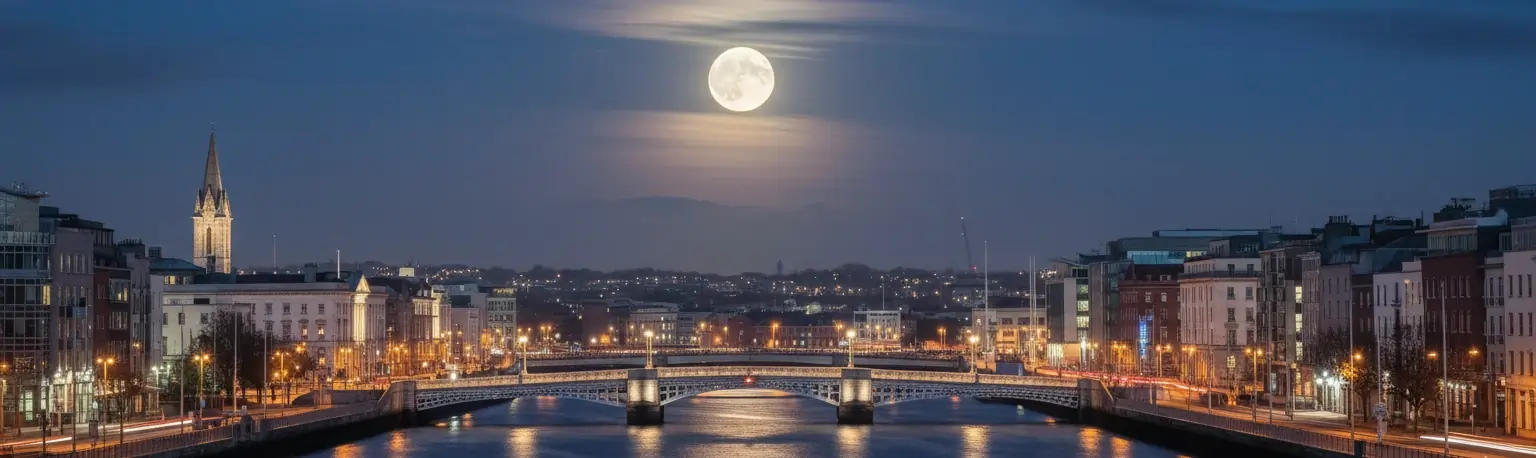
☽ Best Places to View the Moon in Dublin
Dublin’s low skyline, historic bridges, and coastal position create charming moonrises with perfect reflections over the River Liffey. The city rewards photographers who understand its geography: the river is often your foreground and your mirror, and the bay provides vast, unobstructed horizons. Depending on the season, the moon can rise to align directly behind key landmarks like the Samuel Beckett Bridge or the Poolbeg Chimneys — use PhotoPills to plan the exact alignment for your chosen date. All spots are free and accessible 24/7 unless otherwise noted.
Samuel Beckett Bridge
The premier modern Dublin moonrise icon. The moon rises dead-centre behind the harp-shaped cable-stayed bridge, with the Convention Centre cylinder glowing nearby. Liffey reflections are often mirror-perfect, offering stunning symmetry on many dates. Best visited on or around the full moon when maximum brightness makes the bridge pop against the open sky. Ideal for wide-angle and mid-telephoto compositions.
Poolbeg Chimneys / Great South Wall (Pigeon House)
A classic industrial-coastal view. Walk the 2 km sea wall to the end; the moon rises straight out of Dublin Bay behind the red-and-white striped chimneys and distant city lights. This is the darkest accessible spot with zero obstruction, offering dramatic compositions, especially with a telephoto lens to compress the chimneys and the moon. Accessible year-round, but dress warmly as the sea wall can be very exposed to wind.
Custom House Quay / Liffey Boardwalk
A wide riverfront with the moon rising behind the neoclassical Custom House dome and the historic Jeanie Johnston ship. Reflections in the Liffey multiply the lights, creating a vibrant scene. This location offers easy central access and is excellent for capturing the moon alongside Dublin's historic architecture and river activity. Best visited around high tide for optimal reflections.
Sandymount Strand (low tide)
A vast tidal beach with the moon rising over Dublin Bay and the Poolbeg chimneys often perfectly aligned. Low tide provides a huge wet-sand mirror effect, creating incredible opportunities for reflections and telephoto compression magic, making the moon appear enormous over the distant skyline. This spot requires planning around tide times for the best results. Free, open daily.
North Bull Wall / Dollymount Strand
The northern counterpart to the Great South Wall. The moon rises over the water with the Howth Head silhouette and a faint city glow. The wooden bridge and lighthouse add unique foreground elements, and the skies here are very dark, allowing for clearer lunar detail. Accessible via the wooden bridge, this spot offers a more serene and natural moonrise experience away from the city centre.
Memorial Bridge / Tom Clarke Bridge (East Link)
An elevated viewpoint offering a panoramic perspective of the docks and the Liffey estuary. The moon rises behind the distant city skyline and the prominent Poolbeg stacks, providing great opportunities for both drive-by shots and parked long exposures. This toll bridge offers a unique, slightly industrial perspective on Dublin's moonrise. Check for pedestrian access restrictions if planning to walk across.
◉ Best Times for Moon Photography
📷 Quick Photography Tips
Dublin operates on GMT (UTC+0) in winter and IST (UTC+1) during daylight saving time. Clocks go forward on the last Sunday in March and back on the last Sunday in October. Apps like PhotoPills or Stellarium set to Dublin handle the offset automatically — moonrise times shift by several minutes daily, and planning exact alignments with the city's landmarks requires precise local time.
For the moon phase in any other city worldwide, visit our Dynamic Moon Phase Calculator for instant lunar data tailored to wherever you are.
The moon phase today in Dublin is shown in detail above — complete with exact illumination percentage, moonrise/set times, and the best local spots to see it. For the moon phase today in any other city or location worldwide, visit our Dynamic Moon Phase Calculator on the home page.
◐ What the Experience Actually Feels Feels Like
There is a particular magic to a Dublin moonrise that is unique to this coastal capital. Imagine standing on the Liffey Boardwalk, the air crisp and damp, with the warm glow of streetlights reflecting on the water. As the blue hour deepens, the neoclassical Custom House begins to darken, and then, a luminous orb appears over the eastern horizon, perfectly framing itself behind the elegant arch of the Samuel Beckett Bridge. For a few minutes, everything aligns: the historic city, the modern architecture, the flowing river, and the moon, a silent spectator to Dublin’s timeless charm.
Dublin’s low, expansive skyline and direct access to Dublin Bay mean you are often looking across vast stretches of water. From the Great South Wall, you gaze eastward over the Irish Sea, the iconic red-and-white Poolbeg Chimneys standing as sentinels against the horizon. The moon emerges directly from the bay, creating a stark, dramatic contrast against the industrial backdrop. From Sandymount Strand at low tide, the sheer expanse of wet sand transforms the bay into a colossal mirror, doubling the moon and the distant city lights in an ethereal display. The geometry here is often flat and wide, inviting compositions that embrace the expansive Irish sky and sea.
Winter is when Dublin truly shines for moon photography. November to February brings crisper, clearer skies, and the moon's path swings more southerly, allowing for tighter alignments with the city's bridges and the Poolbeg Chimneys. The cold, clear air enhances lunar details and creates striking contrasts with the city's warm lights. Autumn offers a chance for dramatic skies, though coastal fog can sometimes roll in, adding a mysterious atmosphere. Spring brings softer light, while summer offers longer evenings and a moonrise that slowly unfolds against a sky that retains its colour well into the night.
"As the blue hour deepens, the neoclassical Custom House begins to darken, and then, a luminous orb appears over the eastern horizon, perfectly framing itself behind the elegant arch of the Samuel Beckett Bridge."
✓ Your Dublin Moon Chase Checklist
Before You Go
- Check the moonrise time and phase on this page — the moon's alignment with Dublin landmarks is seasonal and requires planning for specific shots
- Use PhotoPills to verify whether the moon will rise near the Samuel Beckett Bridge or Poolbeg Chimneys on your chosen date
- Target the 48–72 hour window before full moon if possible — the moon rises during civil twilight, bathing the city in a soft, balanced light
- Check tide times for optimal conditions at Sandymount Strand (low tide for reflections) or the Liffey (high tide for deeper reflections)
- Scout your chosen location during the day — parking, access points, and potential obstructions are key, especially along the Liffey and at the bay walls
What to Bring
- Sturdy tripod — the constant coastal wind, especially on the Great South Wall and North Bull Wall, necessitates a stable setup for long exposures
- A lens between 200–300mm for tight compression shots — the Poolbeg Chimneys and the Samuel Beckett Bridge frame well at this range from various points
- Layers, waterproofs, and warm clothing — Dublin weather can be unpredictable, and waiting for moonrise by the coast in winter is colder than it sounds
- A wide-angle lens for the Liffey Boardwalk or Custom House Quay — the river, bridges, and architecture reward a 16–35mm range for environmental compositions
- Lens cloth and a sturdy rain cover — coastal humidity and unexpected showers can quickly affect your gear
- A headlamp or flashlight for the sea walls and strands — these areas are unlit and require illumination for safe navigation after dark
On the Night
- Arrive at your viewpoint 30–45 minutes before moonrise — the eastern horizon over Dublin Bay creates a beautiful glow before the moon appears
- At the Samuel Beckett Bridge, position yourself to frame the bridge's harp-like structure and its reflection in the Liffey
- Shoot RAW — the dynamic range between a bright full moon, the city lights, and the dark water requires careful exposure blending in post-production
- Stay 20–30 minutes after moonrise — as the moon climbs, the compositions shift, and the river/bay reflections become more defined
- Watch for dramatic cloud formations — the Irish sky is known for its ever-changing character, which can add immense drama to your moonrise shots
? Dublin Moon Phase — Frequently Asked Questions
Q. What is the moon phase today in Dublin?
The moon phase today in Dublin is a New Moon with 0% illumination. The next full moon is in 17 days, on Oct 26. Moonrise is at 6:19 AM and moonset at 6:06 PM.
Q. Where is the best place to view the moon in Dublin?
The Samuel Beckett Bridge is Dublin's signature moonrise spot, with the moon often rising dead-centre behind the harp-shaped cable-stayed bridge and reflecting in the Liffey. The Great South Wall out to the Poolbeg Chimneys offers the darkest, most unobstructed view straight out over Dublin Bay, and Sandymount Strand at low tide creates a vast wet-sand mirror with the same chimneys often aligned in the distance.
Q. Why does moon visibility change so much in Dublin through the year?
Dublin's low, flat skyline and open bay keep most viewpoints usable year-round, so the moon's path and the weather do the rest: November through February brings a more southerly moon path for tighter alignments with the bridges and chimneys, along with crisper, clearer winter air.
Q. Does Dublin observe daylight saving time?
Yes. Dublin runs on GMT (UTC+0) in winter and switches to Irish Standard Time (IST, UTC+1) from the last Sunday in March to the last Sunday in October. The times shown on this page are already adjusted for whichever period applies today.
Q. What's the best time of year for moon photography in Dublin?
November through February brings the clearest air and the tightest alignments between the moon and landmarks like the Samuel Beckett Bridge and Poolbeg Chimneys. Whatever the season, check the tide times before heading out — high tide suits the Liffey's reflections, low tide suits Sandymount Strand's wet-sand mirror.
Q. Does this page work for cities besides Dublin?
This page is set up specifically for Dublin, Ireland. For the moon phase in any other city or location worldwide, use the Dynamic Moon Phase Calculator on the moonphase.today home page.
✦ Explore Further
Moon Photography Guide
Camera settings, lenses, and techniques for shooting sharp, well-exposed moon shots.
📐Looney 11 Exposure Calculator
Dial in the exact f-stop, ISO, and shutter speed for a full moon — the same rule used in our Samuel Beckett Bridge tips.
🌆Blue Hour Calculator
Find tonight's exact blue hour window to time your Liffey-side moonrise shots.
🌍World Moon Phase Directory
Browse the moon phase today in hundreds of other cities and locations around the world.
NASA Moon Phase & Libration Gallery
NASA's Scientific Visualization Studio's daily renders of the moon's exact phase, libration, and orientation, straight from official mission data.