
Moon Phase Today Des Moines
On Friday, October 9, 2026, the moon in Des Moines is a New Moon with 0% illumination. Moon age: 28.9 days.
☽ Best Places to View the Moon in Des Moines
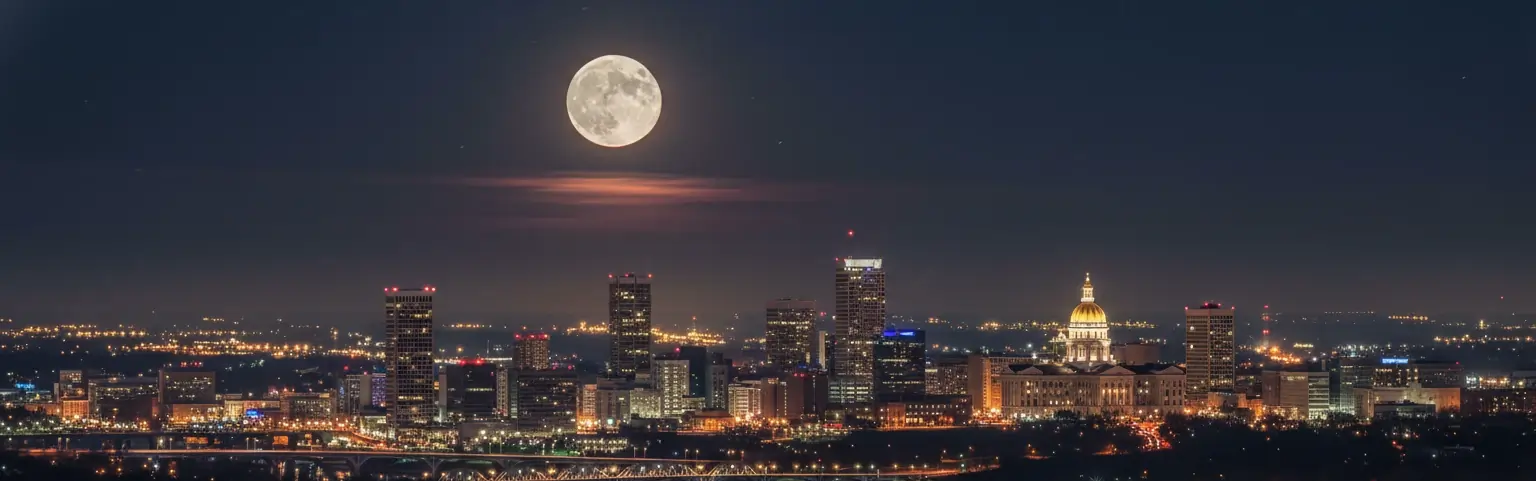
Des Moines sits on the rolling Iowa prairie at the confluence of the Des Moines River and the Raccoon River, and both waterways shape its best moonrise compositions. The city is flat by the standards of most American skyline cities, which means reflections are reliable and foregrounds are wide — but it also means that the elevated positions that do exist, like the bluffs at MacRae Park, are genuinely valuable. The skyline is anchored by 801 Grand — the tallest building in Iowa at 630 feet, topped by a distinctive eight-sided copper pyramid — and the rust-coloured Ruan Center. A few blocks east, the Iowa State Capitol's gold dome adds a second iconic silhouette to the eastern horizon that no other Iowa city can offer. On the right evenings — calm air, low wind, a full moon clearing the horizon — Des Moines produces moonrise photographs that consistently surprise people who expect less from the Iowa capital.
Pappajohn Sculpture Park – Western Gateway Park
The premier Des Moines moonrise viewpoint. Pappajohn Sculpture Park — formally part of Western Gateway Park — occupies open lawns just west of downtown, giving an unobstructed eastern view of the full skyline: 801 Grand's copper-tipped pyramid, the Ruan Center's rust-toned tower, and the cluster of buildings behind them. The modern sculptures scattered across the lawn add distinctive foreground elements that no other skyline viewpoint can offer. Lit pathways make evening access easy. Free, open 24/7; accessible from Grand Avenue at 15th Street.
Gray's Lake Park – Kruidenier Trail Bridge
Gray's Lake Park sits just southwest of downtown and its lighted pedestrian bridge over the lake gives one of the most photogenic water-reflection compositions in the city. On calm evenings the lake surface mirrors both the moonrise and the distant skyline in the frame below the bridge structure. The Kruidenier Trail loops the lake and offers multiple angles for wide-angle shots with open water foreground. Free, open 24/7; the bridge is lit at night making it accessible and safe for late sessions.
MacRae Park – EMC Overlook
MacRae Park, on a bluff south of downtown, is home to the EMC Overlook — a 96-foot-long triangular viewing platform cantilevered 40 feet over the hillside, with LED lighting at night. The platform looks north directly at the Des Moines skyline, the Iowa State Capitol's gold dome, and the Raccoon River below. It includes a telescope viewing area and informational signs identifying skyline features. One of the finest free elevated views in the city. Free, open daily 6am–10pm; parking on site.
Principal Park – Outfield & Riverwalk
Principal Park, the Iowa Cubs' minor league stadium, sits on the west bank of the Des Moines River with the skyline rising directly to the east. From the outfield and the adjacent riverwalk, the moon rises behind the downtown towers with the river below — on calm evenings the water reflects both the city lights and the moon in a long vertical streak. Non-game nights are quiet and the riverwalk is fully accessible. Free access to the riverwalk 24/7; outfield access varies by event schedule.
Water Works Park – Elevated Trails & Arboretum
Water Works Park covers over 1,500 acres along the Raccoon River west of downtown and its elevated trail network gives open views across the river valley toward the skyline. The Arie den Boer Arboretum section offers tree-framed compositions that sit between the natural and the urban — mature trees as foreground silhouettes against the lit city beyond the river. A quieter, more naturalistic alternative to the lakefront and sculpture park viewpoints. Free, open 24/7.
Union Park – Heritage Carousel Area
Union Park on the north side of Des Moines offers elevated ground with open southern views toward the city core. The historic Heritage Carousel and the park's vintage rocket slide add genuinely whimsical foreground architecture — a mid-century amusement park aesthetic silhouetted against the modern skyline behind — that is unique in Des Moines moon photography. A quieter alternative with a different compositional register from the sculpture park or lakefront positions. Free, open 24/7.
◉ Best Times for Moon Photography
📷 Quick Photography Tips
Des Moines operates on CST (UTC−6) in winter and CDT (UTC−5) during daylight saving time. Clocks go forward on the second Sunday in March and back on the first Sunday in November. Iowa observes DST statewide. Apps like PhotoPills or Stellarium set to Des Moines apply the correct local offset automatically — useful for timing exact moonrise alignments with the 801 Grand pyramid and the Iowa State Capitol dome across the seasons.
For the moon phase in any other city worldwide, visit our Dynamic Moon Phase Calculator on our home page for instant lunar data tailored to wherever you are.
The moon phase today in Des Moines, IA is shown in detail above — complete with exact illumination percentage, moonrise/set times, and the best local spots to see it. For the moon phase today in any other city or location worldwide, visit our Moon Phase Calendar on the home page.
◐ What the Experience Actually Feels Like
There is a particular quality to a moonrise in Des Moines that people from larger cities do not expect. You are standing in Pappajohn Sculpture Park with the lawns open around you and the Brancusi-inspired forms casting soft shadows across the grass, and the skyline is right there — not half a mile away, not across a wide river, but close enough that 801 Grand's copper pyramid is clearly legible above the tree line. And then the moon clears the eastern horizon behind the Capitol's gold dome and rises above the towers, and what you realise is that Des Moines at this moment looks genuinely remarkable. The scale is intimate. The sky is enormous. The Iowa prairie dark is darker than city dark, and from the sculpture park you can see both in the same frame.
Gray's Lake changes the experience entirely. The lake sits just far enough from downtown that the reflections are long and clean, and on a still October evening the water holds the moon and the distant skyline in a mirror below your feet that doubles the composition — city above, city below, the lighted bridge spanning both. It is the kind of photograph that requires no particular skill to see: you arrive, you look down, and the shot is already there. What requires skill is timing the wind, and in Des Moines the wind is the variable that experienced photographers learn to plan around. Calm evenings are less common than gusty ones, and the difference between a perfect reflection and a broken surface is a matter of waiting.
MacRae Park, on its bluff south of downtown, offers the view that surprises people most. The park is old and quiet and wooded and the EMC Overlook extends out over the hillside above the Raccoon River flood plain — 96 feet of triangular platform cantilevered into the air, with the downtown skyline and the Capitol dome directly in front of you and the river valley below. It is one of those views that makes a mid-sized Midwestern city feel much larger than its population suggests, and on a clear full-moon evening with the LED platform lights off and the moon tracking above the copper pyramid, it is worth the short drive south.
"The moon clears the eastern horizon behind the Capitol's gold dome and rises above the towers — and what you realise is that Des Moines at this moment looks genuinely remarkable. The scale is intimate. The sky is enormous."
✓ Your Des Moines Moon Chase Checklist
Before You Go
- Check the moonrise time and phase on this page — the moon's alignment with 801 Grand's copper pyramid from Pappajohn Sculpture Park is seasonal; use PhotoPills to find the specific date when the moon rises centred on the building
- Target the 48–72 hour window before full moon if possible — the moon rises during civil twilight and the warm Iowa sky gives the skyline its most atmospheric colour before full dark
- Check wind conditions before heading to Gray's Lake or the Des Moines River riverwalk — calm evenings only produce mirror reflections; even a light breeze will break the lake surface
- Note MacRae Park hours (6am–10pm daily) — the park closes in the evening, which limits access for late moonrise shoots; the EMC Overlook is best visited before 10pm
- For Principal Park riverwalk access on game nights, check the Iowa Cubs schedule in advance — the riverwalk is accessible regardless but crowds near the stadium affect parking and access routes
What to Bring
- Sturdy tripod — open Iowa plains wind is persistent even on seemingly calm evenings; the Pappajohn lawns and the MacRae bluff overlook are particularly exposed and a lightweight tripod will vibrate in moderate gusts
- A lens between 200–400mm for tight compositions — compressing the moon against 801 Grand's copper pyramid or the Capitol dome from Pappajohn or MacRae requires significant focal length
- A wide-angle lens (16–24mm) for Gray's Lake and the sculpture park — the open water foreground and the sculpture lawn reward environmental compositions that include both the foreground and the full skyline
- Layers from October through March — Des Moines winter evenings are cold and damp, and the exposed positions at Pappajohn and MacRae have no windbreaks to shelter a long moonrise session
- Insect repellent from May through September — Gray's Lake and Water Works Park are particularly buggy on warm, calm evenings, and a still night that's perfect for reflections is also perfect for mosquitoes
- A headlamp for Water Works Park — the elevated trail sections away from the main paths are unlit and the return after moonrise in the dark needs a light
On the Night
- Arrive at Pappajohn Sculpture Park 30–45 minutes before moonrise — the eastern sky above the skyline warms to amber before the moon clears the horizon, and the sculptures catch that pre-moonrise glow in ways that full dark does not reproduce
- At Gray's Lake, position yourself on the lighted bridge for the most dynamic foreground — the bridge structure frames both the lake reflection below and the distant skyline above in a single layered composition
- Shoot RAW throughout — the combination of the bright moon, 801 Grand's lit pyramid, the Capitol dome, and the dark water or lawn foreground requires separate exposures carefully blended in post
- Stay 20–30 minutes after moonrise — as the moon climbs above the horizon haze it sharpens and brightens, and the reflections on still water become more defined and more luminous
- At MacRae, note that the platform LED lights can create unwanted reflections on your lens — position yourself toward the outer edge of the platform or use a lens hood to minimise interference from the platform lighting
? Des Moines Moon Phase — Frequently Asked Questions
Q. What is the moon phase in Des Moines, IA today?
The moon phase today in Des Moines is a New Moon with 0% illumination (moon age: 28.9 days). You can see the exact moonrise, moonset, and calendar in the widget at the top of this page. Des Moines' coordinates (41.5868° N, 93.6250° W) and its Central Time zone are already factored in, so the phase and times shown are accurate for the city without any adjustment needed.
Q. What time does the moon rise and set in Des Moines today?
Moonrise and moonset both change daily and are calculated live for Des Moines in the info grid above. Tap any date on the calendar to see the phase and rise/set times for that specific day.
Q. Where is the best place to view the moon in Des Moines?
Pappajohn Sculpture Park is Des Moines' signature moonrise spot, looking east at the full skyline with the sculpture lawn as foreground. Gray's Lake Park gives a still-water skyline reflection, MacRae Park's cantilevered EMC Overlook offers an elevated bluff view of downtown and the Capitol dome, and Principal Park's riverwalk and Water Works Park's trails give quieter alternatives along the rivers.
Q. Why does moon visibility change so much in Des Moines through the year?
Des Moines sits at roughly 41.6° N, high enough in latitude that the moon's path across the sky shifts noticeably with the seasons, riding higher and more southerly in winter. Add to that Iowa's weather swing: humid summer air softens and hazes the moon low on the horizon, while the drier, clearer air from October through March gives much sharper views over the skyline.
Q. When is the next full moon in Des Moines?
The date of the next full moon is calculated live and shown in the "Next Full Moon" card above, already adjusted for Des Moines' time zone.
Q. Does Des Moines observe daylight saving time?
Yes. Des Moines runs on Central Standard Time (CST, UTC−6) in winter and switches to Central Daylight Time (CDT, UTC−5) from the second Sunday in March to the first Sunday in November. All times shown on this page already account for the correct offset.
Q. What's the best time of year for moon photography in Des Moines?
October through March offers the clearest air and the most southerly moon path, giving the tightest alignments with 801 Grand's copper pyramid and the Capitol dome. September and October add mild temperatures and low humidity on top of that clarity, while summer's warmth and moisture tend to haze the moon near the horizon.
Q. Does this page work for cities besides Des Moines?
This page is set up specifically for Des Moines, IA. For the moon phase in any other city or location worldwide, use the Dynamic Moon Phase Calculator on the moonphase.today home page.
✦ Explore Further
Moon Phase Today: Chicago
Check tonight's moon phase in Chicago, about 330 miles east along I-80.
📷Moon Photography Guide
Camera settings, lenses, and techniques for shooting sharp, well-exposed moon shots.
📐Looney 11 Exposure Calculator
Dial in the exact f-stop, ISO, and shutter speed for a full moon — the same rule used in our Des Moines skyline tips.
🌆Blue Hour Calculator
Find tonight's exact blue hour window to time golden and blue-hour moonrise shots over the skyline.
NASA Moon Phase & Libration Gallery
NASA's Scientific Visualization Studio's daily renders of the moon's exact phase, libration, and orientation, straight from official mission data.