
Moon Phase Today Chicago
Tonight in Chicago, Illinois, the moon is a Waxing Crescent at 20% illumination — day 4.3 of the 29.5-day lunar cycle. The next full moon is in 11 days on Sep 26. Moonrise: 11:35 AM · Moonset: 9:00 PM
☽ Best Places to View the Moon in Chicago
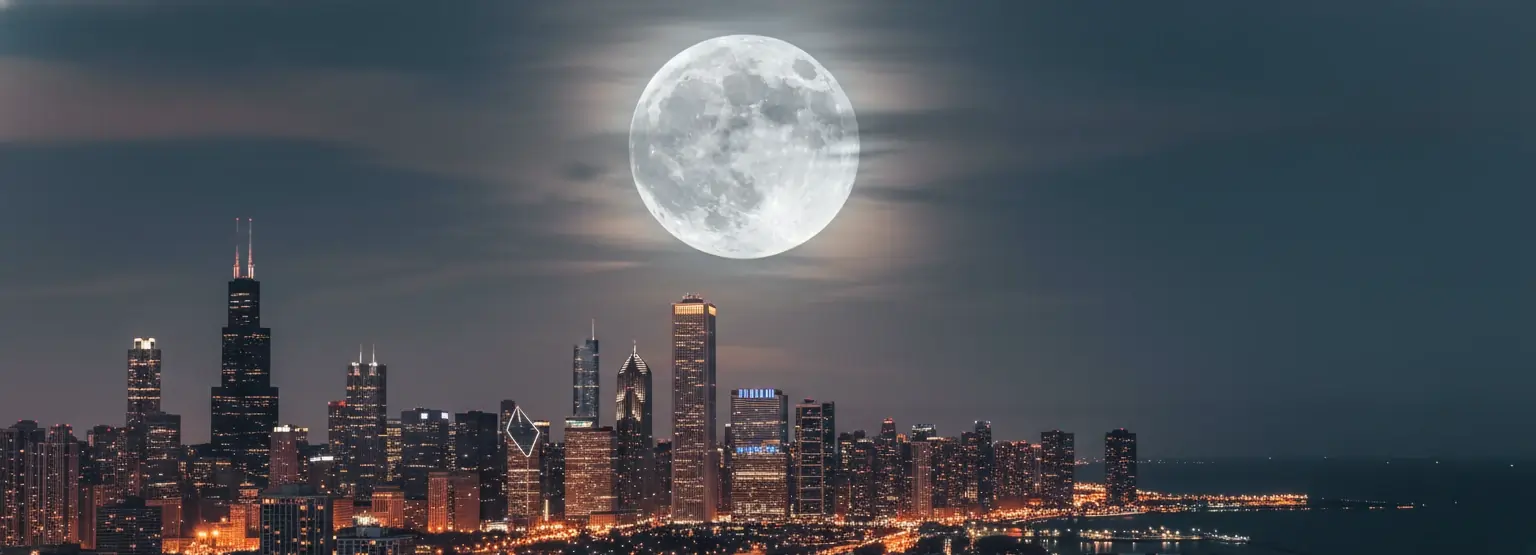
Chicago sits at 41° North on the southwestern shore of Lake Michigan, one of the largest freshwater lakes on earth, with a skyline — Willis Tower, the John Hancock Center, and dozens of mid-century towers — rising directly from the lakefront. It is one of the most photographically extraordinary cities in North America for moonrise: the moon climbs out of the water to the east and tracks directly above the illuminated skyline before setting over the flat prairie to the west. The lake itself acts as a mirror on calm nights, doubling the city and the moon in the same frame. Chicago rewards the photographer who understands the geometry — the moon aligns with specific towers on specific dates, and those alignments are worth planning for.
Adler Planetarium Steps & Promenade
The Adler Planetarium promenade at Museum Campus is the premier Chicago moonrise viewpoint. It offers an unobstructed horizon over Lake Michigan with the entire downtown skyline behind it — Willis Tower, the Hancock Building, and the John Hancock Center all align on many dates as the moon rises dead-centre over the water. The east-facing steps give mirror-perfect lake reflections on calm nights. Free, open 24/7; the wide promenade gives multiple compositions without moving far from the parking area.
Navy Pier – Polk Bros Park & Pier End
Polk Bros Park at the base of Navy Pier and the open end of the pier itself both offer wide lakefront views with the moon rising over the water and silhouetting the full skyline to the south. The Ferris wheel's neon lights add foreground drama on clear nights; reflections are mirror-perfect when the lake is calm. Very popular on full moons; the pier stays open late. Accessible via Red Line to Grand and a short walk west.
Montrose Harbor & Beach
Montrose Harbor on the North Side is a quieter alternative with a completely clear eastern horizon over the lake. The moon rises over open water with the distant downtown skyline visible to the south — telephoto shots compress the moon against the skyline with sailboat masts and harbor lights as foreground. Darker skies than downtown give better contrast. Less crowded than the Museum Campus even on full moon nights; accessible by Montrose bus or by car.
Promontory Point – Hyde Park
Promontory Point is a peninsula in Hyde Park that juts into Lake Michigan and gives a 180° panoramic view from the south side. The moon rises over the entire downtown skyline from this grassy overlook — the perspective from the south compresses the towers differently than the Museum Campus view, and the grassy lakefront foreground gives space for wide-angle compositions with the water in the frame. Accessible via Metra Electric Line to 55th–56th–57th Street.
Maggie Daley Park – South End & Play Garden
Maggie Daley Park offers elevated paths above Grant Park looking southwest toward the skyline and Millennium Park. The moon rises behind the towers with the Bean and surrounding park lights reflecting below — an urban context unlike the open lakefront shots, with the built environment as the foreground rather than the water. Family-friendly and lit at night; best for the photographer who wants the city itself in the frame rather than the lake. Nearest: Millennium Park entrance on Michigan Avenue.
North Avenue Beach Pier
North Avenue Beach extends a short pier into the lake that gives an open eastern horizon with the full skyline stretching south — the Hancock Building's illuminated crown is a strong visual anchor from this angle. Sandy foreground at the waterline allows for creative low-angle compositions with the moon rising large over the water. Accessible from the Red Line at Fullerton and a walk east through Lincoln Park; breezy but accessible year-round.
◉ Best Times for Moon Photography
📷 Quick Photography Tips
Chicago operates on CST (UTC−6) in winter and CDT (UTC−5) during daylight saving time. Clocks go forward on the second Sunday in March and back on the first Sunday in November. Illinois observes DST statewide. Apps like PhotoPills, The Photographer's Ephemeris, or Stellarium set to Chicago handle the offset automatically — useful given how dramatically moonrise times shift across the seasons even at this mid-latitude.
For the moon phase in any other city worldwide, visit our Dynamic Moon Phase Calculator on our home page for instant lunar data tailored to wherever you are.
The moon phase today in Chicago, IL is shown in detail above — complete with exact illumination percentage, moonrise/set times, and the best local spots to see it. For the moon phase today in any other city or location worldwide, visit our Moon Phase Calendar on the home page.
◐ What the Experience Actually Feels Like
There is a particular quality to moonrise in Chicago that is hard to describe to someone who has not stood on the Adler Planetarium promenade on a calm October evening. The lake is dark and still. The skyline is lit — every tower from the Hancock to Willis throwing light upward into low clouds or outward over the water — and then the moon comes up out of the lake itself, huge and orange at the horizon, and for a few minutes the entire skyline is reflected twice: once in the glass of the towers and once in the water below you. It is one of the most photographically compressed urban scenes on earth, and it happens every month.
Chicago is at 41 degrees north, which is close enough to the equator to give the moon a high, sweeping arc across the sky for much of the year, but far enough north that in winter the full moon rides particularly high and aligns in specific ways with the downtown grid. The city was built on a strict north–south, east–west street plan, and that geometry is visible from the lakefront: the towers line up along specific axes, and on specific dates the moon rises dead-centre between or above specific buildings. Photographers who use tools like PhotoPills know these dates months in advance and plan their position accordingly. The alignment shots — moon over Willis Tower, moon rising behind the Bean — are not luck. They are geometry.
What Chicago has that most cities do not is the lake. Lake Michigan at the eastern edge of the city acts as a horizon that is absolutely flat, absolutely unobstructed, and absolutely reflective on calm nights. There is no coastal range, no distant hills, no development on the eastern shore — the moon rises out of open water over 100 miles wide, and at the moment it clears the horizon it is enormous, orange, and perfectly doubled in the reflection below. The wind off the lake is the only variable you cannot control. On calm nights the reflection is flawless. On breezy nights it fragments into streaks. Either way, the moon over Chicago is never dull.
"The moon comes up out of the lake itself, huge and orange at the horizon, and the entire skyline is reflected twice — once in the glass of the towers and once in the water below you."
✓ Your Chicago Moon Chase Checklist
Before You Go
- Check the moonrise time and phase on this page — the exact alignment with specific towers changes by date and requires planning, not guessing
- Target the 48–72 hour window before full moon if possible — the moon rises during blue hour when the skyline is still partially lit by the fading sun
- Check the Lake Michigan wind forecast — calm nights produce mirror-perfect reflections; even a light chop breaks the water reflection entirely
- Use PhotoPills or The Photographer's Ephemeris to identify dates when the moon aligns with Willis Tower or the Hancock Building — these are the iconic Chicago moonrise shots and they require specific positioning
- Confirm parking or transit options for Museum Campus and Navy Pier — both areas are congested on weekends and event nights
What to Bring
- Sturdy tripod — the lakefront is fully exposed to wind off the water, especially at Adler, Navy Pier, and North Avenue Beach
- A lens between 200–300mm for skyline compression shots from Adler and Promontory Point — the flat sight lines over the lake reward longer glass significantly
- Serious cold-weather layers in winter — Chicago's wind chill along the open lakefront drops well below 0°F, and long exposures require staying still in that wind for extended periods
- Spare camera batteries in a chest pocket — cold drains lithium batteries quickly, and a dead battery while the moon is still low and large over the lake is a particular frustration
- A wide-angle lens for foreground shots — the sandy beach at North Avenue and the paved promenade at Adler both offer strong foreground elements at low tide of the moon's arc
- A rain jacket in spring and autumn — lake weather changes quickly and a front moving in from the west can close out a clear evening with little warning
On the Night
- Arrive at your viewpoint 30–45 minutes before moonrise — the sky over the lake goes through a dramatic blue-to-orange gradient as the moon approaches the horizon
- At Adler, position yourself on the east-facing steps for the best reflection angle — the promenade widens here and gives room to adjust composition as the moon rises
- Shoot RAW — the dynamic range between a bright full moon, lit skyscrapers, and dark lake water requires separate exposures blended in post
- Stay 20–30 minutes after moonrise — as the moon climbs above the lowest haze layer its colour shifts from orange to white and the skyline compositions become cleaner and more graphic
- In winter, check whether the outer harbors have frozen — ice formations at the waterline create a foreground element that the summer lakefront cannot offer
? Chicago Moon Phase — Frequently Asked Questions
Q. What is the moon phase in Chicago, IL today?
The moon phase today in Chicago is a Waxing Crescent with 20% illumination (moon age: 4.3 days). You can see the exact moonrise, moonset, and calendar in the widget at the top of this page. Chicago's coordinates (41.8781° N, 87.6298° W) and its Central Time zone are already factored in, so the phase and times shown are accurate for the city without any adjustment needed.
Q. What time does the moon rise and set in Chicago today?
Moonrise and moonset both change daily and are calculated live for Chicago in the info panel above. Tap any date on the calendar to see the phase and moonrise/moonset times for that specific day.
Q. Where is the best place to view the moon in Chicago?
The Adler Planetarium promenade at Museum Campus is the standout spot — it has a wide-open horizon over Lake Michigan with the downtown skyline directly behind you, and the moon often rises dead-centre over the water. Navy Pier and North Avenue Beach give a similar open-lake view, while Promontory Point in Hyde Park offers a quieter, wider panorama from the south.
Q. Why does the moon look so huge rising over Lake Michigan?
Lake Michigan gives Chicago a genuinely flat, unobstructed horizon stretching over 100 miles east with nothing to break the sight line. Combined with the moon illusion — an optical effect that makes the moon appear larger near the horizon than it actually is — a moonrise over open water like this looks especially dramatic, and on calm nights the lake surface doubles the effect with a mirror-like reflection.
Q. When is the next full moon in Chicago?
The date of the next full moon is calculated live and shown in the "Next Full Moon" card above. For a full breakdown of upcoming full moons and their traditional names, see our next full moon guide.
Q. Does Chicago observe daylight saving time?
Yes. Chicago runs on Central Standard Time (CST, UTC−6) in winter and switches to Central Daylight Time (CDT, UTC−5) from the second Sunday in March to the first Sunday in November. All times shown on this page already account for the correct offset.
Q. What's the best time of year for moon photography in Chicago?
October through February brings the clearest skies and a high, southerly moon path that lines up well with Willis Tower and the downtown skyline. September and March are milder and still reliably calm on the lakefront. Whatever the season, check the wind forecast — calm nights on Lake Michigan give the mirror reflections that define the best Chicago moonrise shots.
Q. Does this page work for cities besides Chicago?
This page is set up specifically for Chicago, IL. For the moon phase in any other city or location worldwide, use the Dynamic Moon Phase Calculator on the moonphase.today home page.
✦ Explore Further
Moon Phase Today: Milwaukee
Check tonight's moon phase in Milwaukee, about 90 miles north along the same Lake Michigan shoreline.
📷Moon Photography Guide
Camera settings, lenses, and techniques for shooting sharp, well-exposed moon shots.
🌗Why Does the Moon Rise and Set?
The simple science behind moonrise and moonset, and why the timing shifts every day.
🌝The Moon Illusion, Explained
Why the moon looks so much bigger near the horizon — exactly what you'll see over the lake.
NASA Moon Phase & Libration Gallery
NASA's Scientific Visualization Studio's daily renders of the moon's exact phase, libration, and orientation, straight from official mission data.
? Chicago Moon Phase — Frequently Asked Questions
Q. What is the moon phase in Chicago, IL today?
The moon phase today in Chicago is a Waxing Crescent with 20% illumination (moon age: 4.3 days). You can see the exact moonrise, moonset, and calendar in the widget at the top of this page. Chicago's coordinates (41.8781° N, 87.6298° W) and its Central Time zone are already factored in, so the phase and times shown are accurate for the city without any adjustment needed.
Q. What time does the moon rise and set in Chicago today?
Moonrise and moonset both change daily and are calculated live for Chicago in the info panel above. Tap any date on the calendar to see the phase and moonrise/moonset times for that specific day.
Q. Where is the best place to view the moon in Chicago?
The Adler Planetarium promenade at Museum Campus is the standout spot — it has a wide-open horizon over Lake Michigan with the downtown skyline directly behind you, and the moon often rises dead-centre over the water. Navy Pier and North Avenue Beach give a similar open-lake view, while Promontory Point in Hyde Park offers a quieter, wider panorama from the south.
Q. Why does the moon look so huge rising over Lake Michigan?
Lake Michigan gives Chicago a genuinely flat, unobstructed horizon stretching over 100 miles east with nothing to break the sight line. Combined with the moon illusion — an optical effect that makes the moon appear larger near the horizon than it actually is — a moonrise over open water like this looks especially dramatic, and on calm nights the lake surface doubles the effect with a mirror-like reflection.
Q. When is the next full moon in Chicago?
The date of the next full moon is calculated live and shown in the "Next Full Moon" card above. For a full breakdown of upcoming full moons and their traditional names, see our next full moon guide.
Q. Does Chicago observe daylight saving time?
Yes. Chicago runs on Central Standard Time (CST, UTC−6) in winter and switches to Central Daylight Time (CDT, UTC−5) from the second Sunday in March to the first Sunday in November. All times shown on this page already account for the correct offset.
Q. What's the best time of year for moon photography in Chicago?
October through February brings the clearest skies and a high, southerly moon path that lines up well with Willis Tower and the downtown skyline. September and March are milder and still reliably calm on the lakefront. Whatever the season, check the wind forecast — calm nights on Lake Michigan give the mirror reflections that define the best Chicago moonrise shots.
Q. Does this page work for cities besides Chicago?
This page is set up specifically for Chicago, IL. For the moon phase in any other city or location worldwide, use the Dynamic Moon Phase Calculator on the moonphase.today home page.
✦ Explore Further
Moon Phase Today: Milwaukee
Check tonight's moon phase in Milwaukee, about 90 miles north along the same Lake Michigan shoreline.
📷Moon Photography Guide
Camera settings, lenses, and techniques for shooting sharp, well-exposed moon shots.
🌗Why Does the Moon Rise and Set?
The simple science behind moonrise and moonset, and why the timing shifts every day.
🌝The Moon Illusion, Explained
Why the moon looks so much bigger near the horizon — exactly what you'll see over the lake.
NASA Moon Phase & Libration Gallery
NASA's Scientific Visualization Studio's daily renders of the moon's exact phase, libration, and orientation, straight from official mission data.