
Moon Phase Today Buenos Aires
On Friday, October 9, 2026, the moon in Buenos Aires is a New Moon with 0% illumination. Moon age: 28.9 days.
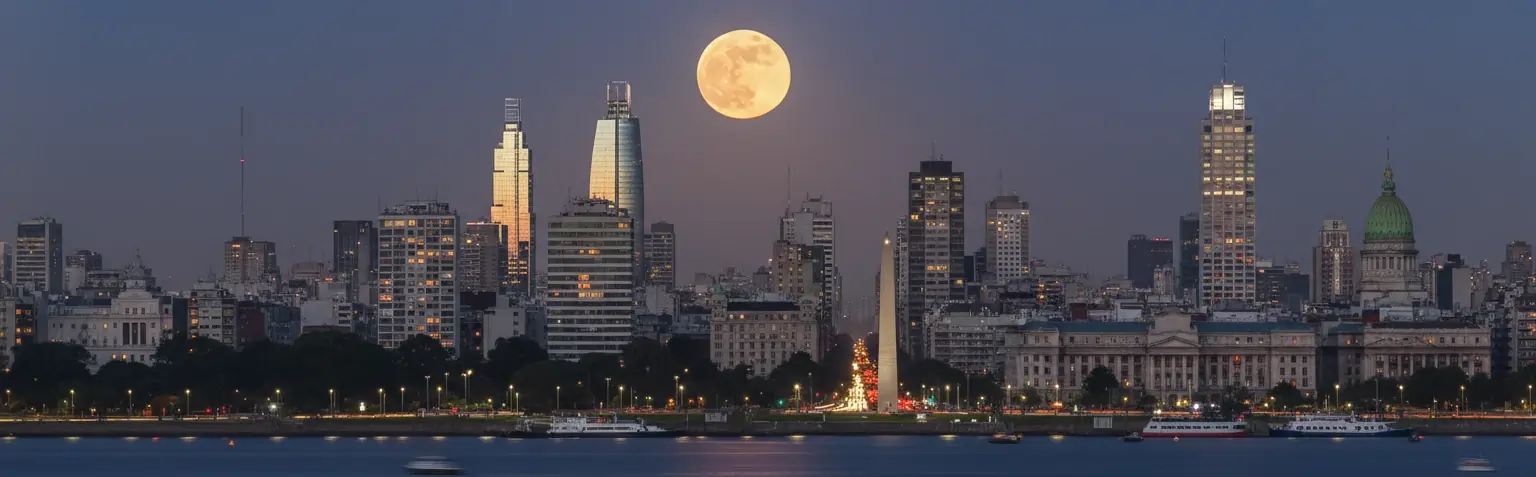
☽ Best Places to View the Moon in Buenos Aires
Buenos Aires is built on the edge of the pampa — an almost perfectly flat city facing east across the Río de la Plata, one of the widest rivers in the world. That eastward orientation gives the city something unusual: a genuine waterfront horizon, and moonrises that come straight out of the river and climb above a skyline that mixes Art Deco towers, French-inspired boulevards, and one of the most symbolically dense buildings in South America. The Río de la Plata is so wide — over 200 kilometres across at its mouth — that on a clear night you cannot see the far shore; the moon rises over what appears to be open sea. The combination of flat terrain, eastern water horizon, and eclectic rooftop architecture makes Buenos Aires one of the finest cities in the Americas for both ground-level and elevated moonrise photography — from the intimate mirador of Galería Güemes to the 100-metre lighthouse of Palacio Barolo, and out across the wide estuary from the Costanera Sur promenade.
Palacio Barolo – Rooftop Lighthouse
The definitive Buenos Aires elevated moonrise position. The Palacio Barolo rises exactly 100 metres on Avenida de Mayo — one metre for each canto of Dante's Divine Comedy — and its glass lighthouse at the summit offers 360° panoramic views of the city. The moon rises over the Río de la Plata to the east while the green dome of the National Congress building aligns directly down the avenue to the west: a compositional axis unique to this building. Evening tours include a wine tasting and are available most days; the climb involves 8 floors of narrow staircase above the 14th floor. Booking in advance is strongly recommended for night tours. Tour fee required.
Galería Güemes – 14th-Floor Mirador
Buenos Aires' first skyscraper, built in 1915 in Art Nouveau style and rising 87 metres on Florida/San Martín in Microcentro, gives the most accessible elevated viewpoint in the city. The mirador on the 14th floor looks out across the downtown roofscape toward the Río de la Plata — on clear days you can see across to Uruguay. Open Monday to Friday only, 10am–1pm and 2pm–4:40pm; closed weekends and holidays. Small entry fee. Take the Torre Mitre elevators inside the gallery. A spiral staircase accesses the top-floor platform. Antoine de Saint-Exupéry, author of The Little Prince, once lived in an apartment in this building.
Puerto Madero Rooftops – Trade Sky Bar & Towers
The regenerated Puerto Madero docklands district offers several elevated bar terraces and hotel rooftops with direct east-facing views over the diques (dock channels) and the Río de la Plata beyond. The Trade Sky Bar is one of the better-known options, with the moon rising over the water and the illuminated Puente de la Mujer below. Drink minimum required; confirm current operating hours before visiting as rooftop bars in Buenos Aires change frequently. The Puerto Madero skyline — glass towers reflecting the dock water — creates a genuinely distinctive foreground unlike anything in the older city.
Reserva Ecológica Costanera Sur – Lagoons & River Edge
Buenos Aires' 865-acre urban nature reserve sits directly on the Río de la Plata riverbank east of Puerto Madero, giving the flattest and most open moonrise horizon in the city. The moon rises over the wide estuary with the Puerto Madero towers visible behind you — an unusual combination of wild wetland and glass skyscrapers in the same frame. The reserve's three lagoons can produce still-water reflections on calm evenings. Open Tuesday–Sunday, 8am to approximately 6pm (hours vary seasonally; closed Mondays and in heavy rain). Free entry. The outside Costanera Sur promenade along the river remains accessible at all hours for those who arrive after closing.
Puente de la Mujer – Puerto Madero
The Puente de la Mujer is a Santiago Calatrava-designed rotating pedestrian bridge in Puerto Madero that pivots 90° on its central axis to allow boat traffic through the dique channel. Its white cable-stay silhouette is one of the most photographed structures in the city. At night the bridge is lit and reflects in the still dock water below, and the moon rises over the river to the east with the bridge in the foreground. A ground-level shot from the southern bank of Dique 3 with the bridge white against the moon is one of the city's signature compositions. Free, accessible 24/7.
Costanera Sur Promenade – Riverside Walkway
The long Costanera Sur promenade runs along the river's edge south of Puerto Madero, giving an unobstructed eastern horizon over the Río de la Plata with no buildings in the way — the cleanest ground-level moonrise view in Buenos Aires. The moon appears enormous near the horizon over the wide estuary. Parillas and food kiosks along the walkway give a lively local atmosphere; on summer weekends the promenade fills with porteños and street performers. The separation from downtown light sources makes the moon appear noticeably brighter here than at Puerto Madero. Free, accessible 24/7; parking along Avenida Costanera Rafael Obligado.
◉ Best Times for Moon Photography
📷 Quick Photography Tips
Buenos Aires operates on ART (UTC−3) year-round — Argentina does not observe daylight saving time. The clock stays fixed throughout the year, making moonrise calculations straightforward: apps like PhotoPills or Stellarium set to Buenos Aires apply the correct offset without seasonal adjustment.
For the moon phase in any other city worldwide, visit our Dynamic Moon Phase Calculator on our home page for instant lunar data tailored to wherever you are.
The moon phase today in Buenos Aires is shown in detail below — complete with exact illumination percentage, moonrise/set times, and the best local spots to see it. For the moon phase today in any other city or location worldwide, visit our Moon Phase Calendar on the home page.
◐ What the Experience Actually Feels Like
Buenos Aires moonrises have a particular quality that visitors from hillier cities do not expect. The pampa extends in every direction — the city is built on what is effectively a sea-level plain — and when the moon comes up over the Río de la Plata to the east, there is nothing to interrupt it. No hills, no mountains, no gradual emergence above a ridgeline. The moon simply appears at the horizon over a river so wide it looks like an ocean, and within minutes it is high enough to illuminate the full length of Avenida de Mayo all the way from the Casa Rosada to the Congress dome, with the Palacio Barolo's lighthouse glowing at the midpoint like a marker buoy dropped between two governments.
The Palacio Barolo is the experience that separates serious Buenos Aires photographers from casual visitors. The building is 100 metres tall, completed in 1923, designed by the Italian architect Mario Palanti as an architectural embodiment of Dante's Divine Comedy — hell in the basement, purgatory through the office floors, paradise at the top in the glass lighthouse. Getting there requires a guided tour, a narrow staircase through the upper floors, and some faith that the views justify the climb. They do. From the lighthouse balconies you look straight down Avenida de Mayo at the Congress building to the west and straight over the Puerto Madero towers and the Río de la Plata to the east — and the moon, rising above the river, completes a composition that the building's architect could not possibly have planned for but that the building was built to receive.
Down at river level, the Costanera Sur promenade delivers a completely different version of the same moon. The city recedes behind you, the estuary stretches flat and dark ahead, and the porteños come out in numbers — families, couples, cyclists, vendors — to share the riverfront in the way that only cities with genuine public life manage. The moon comes up enormous over the water, and nobody is looking at it through a lens. They are just there, watching it rise over a river too wide to see across, in a city that considers itself the most European in Latin America and has somehow managed, against all odds, to be the most distinctively itself.
"From the Barolo lighthouse you look straight down Avenida de Mayo at Congress to the west and straight over the river to the east — and the moon, rising above the Río de la Plata, completes a composition the architect could not have planned for but that the building was built to receive."
✓ Your Buenos Aires Moon Chase Checklist
Before You Go
- Check the moonrise time and phase on this page — the azimuth shifts significantly through the year, and aligning the moon with the Avenida de Mayo axis from Palacio Barolo requires PhotoPills planning
- Book Palacio Barolo evening tours in advance — night tours sell out, particularly on weekends and full-moon dates; book through the official site or kiosk at Av. de Mayo 1370
- If planning Galería Güemes mirador, confirm it is not a weekend — the viewpoint is strictly weekdays only (Mon–Fri), and closed on public holidays and in bad weather
- Check whether the Reserva Ecológica is open — it is closed Mondays and closes in rain or strong winds; if the reserve is shut, the outside Costanera promenade is always accessible
- Check wind conditions for the Puerto Madero diques — calm nights give mirror-flat reflections of the Puente de la Mujer and tower lights; even a moderate wind will break the dock surface
What to Bring
- Sturdy tripod — the river wind along the Costanera is persistent; the Palacio Barolo lighthouse balconies and Güemes top floor are exposed and can gust strongly at night
- A telephoto lens (200–400mm) for the Palacio Barolo lighthouse and Güemes mirador — compressing the moon against the Congress dome or Puerto Madero towers from height rewards longer glass significantly
- A wide-angle lens (16–24mm) for the Puente de la Mujer and Costanera promenade — the bridge silhouette, the dock reflection, and the rising moon all fit at shorter focal lengths
- Comfortable shoes for the Barolo climb — the final 8 floors are steep, narrow staircase with landings; the passages narrow to 48cm at points near the top
- Layers for the rooftop positions — Buenos Aires nights at the river can be cold, particularly from May through August, and the exposed rooftop and promenade positions offer no shelter
- Argentine pesos in cash for the Barolo tour and Güemes entry fee — card payments are not always reliable at smaller attraction kiosks
On the Night
- Arrive at your viewpoint 30–45 minutes before moonrise — the sky over the Río de la Plata transitions through a warm amber-to-deep-indigo gradient as the moon approaches the horizon, and the city lights come up against it before the moon appears
- At the Costanera promenade, position yourself facing due east along the river for the widest, most unobstructed horizon — the moon rises quickly over the flat estuary and reaches full brightness faster than over any city skyline
- At Palacio Barolo, ask your guide about the current moon azimuth relative to Avenida de Mayo — on certain dates the alignment is near-perfect and the guide will know the best balcony position
- Shoot RAW throughout — the dynamic range between the moon, the city lights, the dark river surface, and the dock reflections requires separate exposures carefully blended in post
- Stay 20–30 minutes after moonrise — the moon clears the river horizon haze quickly and the compositions tighten and sharpen as it climbs; the dock reflections at Puerto Madero are best 15–20 minutes after moonrise when the moon has enough height to reflect cleanly in the water
? Buenos Aires Moon Phase — Frequently Asked Questions
Q. What is the moon phase today in Buenos Aires?
The moon phase today in Buenos Aires is a New Moon with 0% illumination. The next full moon is in 17 days, on Oct 26. Moonrise is at 5:36 AM and moonset at 6:26 PM.
Q. Where is the best place to view the moon in Buenos Aires?
Palacio Barolo's 100-metre rooftop lighthouse is the city's signature elevated viewpoint, with the moon rising over the Río de la Plata while the Congress dome aligns down Avenida de Mayo. At river level, the Costanera Sur Promenade and the Reserva Ecológica give the widest, most open horizon over the estuary, and the Puente de la Mujer in Puerto Madero adds a striking bridge silhouette for a ground-level shot.
Q. Why does the moon look different in Buenos Aires than it does further north?
Buenos Aires sits well south of the equator, and in the Southern Hemisphere the moon appears mirror-flipped compared to how it looks in places like New York or London — a waxing crescent that curves one way up north curves the other way down here. It's the same moon and the same phase, just seen from the other side of the planet.
Q. Does Buenos Aires observe daylight saving time?
No. Argentina stays on Argentina Time (ART, UTC−3) year-round and does not observe daylight saving time, so moonrise, moonset, and transit times on this page keep a consistent offset from UTC throughout the year.
Q. What's the best time of year for moon photography in Buenos Aires?
October through March, the Southern Hemisphere summer, brings clearer skies and a higher moon path for stronger river alignments. April through September trades some of that height for cooler, drier air and sharper moonrises, since southerly winds tend to clear the horizon haze that summer humidity can add.
Q. Does this page work for cities besides Buenos Aires?
This page is set up specifically for Buenos Aires, Argentina. For the moon phase in any other city or location worldwide, use the Dynamic Moon Phase Calculator on the moonphase.today home page.
✦ Explore Further
Moon Phase Today: Lima
Check tonight's moon phase elsewhere in South America, in Lima, Peru.
📷Moon Photography Guide
Camera settings, lenses, and techniques for shooting sharp, well-exposed moon shots.
🌕When Is the Next Full Moon?
A running guide to upcoming full moons and what each one is traditionally called.
🌗Waxing vs Waning Moon
What decides which way the crescent curves — and why it flips once you cross into the Southern Hemisphere.
🌙The Moon Illusion Explained
Why the moon looks so enormous rising over the wide-open Río de la Plata horizon.
NASA Moon Phase & Libration Gallery
NASA's Scientific Visualization Studio's daily renders of the moon's exact phase, libration, and orientation, straight from official mission data.