
Moon Phase Today Budapest
On Saturday, October 10, 2026, the moon in Budapest is a New Moon with 0% illumination. Moon age: 28.9 days.
☽ Best Places to View the Moon in Budapest
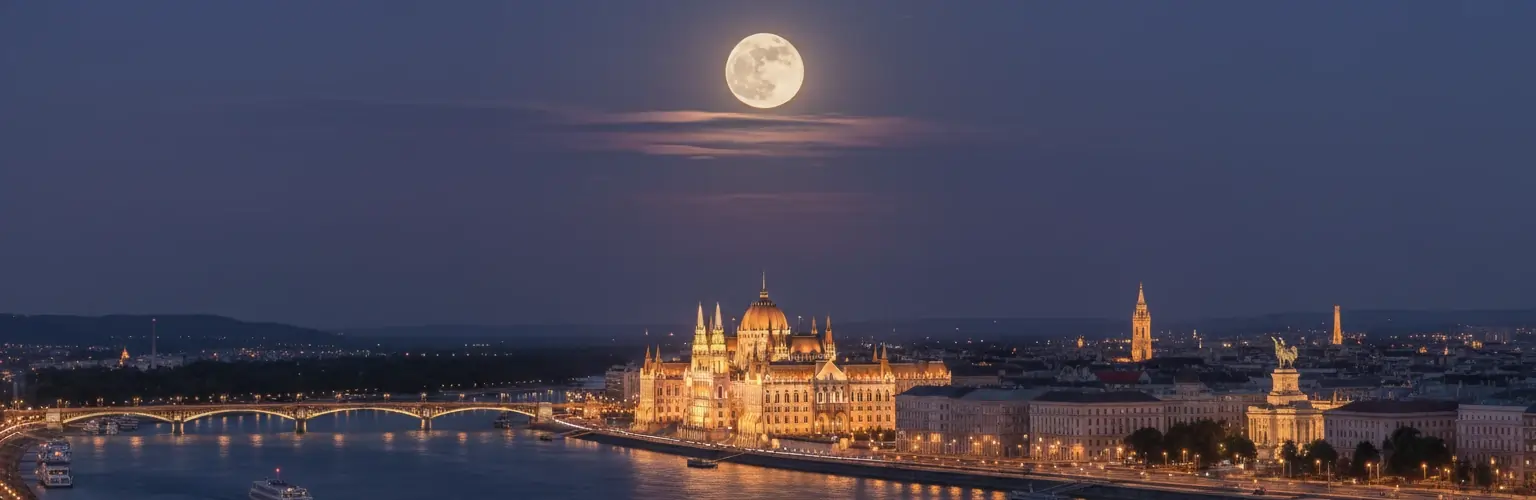
Budapest sits at 47.5° North, where the Danube River creates a theatrical stage between the hilly Buda side and the flat, sprawling Pest plain. This geographical split provides some of Europe’s most romantic moon photography opportunities. By positioning yourself on the elevated West bank (Buda), you can capture the moon rising directly behind the Gothic Revival Parliament or the massive domes of the Pest side. The combination of Neo-Romanesque architecture, golden floodlighting, and the shimmering river turns every full moon into a cinematic experience.
Fisherman’s Bastion (Halászbástya)
The absolute #1 Budapest moonrise viewpoint. These fairytale terraces on Castle Hill offer a direct line of sight to the Parliament across the river. On specific winter alignments, the moon rises dead-centre behind the Parliament’s Gothic spires. The paid upper terraces (~HUF 1,200) provide cleaner, elevated angles away from the tourist crowds; the lower sections remain free and accessible 24/7.
Gellért Hill (Citadel)
Standing at 235m, this panoramic fortress hill offers the widest vistas in the city. Following extensive restorations, the site fully reopened in early April 2026, providing clean pathways and restored overlooks. The moon rises over the Pest plain, framing the Danube, the Chain Bridge, and the illuminated Parliament in a single sweeping composition. Reach it via a short hike or Bus 27.
Buda Castle Terraces
The royal palace grounds offer multiple promenades along the eastern ridge. From here, the moon rises over the Pest skyline, appearing massive against the distant dome of St. Stephen’s Basilica. The castle’s own architectural floodlighting provides a regal foreground glow. It is an ideal spot to combine with a walk to Fisherman’s Bastion for a variety of lunar angles.
Danube Promenade (Pest Side)
For a riverside perspective, walk the Pest bank near the Shoes on the Danube Bank. From this low vantage point, the moon rises behind Buda Castle and Matthias Church, silhouetting the historic hills of the west bank. The river acts as a mirror, doubling the lunar light in the water. It is a vibrant, easy-access spot that captures the "Pearl of the Danube" atmosphere perfectly.
Margaret Bridge
The pedestrian paths on this uniquely angled bridge offer a mid-river perspective. The moon rises over Margaret Island and the northern city districts, allowing you to frame both the Parliament and the Buda side lights in a single frame. Because the bridge is slightly further north, it provides a deeper perspective of the river bend than the central bridges.
St. Stephen’s Basilica Dome
Located in the heart of Pest, the circular observation deck provides 360° views. While the building's total height is a symbolic 96m, the deck is situated roughly 65m above the plaza, putting you right among the rooftops. The moon rises over the urban landscape, framed by 19th-century architecture. Note that the dome has specific ticketed hours; entry fee is approximately HUF 1,500.
◉ Best Times for Moon Photography
📷 Quick Photography Tips
Budapest operates on Central European Time (CET, UTC+1) in winter and CEST (UTC+2) in summer. Clocks go forward on the last Sunday of March and back on the last Sunday of October. Professional apps like PhotoPills or Stellarium handle these shifts automatically for precise moonrise calculations.
The moon phase today in Budapest, Hungary is shown below — featuring exact rise/set times and illumination percentages.
◐ What the Experience Actually Feels Like
There is a specific, quiet romance to a Budapest moonrise. As the sun sets behind the Buda hills, the Parliament building across the water begins to glow with warm, amber light. From the white stone arches of Fisherman’s Bastion, you watch the sky over Pest turn a deep, electric blue. Then, the moon appears—often a dark orange at first as it clears the horizon—climbing until it sits perfectly framed by the Gothic Revival spires.
The sound of the Danube is a constant companion; even in the heart of the capital, the river provides a sense of openness. On a calm night, the water is so still that the moon’s reflection forms a shimmering pillar of light that stretches from the Pest bank to the foot of Castle Hill. It is an experience defined by stone and water, steeped in history, and lit by a moon that seems to favor the "Queen of the Danube."
"The moon rises behind the Gothic spires, casting a silver light across the Danube that turns the entire city into a theater of gold and shadow."
✓ Your Budapest Moon Chase Checklist
Before You Go
- Check the "Parliament Light Schedule" — Budapest energy-saving measures mean lights may dim at midnight; ensure your shoot happens earlier.
- Verify DST dates — Hungary follows the EU standard (last Sunday of March/October).
- Arrive early at Fisherman’s Bastion — the prime photography arches fill up 45 minutes before a full moonrise.
- Check the moon's azimuth — use an app to ensure the moon will rise behind the Parliament from your specific Buda-side viewpoint.
What to Bring
- Warm layers — river winds can make the Buda hills feel significantly colder than the street level; dress for 10 degrees below the forecast.
- A lens in the 200mm-400mm range — essential for "compressing" the moon against the Parliament dome.
- Wide-angle lens — for sweeping panoramas from the newly reopened Citadel on Gellért Hill.
- Extra batteries — Budapest winters drain power quickly; keep spares in an inside pocket to keep them warm.
On the Night
- Arrive 45 minutes early — the "Blue Hour" light is the best time to set your exposure for the floodlit landmarks.
- Use a remote shutter — the stone walkways of Buda are stable, but even a slight camera touch can cause blur in the high-altitude winds.
- Shoot RAW — the dynamic range between the bright moon and the dark river requires careful post-processing.
- Be respectful of the quiet — the Castle District is a residential zone; keep noise levels low during late-night shoots.
? Budapest Moon Phase — Frequently Asked Questions
Q. What is the moon phase today in Budapest?
The moon phase today in Budapest is a New Moon with 0% illumination. The next full moon is in 17 days, on Oct 26. Moonrise is at 6:45 AM and moonset at 5:46 PM.
Q. Where is the best place to view the moon in Budapest?
Fisherman's Bastion is the city's signature moonrise spot, with the moon often rising directly behind the Parliament's Gothic spires across the river. Gellért Hill's Citadel gives the widest panorama since reopening in April 2026, Buda Castle's terraces frame the moon against St. Stephen's Basilica dome, and the Danube Promenade or Margaret Bridge offer river-level alternatives on the Pest side.
Q. Why does moon visibility change so much in Budapest through the year?
Budapest's Danube valley keeps most viewpoints clear year-round, so the main factors are weather and light: November through February brings the clearest air and a moon path that aligns most tightly with the Parliament from Buda, while autumn evenings can bring soft river fog that either obscures the moon or gives it an ethereal glow.
Q. Does Budapest observe daylight saving time?
Yes. Budapest runs on CET (UTC+1) in winter and switches to CEST (UTC+2) for Central European Summer Time, from the last Sunday in March to the last Sunday in October. The times shown on this page are already adjusted for whichever period applies today.
Q. What's the best time of year for moon photography in Budapest?
November through February offers the clearest skies and the tightest Parliament alignments from the Buda side. Whatever the season, aim to arrive at least 60 minutes before moonrise, since Budapest's landmark floodlighting is often dimmed around midnight as an energy-saving measure.
Q. Does this page work for cities besides Budapest?
This page is set up specifically for Budapest, Hungary. For the moon phase in any other city or location worldwide, use the Dynamic Moon Phase Calculator on the moonphase.today home page.
✦ Explore Further
Moon Phase Today: Belgrade
Check tonight's moon phase in Belgrade, about 200 miles south along the Danube.
📷Moon Photography Guide
Camera settings, lenses, and techniques for shooting sharp, well-exposed moon shots.
📐Looney 11 Exposure Calculator
Dial in the exact f-stop, ISO, and shutter speed for a full moon — the same rule used in our Parliament alignment tips.
🌆Blue Hour Calculator
Find tonight's exact blue hour window to time your Fisherman's Bastion moonrise shots.
NASA Moon Phase & Libration Gallery
NASA's Scientific Visualization Studio's daily renders of the moon's exact phase, libration, and orientation, straight from official mission data.