
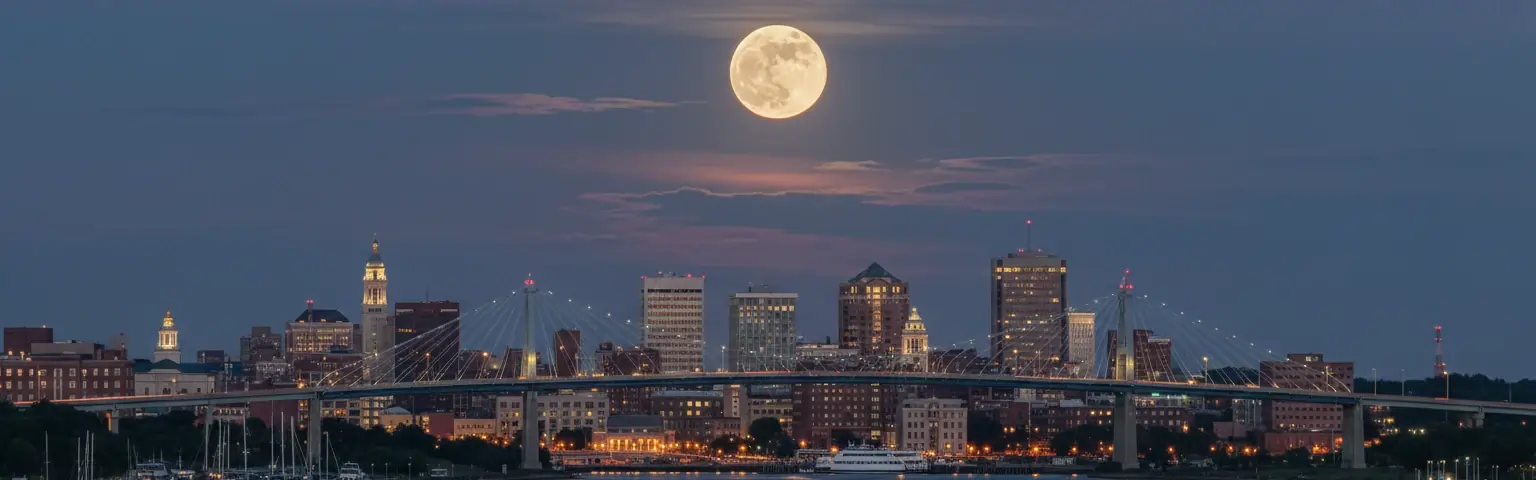
☽ Best Places to View the Moon in Bridgeport
Bridgeport sits on the northern shore of Long Island Sound, where Connecticut meets the water in a crescent of beaches, harbours, and tidal flats that give the city something most inland New England cities lack: a genuinely open eastern horizon over open water. Moonrises here come straight out of the Sound, climbing above the flat line where the water meets the sky, and in the right conditions — low tide, still air, a clear autumn evening — the wet sand and sheltered harbour channels produce reflections that transform a working-class waterfront into something genuinely beautiful. The city's history is written into the landscape: Seaside Park, laid out by Frederick Law Olmsted and Calvert Vaux (the same team behind Central Park and Prospect Park), wraps 2.5 miles of coastline along the Sound, with the bronze P.T. Barnum seated at its entrance facing the water he donated the land to preserve. Light pollution is real here, but the moon is bright enough to dominate, and the 1823 lighthouse on Fayerweather Island gives Bridgeport a foreground that few American cities of its size can match.
Seaside Park – Main Promenade & Beachfront
The undisputed best Bridgeport moonrise position. This 375-acre Olmsted-designed park curves along Long Island Sound for 2.5 miles, giving a wide open eastern horizon where the moon rises straight out of the water. At low tide, wet sand along the beach produces long, glassy reflections; the bronze P.T. Barnum statue at the park entrance and the distant Fayerweather Island lighthouse add foreground depth at various positions along the promenade. Important: the vehicle gate closes at 8 PM daily and there is a day-use fee for non-Bridgeport residents ($30–$60 depending on season). Arriving on foot or bicycle from street parking on Iranistan Avenue avoids the fee and keeps access open after the gate closes.
Fayerweather Island – Black Rock Harbor Lighthouse
The most dramatic single foreground element on this list. The 1823 stone lighthouse on Fayerweather Island stands at the end of a long boulder breakwater accessible from Seaside Park's southern end. The moon rises over open Long Island Sound behind and beside the lighthouse tower, giving a composition unlike anything available from the main beach. The breakwater walk is over large uneven boulders — do not attempt at high tide, as the final stretch to the island floods. Low tide is essential; the walk takes 20–30 minutes each way. The lighthouse tower is closed to the public; the grounds are open. Bring a torch for the return in the dark.
St. Mary's by the Sea – Black Rock Harbor
Many photographers prefer St. Mary's by the Sea in the Black Rock neighbourhood for lighthouse views — the Fayerweather Island lighthouse is visible directly across the harbour from the coastal walkway here, and you get both the lighthouse and the Sound horizon without the boulder walk. The rocky shoreline and harbour channel provide textured foreground; slightly darker than Seaside Park and with a more intimate coastal atmosphere. You can also see the offshore Penfield Reef Lighthouse from this position on clear days. Street parking on Grovers Avenue; no fee, accessible at all hours.
Captain's Cove Seaport – Boardwalk
The Captain's Cove Seaport marina and boardwalk complex on Black Rock Harbor gives a sheltered harbour view with moored boats as immediate foreground. The moon rises over the Sound to the east and south, and the calm harbour channels between the slips produce the clearest reflections of any position in the Black Rock area — more protected from wind chop than the open Sound at Seaside Park. The restaurant and bar lighting adds warm ambient colour to evening compositions. Parking in the marina lot; access hours vary by season, so confirm before planning a late moonrise session.
Beardsley Park – Elevated Paths
Bridgeport's other great Olmsted-designed park, Beardsley Park sits inland to the north and offers a completely different moonrise character — the moon rises over the city's rooftops and treetops rather than over water, with the Pequonnock River visible from the park's northern bluffs on clear nights. The elevated paths give a slightly elevated vantage and tree-framed compositions that suit photographers looking for something quieter and greener than the exposed beachfront. Notably darker skies than anywhere on the waterfront. Free, open during park hours; parking off Noble Avenue.
Success Park – East Side Overlooks
A neighbourhood park on Bridgeport's East Side with open eastern views directly over the Sound — less visited than Seaside Park and with a more local, unpolished atmosphere. The moon rises over the open water horizon with the distant glow of Long Island visible on the far shore on very clear nights. No lighthouse or historic foreground, but a genuinely unobstructed horizon and fewer crowds than the main park. Free, open 24/7; street parking on Success Avenue and surrounding residential streets.
◉ Best Times for Moon Photography
📷 Quick Photography Tips
Bridgeport operates on EST (UTC−5) in winter and EDT (UTC−4) during daylight saving time. Clocks go forward on the second Sunday in March and back on the first Sunday in November. Connecticut observes DST statewide. Apps like PhotoPills or Stellarium set to Bridgeport apply the correct offset automatically — useful for calculating exact moonrise times over Long Island Sound throughout the year.
For the moon phase in any other city worldwide, visit our Dynamic Moon Phase Calculator on our home page for instant lunar data tailored to wherever you are.
The moon phase today in Bridgeport, CT is shown in detail below — complete with exact illumination percentage, moonrise/set times, and the best local spots to see it. For the moon phase today in any other city or location worldwide, visit our Dynamic Moon Phase Calculator on the home page.
◐ What the Experience Actually Feels Like
Bridgeport moonrises do not announce themselves the way San Francisco or Austin moonrises do. There is no famous bridge to frame them, no bat colony to add spectacle, no mountain backdrop to put them in context. What there is, instead, is the Sound — a wide, still, ancient body of water that has been the economic and geographic anchor of this city since the 17th century — and the particular quality of moonlight on open coastal water that has no inland equivalent. On a clear October evening at low tide on the Seaside Park beach, the moon comes up over the flat horizon and the wet sand in front of you catches it whole, and you understand immediately why Frederick Law Olmsted spent time here and why P.T. Barnum spent 40 years trying to give this shoreline to the public.
The Fayerweather Island breakwater is the experience that separates serious Bridgeport photographers from casual visitors. The walk out over the boulders takes 20–30 minutes and requires attention; the lighthouse at the end, built in 1823 from brownstone and rubble, has been standing at the mouth of Black Rock Harbor for over two centuries. When you reach it at dusk, before the moon rises, you are standing on a seven-acre island in Long Island Sound with the city's lights behind you and open water in every other direction. The moon comes up to the east and south, and there is nothing between you and it except water. The breakwater forces the question: is this worth it? The answer, on a clear night at low tide, is unambiguous.
St. Mary's by the Sea, in the Black Rock neighbourhood, is the local's alternative — easier to reach, no tidal constraints, the lighthouse visible across the harbour rather than towered above you, and noticeably darker than the main park. The photographers who know Bridgeport well tend to rotate between these three positions depending on tide and wind: the open beach at Seaside for the wide wet-sand reflection, the breakwater for the lighthouse close-up, and St. Mary's for the harbour-framed telephoto. All three are within a mile and a half of each other and all face the same rising moon.
"On a clear October evening at low tide, the moon comes up over the flat horizon and the wet sand catches it whole — and you understand immediately why Olmsted spent time here and why Barnum spent 40 years trying to give this shoreline to the public."
✓ Your Bridgeport Moon Chase Checklist
Before You Go
- Check the moonrise time and phase on this page — the azimuth of the moonrise shifts enough through the year that the difference between a moon rising over the Sound horizon versus the distant Long Island shore glow is worth planning around
- Check tide times — this is essential for Fayerweather Island (breakwater floods at high tide) and for Seaside Park beach (low tide gives the widest wet-sand reflection surface)
- If driving to Seaside Park, note the vehicle gate closes at 8 PM daily; non-residents pay a day-use fee. Arriving on foot from Iranistan Avenue street parking avoids both constraints
- Check wind conditions — the Sound is exposed and even a moderate wind will break harbour reflections in the Captain's Cove channels; calm nights are essential for the mirror-surface shots
- For the Fayerweather Island breakwater, check the weather forecast for the next several hours — conditions can change fast on the Sound, and the exposed boulder walk becomes dangerous if a squall moves in while you are on the island
What to Bring
- Sturdy tripod with a ballast hook — the sea breeze is persistent at every waterfront position and the exposed breakwater to Fayerweather Island amplifies wind considerably
- A wide-angle lens (16–35mm) for the Seaside Park beach and Fayerweather Island lighthouse — the wet sand foreground, the lighthouse, and the rising moon all benefit from a shorter focal length that takes in the full coastal scene
- A telephoto lens (200–400mm) for St. Mary's by the Sea — shooting across the harbour compresses the lighthouse against the moon and the Sound horizon in a way the wider positions cannot achieve
- Sturdy shoes with ankle support for the Fayerweather Island breakwater — the boulders are uneven, sometimes slick with seaweed, and the gaps between stones are significant in places; trainers are inadequate
- A torch and a spare for the Fayerweather Island return — there is no lighting on the breakwater and finding your footing on the boulders in the dark without one is genuinely hazardous
- Warm layers in all but the warmest months — the Sound amplifies the cold and the exposed positions at Seaside Park and the breakwater offer no shelter from the wind off the water
On the Night
- Arrive 30–45 minutes before moonrise — the sky over Long Island Sound transitions from amber to indigo as the moon approaches, and the lighthouse silhouette against the pre-moonrise sky is a composition in its own right
- At Seaside Park beach, position yourself facing east-southeast along the tideline for the best combined view of the wet-sand reflection and the open Sound horizon — the moon rises into a clear sky unobstructed by any structure
- At Fayerweather Island, position yourself south or southeast of the lighthouse so the tower catches the moonlight on its seaward face rather than being fully silhouetted — this adds texture and colour to the stone
- Shoot RAW throughout — the dynamic range between the bright moon, the dark water, the lighthouse, and any ambient city glow from the north requires multiple exposures blended in post for the full scene
- Stay 15–20 minutes after moonrise — the moon clears the horizon haze quickly in the cleaner autumn and winter air, and the compositions tighten and sharpen as it climbs away from the water
Moon Phase Today Bridgeport

Weather in Bridgeport
Loading Bridgeport conditions...
